

Why Choosing the Right Bone Repair Supplement Can Make or Break Your Recovery
A bone repair supplement can play a meaningful role in how quickly and completely you heal after a fracture, surgery, or accident. Here are the most important nutrients to look for:
Top nutrients in an effective bone repair supplement:
- Calcium (1,000–1,200 mg/day for active healing)
- Vitamin D3 (at least 600–800 IU/day; higher under medical guidance)
- Vitamin K2 (directs calcium into bones, not arteries)
- Magnesium (supports bone mineralization and calcium metabolism)
- Hydrolyzed collagen peptides (rebuilds the protein scaffold of bone)
- Vitamin C (essential for collagen synthesis)
- Zinc and phosphorus (support osteoblast function and bone matrix)
These nutrients work together. Taking calcium alone is not enough. Each cofactor plays a specific role in getting minerals where they need to go — into your bones.
Bone is living tissue. Your body is constantly breaking it down and rebuilding it. When you suffer a fracture or traumatic injury, that process goes into overdrive. The problem is that most people — especially those recovering from a car accident — don’t know what their bones actually need at the cellular level to heal properly.
The statistics are sobering. 1 in 2 women will break a bone due to low bone density in her lifetime. Up to 20% of bone density can be lost during perimenopause and menopause alone. And for accident victims already dealing with trauma, pain medications, reduced mobility, and high stress, the nutritional demands of bone repair are even greater.
The right supplement protocol isn’t just about swallowing a calcium pill. It’s about understanding which nutrients your body needs, what forms are best absorbed, and how they interact with each other and with your recovery timeline.
I’m Dr. Adam Savage, and in this guide I’ll walk you through exactly what to look for — and what to avoid — so you can make informed decisions about your recovery.
Bone repair supplement terms you need:
Essential Nutrients in a Bone Repair Supplement
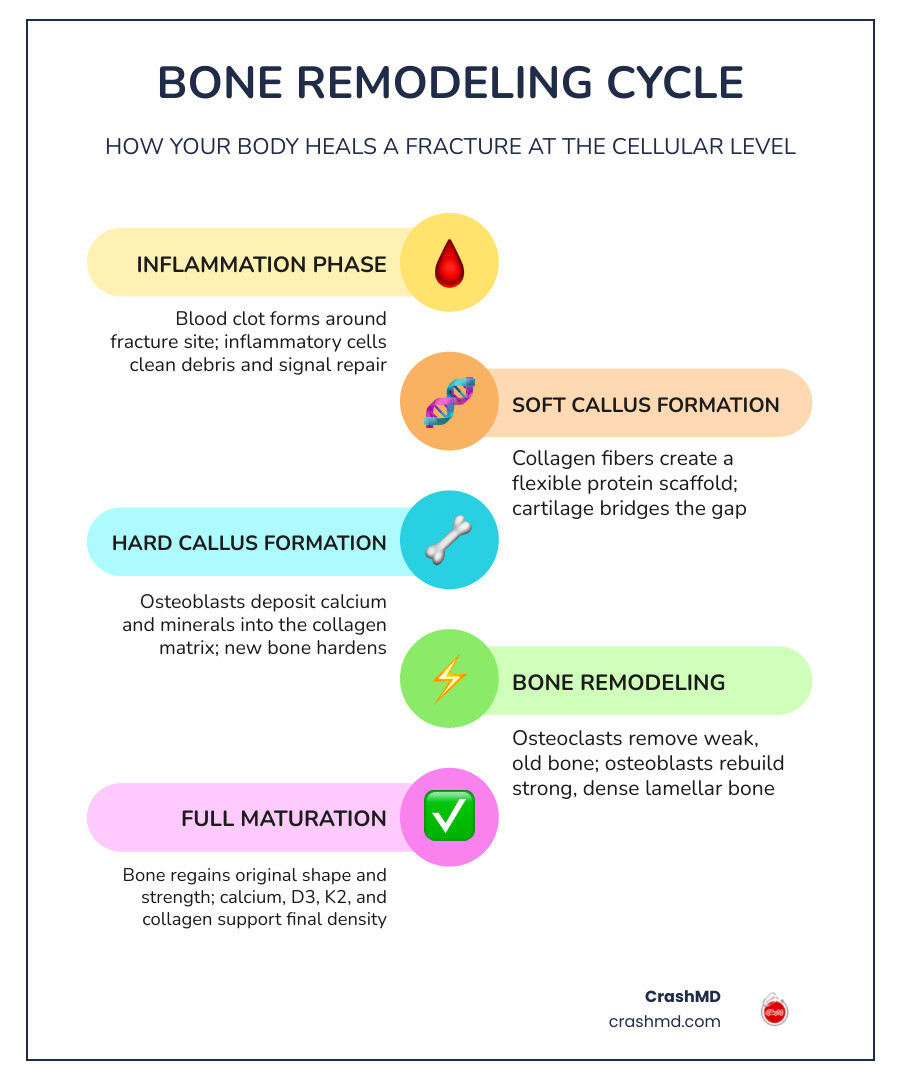
When you break a bone, your body must construct a temporary soft callus of cartilage and collagen before laying down hard mineralized bone. This multi-phase recovery process requires both structural building blocks and biological catalysts.
To support this complex process, we must look beyond standard calcium tablets. A complete bone repair supplement protocol needs to address bone mineralization from multiple angles. While calcium is the primary mineral stored in our skeleton, it cannot build new bone alone. To understand how to choose the right form of calcium and how it works with other minerals, explore our In-Depth Guide to Calcium Tablets for Bone Healing.
For a broader perspective on managing acute injuries, you can also read The Complete Guide to Supplements for Fractures. If you prefer a highly curated, pharmacist-formulated baseline that packages several of these crucial elements together, you might consider checking out Ultimate Bone Support | MCHC, ch-OSA, Vitamin D, and More .
The Role of Bioactive Collagen Peptides
Did you know that about half of your bone’s physical volume is actually made of protein? Specifically, Type I collagen provides the flexible scaffold upon which calcium and phosphorus crystals are deposited. Without this flexible framework, your bones would be incredibly brittle—like a piece of dry chalk.
Bioactive collagen peptides play a critical role in accelerating fracture recovery. Clinical research on specialized collagen peptides, such as Fortibone®, shows a +7.0% improvement in lumbar bone mineral density over 12 months. Furthermore, studies on these bioactive peptides demonstrate a -48% reduction in CTX-1, which is a key biomarker of bone resorption (the process where bone is broken down).
By actively stimulating osteoblasts (the bone-building cells) and suppressing excessive osteoclast (bone-clearing) activity, collagen peptides help speed up the formation of the initial soft callus. If you are looking to support this structural matrix, a high-quality option to consider is Bone & Joint Support – Bioactive Collagen Powder | Vital Proteins .
Additionally, if your accident caused soft tissue damage alongside a fracture, you can learn more about healing connective tissues in The Complete Guide to Tendon and Ligament Repair Supplements and explore The Best Cartilage Repair Supplements to Keep You Moving.
Critical Cofactors: Vitamin D3, K2, and Magnesium
If calcium is the brick, and collagen is the mortar, then Vitamins D3 and K2 are the construction workers who make sure the bricks actually get to the building site.
- Vitamin D3: This crucial hormone increases calcium absorption in your gut. Without it, the vast majority of the calcium you consume simply passes through your system.
- Vitamin K2 (particularly MK-4 and MK-7): K2 activates osteocalcin, the protein that binds calcium to the bone matrix. More importantly, Vitamin K2 prevents “arterial calcification” by keeping calcium out of your blood vessels and kidneys and routing it directly into your skeletal system.
- Magnesium: This mineral converts Vitamin D into its active form. It also works in a tight biological balance with calcium to support overall mineralization.
For an advanced formulation that combines these critical cofactors with multiple highly absorbable forms of calcium, consider Bone Restore Elite with Vitamin K2, 120 Capsules – Life Extension . To find the ideal calcium tablet for your specific type of injury, check out our AZ Guide to Best Calcium Tablets for Fractures.
Whole-Food vs. Synthetic Bone Support Formulas
When browsing for a bone repair supplement, you will quickly notice a divide between synthetic isolated nutrients and whole-food-based complexes.
Synthetic supplements typically use isolated chemical salts like calcium carbonate or calcium citrate. While calcium citrate is highly bioavailable and can be absorbed without stomach acid, it still only provides isolated calcium.
In contrast, whole-food-based formulas utilize Microcrystalline Hydroxyapatite Concentrate (MCHC) or bone marrow extracts. MCHC is a clinical-grade compound derived from bovine bone. Because it is a whole-bone extract, it naturally delivers calcium and phosphorus in their ideal 2:1 ratio, alongside naturally occurring Type I collagen, bone growth factors, and trace minerals.
If you are looking for a complete, whole-bone matrix supplement, you can read more about M.C.H.C. Calcium — Microcrystalline Hydroxyapatite Bone Matrix Support | Priority One – Priority One Nutritional Supplements . For an ancestral, whole-food approach sourced from grass-fed New Zealand cattle, you might also consider Grass-Fed Beef Bone & Marrow | MK Supplements .
| Feature | MCHC (Whole-Bone Matrix) | Synthetic Calcium Carbonate |
|---|---|---|
| Source | Natural Bovine Bone | Inorganic Mineral / Limestone |
| Nutrient Synergy | Includes Collagen, Phosphorus, & Growth Factors | Isolated Calcium Only |
| Absorption Rate | Highly Bioavailable, Gradual Release | Requires Stomach Acid, Can Cause Constipation |
| Best Used For | Advanced Fracture Healing & Bone Density | Basic Daily Calcium Supplementation |
The 7-Step Protocol to Maximize Bone Healing
To truly accelerate recovery after a traumatic injury or accident, supplements should not be viewed as a standalone cure. We recommend integrating your supplementation into a holistic, step-by-step recovery framework.
- Prioritize Rest: Aim for 8 to 10 hours of sleep nightly to maximize growth hormone production.
- Eliminate Toxins: Completely avoid smoking and alcohol, both of which severely impair osteoblast activity and delay bone mending.
- Nutritional Shock-Loading: Increase your intake of high-quality proteins. For example, a 200-pound man should consume 90 to 110 grams of protein daily during active healing.
- Preserve Muscle Mass: Consider taking 5 grams of creatine monohydrate daily to minimize muscle atrophy during periods of immobilization. To learn more about this, check out how to Mend and Strengthen with Creatine for Recovery.
- Optimize Blood Flow: Keep the tissues surrounding the injury healthy by eating anti-inflammatory foods.
- Controlled Micro-Movements: Under the strict guidance of your physical therapist or orthopedic specialist, perform safe, controlled micro-movements to stimulate the piezoelectric effect, which signals your bone to remodel and strengthen.
- Targeted Supplementation: Maintain a consistent daily schedule of a comprehensive bone repair formula. For a complete look at how to structure this protocol, refer to A Practical Guide to Supplements for Bone Fracture Healing.
Choosing the Right Bone Repair Supplement for Fractures vs. Osteoporosis
Your nutritional strategy should match your specific clinical situation:
- For Acute Fracture Recovery: Your body needs immediate, high-dose structural building blocks to form the soft callus. During this acute phase, higher amounts of protein, Vitamin C (to synthesize collagen), and balanced calcium/magnesium are required.
- For Long-Term Osteoporosis or Osteopenia Management: The goal shifts from rapid emergency tissue building to slow, steady bone preservation. This is especially true during menopause, when declining estrogen levels accelerate bone resorption.
For a comprehensive, physician-formulated 90-day protocol designed to support both skeletal longevity and active recovery, you can read about UNBREAKABLE BONE 90-day bundle – Bone Density & Quality Support – Dr. Vonda’s Unbreakable .
What to Avoid When Taking a Bone Repair Supplement
Just as some nutrients accelerate bone healing, certain dietary habits can actively steal calcium from your bones or block its absorption:
- Oxalates (e.g., Spinach): Although spinach is rich in calcium, its high oxalate content binds to the mineral, making it highly inefficient for absorption. Choose low-oxalate greens like kale, broccoli, or bok choy instead.
- Excessive Sodium: Consuming too much salt causes your kidneys to excrete calcium in your urine. Limit your daily sodium intake during recovery.
- Heavy Caffeine: Drinking more than four cups of strong coffee per day can interfere with calcium absorption and slow down bone mending.
- Alcohol and Dark Sodas: These contain compounds that disrupt bone remodeling and deplete your body’s mineral reserves.
To manage pain and lower inflammation naturally without relying solely on medications that might disrupt your digestion, you can explore How to Use Turmeric for Bone Fracture Healing.
Frequently Asked Questions About Bone Recovery
What are the risks of taking high-dose calcium supplements?
Taking excessive doses of isolated calcium (especially carbonate) all at once can lead to hypercalcemia, kidney stones, and arterial plaque buildup. To maximize safety and absorption, always divide your calcium doses (taking no more than 500–600 mg at one time) and take them with food. Most importantly, ensure your supplement contains Vitamin K2 to route the calcium out of your blood vessels and into your bones.
How does age or menopause affect bone healing?
As we age, our natural bone-remodeling cycle slows down. During menopause, the rapid decline in estrogen removes a protective shield from our bones, allowing osteoclasts (bone-breakers) to outpace osteoblasts (bone-builders). This can lead to a loss of up to 20% of bone density during this transition. Supplementing with bioactive collagen, Vitamin D3, and K2 helps rebalance this cellular relationship.
Can I take bone supplements with blood thinners?
If you are taking blood-thinning medications like Warfarin, you must consult your doctor before taking any supplement containing Vitamin K. Vitamin K plays an essential role in blood clotting, and taking high doses (particularly K1 or the MK-4/MK-7 forms of K2) can interfere with the efficacy of your medication.
Conclusion: Your Path to Complete Skeletal Recovery
Healing a broken bone or recovering from a major orthopedic surgery is a demanding journey. By choosing a high-quality bone repair supplement that combines structural elements like MCHC or bioactive collagen with critical cofactors like Vitamin D3, K2, and magnesium, you give your body the exact tools it needs to rebuild a strong, resilient skeleton.
At CrashMD, we understand that post-accident recovery is about more than just physical healing—it is also about securing your peace of mind. We specialize in guiding accident victims across Arizona, Nevada, Texas, Oklahoma, Southern California, and Northern California through their recovery journeys.
Our team provides expert pain management and tailored treatment plans while advocating for your rights. We meticulously document your injuries for legal cases to ensure you achieve a comprehensive medical recovery before taking legal action.
If you are ready to take control of your recovery, Explore our comprehensive injury recovery guide and let us support you every step of the way.