

Why What You Say to Your Doctor After a Car Accident Matters
What to say to doctor after car accident is critical for both your health and any future claim. Here’s what you need to communicate clearly:
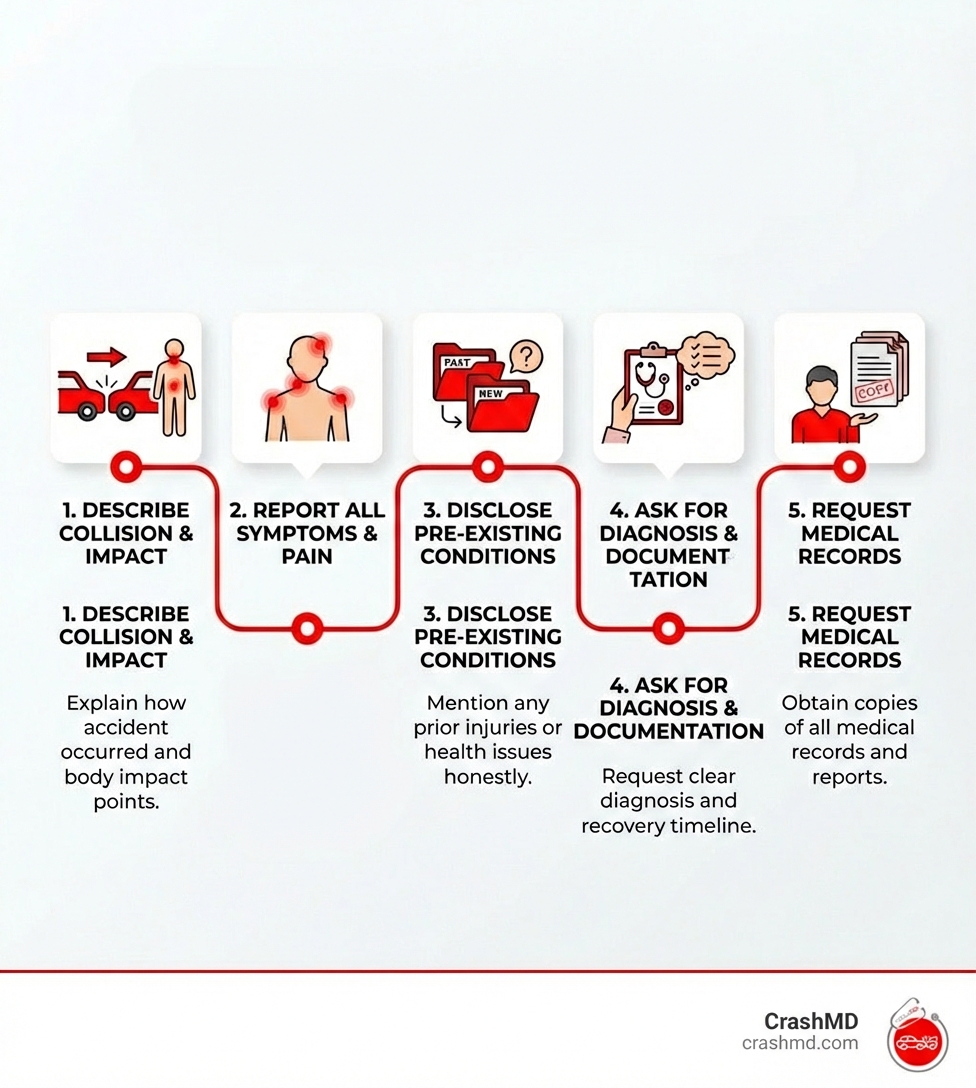
- Describe the accident mechanism – How the collision happened (rear-end, T-bone, head-on) and where your body made contact with the vehicle
- Report all symptoms – Every ache, pain, dizziness, numbness, or confusion, even if it seems minor
- Disclose pre-existing conditions – Any prior injuries or health issues, so your doctor can differentiate new injuries from aggravated old ones
- Ask about your diagnosis and prognosis – Request clear documentation of your injuries and expected recovery timeline
- Request comprehensive documentation – Ensure your medical records include all injuries, treatments, and work restrictions
After a car crash, your body floods with adrenaline and endorphins. These chemicals can mask pain for hours or even days. You might walk away from the scene feeling fine, only to wake up the next morning unable to turn your neck. This is why what you tell your doctor matters so much.
Your doctor’s visit serves two crucial purposes. First, it ensures you get proper medical care for injuries that might not be immediately obvious—like soft tissue damage, concussions, or internal bleeding. Second, it creates a medical record that documents what happened to your body and how the accident affected you.
Many accident victims make critical mistakes during their first doctor’s visit. They downplay symptoms because they don’t want to complain. They forget to mention certain pains because they’re focused on the worst injury. They fail to disclose prior health issues, thinking it will hurt their case.
The truth is simpler: Your doctor needs the complete picture to help you heal. And if you do need to file an insurance claim later, those medical records become the foundation of your case. Insurance companies will scrutinize every word in your chart, looking for reasons to minimize your injuries.
Why Seeking Prompt Medical Care is Non-Negotiable
We understand that after a car accident, your mind might be racing with a million things—the police report, vehicle damage, insurance calls. But one of the most critical steps, often overlooked or delayed, is seeking prompt medical attention. This isn’t just about your immediate well-being; it’s about protecting your long-term health and any future claims you might need to make.
The initial shock and the body’s natural release of adrenaline and endorphins can be quite deceptive. These powerful chemicals act as natural painkillers, masking the severity of injuries. You might feel a little sore, or even completely fine, only for significant pain and symptoms to emerge hours, days, or even a week later. This is incredibly common with injuries such as whiplash, concussions, internal bleeding, and various soft tissue damage.
For more information on why getting care quickly is so important, explore More info about why early intervention is key. If you’re concerned about neck pain, our guide on Whiplash recovery can offer insights. For head injuries, understanding Concussion symptoms after an accident is crucial.
Beyond your physical health, immediate medical attention plays a pivotal role in the legal and financial aspects of your recovery. Insurance companies are notorious for scrutinizing medical records, and any gaps in treatment can be used against you. They might argue that your injuries weren’t caused by the accident, or that you exacerbated them by delaying care. Establishing a clear timeline of medical treatment directly after the incident is key to proving that your injuries are a direct result of the car accident.
To learn more about the importance of early medical care, read Reasons to See a Doctor After a Car Accident.
The Risk of Waiting: How Insurance Companies View Delays
When it comes to car accident claims, timing is everything. Our experience shows that the longer you wait to see a doctor after an accident, the easier it is for an insurance adjuster to argue that your injury wasn’t caused by the accident. Insurance companies feel that the more time that passes between the car accident and the initial treatment, the likelier it is that the claimant or plaintiff could be faking or at least exaggerating the extent of their injuries.
Imagine this scenario: you have a car accident on Tuesday, but your medical records show that you didn’t receive any medical treatment until Saturday. An insurance adjuster might quickly claim you could have hurt yourself doing something else in the interim. This delay creates a “gap in treatment” that they can exploit, casting doubt on the direct link between the accident and your injuries. They might even try to blame your pain, discomfort, or need for treatment on other activities you engaged in during that gap.
These tactics can significantly reduce the settlement offer you receive or, in some cases, lead to your claim being denied outright. This is why immediate documentation of your injuries is paramount.

Protecting Your Health and Your Claim
While some injuries, like cuts and broken bones, are immediately apparent, others can be insidious. Soft tissue injuries, such as sprains and strains, might not show up on an X-ray but can cause debilitating pain. Concussions and other traumatic brain injuries (TBIs) can have delayed symptoms like headaches, dizziness, confusion, or mood changes. Even internal bleeding might not present obvious signs until it becomes a severe medical emergency.
By seeking prompt medical care, you are creating a crucial medical timeline that directly connects your injuries to the car accident. This timeline is vital for proving causation, which is the legal term for demonstrating that the other side’s actions caused your injuries. Without this documentation, it becomes much harder to argue for fair compensation.
Your doctor’s notes, diagnostic tests, and treatment plans become irrefutable evidence. They tell the story of your injuries, their severity, and their impact on your life. This comprehensive record is not just for your physical recovery; it’s the bedrock of your personal injury claim. For those dealing with persistent pain, understanding More info about chronic pain after a car accident can be very helpful.
What to Say to Your Doctor After a Car Accident: A Step-by-Step Guide

When you step into the doctor’s office after a car accident, it’s easy to feel overwhelmed. But what you say, and how you say it, can make all the difference for your health and your legal case. Our goal is to empower you to communicate effectively. The key is to be honest, thorough, and focused on medical facts, not legal fault. We want your doctor to have the clearest picture possible of your injuries and how they affect you.
Preparing for Your Appointment
Preparation is your secret weapon. Before your appointment, take a few moments to gather your thoughts and necessary documents. This will ensure you don’t forget crucial details and make the most of your time with the doctor.
Here’s a list of items we recommend bringing to your appointment:
- A symptom journal: Start tracking your symptoms from the moment they appear. Note the date, exact location of pain, intensity (on a scale of 1-10), and a description of the pain (e.g., sharp, dull, throbbing, burning). Include any non-pain symptoms like dizziness, nausea, confusion, numbness, or tingling. Also, document how these symptoms impact your daily activities.
- Police report details: While you don’t need the full report, having key information like the date, time, and location of the accident can be helpful. Your doctor doesn’t need to know who was at fault, just the circumstances that led to your injuries.
- Insurance information: Bring details for both your auto insurance (Personal Injury Protection or Medical Payments coverage, if applicable in your state like Arizona, Nevada, Texas, Oklahoma, or California) and your health insurance. This ensures your medical bills can be processed correctly.
- A list of questions: We’ll cover some essential questions to ask later, but add your own concerns. Writing them down helps ensure you get all the answers you need.
Choosing the right doctor is also essential for post-accident care. You can find more guidance on More info on choosing a pain doctor.
Describing the Accident and Your Symptoms
When discussing the accident with your doctor, keep it factual and focused on the “mechanism of injury”—how the collision physically affected your body. Avoid speculating about fault or liability. Simple, direct statements are best:
- “I was rear-ended at a stoplight, and my head snapped back and forth, hitting the headrest.”
- “My vehicle was T-boned on the driver’s side, and my left shoulder hit the side door.”
- “It was a head-on collision, and my chest hit the steering wheel, and my knees impacted the dashboard.”
These details help your doctor understand the forces involved and anticipate potential injuries.
Next, and perhaps most importantly, be specific and thorough when describing your symptoms. Now is not the time to be stoic! Even seemingly minor aches and twinges can be important clues for your doctor, indicating deeper issues.
- Location: Point to every area of discomfort. “My neck hurts here, and the pain radiates down my left arm.”
- Intensity: Use the 1-10 pain scale honestly. “My neck pain is a 7 today, and my headache is a 5.”
- Type of pain: Use descriptive words. “I have a sharp pain in my lower back,” or “My shoulder has a burning sensation,” or “My knee feels dull and achy.”
- Impact on daily life: Explain how the pain affects you. “I can’t lift my child,” “It’s difficult to sleep,” “I can’t sit for more than 15 minutes without severe pain.”
For a deeper dive into different types of pain, check out More info on understanding muscle and joint pain.
Beyond pain, report all other symptoms you’re experiencing, no matter how unrelated they might seem:
- Dizziness or lightheadedness
- Nausea or vomiting
- Confusion, difficulty concentrating, or memory issues
- Numbness or tingling in your extremities
- Irritability or changes in mood
- Fatigue
- Blurred vision or sensitivity to light
These non-pain symptoms can be critical indicators of concussions or other internal injuries.
Discussing Pre-existing Conditions and Prior Injuries
We know this can be a sensitive topic, but honesty is truly the best policy when discussing your medical history with your doctor. Disclosing any pre-existing conditions or prior injuries, even if they seem unrelated, is crucial for several reasons:
- Accurate Diagnosis and Treatment: Your doctor needs the full picture to accurately diagnose your current injuries and create the most effective treatment plan. A prior back injury, for example, might influence how your doctor treats new back pain from the accident.
- Credibility with Insurance Companies: Insurance companies will almost certainly investigate your medical history. If you fail to disclose a past injury, and they find it, they will use it to argue that you are hiding something, potentially denying your claim or significantly reducing your compensation. The research shows that not talking with your doctor about a past injury is more likely to cost you in a lawsuit because once the insurance company finds out about it, they’ll take your silence to mean that you’re “hiding something.” If the insurance company finds out you were being deceitful about your injuries, you will most likely lose your case.
- Aggravation of Prior Injuries: Car wrecks can light a fire under old injuries, making them flare up and morph into something nastier. Your doctor can document that the accident aggravated a pre-existing condition, making it a compensable injury. This is different from claiming a brand new injury.
Be clear and specific. For example, “I had some lower back pain years ago, but it was resolved. Now, after the accident, the pain is much worse and in a different area.” This helps your doctor differentiate between what was there before and what the crash has made worse.
For more on this important discussion, refer to Discussing Your Car Crash Injuries with a Doctor.
The Power of Your Medical Record: Documenting for Health and Compensation
Your medical records are far more than just notes about your health; they are the foundation of your injury claim. These documents serve as tangible evidence, proving the extent of your injuries, the necessity of your treatment, and the link between the car accident and your suffering. Without thorough and accurate medical documentation, proving your right to financial compensation becomes an uphill battle.
Medical records serve as the foundation of an injury claim. They connect your injuries directly to the car accident, detailing how the impact likely caused specific trauma. This comprehensive record can demonstrate the accident’s impact on your daily life, including missed work, physical limitations, and emotional distress.
Essential Information for Your Doctor’s Note
To ensure your medical records effectively support both your recovery and any potential legal claim, we encourage you to discuss the following with your doctor and ensure they are documented:
- Detailed Injury List: Every single injury, from the most severe to the seemingly minor aches and pains. Do not just focus on your primary complaint; mention everything.
- Diagnosis and Prognosis: A clear diagnosis of each injury, along with a prognosis (the likely course of your recovery, including any potential long-term effects or permanent impairments).
- Pain Levels and Limitations: Objective observations of your pain levels and how your injuries limit your ability to perform daily activities such as walking, sleeping, sitting, driving, and working.
- Objective Observations: Documentation of visible injuries like bruising, cuts, swelling, and any observed limitations in your range of motion.
- Diagnostic Test Results: The results of any X-rays, MRIs, CT scans, or other diagnostic tests, and how they relate to your injuries.
- Prescribed Medications: A record of all medications prescribed, including dosage and duration, to manage pain or other symptoms.
- Treatment Plan Details: A clear outline of your recommended treatment plan, including physical therapy, chiropractic care, follow-up appointments, and any other therapies. This demonstrates your commitment to healing. For insights into how these plans are created, see More info on personalized treatment plans.
- Work Restrictions: Any limitations on your ability to work, including specific tasks you cannot perform or the duration you need to be off work.
- Specialist Referrals: Documentation of any referrals to specialists (e.g., orthopedists, neurologists, pain management specialists) and the reasons for these referrals.
It is crucial that your doctor’s notes clearly state that your injuries resulted from the car accident and explain how the impact likely caused specific trauma. This explicit connection is invaluable.
Essential Questions to Ask: What to Say to Your Doctor After a Car Accident
Beyond simply reporting your symptoms, actively engaging with your doctor by asking specific questions will ensure you receive comprehensive care and robust documentation. Here are some essential questions we recommend you ask:
- “What is my exact diagnosis?” Don’t be afraid to ask your doctor to list all your injuries in detail. They might go into further detail than they would have if you hadn’t asked. Take detailed notes!
- “What is my long-term prognosis?” In states like Arizona, Nevada, Texas, Oklahoma, and California, you have a right to compensation for future medical bills. Your doctor’s professional opinion on the long-term outlook for your injuries is essential for estimating these costs.
- “Will I need physical therapy or other specialists?” Rehabilitative therapy is often ongoing after a personal injury. Understanding this early helps ensure you get the care you need and that it’s documented for your claim. For more about physical therapy needs, check out More info on signs you need physical therapy.
- “What are my activity restrictions?” Your doctor can provide clear guidance on what activities to avoid during recovery. This protects you from further injury and provides crucial evidence of your limitations.
- “When can I return to work?” If your injuries prevent you from working, your doctor’s opinion can be significant evidence for claiming lost wages. Ask for an estimate of how long you might be out of work.
- “How did I sustain these injuries?” This question helps establish “proximate causation”—proving the accident caused your injuries. Your doctor’s expert opinion can refute arguments about pre-existing conditions.
- “What is my treatment plan?” Understanding and following your treatment plan is vital. Juries look for commitment to recovery when considering future medical bills. Ask your doctor to spell it out for you.
- “What are the possible outcomes?” Your prognosis might not be black and white. Understanding the range of possible problems, complications, and outcomes helps you and us gauge the extent of what might happen down the road, building a more comprehensive case.
- “Is there anything else I should do?” Your doctor might recommend seeing a specialist for a more specific diagnosis or treatment. This can provide stronger evidentiary proof for your claims.
For more questions to ask your pain management doctor, see More info on top questions to ask your pain management doctor.
Frequently Asked Questions about Post-Accident Doctor Visits
We often hear similar questions from our patients after they’ve been in a car accident. Here are some of the most common ones, along with our advice:
What if I feel fine right after the accident?
It’s a common misconception that if you feel fine immediately after a crash, you’re in the clear. As we’ve discussed, adrenaline and endorphins are powerful, natural painkillers that can mask serious injuries like whiplash, internal bleeding, or concussions. These “hidden” injuries can surface hours or even days later, often with increased pain and debilitating symptoms. It’s crucial to get checked out by a medical professional as soon as possible to rule out any underlying damage. A delay can harm both your health, potentially allowing an injury to worsen, and a potential claim, as insurance companies might argue your injury wasn’t caused by the accident.
Should I tell my doctor I’m considering a lawsuit?
Our advice is to focus your conversation with your doctor entirely on your medical condition, symptoms, and treatment. While your medical records are vital for any legal claim, discussing your intentions to pursue a lawsuit with your doctor can sometimes make them wary of getting involved in legal proceedings, which is not helpful for your medical care or future claim. Your doctor’s role is to treat your injuries, and our role is to handle the legal aspects. Let your medical records speak for themselves regarding your injuries and treatment. In short, give your doctor a clear history of the crash and your symptoms, but don’t talk about your lawsuit.
What if I disagree with my doctor’s treatment plan?
It’s important to have open and honest communication with your doctor. If you have concerns or disagree with a recommended treatment plan, voice them respectfully. Ask for clarification, understand the reasoning behind their recommendations, and inquire about alternative treatments. You always have the right to seek a second opinion if you’re uncomfortable or unsure. The key is to work collaboratively with your medical team to find a treatment plan you’re comfortable with and can adhere to. Disobeying your doctor’s orders without discussion or a documented alternative could hurt your recovery, prolong your treatment, and potentially allow the insurance company to claim your injuries are not as bad as you said, or that you are not committed to your recovery.
Your Recovery is the Priority
Navigating the aftermath of a car accident can feel like a maze, but remember, your health and well-being are always the top priority. What you say to your doctor after a car accident forms the bedrock of your recovery journey—both physically and, if necessary, legally.
Here are our key takeaways to guide you:
- Be Prompt: Seek medical attention immediately, even if you feel fine. Delayed symptoms are common, and prompt care protects both your health and your potential claim.
- Be Thorough: Communicate every symptom, every ache, and every concern. Do not downplay your pain. Your doctor needs the full picture to help you heal.
- Be Honest: Disclose your full medical history, including any prior injuries. This builds credibility and ensures accurate diagnosis and treatment.
- Follow Medical Advice: Adhere to your doctor’s treatment plan, attend all appointments, and take prescribed medications. This demonstrates your commitment to recovery.
- Document Everything: Ensure your medical records are comprehensive, linking your injuries directly to the accident and detailing your prognosis and limitations.
At CrashMD, we guide accident victims through recovery, offering expert pain management and custom treatment plans in Arizona, Nevada, Texas, Oklahoma, and California. We advocate for our patients, ensuring their injuries are thoroughly documented for comprehensive recovery, long before any legal action. We’re here to help you heal and protect your future.
Schedule your appointment with a motor vehicle accident doctor today.