

Why a Car Accident Recovery Plan Can Save Your Health and Financial Future
A car accident recovery plan is your structured roadmap to physical healing, financial stability, and legal protection after a collision. More than 5.4 million Americans experienced car crashes in 2021 alone, and most will face three to four traffic incidents in their lifetime. Without a clear plan, victims often miss critical deadlines, develop chronic pain from untreated injuries, or lose thousands in denied insurance claims.
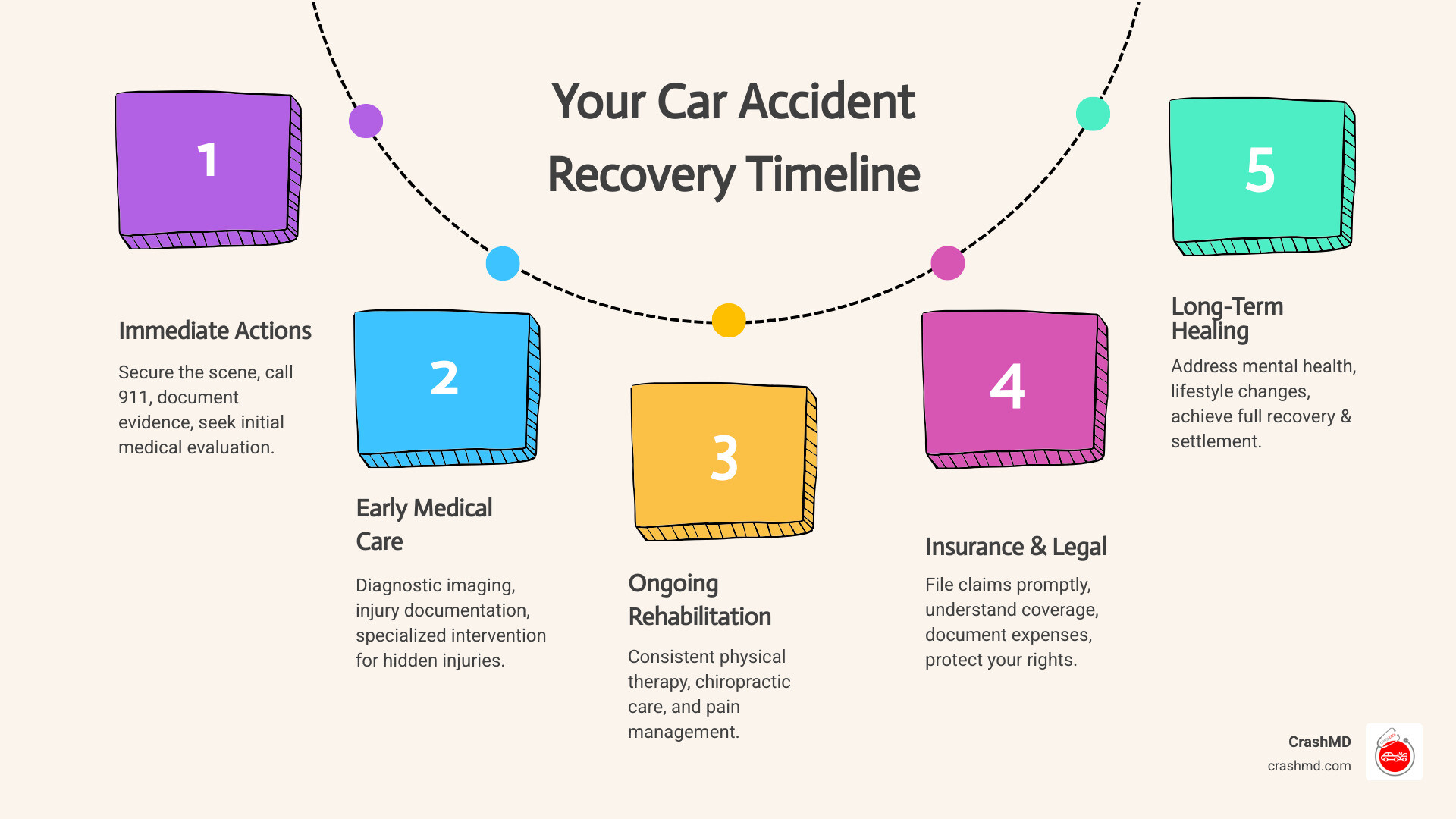
Essential Components of Your Car Accident Recovery Plan:
- Immediate Actions (First 24 Hours) – Secure the scene, call 911, document everything, seek medical evaluation even if you feel fine
- Medical Foundation – Get diagnostic imaging, establish injury documentation, begin early intervention with specialized providers
- Pain Management – Start physical therapy, chiropractic care, and rehabilitation services within days of the accident
- Insurance Navigation – File claims promptly, understand your coverage limits, maintain detailed expense records
- Mental Health Support – Address anxiety, PTSD, and emotional trauma as part of your recovery
- Legal Protection – Know fault determination rules in your state, preserve your right to compensation
The challenge? Adrenaline masks pain immediately after a crash. You might walk away feeling “fine,” only to experience debilitating neck pain, headaches, or dizziness 24-72 hours later. Whiplash, concussions, and soft tissue damage don’t always announce themselves right away – but they can worsen dramatically without prompt treatment.
I’m Dr. Adam Savage, and I’ve guided thousands of patients through post-collision recovery. The victims who recover fastest and most completely are those who follow a structured plan from day one. They understand that recovery isn’t just about physical healing – it’s about protecting your legal rights, managing insurance complexities, and addressing the mental toll of trauma.
This guide breaks down every step you need to take, from the moment of impact through long-term rehabilitation. You’ll learn when to seek emergency care versus urgent care, how to document injuries for insurance claims, and why consistent treatment prevents chronic pain that can last months or years.
Immediate Actions: Securing the Scene and Your Health
The moments immediately following a car accident can be disorienting, but acting swiftly and calmly is paramount. Your priority is always safety and then gathering crucial information.
What to Do Right After a Car Accident
- Ensure Safety First: Stop your vehicle immediately. If it’s safe and your car is drivable, move it to the side of the road, out of the flow of traffic. Turn on your hazard lights to warn other drivers. If the vehicle is undrivable or unsafe to move, stay inside with your seatbelt fastened, if possible, and wait for assistance.
- Check for Injuries and Call 911: Evaluate your physical condition and that of any passengers. Even if you feel fine, adrenaline can mask pain. If anyone is injured, or if there are spilled fluids, fire risks, or significant damage, call 911 immediately. Don’t hesitate; medical assistance and police presence are crucial in these situations.
- Document the Scene: This is where your inner detective comes out. While waiting for authorities, if it’s safe to do so, start gathering evidence.
- Photography: Take comprehensive photos of the accident scene. Capture the damage to all vehicles involved, license plates, the position of the cars, road conditions (skid marks, debris), traffic signs, weather conditions, and any visible injuries. The more photos, the better – details matter!
- Witness Contacts: Look for any witnesses who saw the accident occur. Their unbiased accounts can be invaluable. Ask for their names, phone numbers, and email addresses.
- Gathering Vehicle Parts: If any vehicle parts have fallen off and it’s safe to do so, collect them. This can help in accident reconstruction.

- Exchange Information: With other parties involved, exchange the following details:
- Names, addresses, and phone numbers.
- Driver’s license numbers.
- Insurance company names and policy numbers.
- Vehicle make, model, year, and license plate numbers.
- Avoid discussing fault or apologizing, even if you think you might be at fault. Statements made at the scene can negatively impact your claim later.
- File a Police Report: When is it necessary to file a police report, and how is it done? In many of our target states like California, you’re required to report an accident to the DMV within 10 days if there are injuries or property damage exceeds a certain threshold (e.g., $750 in California). While not every fender-bender requires police presence at the scene, it’s almost always a good idea to call law enforcement. Your insurance company may require an official police report, and it provides an objective account of the incident. If police don’t respond to minor accidents, you might need to file a report at a local police station or, in some areas, a Collision Reporting Centre. Always ask the responding officer for their name, badge number, and the report number.
Building Your Car Accident Recovery Plan: The Medical Foundation
After the immediate chaos subsides, the next critical phase of your car accident recovery plan begins: focusing on your health. I’m Dr. Adam Savage, and I’ve helped thousands of patients steer the complexities of post-crash health. According to the National Safety Council, millions experience crashes annually, and many suffer injuries that require expert care. Even if you feel okay, a medical evaluation is non-negotiable.
Why Early Intervention is the Core of Your Car Accident Recovery Plan
Many car accident injuries, particularly those involving soft tissues, don’t manifest immediately. Adrenaline, shock, and the body’s natural pain-masking mechanisms can hide symptoms for hours, days, or even weeks. This is why seeking medical attention is crucial, even if injuries seem minor.
- Delayed Symptoms: Whiplash, concussions, and soft tissue damage are notorious for their delayed onset. You might wake up 24-72 hours later with severe neck pain, headaches, dizziness, blurred vision, or even numbness and tingling. These aren’t just minor aches; they can indicate serious underlying issues. For instance, more than 289,000 cases of concussions from car accidents occur each year, and screening for them immediately after an accident is always best.
- Injury Documentation: From a medical perspective, prompt evaluation allows for early diagnosis and treatment. From a legal standpoint, this creates a clear record linking your injuries to the accident. Without this initial documentation, it can be challenging to prove that your pain and suffering are directly related to the collision, potentially jeopardizing your insurance claim. We emphasize comprehensive injury documentation through diagnostic imaging (X-rays, MRIs, CT scans) and thorough medical assessments.
- Preventing Chronic Pain: Early intervention with a specialized doctor can prevent acute injuries from developing into chronic conditions. Untreated inflammation or misaligned spinal structures can lead to long-term pain and disability. For more information on how specialized medical care can make a difference, explore our resources on motor vehicle accident doctors.
Managing Pain and Mobility Through Specialized Care
Once injuries are diagnosed, a personalized treatment plan is essential. We focus on a multidisciplinary approach to ensure comprehensive healing and pain management.
- Physical Therapy: This is often a cornerstone of recovery. Physical therapists use targeted exercises, manual therapy, and modalities to restore strength, flexibility, and range of motion. They address muscular damage, weakness, and stiffness, helping your body regain its pre-accident function.
- Chiropractic Care: Car accidents frequently cause spinal misalignments (subluxations), leading to pain, nerve compression, and reduced mobility. Chiropractic adjustments help realign the spine, reduce nerve pressure, improve blood flow, and restore proper joint function. This can be particularly effective for whiplash and back injuries.
- Other Rehabilitation Services: Depending on your specific injuries, your car accident recovery plan might also include massage therapy to relax tense muscles, acupuncture for pain relief, or specialized neurological care for concussions or traumatic brain injuries. We ensure you receive the precise care you need to address all aspects of your recovery. For more on our comprehensive recovery services, visit our recovery services page.
Navigating the 24-Hour Window and Insurance Claims
The first 24 hours after an accident are crucial, not just for your health, but for establishing your insurance claim. Ignoring these steps can lead to significant headaches down the line.
Important Steps Within 24 Hours
- Seek a Medical Checkup: Even if you think you’re fine, get checked by a doctor within 24 hours. As we’ve discussed, delayed symptoms are common. A medical professional can identify hidden injuries and create an official record of your condition, which is vital for any insurance claim.
- Notify Your Insurance Company: Report the accident to your insurance provider as soon as possible. Most policies require prompt notification. Be prepared to provide details collected at the scene. They will likely assign an adjuster to your case.
- Start the Claims Process: Your insurance company will guide you through filing a claim. This involves providing your detailed account of the accident and the information you gathered. The goal is to provide facts, not speculation.
The Insurance Claims Process
The insurance claims process can be complex, but understanding the basics will empower you.
- Adjuster Communication: An insurance adjuster will review your claim, assess damages, and determine coverage. Be cooperative, but also cautious. Stick to the facts, and remember that any statements you make can be used in evaluating your claim.
- Policy Coverage: Understand your policy. What are your limits for medical payments (MedPay), personal injury protection (PIP), property damage, and rental car coverage? For example, in California, most policies cover accidents in other states and Canada but not typically Mexico without separate coverage. Also, a standard auto policy generally pays the lesser of the amount to repair your vehicle or its actual cash value (ACV) if it’s totaled.
- ER vs. Urgent Care: Knowing where to go for immediate medical attention can save you time and money, while still ensuring proper documentation.
| Feature | Emergency Room (ER) | Urgent Care Center |
|---|---|---|
| Best For | Severe injuries (e.g., suspected fractures, head trauma, internal bleeding, severe pain, loss of consciousness) | Non-life-threatening injuries (e.g., minor cuts, sprains, whiplash, general aches, follow-up for delayed pain) |
| Cost | Typically higher co-pays and deductibles, often the most expensive option | Generally lower co-pays than ER, more affordable |
| Wait Times | Can be very long, as critical cases are prioritized | Shorter wait times, often walk-in friendly |
| Documentation | Provides comprehensive medical records, crucial for serious injury claims | Provides medical records, sufficient for less severe injuries and initial documentation |
| Diagnostic Tools | Full range of diagnostic tests (X-rays, CT scans, MRI, advanced labs) | Limited diagnostic tools (often X-rays, basic labs) |
| When to Choose | If you suspect a serious or life-threatening injury, or if you are unsure of the severity | If your injury is not life-threatening but requires prompt medical attention |
| Our Recommendation | If in doubt, or if you experience significant symptoms, choose the ER. It’s always better to be safe. | For less severe but immediate concerns, an urgent care visit can provide quick assessment and initial care. |
Holistic Healing: Mental Health, Nutrition, and Rest
A car accident recovery plan isn’t solely about mending physical wounds; it’s about healing the whole person. The emotional and psychological toll of a collision can be profound, and integrating mental well-being with physical care, proper nutrition, and adequate rest is essential for a complete recovery.
The Importance of Mental and Emotional Health
Car accidents are traumatic events that can leave lasting psychological scars. It’s common to experience:
- Anxiety: Fear of driving, flashbacks, and general unease.
- Depression: Feelings of sadness, hopelessness, and loss of interest in activities.
- PTSD (Post-Traumatic Stress Disorder): Intrusive thoughts, nightmares, hyper-vigilance, and avoidance behaviors.
Ignoring these symptoms can prolong your recovery and impact your quality of life. Seeking support from a mental health professional, such as a therapist or counselor, is a vital part of your healing journey. They can provide coping strategies, trauma-informed therapy, and a safe space to process your experience. Many insurance policies, including accident benefits, may cover mental health support.
Supporting Your Car Accident Recovery Plan with Lifestyle Changes
Your body needs all the help it can get to repair and rebuild after an injury. Lifestyle choices play a significant role in accelerating or hindering this process.
- Nutrition and Hydration: Fueling your body with a healthy, anti-inflammatory diet is crucial. Focus on lean proteins for tissue repair, fruits and vegetables rich in vitamins and antioxidants to reduce inflammation, and whole grains for sustained energy. Staying well-hydrated is equally important for cellular function and overall healing.
- Rest and Sleep: Adequate rest is non-negotiable. It’s during sleep that your body does most of its repair work. Tissue and muscle growth occur during sleep, hastening the healing process for injured body parts. Additionally, the levels of stress hormones in your body drop when you sleep, lowering internal inflammation. Prioritize 7-9 hours of quality sleep each night.
- Gradual Activity and Light Stretching: While rest is important, complete inactivity can be detrimental. As advised by your physical therapist, gradually reintroduce light activities and gentle stretching. This helps prevent stiffness, improves circulation, and maintains muscle tone. Avoid pushing through pain, as this can worsen injuries.
- Emotional Support Systems: Lean on friends, family, or support groups. Sharing your experiences and feelings can provide comfort and reduce feelings of isolation. Journaling can also be a powerful tool to process emotions and track your progress.
Financial and Legal Considerations for Long-Term Stability
Beyond physical and emotional healing, a comprehensive car accident recovery plan must address the financial and legal aftermath of a collision. Navigating insurance complexities, understanding fault, and protecting your rights are crucial for long-term stability.
How Fault is Determined and Its Impact on Claims
Determining fault is a critical step in the claims process, as it directly affects who pays for damages and injuries.
- General Principles: In simple terms, a driver who causes an accident by driving carelessly or recklessly is considered at fault. The police report often includes the responding officer’s initial assessment of fault, but insurance companies conduct their own investigations.
- Comparative vs. Contributory Negligence: Many of our target states, including California, Arizona, Nevada, Texas, and Oklahoma, follow a “comparative negligence” system. This means you can still recover damages even if you are partially at fault, but your compensation will be reduced by your percentage of fault. For example, if you are 20% at fault, you can recover 80% of your damages. This differs from “contributory negligence” states where being even 1% at fault bars you from any recovery.
- Evidence is Key: Fault determination relies heavily on evidence gathered at the scene, witness statements, police reports, and sometimes accident reconstruction.
Understanding Your Rights Under Insurance Settlement Regulations
Insurance companies are legally bound by regulations designed to protect consumers. Knowing your rights can prevent you from accepting an unfair settlement.
- Timelines: Insurers typically have specific timeframes to acknowledge a claim, begin an investigation, and accept or deny it. For instance, in California, insurers generally have 15 days to acknowledge a claim and respond to communications, and 40 days to accept or deny a claim after receiving proof of loss.
- Fair Offers: You have the right to a fair settlement offer that covers your damages, including medical expenses, lost wages, property damage, and pain and suffering. If your vehicle is a total loss, the insurer must offer its actual cash value (ACV), which is its fair market value.
- Right to Choose Repair Shop: In states like California, you have the right to choose your own auto body repair shop. Insurance companies cannot require you to use a specific shop, although they may recommend “preferred” facilities.
- Subrogation and Deductible Recovery: “Subrogation” is your insurance company’s right to recover money from the at-fault party’s insurer for what they paid on your claim. If successful, they are often required to help you recover your deductible.
What to Watch Out For: Automobile Insurance Fraud
Be aware of common types of automobile insurance fraud that can complicate your recovery.
- Staged Accidents: Organized rings may intentionally cause accidents to file fraudulent claims.
- Dishonest Repair Shops: Some shops inflate repair costs or charge for work not performed.
- Capping: Illegal referrals by tow truck drivers or others to specific body shops, law firms, or medical offices in exchange for a fee. Always be cautious of unsolicited advice or referrals after an accident.
What to Do if You Are Served with a Lawsuit
If you are served with a Summons and Complaint as a result of an accident, act immediately:
- Notify Your Insurer: Contact your insurance agent and company without delay. This is critical, as your policy likely requires prompt notification.
- Deliver Documents: Provide the original lawsuit documents to your insurance company.
- No Independent Statements: Do not give statements or discuss the accident with anyone except a verified representative of your insurance company. If the loss is covered, your insurer will provide legal defense.
Insurance for Newly Acquired Vehicles or Rental Cars
- Newly Acquired Vehicles: Most policies provide automatic coverage for a replacement vehicle or an addition to your existing vehicles, usually with the same coverage as your previous car. However, you must notify your insurance provider within a designated time period (often 30 days, but sometimes less) to ensure continuous coverage.
- Rental Cars: If you have rental vehicle coverage on your personal policy, your insurer will pay up to a specified daily amount for a set number of days while your car is being repaired. Be aware that your personal policy may not cover collision damage waivers (CDW) offered by rental companies, so always review your policy or consult your agent before renting.
Navigating these financial and legal waters can be daunting, but you don’t have to do it alone. We at CrashMD advocate for our patients, ensuring that your injuries are thoroughly documented for legal cases and that you receive comprehensive care before any legal action. For more information on how we can support you, visit our patient advocacy page.
Frequently Asked Questions about Car Accident Recovery
We understand that you’ll have many questions as you steer your recovery. Here are answers to some of the most common concerns we hear.
How long does a typical car accident recovery take?
The recovery timeline for different types of car accident injuries varies significantly based on several factors:
- Injury Severity: Minor injuries like bruises or mild sprains might resolve in a few days to two weeks. Moderate trauma, such as whiplash or minor fractures, often requires several weeks to three months of rehabilitation. Serious conditions like traumatic brain injuries (TBI), spinal cord trauma, or severe fractures can take many months to years to fully heal, sometimes involving lifelong management.
- Individual Health: Your overall health, age, and pre-existing conditions can influence how quickly you heal. Older drivers, especially those 70 and up, are at higher risk for serious injury and often experience slower recovery rates.
- Treatment Compliance: Adhering strictly to your prescribed treatment plan, including physical therapy, chiropractic care, and medication, is crucial for optimizing your healing process.
- Psychological Healing: The mental and emotional aspects of recovery also play a role. Unaddressed anxiety or PTSD can prolong the overall recovery experience.
There’s no one-size-fits-all answer, but with a dedicated car accident recovery plan and consistent effort, you can work towards the best possible outcome.
What if I feel fine immediately after the accident?
This is a very common scenario, and it’s a critical point we emphasize: always seek medical attention, even if you feel fine immediately after the accident.
- Adrenaline Mask: The body’s “fight or flight” response floods your system with adrenaline, which can mask pain and mental fogginess. You might not feel the full extent of your injuries until hours or even days later.
- Delayed Pain and Symptoms: Many common car accident injuries, like whiplash (neck pain, stiffness, headaches), concussions (dizziness, confusion, sensitivity to light), and soft tissue damage (muscle aches, swelling), can take 24 to 72 hours to manifest. Ignoring these delayed symptoms can lead to them worsening and becoming chronic.
- Documentation: From a medical and legal perspective, prompt evaluation provides immediate documentation of your condition, linking any future symptoms directly to the accident. This record is invaluable for insurance claims and legal proceedings.
Don’t let a temporary lack of pain deceive you. A quick check-up can save you from significant pain and complications down the road.
Does insurance cover all rehabilitation services?
Insurance coverage for car accident recovery services can vary, but generally, many treatments are covered:
- Personal Injury Protection (PIP) / Medical Payments (MedPay): If you have PIP or MedPay coverage on your own auto insurance policy, it will typically cover medical expenses (including doctor visits, physical therapy, chiropractic care, and medication) regardless of who was at fault, up to your policy limits.
- Third-Party Claims: If another driver was at fault, their liability insurance should cover your medical expenses, lost wages, and other damages.
- Health Insurance: Your private health insurance may also cover medical treatments, though it might require a referral or have its own co-pays and deductibles.
- Workers’ Compensation: If the accident occurred while you were working, workers’ compensation might cover your medical expenses and lost wages.
It’s crucial to review your specific auto insurance policy to understand your coverage limits and what services are included. We can help you understand your options and steer the process to ensure you receive the care you need.
Conclusion
A car accident can be a life-altering event, but with a well-structured car accident recovery plan, you can steer the path to healing with confidence and clarity. From the immediate aftermath at the scene to the long-term journey of physical, mental, and financial recovery, every step you take matters.
At CrashMD, we understand the complexities and challenges you face. We are dedicated to guiding accident victims through recovery, offering expert pain management and custom treatment plans. Our unique strength lies in advocating for our patients and carefully documenting injuries, ensuring you have the comprehensive care and robust legal documentation needed for a successful outcome. Your health, peace of mind, and future stability are our top priorities.
Don’t leave your recovery to chance. Take control of your healing journey. For more information about starting your personalized car accident recovery plan and to connect with our specialized team, visit CrashMD. We’re here to help you move beyond the bump and reclaim your life.