

Why Turmeric May Help You Heal Faster After a Bone Fracture
If you’re wondering how to use turmeric for bone fracture healing, here’s a quick answer:
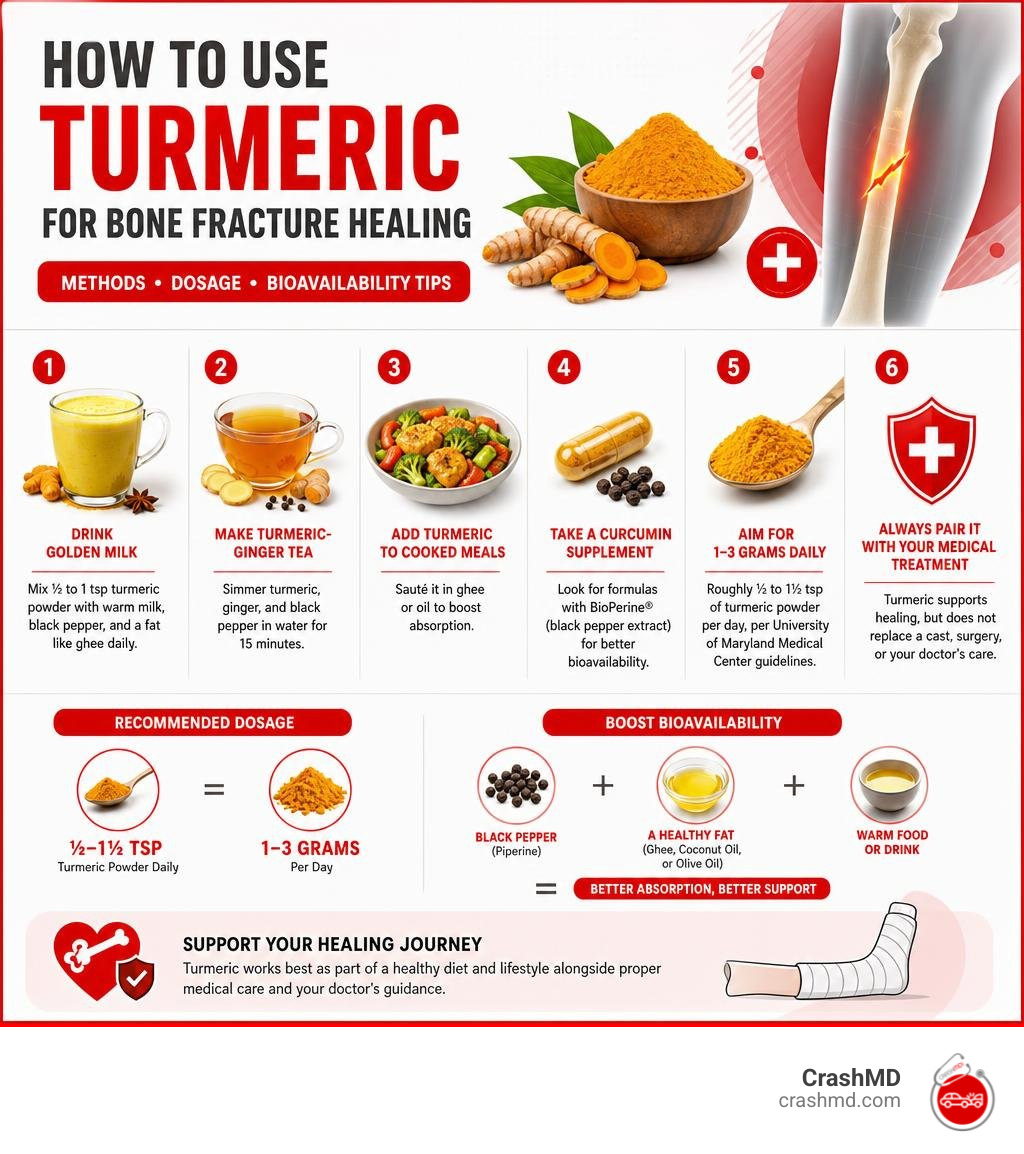
- Drink golden milk — mix ½ to 1 tsp turmeric powder with warm milk, black pepper, and a fat like ghee daily
- Make turmeric-ginger tea — simmer turmeric, ginger, and black pepper in water for 15 minutes
- Add turmeric to cooked meals — sauté it in ghee or oil to boost absorption
- Take a curcumin supplement — look for formulas with BioPerine (black pepper extract) for better bioavailability
- Aim for 1–3 grams of turmeric powder per day — roughly ½ to 1½ tsp, per University of Maryland Medical Center guidelines
- Always pair it with your medical treatment — turmeric supports healing, but does not replace a cast, surgery, or your doctor’s care
I’m Dr. Adam Savage, and if you’ve recently fractured a bone — whether from a car accident or another injury — you already know how long and painful the recovery road can be.
Beyond rest, immobilization, and medical care, many patients ask about natural ways to support their healing. Turmeric is one of the most talked-about options, and for good reason.
Turmeric’s active compound, curcumin, has been widely studied for its anti-inflammatory and antioxidant properties. Research suggests it may support bone cell activity and reduce the kind of chronic inflammation that slows recovery. A 6-month clinical study found that daily turmeric supplementation increased bone density by up to 7% in adults over age 70.
But there’s a lot of misinformation out there too — including the idea that rubbing turmeric paste on a fracture will speed up healing. It won’t. Bone repair happens deep inside the body, not at the skin’s surface.
This guide focuses on what actually works: how to take turmeric orally, in the right form and dose, to give your bones the best possible support during recovery.
Essential how to use turmeric for bone fracture terms:
- best calcium tablets for fractures
- calcium tablets for bone healing
- supplements for bone fracture healing
The Science Behind How to Use Turmeric for Bone Fracture Healing
To understand why we recommend turmeric, we have to look at how bones heal. Bone remodeling is a continuous, delicate dance between two types of cells: osteoblasts (which build new bone) and osteoclasts (which break down and resorb old bone). When you experience a fracture, your body goes into overdrive to rebuild this matrix, initiating a complex healing cascade.
Curcumin, the primary active polyphenol in turmeric, influences this cellular dance in several fascinating ways:
- Stimulating Osteoblast Activity: Curcumin has been shown to increase the viability and proliferation of new bone cells. In fact, a study from Washington State University (WSU) found that coating 3D-printed ceramic bone scaffolds with curcumin improved bone-growing capabilities by 30% to 45%.
- Promoting Angiogenesis: For bones to heal, they need a robust blood supply. Curcumin helps promote the expression of Vascular Endothelial Growth Factor (VEGF) and Proliferating Cell Nuclear Antigen (PCNA), which are crucial for forming new blood vessels in the surrounding tissue.
- Immunological Support: Research published in the study Protective Effect of Curcumin on Bone Trauma shows that curcumin helps expand myeloid-derived suppressor cells (MDSCs). This helps regulate the body’s immune and inflammatory responses, creating a more favorable environment for tissue repair.
However, science also teaches us to be realistic. Some animal studies, such as the Effect of curcumin on bone healing in a rat model of femur fracture, suggest that high-dose antioxidant therapy may not dramatically speed up the active “repair” phase of a fracture. Instead, curcumin’s true superpower lies in controlling excessive inflammation and supporting the long-term “remodeling” phase.
For a complete look at how different nutrients interact during this recovery period, check out our Practical Guide to Supplements for Bone Fracture Healing.
Practical Methods: How to Use Turmeric for Bone Fracture Healing Daily
If you want to know how to use turmeric for bone fracture recovery successfully, you must address its biggest weakness: bioavailability.
Curcumin is notoriously difficult for the human body to absorb. It is fat-soluble, meaning it does not dissolve well in water, and our livers quickly metabolize and eliminate it before it can reach our bones.

To get the most out of your daily dose, we must use culinary science to bypass these absorption barriers.
Traditional Recipes: How to Use Turmeric for Bone Fracture Recovery
Traditional Indian medicine (Ayurveda) solved the bioavailability problem centuries ago by pairing turmeric with healthy fats and heat. Here are the most effective ways to prepare it at home:
- Golden Milk (Haldi Doodh): This is the ultimate comfort food for healing bones. Whisk ½ to 1 teaspoon of turmeric powder into a cup of warm milk (whole dairy milk, almond milk, or coconut milk). Add a pinch of black pepper and a teaspoon of ghee or coconut oil. Heat the mixture to a light boil. The heat and fat dissolve the curcumin, while the piperine in black pepper boosts curcumin absorption by up to 2,000%!
- Turmeric Ghee: Melt a jar of grass-fed ghee and stir in 2 tablespoons of turmeric powder, ½ teaspoon of black pepper, and a pinch of ginger. Let it cool and solidify. Use this spice-infused ghee to cook your daily meals, sauté vegetables, or stir into warm rice.
- Turmeric-Ginger Tea: Simmer ½ teaspoon of turmeric powder, a few slices of fresh ginger, a cinnamon stick, and a pinch of black pepper in two cups of water for 15 minutes. Strain, add a teaspoon of honey, and drink warm. Boiling the turmeric helps break down the starches and improves water solubility.
Supplementation: How to Use Turmeric for Bone Fracture Support
While cooking with turmeric is highly beneficial, culinary amounts may not always deliver a therapeutic dose of curcumin. If you prefer a more convenient, concentrated option, supplements are highly effective.
The University of Maryland Medical Center recommends 1 to 3 grams of dried, powdered turmeric root per day (roughly ½ to 1½ teaspoons) for general health benefits. If you choose standardized curcumin extracts, a typical daily dose ranges between 500 mg and 1,500 mg.
When shopping for supplements:
- Always choose a formula labeled with BioPerine or black pepper extract.
- Look for advanced delivery systems like phytosomes, micelles, or liposomal curcumin, which dramatically improve absorption.
- Read The Complete Guide to Supplements for Fractures to see how to sequence your supplements for maximum recovery.
Synergistic Combinations and Safety Considerations
Turmeric works best when it has teammates. To optimize your bone-building potential, combine your turmeric intake with:
- Calcium and Vitamin D: Turmeric supports the bone matrix, but calcium is the actual concrete. Ensure you are getting enough calcium from your diet or high-quality supplements. Learn more in our In-Depth Guide to Calcium Tablets for Bone Healing.
- Traditional Herbal Synergies: In historical Persian and Ayurvedic medicine, turmeric was often combined with other natural substances. For instance, the Combined Extracts of Mummy, Withania Coagulans, and Turmeric Study demonstrated that combining turmeric with Shilajit (mummy) and Ashwagandha (Withania coagulans) significantly stimulated osteogenesis (new bone formation) in animal models.
Safety & Contraindications: Because turmeric is a natural blood thinner (antiplatelet/anticoagulant), you should avoid high doses if you are taking blood-thinning medications (like aspirin, warfarin, or clopidogrel) or if you have an upcoming surgery scheduled. Always consult your healthcare provider before starting any new supplement regimen, especially during post-accident medical care.
Myth vs. Reality: Can Turmeric Paste Heal Fractures Faster?
Walk into many traditional households, and you might be told to whip up a thick paste of turmeric, lime, and water, plaster it over your broken limb, and wrap it in a bandage.
Let’s bust this myth once and for all.

While topical turmeric paste has excellent antimicrobial and anti-inflammatory properties for superficial skin wounds, it cannot heal a bone fracture.
As noted in Dr. Gaurav Jain’s Myth Buster on Turmeric Paste, bone healing occurs deep inside the body. A topical paste simply cannot penetrate through the skin, fat, and muscle layers to reach the fractured bone.
Furthermore, attempting to apply pastes to a broken limb can be dangerous if it delays proper immobilization. For a bone to heal correctly, the two broken ends must be perfectly aligned and held completely still using a medical cast, splint, or surgical hardware. Relying on topical remedies instead of seeking immediate orthopedic care can lead to malunion (the bone healing crooked) or nonunion (the bone failing to heal at all).
Frequently Asked Questions about Turmeric and Bone Healing
Does turmeric reduce bone inflammation?
Yes, there is strong molecular evidence supporting this. When a bone breaks, the surrounding tissues experience a massive inflammatory response. While initial inflammation is necessary to kickstart healing, chronic, excessive inflammation can trigger osteoclasts to resorb bone too quickly.
As detailed in the article Does turmeric reduce bone inflammation?, curcumin works at a cellular level to inhibit the NF-κB pathway. This pathway is responsible for producing inflammatory cytokines like TNF-α and IL-6. By keeping these cytokines in check, curcumin helps balance the RANKL/OPG ratio, preventing excessive bone resorption and protecting the structural integrity of your healing bone.
How long does it take for turmeric to show effects on bone density?
Bone remodeling is a slow, steady process. In clinical trials evaluating bone density, changes are typically measured over several months. For example, a 6-month clinical trial in elderly patients showed up to a 7% increase in bone density with daily bioavailable turmeric supplementation. While you may feel the anti-inflammatory and pain-relieving benefits of turmeric within 4 to 12 weeks, structural improvements to bone density and bone remodeling take at least 3 to 6 months to register.
Can turmeric replace conventional medical treatments for fractures?
Absolutely not. Turmeric is a supportive, natural therapy—it is not a replacement for professional orthopedic care. A broken bone requires physical alignment, stabilization (via casting, splinting, or surgery), and careful monitoring. We always advise using turmeric as an adjunct therapy alongside your doctor’s treatment plan to support your body’s internal healing mechanisms.
Conclusion
Recovering from a bone fracture is a journey that requires patience, proper nutrition, and expert medical guidance. Learning how to use turmeric for bone fracture healing — whether through warm cups of traditional golden milk or high-quality curcumin supplements — can give your body a natural, scientifically backed boost during the recovery process.
At CrashMD, we specialize in helping accident victims navigate their post-injury recoveries across Arizona, Nevada, Texas, Oklahoma, and California. We advocate for your health, design comprehensive recovery plans, and document your injuries thoroughly to ensure you get the care and support you deserve.
If you are recovering from an injury and want to explore the best ways to rebuild your strength, explore our Complete Guide to Supplements for Fractures or reach out to us today to schedule a consultation.