

A gap in treatment car accident patients don’t plan for is one of the most common problems I see — and one of the most avoidable. It happens quietly: you feel “mostly okay” after the crash, you put off the first visit, or you miss a few physical therapy sessions when work gets busy. Weeks later the pain is worse, and the medical record has a hole in it. I’m Dr. Adam Savage, a pain management physician with CrashMD in Oklahoma, and in this article I’ll explain what a treatment gap is, why it can hurt your recovery, why insurers pay so much attention to it, and the practical habits that prevent one.
A quick note before we start: this article is educational and is not medical advice — only an in-person exam can evaluate your injury. I’m also not an attorney. Where I describe how insurers tend to view treatment gaps, that’s general information from the medical side, not legal advice. For anything about your specific claim, talk to a licensed attorney.
What Is a Gap in Treatment?
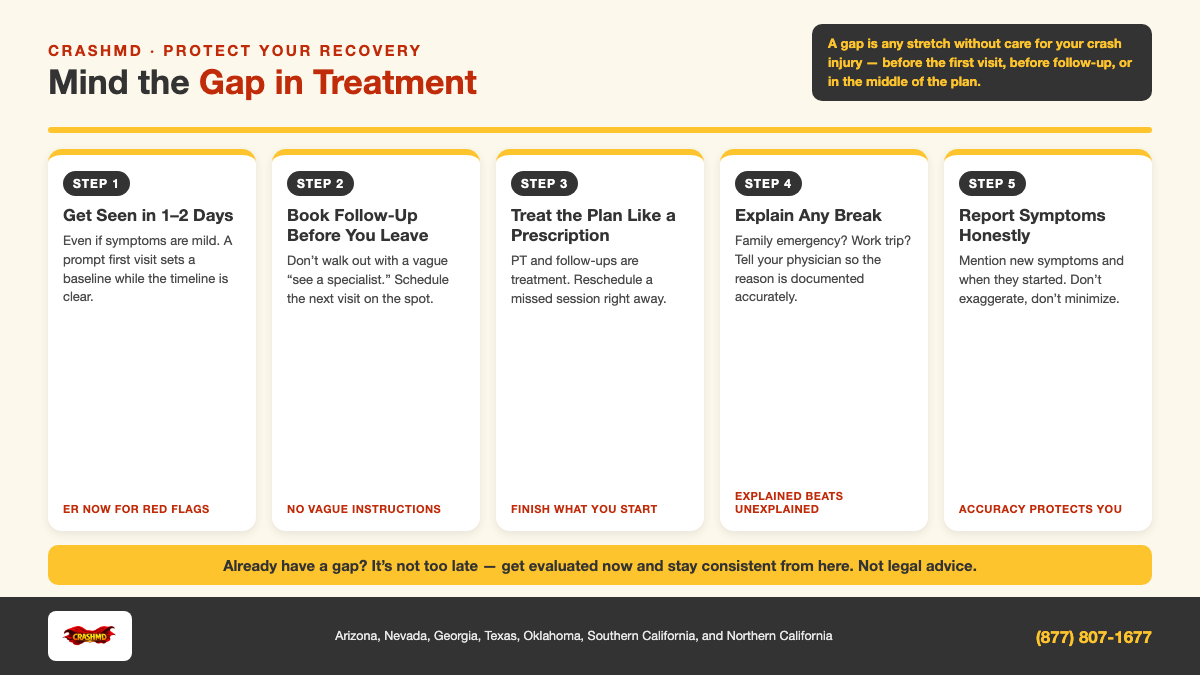
A gap in treatment is a stretch of time when an injured person isn’t receiving care for their crash injury. It usually shows up in one of three places:
- Between the crash and the first visit. The most common gap. Someone skips the ER or urgent care, waits to see if the soreness passes, and first sees a doctor two, three, or four weeks later.
- Between the first visit and follow-up. The ER says “follow up with a specialist,” and that follow-up never gets scheduled — or gets scheduled a month out.
- In the middle of a treatment plan. Missed physical therapy sessions, canceled appointments, or stopping treatment for a while and then returning when pain flares.
There’s no single number of days that defines a gap. In general, the longer the stretch without care, and the less it’s explained in the record, the more questions it tends to raise — medically and on paper.
It’s also worth separating two things that often get blurred together: a delay in symptoms and a delay in care. Symptoms that appear a few days after a collision are common and medically expected. A gap in treatment car accident patients create by not seeking care once symptoms are present is a different matter, and it’s the one you have some control over. You can’t choose when your neck starts hurting, but you can choose how quickly you get it looked at once it does.
How Waiting Hurts Your Health
Before we get to the claim side, let’s start where I start: your body. A gap in treatment car accident injuries go through isn’t just a paperwork issue. It can change how you heal.
Injuries evolve during the gap
Many crash injuries don’t announce themselves on day one. Adrenaline masks pain, and inflammation builds over the following days — which is why delayed back pain after a car accident and delayed neck pain are so common. A disc or joint injury that could have been identified early may go unrecognized while you wait.
Guarding and deconditioning set in
When something hurts, people move less. Muscles around the injury tighten to protect it, and after a few weeks of limited movement, stiffness and weakness can become part of the problem. Early, guided movement is a cornerstone of recovery for many soft tissue injuries, and a gap delays it.
Acute pain can drift toward chronic pain
Most crash injuries heal well with appropriate care. But pain that goes untreated for months is more likely to become persistent and harder to treat. I can’t promise any individual outcome, and results vary — yet in my practice, the patients who struggle most are often the ones who waited longest to start or who stopped partway through.
Haven’t been seen since your crash?
It’s not too late to start. CrashMD pain specialists can evaluate you this week — often with no upfront cost.
Or call (877) 807-1677 — serving Arizona, Nevada, Georgia, Texas, Oklahoma, Southern California, and Northern California.
The Gap in Treatment Car Accident Claims Problem
Now the paperwork side, explained from a physician’s chair rather than a lawyer’s. When an insurance adjuster reviews a crash injury, the medical record is the main evidence. A gap in treatment car accident adjusters see in that record tends to invite alternative explanations:
- “Maybe it wasn’t the crash.” If three weeks passed before the first visit, an adjuster may suggest something else caused the pain in the meantime — a workout, yard work, an old injury.
- “Maybe it wasn’t that serious.” The reasoning goes: if it really hurt, you would have gone sooner.
- “Maybe you recovered.” A long break in the middle of treatment can be read as the injury having resolved, with later care treated as unrelated.
None of these arguments are necessarily fair. Delayed symptoms are medically normal, and people skip appointments for all kinds of legitimate reasons — childcare, work, transportation, cost. But a gap leaves the record silent, and silence gets filled with someone else’s interpretation. How any of this affects your particular claim is a legal question, and a licensed attorney is the right person to ask.
Common Reasons Patients Fall Into a Gap
In my experience, most gaps aren’t about anyone being careless. They usually come from one of these:
- “I felt fine.” Mild symptoms at first, followed by pain that builds over days. Our article on why you should see a doctor after a car accident even if you feel fine covers this in detail.
- Worry about cost. Not knowing who will pay is one of the biggest reasons people delay. Our guide to car accident medical bills explains Med-Pay, PIP, health insurance, and lien options.
- Not knowing where to go. The ER discharges you with “follow up with a specialist,” but doesn’t tell you which kind. Our comparison of where to go after a car accident can help.
- Life gets in the way. Work schedules, kids, a car that’s in the shop — the very car that was in the crash.
5 Ways to Avoid a Gap in Treatment
The fix is mostly about habits. Here’s what I recommend to my own patients:
1. Get examined within a day or two of the crash
Even if symptoms are mild. A prompt first visit establishes a baseline and connects your symptoms to the collision while the timeline is clear. If you have red flags — severe pain, weakness, numbness, confusion, or a bad headache — go to the ER immediately.
2. Schedule follow-up before you leave
Don’t leave the ER or first appointment with a vague instruction. Book the next visit, or the referral, before you walk out the door.
3. Treat the plan like a prescription
Physical therapy and follow-up visits are part of treatment, not optional extras. If a session doesn’t fit your schedule, reschedule it right away rather than skipping it.
4. If you must miss care, tell your provider why
Life happens. If you had to pause treatment — a family emergency, a work trip, transportation problems — tell your physician at your next visit so the reason is documented accurately. An explained gap reads very differently from an unexplained one.
5. Report symptoms honestly and as they change
If a new symptom appears — tingling in a hand, headaches, low back pain that wasn’t there before — mention it at your next appointment, along with when it started. Accurate, consistent reporting is the best protection for your health and your record. Don’t exaggerate, and don’t minimize.
Close the gap before it gets used against you.
CrashMD physicians treat crash injuries every day — with consistent follow-up, documentation done right, and no upfront cost options.
Or call (877) 807-1677 — serving Arizona, Nevada, Georgia, Texas, Oklahoma, Southern California, and Northern California.
Already Have a Gap? What to Do Now
If you’re reading this three or four weeks after your crash and you haven’t been seen, don’t conclude it’s too late. A gap in treatment car accident patients already have doesn’t mean the injury isn’t real, and it doesn’t mean care can’t help. Here’s what I’d suggest:
- Get evaluated now. The best time to close a gap is today. A thorough exam can identify what’s injured and start an appropriate plan.
- Give an accurate history. Tell your physician when the crash happened, when each symptom started, how it has changed, and why you waited. Honesty is your friend here.
- Stay consistent from here forward. One gap explained, followed by steady care, tells a far better story than repeated gaps.
- Ask an attorney about the claim side. Whether and how an earlier gap matters for a claim is a legal question, not a medical one.
Crash data from the National Highway Traffic Safety Administration shows that injuries occur across a wide range of crash severities, so a “minor” collision is not proof of a minor injury. The physicians in the CrashMD network see patients at every stage — including those who waited longer than they meant to.

Frequently Asked Questions
What counts as a gap in treatment after a car accident?
Generally, any stretch of time when you’re not receiving care for your crash injury — most often the delay between the crash and your first visit, or missed appointments in the middle of a treatment plan. There’s no universal cutoff; longer, unexplained gaps tend to raise more questions.
How long is too long to see a doctor after a car accident?
From a medical standpoint, sooner is better: ideally within a day or two, even if symptoms are mild, and immediately if you have red flags. That said, it’s never too late to be evaluated. If time has already passed, get seen now and give your physician an accurate history.
Does a gap in treatment car accident patients have hurt their claim?
Insurers often scrutinize treatment gaps and may argue the injury came from something else or wasn’t serious. How that plays out in any specific case is a legal question — a licensed attorney is the right person to ask. Medically, consistent care is the best way to keep your record accurate.
What if I missed physical therapy appointments?
Reschedule as soon as possible and tell your provider why you missed them so the reason is documented. Then stay consistent going forward. Completing the plan matters for recovery, and steady attendance keeps your record clear.
The Bottom Line
A gap in treatment car accident patients fall into usually starts with good intentions — waiting to see if it gets better, or trying to keep up with work and family. But waiting can let an injury settle in, and it leaves a hole in the one record that documents what happened to you. Get seen early, book your follow-ups, finish the plan, and explain any break honestly. Your body and your record will both be better for it.
Don’t wait out the pain.
Pain specialists who treat crash injuries every day — with no upfront cost options through liens.
Or call (877) 807-1677 — serving Arizona, Nevada, Georgia, Texas, Oklahoma, Southern California, and Northern California.
— Dr. Adam Savage is a pain management physician with CrashMD in Oklahoma. Connect with him on LinkedIn.
This article is for educational purposes only and is not medical advice. It does not create a doctor-patient relationship, and it is not legal advice. Consult a licensed physician about your symptoms and a licensed attorney about any legal questions.