

Delayed back pain after car accident trauma is one of the most common — and most misunderstood — patterns I see in my clinic. A patient walks away from a collision feeling shaken but intact, spends two days reassuring family that they got lucky, and then wakes up on day three with a back that won’t let them tie their shoes. I’m Dr. Adam Savage, a pain management physician with CrashMD in Oklahoma, and I want to walk you through why back pain so often arrives late, which causes are behind it, the red flags that mean you should stop reading and get seen today, and why the timing gap matters for both your spine and your insurance claim.
A quick note before we start: this article is educational and is not medical advice — only an in-person exam can evaluate your specific injury. And where I touch on insurance or claims, that’s general information, not legal advice.
Why Back Pain Shows Up Days After a Crash
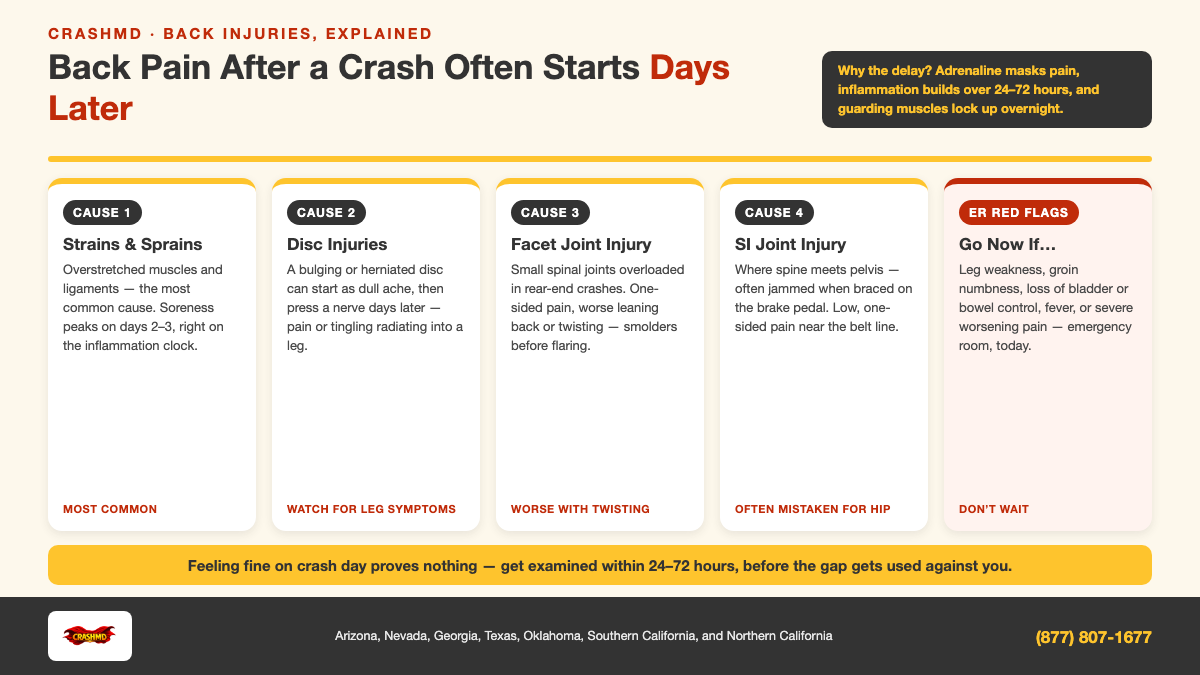
The delay is not in your head, and it is not rare. Three mechanisms stack on top of each other after a collision:
- Adrenaline masks pain. A crash fires your fight-or-flight response, and the stress hormones it releases blunt pain perception for hours. You can have a genuinely injured back and feel almost nothing at the scene.
- Inflammation builds on a 24–72 hour clock. When muscle fibers, ligaments, and joint capsules are overstretched, the body’s inflammatory response ramps up over one to three days. The swelling and chemical irritation are a large part of what actually hurts — which is why the pain so often peaks on day two or three.
- Muscle guarding develops overnight. The muscles along your spine reflexively tighten to splint the injured area. You usually discover that guarding the first time you try to get out of bed.
Put together, those three explain the classic story: fine at the scene, stiff the next morning, miserable by day three. The injury was there the whole time — your body just hadn’t finished telling you about it. It’s the same delayed pattern we see with whiplash after a car accident, playing out lower in the spine.
Delayed Back Pain After Car Accident: The 5 Most Common Causes
When delayed back pain after car accident trauma shows up in my exam room, these are the usual suspects, roughly in order of frequency:
1. Muscle strains and ligament sprains
The most common cause by far. The violent forward-and-back motion of a crash overstretches the muscles and ligaments that stabilize your spine. Strains and sprains follow the inflammation timeline almost perfectly — minimal pain on day zero, peak soreness on days two and three.
2. Disc injuries
The discs between your vertebrae can bulge, tear, or herniate under crash forces. A herniated disc may cause only dull back ache at first, then begin pressing on a nerve root as inflammation builds — producing pain, numbness, or tingling that radiates into a buttock or leg days after the collision. The same mechanism in the neck produces a cervical disc herniation, which is why arm symptoms deserve the same respect as leg symptoms.
3. Facet joint injuries
The small joints at the back of each vertebra take enormous load in a rear-end collision. An irritated facet joint classically causes one-sided back pain that worsens with leaning back or twisting — and it is notorious for smoldering quietly for days before flaring.
4. Sacroiliac (SI) joint injury
The joint where your spine meets your pelvis can be jammed or sprained, especially if you were braced against the brake pedal at impact. SI pain sits low — near the belt line and off to one side — and is frequently mistaken for a hip problem.
5. Compression fractures
Less common but important: a vertebra can crack under axial load, particularly in older adults or anyone with thinner bones. The pain can be surprisingly tolerable at first and then worsen as the fracture settles. This is one of several reasons an exam — not a guess — should decide what’s going on. You can read more about the full range of car accident conditions we evaluate.
Back pain creeping in days after your crash?
That’s the most common pattern we see. CrashMD pain specialists can evaluate you this week — often with no upfront cost.
Or call (877) 807-1677 — serving Arizona, Nevada, Georgia, Texas, Oklahoma, Southern California, and Northern California.
The Red Flags: When Delayed Back Pain Is an Emergency
Most delayed back pain after car accident injuries is soft tissue and heals well with proper care. But a short list of symptoms means you should go to an emergency room now, not book an appointment for next week:
- Weakness in a leg or foot — trouble lifting your foot, a knee that buckles, or a leg that drags
- Numbness in the groin or inner thighs (saddle anesthesia)
- Loss of bladder or bowel control, or new difficulty urinating
- Severe pain that is rapidly worsening rather than plateauing
- Back pain with fever
- Pain after a high-speed crash in anyone with osteoporosis or long-term steroid use — fracture until proven otherwise
The first three can signal cauda equina syndrome — compression of the nerve bundle at the base of the spine — which is a true surgical emergency where hours matter. These are rare. But the whole point of knowing red flags is that you never want to learn them in hindsight.
The Typical Timeline: What Delayed Back Pain Usually Does
After years of treating delayed back pain after car accident collisions, here is the arc I see most often:
- Day 0: Adrenaline. Mild tightness at most. Many people report “I felt fine.”
- Day 1: Stiffness on waking. Bending and transitions — bed to standing, car to standing — start to hurt.
- Days 2–3: The peak. Inflammation crests, guarding locks in, and pain may start radiating into a buttock or thigh.
- Weeks 1–2: With early evaluation and guided movement, most strains begin a steady decline.
- Weeks 2–12: The fork in the road. Most people recover well; a meaningful minority — especially those with untreated disc or joint injuries — slide toward chronic pain.
Two lessons from that timeline. First, judge nothing before day three — a comfortable day one tells you very little. Second, the patients who do best in my experience are the ones examined early, not the ones who waited three weeks to see if it would pass.
Why the Delay Matters for Your Insurance Claim
This is the medical-legal gap that CrashMD exists to close. Insurance adjusters are well aware that delayed back pain after car accident trauma is medically normal — but a delay in symptoms and a delay in seeking care are treated very differently on paper.
If you’re examined within a day or two of the crash, your record shows a collision, an exam, and symptoms that evolved exactly the way back injuries evolve. The connection is clean. If you instead wait two or three weeks, the record shows a gap — and gaps get filled with arguments: maybe it was the gym, maybe it’s an old injury, maybe it’s exaggerated. I have watched honest patients with real injuries struggle to get care covered for exactly this reason.
The practical takeaway: get examined promptly even if the pain hasn’t fully arrived, and when symptoms appear or change, report them so the record reflects their actual onset. You’re not building a case — you’re keeping an accurate diary in the one place it counts. For how any of this affects a specific claim, talk to a licensed attorney; that’s their lane, not mine.
Get the exam on record before the gap gets used against you.
CrashMD physicians treat crash-related back pain every day — with documentation done right and no upfront cost options.
Or call (877) 807-1677 — serving Arizona, Nevada, Georgia, Texas, Oklahoma, Southern California, and Northern California.
How We Diagnose and Treat Crash-Related Back Pain
The evaluation starts with a detailed history and hands-on exam: where the pain lives, what provokes it, strength, reflexes, sensation, and the specific maneuvers that light up facet joints, SI joints, or nerve roots. Imaging is used selectively — X-rays when fracture is a possibility, MRI when the exam suggests disc or nerve involvement. Normal imaging does not mean the pain isn’t real; much of back injury is a clinical diagnosis.
Treatment is matched to the structure that’s actually injured. Depending on your exam, the plan may include early guided movement rather than bed rest, physical therapy to restore strength and normal mechanics, short-term anti-inflammatories or muscle relaxants, and — for pain that persists — targeted options like trigger point injections, facet joint injections, or epidural steroid injections. Our overview of car accident treatments walks through the full menu, and the physicians in the CrashMD network coordinate the whole plan under one roof, with every step documented properly.
One more point worth repeating, because federal crash data from the National Highway Traffic Safety Administration consistently shows that injuries occur across the full range of crash severities: vehicle damage is a poor predictor of body damage. A collision that barely scratched your bumper can still sprain a facet joint or tear a disc. Don’t let the repair estimate talk you out of an exam.

Frequently Asked Questions
Is delayed back pain after car accident trauma normal?
Yes — it’s arguably the normal pattern. Adrenaline masks pain for hours, inflammation builds over 24 to 72 hours, and muscle guarding sets in overnight, so back pain very commonly first appears one to three days after the collision. Normal doesn’t mean ignorable: the delay is expected, but the pain still deserves an exam, both to rule out structural injury and to document the onset.
How long after a car accident can back pain start?
Most crash-related back pain declares itself within 72 hours. Some presentations — disc-related nerve pain in particular — can take a week or more to become obvious as inflammation around the nerve root builds. Pain that starts days later is still very plausibly from the crash, but the longer you wait before your first medical visit, the harder that connection becomes to document.
Should I go to the ER for back pain that showed up two days after my crash?
Go to the ER if you have any red flags: leg weakness, numbness in the groin or inner thighs, loss of bladder or bowel control, fever, or severe rapidly worsening pain. Without red flags, a prompt visit with a physician who treats crash injuries — ideally within a day or two — is usually the better fit: a more thorough musculoskeletal workup, a treatment plan, and proper documentation.
How long does back pain last after a car accident?
Most soft tissue back injuries improve substantially within a few weeks to three months with appropriate care. Disc and joint injuries can take longer, and untreated pain that persists past three months is at real risk of becoming chronic. Early evaluation and an active, movement-based treatment plan are among the better predictors of a good outcome — and finishing the plan matters as much as starting it.
The Bottom Line
Delayed back pain after car accident impacts is the rule, not the exception: adrenaline, inflammation, and muscle guarding run on a 72-hour clock, and your back reports its damage on that schedule whether you like it or not. Feeling fine on crash day proves nothing. Get examined early, know the red flags, report symptoms when they actually appear, and treat the injury properly the first time — your spine and your claim will both thank you.
Don’t wait out the pain.
Pain specialists who treat crash-related back injuries every day — with no upfront cost options through liens.
Or call (877) 807-1677 — serving Arizona, Nevada, Georgia, Texas, Oklahoma, Southern California, and Northern California.
— Dr. Adam Savage is a pain management physician with CrashMD in Oklahoma. Connect with him on LinkedIn.
This article is for educational purposes only and is not medical advice. It does not create a doctor-patient relationship, and it is not legal advice. Consult a licensed physician about your symptoms and a licensed attorney about any legal questions.