

Whiplash treatment has changed a lot over the years, and a surprising amount of what people still believe about it — wear the collar, stay in bed, wait it out — is advice that tends to slow recovery rather than speed it up. I’m Dr. Adam Savage, a pain management physician with CrashMD in Oklahoma, and neck injuries from car crashes are a large part of what I treat. In this article I’ll walk you through what generally works, what generally doesn’t, how long recovery tends to take, and the signs that your neck needs more than time.
A quick note before we start: this article is educational and is not medical advice — the right plan for your neck depends on an in-person exam. And where I touch on insurance or claims, that’s general information, not legal advice.
First, What Whiplash Actually Is
Whiplash is a soft tissue injury to the neck caused by a rapid back-and-forth motion — most famously in rear-end collisions, but it can happen in almost any crash direction. In a fraction of a second, the neck is forced through a motion it isn’t built to handle, and the muscles, ligaments, small facet joints, and sometimes the discs between the vertebrae are strained or sprained.
The symptoms often don’t peak right away. Neck pain, stiffness, headaches at the base of the skull, shoulder and upper-back pain, and sometimes tingling into the arms can build over the first few days. We cover that delay in detail in our article on why whiplash symptoms can take days to appear, and the broader picture in our guide to whiplash after a car accident. The key point for treatment is this: what’s injured varies from patient to patient, and good whiplash treatment starts by figuring out which structures are actually involved.
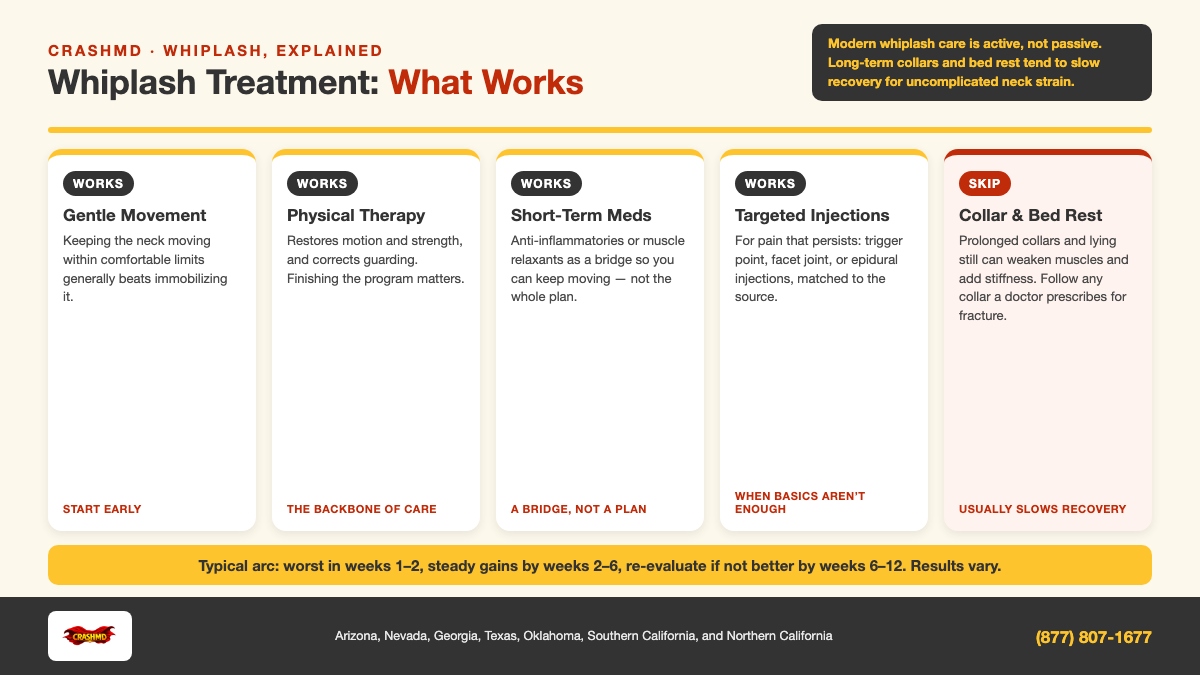
Whiplash Treatment That Works: 5 Proven Options
Every patient is different, and results vary. But these are the approaches I see help most often, and they are broadly consistent with mainstream guidance on neck injuries.
1. Early, gentle movement
This is the single biggest shift in modern whiplash treatment. For most uncomplicated neck strains, keeping the neck moving within comfortable limits — gentle range-of-motion exercises, normal daily activity as tolerated — tends to lead to better recovery than immobilizing it. Movement keeps the tissues from stiffening, maintains blood flow, and helps the muscles relearn normal patterns. “Gentle” is the operative word: no pushing into sharp pain, no heavy lifting in the first days.
2. Physical therapy
A structured physical therapy program builds on early movement. A therapist works on restoring range of motion, strengthening the deep neck stabilizers and upper-back muscles, and correcting the posture and guarding habits that keep pain going. For many patients, PT is the backbone of whiplash treatment, and finishing the program matters as much as starting it.
3. Short-term medications
Over-the-counter anti-inflammatories or acetaminophen, and sometimes a short course of a prescription muscle relaxant, can take the edge off in the first weeks so you can keep moving. The goal of medication is to make the active parts of treatment possible — not to replace them. Any medication plan should account for your health history, which is one more reason to be examined rather than guess.
4. Heat, ice, and manual therapy
Ice can help with acute soreness in the first couple of days; heat often feels better once the initial inflammation settles and muscles are tight. Manual therapy — hands-on techniques from a physical therapist or other qualified provider — may help with stiffness as part of a broader plan. These are supporting tools, useful mainly because they make movement easier.
5. Targeted interventional treatment for persistent pain
When pain lingers despite a good conservative program, a pain management physician can look for a specific pain generator. Depending on the exam, options may include trigger point injections for knotted muscles, facet joint injections or medial branch blocks when the small joints of the neck are the source, and — when a disc is irritating a nerve — epidural steroid injections. When facet pain is confirmed and persistent, radiofrequency ablation is sometimes considered. These are not first-line treatments for everyone; they’re tools for the patients whose pain hasn’t responded to the basics. Our overview of car accident treatments explains each one.
Neck still stiff days after your crash?
CrashMD pain specialists can evaluate your whiplash this week and build a plan that fits your injury — often with no upfront cost.
Or call (877) 807-1677 — serving Arizona, Nevada, Georgia, Texas, Oklahoma, Southern California, and Northern California.
What Doesn’t Work (or Can Make Things Worse)
Some of the most common approaches to whiplash are the ones I most often have to talk patients out of:
- Long-term soft collars. A collar may feel protective, but wearing one for days or weeks can weaken the neck muscles and increase stiffness. For uncomplicated whiplash, prolonged immobilization is generally discouraged. (A collar prescribed for a suspected fracture or instability is a different situation entirely — follow that instruction.)
- Bed rest. Lying still for days tends to make stiffness and pain worse, not better.
- “Waiting it out” without an exam. Many whiplash injuries do improve, but some involve disc or joint injuries that need specific care. Waiting also creates a gap in your records.
- Pain medication as the whole plan. Pills without movement and rehab can mask symptoms while the underlying problem goes unaddressed.
- Stopping treatment the moment you feel better. Pain often improves before strength and mobility are fully restored. Quitting early is a common reason symptoms come back.
How Long Whiplash Treatment Takes
This is the question everyone asks, and the honest answer is: it varies. Here’s the general pattern I see, with the caveat that your own timeline depends on the severity of the injury, your age and health, and how early care starts.
- First 1–2 weeks: Pain and stiffness are usually at their worst early, then begin to ease. The focus is calming things down and keeping the neck moving.
- Weeks 2–6: For many mild-to-moderate strains, this is when steady improvement happens with physical therapy and a home exercise program.
- Weeks 6–12: Many patients are substantially better by this point. Those who aren’t deserve a closer look for a specific pain generator — a facet joint, a disc, or nerve involvement.
- Beyond 3 months: A minority of patients develop persistent neck pain. This is where targeted interventional care and a comprehensive pain plan matter most.
One pattern holds up consistently in my practice: patients who are evaluated early and stay active in their whiplash treatment generally do better than those who wait weeks for a first visit. Early care doesn’t guarantee a fast recovery, but delay rarely helps.
Signs Your Whiplash Needs More Than Time
Most whiplash is soft tissue and heals well. But some symptoms mean you should be seen promptly — and a few mean you should go to an emergency room now:
- Go to the ER: severe neck pain after a high-speed crash, weakness in an arm or leg, numbness that is spreading, loss of coordination, trouble walking, or loss of bladder or bowel control.
- Get seen soon: pain, numbness, or tingling radiating into the shoulder, arm, or hand — a possible sign of a cervical disc herniation.
- Get seen soon: headaches that are new, worsening, or paired with confusion, memory problems, or sensitivity to light — which can overlap with a concussion.
- Get re-evaluated: pain that isn’t improving after several weeks of good conservative care.
The MedlinePlus overview of neck injuries and disorders from the National Library of Medicine is a reliable plain-language reference if you want to read more.
Not improving after a few weeks?
CrashMD physicians look for the specific source of lingering neck pain — with documentation done right and no upfront cost options.
Or call (877) 807-1677 — serving Arizona, Nevada, Georgia, Texas, Oklahoma, Southern California, and Northern California.
Why Your Treatment Record Matters, Too
There’s a practical side to whiplash treatment that patients rarely think about until it becomes a problem. Neck strains don’t usually show up on X-rays, so the medical record — your exam findings, your symptoms over time, and the treatment you received — is often the main evidence that the injury exists. Insurers review those records closely.
A record that shows prompt evaluation, a clear plan, and consistent follow-through tells a coherent story. A record with a three-week delay before the first visit, or a stretch of missed physical therapy, invites questions. I’m not a lawyer, and how this affects any particular claim is a question for one. But from the medical side, the same habits that help you heal — getting seen early and finishing the plan — also keep your record accurate. If your whiplash came with neck strain that’s lingering, our article on car accident neck strain goes deeper on recovery.

Frequently Asked Questions
What is the best whiplash treatment?
For most uncomplicated whiplash, the best-supported approach combines early gentle movement, a physical therapy program, and short-term pain relief to make that movement possible. When pain persists despite good conservative care, targeted options such as trigger point or facet joint injections may be considered. The best plan is the one matched to your specific injury after an exam.
Should I wear a neck brace for whiplash?
For typical whiplash, prolonged use of a soft collar is generally discouraged because it can weaken muscles and increase stiffness. If a physician prescribed a collar because of a suspected fracture or instability, follow that instruction. Otherwise, gentle movement within comfortable limits usually serves recovery better.
How long does whiplash take to heal?
Many mild-to-moderate whiplash injuries improve substantially within a few weeks to three months with appropriate care. Some take longer, and a minority develop persistent pain. Early evaluation, staying active, and completing your treatment plan are among the factors associated with better outcomes, but results vary.
When should I see a doctor for whiplash?
Ideally within a day or two of the crash, even if symptoms are mild — whiplash often worsens over the first few days. Go to an ER right away for severe pain, arm or leg weakness, spreading numbness, or loss of coordination. See a physician soon for arm tingling, worsening headaches, or pain that isn’t improving.
The Bottom Line
Effective whiplash treatment is active, not passive. Keep the neck gently moving, commit to physical therapy, use medication as a bridge rather than a plan, and get re-evaluated if you’re not improving after several weeks. Skip the long-term collar and the bed rest. And don’t wait to get examined — early care helps your neck and keeps your medical record accurate.
Start whiplash treatment the right way.
Pain specialists who treat crash-related neck injuries every day — with no upfront cost options through liens.
Or call (877) 807-1677 — serving Arizona, Nevada, Georgia, Texas, Oklahoma, Southern California, and Northern California.
— Dr. Adam Savage is a pain management physician with CrashMD in Oklahoma. Connect with him on LinkedIn.
This article is for educational purposes only and is not medical advice. It does not create a doctor-patient relationship, and it is not legal advice. Consult a licensed physician about your symptoms and a licensed attorney about any legal questions.