

What to Expect: Healing Time for a Broken Scapula
Understanding the healing time for a broken scapula is the first step toward knowing what lies ahead after this serious injury. Here’s the quick answer:
| Recovery Stage | Typical Timeframe |
|---|---|
| Bone healing (fracture union) | 6 to 12 weeks |
| Return to light activities (nonsurgical) | 6 to 8 weeks |
| Full fracture healing | 3 to 4 months |
| Muscle strength and mobility recovery | Several months after bone healing |
| Full shoulder motion restored | 6 months to 1 year |
| Complete rehabilitation (shoulder girdle) | 6 months to 2 years |
I’m Dr. Adam Savage, and if you’ve fractured your scapula — most likely from a car accident or a high-impact fall — you’re dealing with one of the rarer injuries in orthopedic medicine.
The scapula, or shoulder blade, accounts for less than 1% of all broken bones. That’s because it sits deep under thick layers of muscle, making it extremely hard to break. When it does fracture, it usually means significant force was involved.
The good news? Most scapula fractures heal without surgery. Research shows that over 90% of cases are minimally displaced and respond well to conservative treatment — with 86% of nonsurgical patients reporting good to excellent outcomes.
But the recovery road is longer than many people expect. Bone healing and full functional recovery are two very different things. The bone may knit back together in a few months, while regaining full strength and shoulder motion can take the better part of a year.
Understanding the Healing Time for Broken Scapula
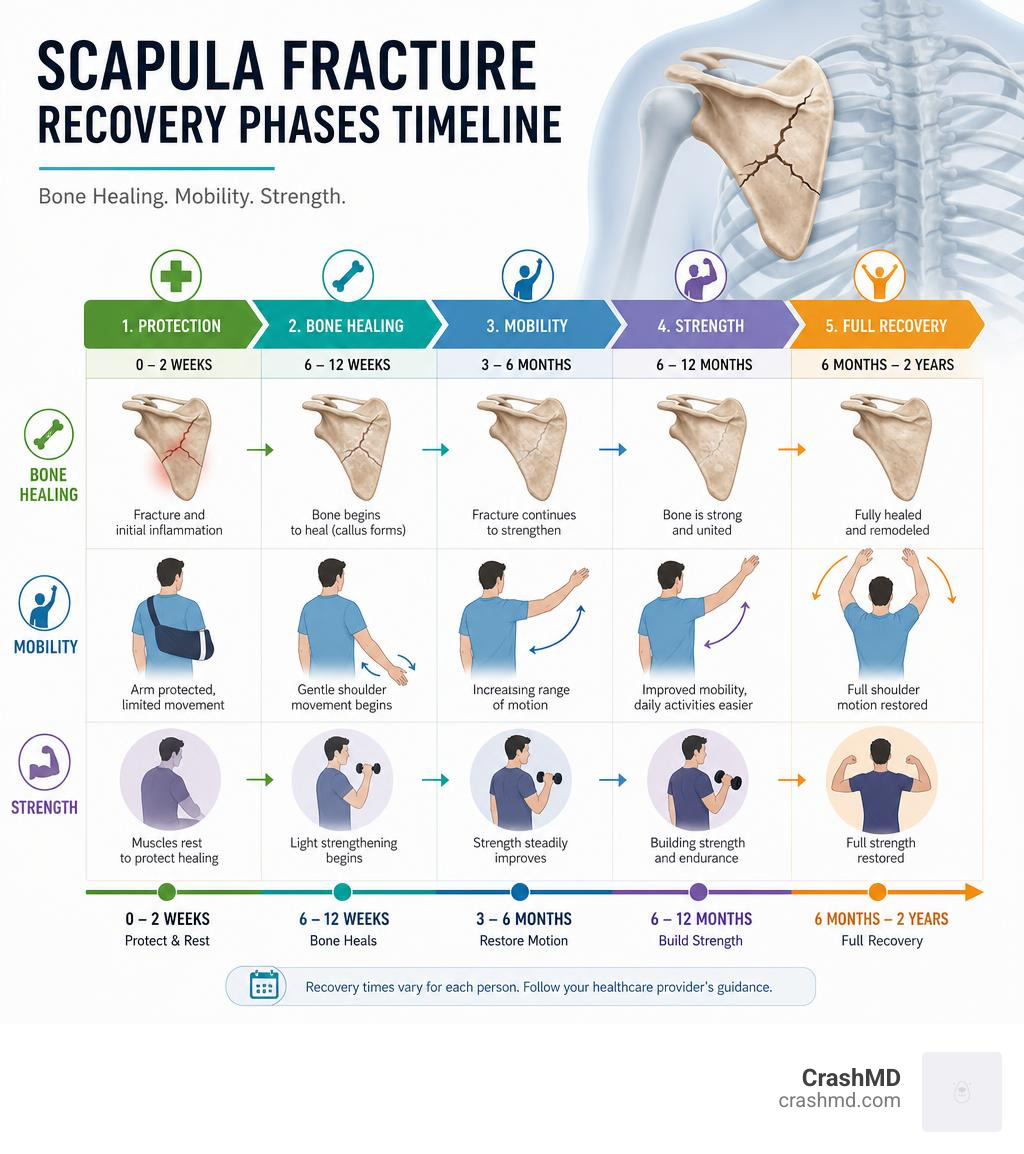
When we talk about the healing time for a broken scapula, we have to separate the biological knitting of the bone from the functional recovery of your shoulder.
The biological healing of a scapular fracture typically takes 6 to 12 weeks. Because the scapula is surrounded by a rich network of muscles and has an abundant blood supply, it actually has an excellent biological healing potential compared to other bones in the body. However, the actual fracture is not considered fully consolidated and mature until about 3 to 4 months post-injury.
Even after the bone itself is structurally sound, your shoulder will likely feel weak, stiff, and uncooperative. Recovering your muscle strength, joint mobility, and coordination takes a few additional months. This is why a complete recovery of the shoulder girdle—including the joints, ligaments, and supporting musculature—frequently takes anywhere from 6 months to 2 years.
To dive deeper into what a shoulder fracture entails, you can read the comprehensive overview provided by the Orthopaedic Trauma Association on Scapula Fracture (Broken Shoulder Blade). If you want to optimize your body’s natural bone-building processes during this critical window, check out our resource on The Complete Guide to Supplements for Fractures.
Factors Influencing the Healing Time for Broken Scapula
Not every broken shoulder blade heals on the exact same schedule. Several key factors can speed up or drag out your recovery timeline:
- Patient Age and Overall Health: Younger patients generally experience faster cellular turnover and bone remodeling.
- Bone Displacement: If the broken pieces of your scapula remain perfectly aligned (nondisplaced), the bone heals much faster. Significant displacement or fragmentation (comminution) slows the process.
- Smoking and Nicotine Use: This is a major factor. Medical evidence clearly demonstrates that smoking prolongs fracture healing times. In extreme cases, nicotine can completely stop the bone-healing process (resulting in a nonunion). If there was ever a time to quit, it is right now.
- Nutritional Status: Your body requires extra energy, protein, and specific micronutrients to rebuild bone matrix. To support your muscles and skeletal system as they rebuild, explore how to Mend and Strengthen with Creatine for Recovery.
How Fracture Severity Affects Healing Time for Broken Scapula
The anatomy of your shoulder blade is complex, consisting of the flat scapular body, the acromion, the coracoid process, and the glenoid fossa (the socket of your shoulder joint). Where and how the bone breaks dictates your recovery path.
- Scapular Body Fractures: These make up 50% to 60% of all scapula fractures. Because the body is wrapped in a thick envelope of muscle, these pieces rarely displace far and heal very reliably without surgery.
- Scapular Neck Fractures: Accounting for about 25% of cases, these occur just below the socket. If they do not involve the joint and aren’t heavily angled, they heal well conservatively.
- Glenoid Fossa (Articular) Fractures: These breaks extend into the shoulder joint’s socket. They require extreme precision. If there is an articular step-off of more than 4 to 5 millimeters, or if the joint is unstable, surgery is usually required to prevent early-onset osteoarthritis and permanent loss of motion.
| Fracture Type | Common Treatment | Average Bone Union Time | Expected Time to Full Activities |
|---|---|---|---|
| Nondisplaced Body/Neck | Nonsurgical (Sling) | 6 to 8 weeks | 3 months |
| Displaced Body/Neck | Nonsurgical or Surgery | 8 to 12 weeks | 4 to 6 months |
| Intra-articular (Glenoid) | Surgery (ORIF) | 10 to 12 weeks | 6 to 12 months |
Treatment and Rehabilitation Timelines

Whether your injury requires conservative management or surgical intervention, a structured timeline is essential to safely rebuild your shoulder’s function.
For a detailed clinical breakdown of how different fracture patterns are managed, you can reference the medical literature on Fractures of the Scapula. For a broader look at recovering after a major accident, read The Ultimate Guide to Post-Crash Physical Repair.
Nonsurgical Recovery Timeline
If your fracture is stable and minimally displaced—which is true for more than 90% of scapular fractures—your treatment will focus on conservative management:
- Weeks 0 to 3: You will wear a sling to support the weight of your arm and let the soft tissues settle. However, you shouldn’t keep your arm completely frozen. To prevent severe stiffness, you should begin gentle, passive exercises (like hand, wrist, and elbow movements, as well as light pendulum swings) within the first week under medical guidance.
- Weeks 3 to 6: You will gradually phase out the sling. Under the guidance of a specialist, you will start active-assisted movements where your other arm or a pulley helps lift the injured arm.
- Weeks 6 to 8: Most patients can return to daily light activities without restriction, though heavy lifting is still strictly off-limits.
For step-by-step home care instructions, review the Shoulder Blade Fracture: Care Instructions provided by Kaiser Permanente.
Surgical Recovery Timeline
Surgery is reserved for complex cases, such as severe joint displacement, unstable fracture patterns, or when the shoulder’s suspensory complex is completely disrupted.
During an Open Reduction Internal Fixation (ORIF) procedure, orthopedic surgeons use 3D CT planning to map out the bone and secure the fragments using specialized plates and screws. To see how trauma centers evaluate and decide on surgical pathways, you can read the clinical study on the Management of Scapula Fractures at a Level 1 Trauma Centre in the United Kingdom.
While surgery immediately stabilizes the bone, the initial recovery can feel more intense due to surgical incisions and altered muscle dynamics. Active range-of-motion exercises are typically delayed for a few weeks to protect the surgical repair, but early passive motion is still initiated to combat stiffness.
Physical Therapy and Rehabilitation Phases
Rehabilitation is the cornerstone of your recovery. Without it, the muscles surrounding your shoulder blade will weaken, and your joint capsule will tighten.
- Phase 1 (Early Motion, Weeks 1–6): Focusing on passive and active-assisted range of motion. The goal is to keep the shoulder moving without stressing the healing bone.
- Phase 2 (Active Range of Motion, Weeks 6–12): Transitioning to moving the arm entirely under its own power.
- Phase 3 (Strengthening, Months 3–4+): Progressive resistance exercises targeting the rotator cuff and scapular stabilizers (like the serratus anterior and rhomboids).
For a complete roadmap on restoring your body’s mechanics after an accident, explore Finding Your Way Back: Comprehensive Rehabilitation for Accident Injuries.
Potential Complications and Long-Term Outlook
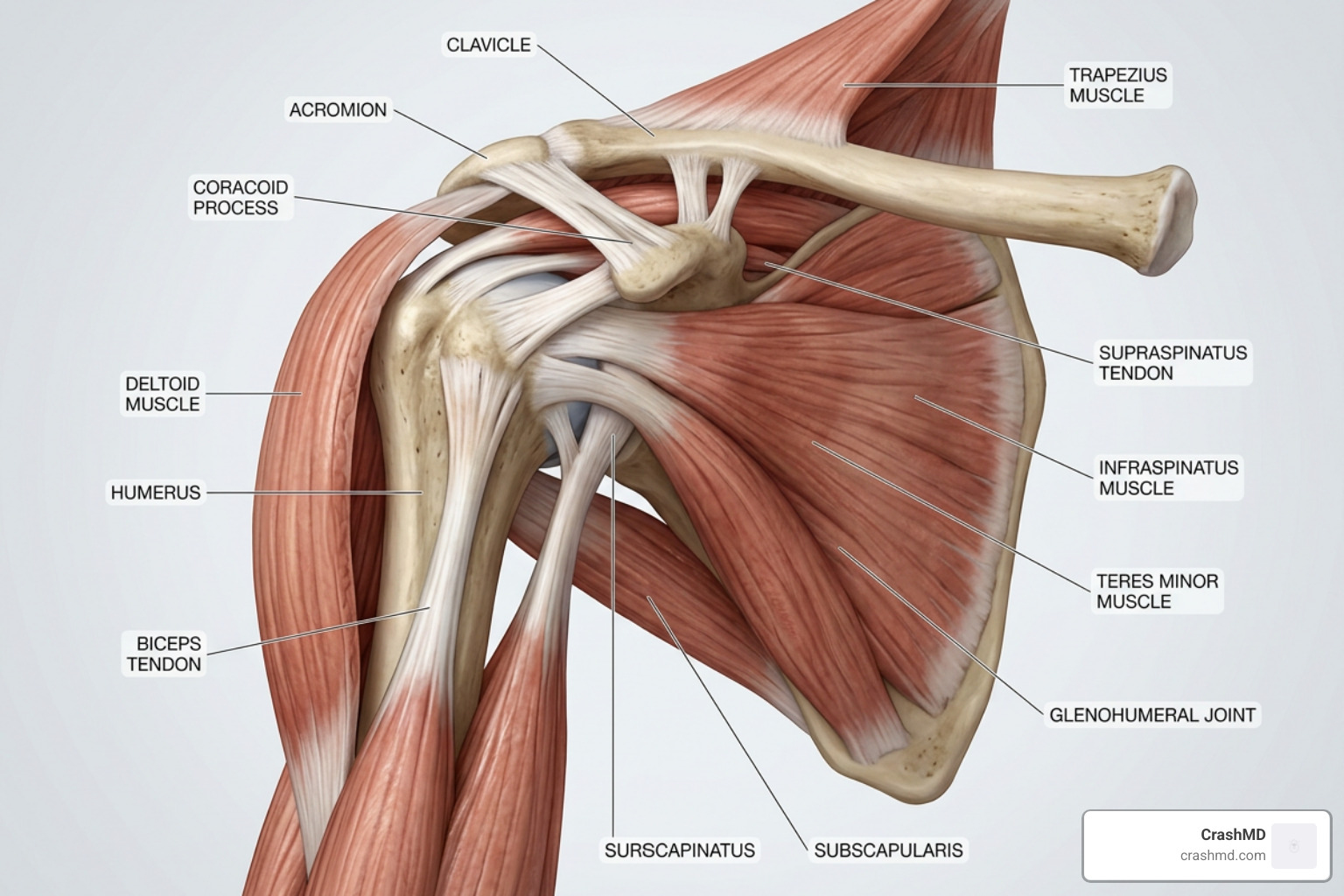
Because the scapula is highly integrated into your upper body’s biomechanics, complications can have a lasting impact on how your shoulder functions.
- Malunion: If a severely displaced scapular neck or body fracture heals in an abnormal position, it alters the muscle vectors of your rotator cuff. This can lead to chronic weakness, popping, and “scapular winging.”
- Nerve Injury: The suprascapular nerve and the brachial plexus run very close to the shoulder blade. Nerve injuries occur in approximately 10% of scapular fractures, causing numbness, tingling, or weakness.
- Chronic Stiffness (Frozen Shoulder): Keeping the shoulder immobilized for too long is the primary cause of permanent stiffness.
To understand the biomechanics of these complications, read the clinical insights in the Scapula Fractures – Clinical Tree. If your physical injuries are accompanied by sleep disturbances or stress during your recovery, read our supportive guide, From Broken Ribs to Bad Dreams: A Guide to Natural Recovery.
Frequently Asked Questions About Scapula Recovery
Can a broken scapula heal on its own?
Yes! In fact, the vast majority of scapular fractures (over 90%) heal beautifully on their own without any surgical intervention. Because the bone is wrapped in a thick “envelope” of highly vascularized muscle, it has an incredibly reliable blood supply that promotes rapid natural healing.
When can I sleep on my side after a scapula fracture?
Most patients find it impossible to sleep on the injured side for the first 6 to 8 weeks. In the early stages, sleeping propped up at a 45-degree angle with pillows supporting your elbow and lower back is highly recommended to minimize throbbing and prevent accidental rolling.
What are the signs of a poorly healing shoulder blade?
Signs of a poor recovery or malunion include persistent, sharp pain after 8 weeks, a visible “winging” or protrusion of the shoulder blade, grinding or popping sounds during arm movement, and a severe inability to lift your arm past shoulder height.
Conclusion
A broken scapula is a serious, high-impact injury that demands patience. While the bone itself will likely heal within 6 to 12 weeks, rebuilding your shoulder’s strength, range of motion, and overall function is a journey that can take anywhere from six months to two years.
At CrashMD, we specialize in guiding accident victims through every step of this complex recovery process. If you are located in Arizona, Nevada, Texas, Oklahoma, Southern California, or Northern California, we are here to provide expert pain management, coordinate your physical therapy, and meticulously document your injuries to support your recovery and any legal needs.
Let us help you get back to moving freely. Schedule an Appointment with our team today, or Visit CrashMD to learn more about our comprehensive post-accident care.