

Knowing where to go after car accident injuries strike — emergency room, urgent care, or an accident doctor — is a decision most people make in the worst possible moment: rattled, sore, and guessing. I’m Dr. Adam Savage, a pain management physician with CrashMD in Oklahoma, and I see the downstream consequences of that guess every week. Some patients spend twelve hours and thousands of dollars in an ER for a muscle strain; others “tough out” a disc injury at home because urgent care sent them off with ibuprofen and no follow-up plan. In this article I’ll give you a clear decision framework: when the ER is non-negotiable, what urgent care can and can’t do, and where an accident doctor fits — including the follow-up and documentation piece that the other two were never designed to handle.
A quick note before we start: this article is educational and is not medical advice — if you’re unsure where to be seen, err toward the higher level of care. And where I mention insurance or claims, that’s general information, not legal advice.
Where to Go After Car Accident: The 60-Second Answer
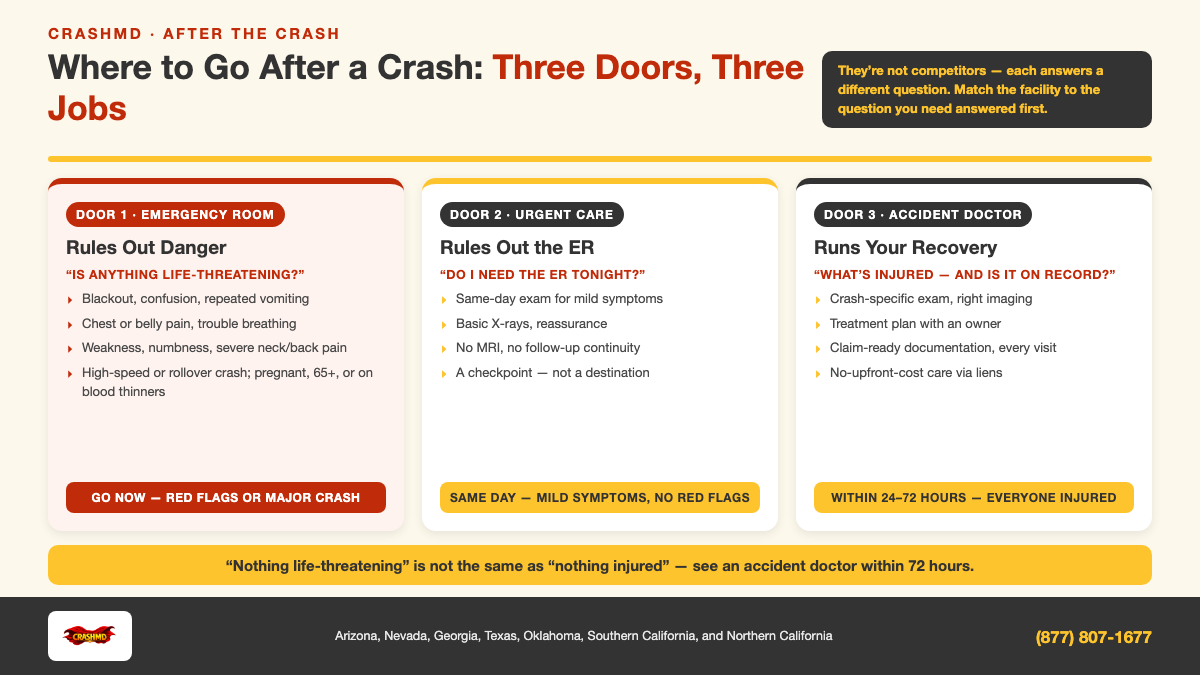
If you remember nothing else, remember this three-line triage:
- Emergency room: any red-flag symptom (listed below), a high-speed or rollover crash, loss of consciousness, or anyone pregnant, elderly, or on blood thinners.
- Urgent care: same-day evaluation of mild symptoms when no red flags are present and the ER isn’t warranted — a reasonable first stop, not a final one.
- Accident doctor: within 24–72 hours for everyone injured in a crash — either as the first stop for mild-to-moderate symptoms or as the follow-up after ER or urgent care. This is where diagnosis gets specific, treatment gets planned, and documentation gets done right.
Notice the three options aren’t really competitors. They answer different questions. The ER answers “is anything life-threatening?” Urgent care answers “do I need the ER?” An accident doctor answers “what exactly is injured, how do we treat it, and is it on record?” Deciding where to go after car accident trauma is really about which question you need answered first.
When the Emergency Room Is the Right Call
The ER exists to find and stabilize dangerous injuries, and it is extremely good at that job. Go directly to the emergency room — by ambulance if needed — if you have any of the following after a crash:
- Loss of consciousness, even briefly, or any confusion or unusual drowsiness
- Severe or worsening headache, repeated vomiting, or seizure
- Chest pain, trouble breathing, or suspected rib injury near the seatbelt line
- Abdominal pain or bruising across the belly — internal bleeding can be silent at first
- Weakness or numbness in an arm or leg, or loss of bladder or bowel control
- Severe neck or back pain, or any inability to move
- Obvious fractures, deep cuts, or heavy bleeding
- You are pregnant, over 65, or take blood thinners — the threshold should be much lower
Also weigh the crash itself, not just how you feel: high speed, rollover, airbag deployment, intrusion into the cabin, or a death at the scene are all mechanisms that justify an ER evaluation even with minimal symptoms. The National Highway Traffic Safety Administration has documented for decades that serious injury can occur across the full range of crash types — including crashes with surprisingly little vehicle damage.
What the ER will not do — and this surprises people — is manage your recovery. A typical ER workup rules out fractures, bleeding, and organ injury, then discharges you with pain medication and a line that should sound familiar: “follow up with a doctor.” The soft tissue, disc, joint, and nerve injuries that cause months of pain are usually not fully diagnosed in an emergency room, because that was never its job.
Already been to the ER or urgent care?
That was step one. CrashMD pain specialists handle the follow-up: specific diagnosis, a real treatment plan, and documentation done right — often with no upfront cost.
Or call (877) 807-1677 — serving Arizona, Nevada, Georgia, Texas, Oklahoma, Southern California, and Northern California.
What Urgent Care Can — and Can’t — Do After a Crash
Urgent care is a reasonable same-day option when you have mild symptoms and none of the red flags above: a sore neck, a stiff back, a bruised knee. A good urgent care visit gets you a basic exam, X-rays if a simple fracture is suspected, and reassurance that you don’t need the ER tonight.
Its limits matter just as much:
- No advanced imaging. Most urgent care centers can’t order or perform MRI — the study that actually shows disc, ligament, and nerve injuries.
- No continuity. You’ll likely never see that clinician again. Nobody is tracking whether your day-two stiffness became day-ten radiating leg pain.
- Limited crash-injury experience. Delayed-onset injury patterns — the 24–72 hour inflammation clock, facet and SI joint pain, post-traumatic headaches — are a specialty of their own.
- Billing friction. Many urgent care centers are uncomfortable with third-party liability claims, and some decline crash patients outright. Few work on a lien basis.
So when you’re weighing where to go after car accident soreness that isn’t urgent, treat urgent care as a checkpoint, not a destination. If it’s 8 p.m., you’re sore, and you want a professional to confirm nothing urgent is brewing — go. Just don’t let a normal urgent care visit convince you the matter is closed. Symptoms that arrive on day two or three, like whiplash after a car accident, are still ahead of you.
What an Accident Doctor Actually Does
An accident doctor — in our network, a pain management physician who treats crash injuries daily — is built for everything that happens after “you’re not dying.” That includes:
- A crash-specific exam. Range of motion, neurological testing, and the provocative maneuvers that distinguish muscle strain from facet joint injury from nerve root compression — the full range of car accident conditions.
- The right imaging at the right time. X-rays when fracture is possible, MRI when the exam points to disc or nerve involvement — ordered by someone who will actually act on the results.
- A treatment plan with an owner. Physical therapy, medication, and targeted procedures when needed, coordinated across visits — see our overview of car accident treatments.
- Documentation built for a claim. Every visit links symptoms to the crash, records their onset, and tracks their course — in the format adjusters and attorneys actually use.
- No-upfront-cost care via liens. CrashMD physicians commonly treat crash patients on a lien basis, meaning care proceeds now and bills are resolved from the settlement — so treatment isn’t delayed by a billing fight.
That last pair is the medical-legal gap in a nutshell. ERs and urgent cares generate records, but they aren’t designed to connect evolving symptoms to a specific collision over weeks of recovery. If you want to understand what to look for in this kind of physician, our guide to finding an accident pain specialist covers it in detail.
Where to Go After Car Accident Injuries: Scenario by Scenario
Here’s how the decision plays out in the situations I hear most often. When patients ask me where to go after car accident collisions of different severities, I walk through it like this:
- High-speed crash, you blacked out: ER, now. Accident doctor within 72 hours for follow-up.
- Moderate crash, airbags deployed, you’re sore but walking: ER or urgent care today depending on symptoms; accident doctor within 24–72 hours regardless.
- Low-speed crash, you feel fine: Accident doctor within 24–72 hours anyway. Adrenaline masks pain, inflammation takes days to build, and an early exam creates the record that protects you if symptoms bloom on day three.
- Felt fine at the scene, hurting two days later: Accident doctor promptly — this is the classic delayed presentation. ER only if red flags appear.
- ER already cleared you, still in pain a week later: Accident doctor. “Nothing life-threatening” and “nothing injured” are very different findings.
Why the Choice Affects Your Insurance Claim
Deciding where to go after car accident trauma isn’t only a medical question — it quietly shapes your claim. Three patterns I see constantly:
The gap problem. Adjusters read timelines. A crash on the 1st and a first medical visit on the 20th leaves nineteen days for someone to argue your pain came from somewhere else. Being seen somewhere — ER, urgent care, or accident doctor — within 72 hours keeps the timeline clean.
The follow-through problem. A single ER visit followed by silence reads as “they got better.” If you’re still hurting, the record needs to say so, visit by visit. Consistent follow-up care is both good medicine and an honest record.
The specificity problem. “Neck strain, discharged” supports a claim far less than a documented diagnosis with imaging, a treatment plan, and tracked progress. Specific records get injuries covered; vague ones get them disputed.
None of this is about gaming a system — it’s about making sure an honest record of a real injury exists. For questions about your specific claim, talk to a licensed attorney; that’s their lane, not mine.
Not sure where to be seen? Start with a crash-injury exam.
CrashMD physicians evaluate accident injuries every day, coordinate the full treatment plan, and document each step — with no upfront cost options.
Or call (877) 807-1677 — serving Arizona, Nevada, Georgia, Texas, Oklahoma, Southern California, and Northern California.

Frequently Asked Questions
Should I go to the ER after a car accident even if I feel fine?
If the crash was severe — high speed, rollover, airbag deployment, loss of consciousness — yes, regardless of how you feel, and the threshold drops further if you’re pregnant, over 65, or on blood thinners. After a minor crash with no symptoms and no red flags, the ER is usually unnecessary, but an exam by an accident doctor within 24–72 hours still is: adrenaline and slow-building inflammation routinely hide injuries for days.
Can urgent care treat car accident injuries?
Urgent care can evaluate mild injuries, take X-rays, and confirm you don’t need an ER — a useful same-day checkpoint. What it generally can’t do is order MRI, provide follow-up continuity, manage delayed-onset injuries, or handle lien-based billing for liability claims. Use it to answer “do I need the ER tonight?”, then follow up with a physician who treats crash injuries.
What kind of doctor should I see after a car accident?
After emergencies are ruled out, the best fit is a physician who treats crash injuries routinely — in the CrashMD network, pain management physicians who diagnose the specific injured structure, coordinate therapy and procedures, document everything in claim-ready form, and commonly work on a lien basis. Our page on motor vehicle accident doctors explains how that works.
How soon after a car accident should I see a doctor?
Wherever you land on where to go after car accident injuries, aim to be seen within 24 to 72 hours — even if symptoms are mild or absent. Medically, that window catches injuries as inflammation makes them findable and gets treatment started early, which predicts better outcomes. Practically, it creates a medical record connected to the crash before any gap opens up. If red-flag symptoms appear at any point, upgrade to the ER immediately.
The Bottom Line
Where to go after car accident injuries isn’t one decision — it’s a sequence. The ER rules out danger. Urgent care rules out the ER. And an accident doctor handles everything that actually determines how the next three months go: specific diagnosis, a treatment plan, follow-up, and a record that tells the truth on your behalf. Match the facility to the question you need answered, and don’t stop at “nothing life-threatening” when the real question is “what’s injured, and who’s treating it?”
Crash this week? Get the right exam now.
Appointments within days, treatment coordinated under one roof, and no-upfront-cost options through liens.
Or call (877) 807-1677 — serving Arizona, Nevada, Georgia, Texas, Oklahoma, Southern California, and Northern California.
— Dr. Adam Savage is a pain management physician with CrashMD in Oklahoma. Connect with him on LinkedIn.
This article is for educational purposes only and is not medical advice. It does not create a doctor-patient relationship, and it is not legal advice. Consult a licensed physician about your symptoms and a licensed attorney about any legal questions.