

Car accident medical bills are the question that keeps injured people away from the doctor. I hear it in my exam room every week, usually phrased as an apology: “I would have come in sooner, but I didn’t know who was going to pay for it.” I’m Dr. Adam Savage, a pain management physician with CrashMD in Oklahoma, and I want to demystify the money side of crash care — Med-Pay, PIP, health insurance, the other driver’s liability coverage, and medical liens — so that worry about the bill never becomes the reason an injury goes untreated.
A quick note before we start: I’m a physician, not a lawyer or an insurance agent. This article is general education about how crash care is commonly paid for. It is not medical advice and it is not legal advice. Coverage rules vary by state and by policy, and an attorney or your insurer can tell you how they apply to you.
Why Paying for Crash Care Feels So Confusing
When you sprain an ankle at home, the payment path is simple: you use your health insurance, pay your copay, and move on. After a collision, there can suddenly be four or five possible payers in the picture, each with its own rules, limits, and timing — and some of them won’t pay anything until months after you need the care.
That mismatch is the core problem. Your injury needs attention in the first days and weeks. But the party who may ultimately be responsible for your car accident medical bills — often the at-fault driver’s insurer — typically doesn’t pay as you go. It pays, if it pays, at the end, when the claim resolves. Everything in this article is really about how people bridge that gap between when care is needed and when money arrives.
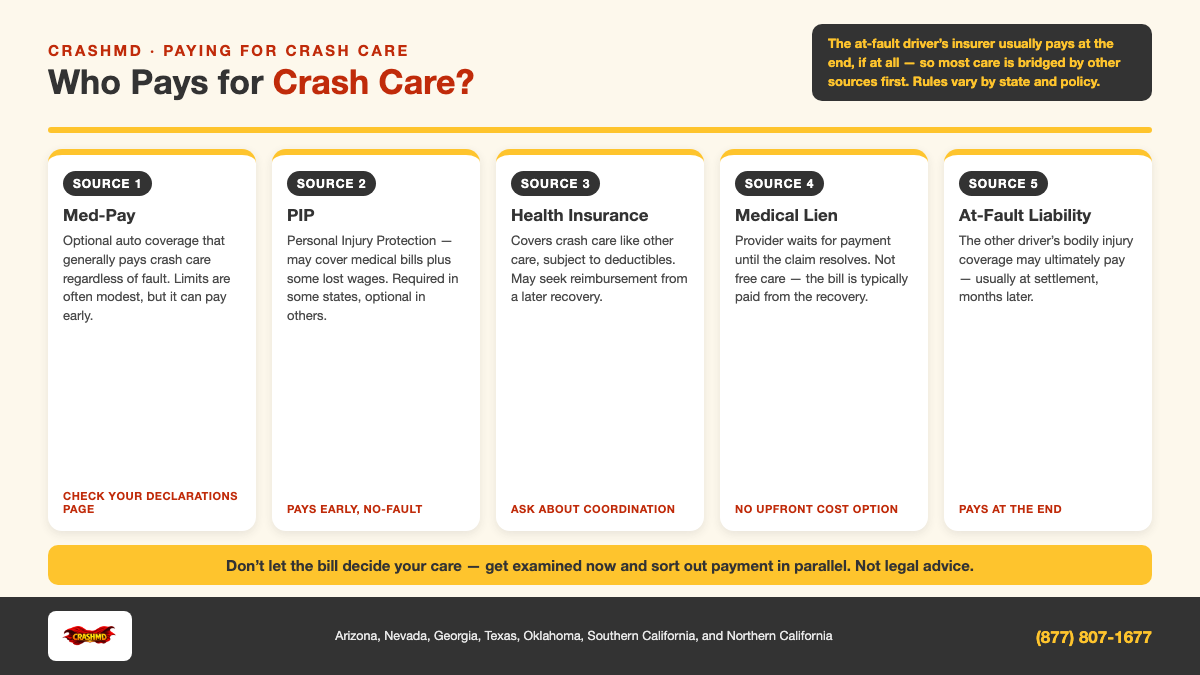
Car Accident Medical Bills: The 5 Common Ways They Get Paid
Here are the payment sources most patients encounter. Not every one applies to every crash, and the order in which they pay depends on your state and your policies.
1. Medical Payments coverage (Med-Pay)
Med-Pay is an optional coverage on many auto insurance policies. Its key feature is that it generally pays for crash-related medical care for you and your passengers regardless of who caused the accident. Limits are usually modest — often a few thousand dollars, sometimes more — but it can be the fastest money available, because you don’t have to wait for anyone to decide fault. Many people carry Med-Pay without knowing it. Pull out your declarations page and look; it’s one of the first calls worth making.
2. Personal Injury Protection (PIP)
PIP is similar in spirit to Med-Pay but typically broader. Depending on the state and the policy, it may cover medical expenses plus a portion of lost wages and other costs. Some states require drivers to carry PIP; in others it’s optional or not offered. If you have it, it is usually designed to pay early and without regard to fault, which makes it a valuable first line for car accident medical bills.
3. Your own health insurance
Your regular health plan can usually cover crash-related care like any other medical care, subject to your deductible, copays, and network rules. Two wrinkles are worth knowing. First, some plans coordinate with auto coverage and may expect Med-Pay or PIP to pay first. Second, if your health insurer pays for crash care and you later recover money from the at-fault driver, the health plan may have a right to be reimbursed from that recovery — a concept called subrogation. That’s not a reason to avoid using your health insurance; it’s simply something to be aware of and to ask about.
4. The at-fault driver’s liability insurance
If another driver caused the crash, their bodily injury liability coverage may ultimately be responsible for your reasonable medical expenses. The catch, again, is timing: liability insurers generally don’t pay your providers as treatment happens. Payment typically comes as part of a settlement or judgment, often months down the road, and only after the insurer has reviewed your records. If the at-fault driver is uninsured or underinsured, your own uninsured/underinsured motorist coverage may step in, depending on your policy.
5. Medical liens and letters of protection
This is the option that surprises most of my patients. Some medical providers who treat crash injuries — CrashMD included — can offer care with no upfront cost through a lien or a letter of protection. In plain terms, the provider agrees to wait for payment until your claim resolves, and the bill is then paid from the settlement or other recovery. It’s a way to get treatment now instead of postponing care until money arrives.
It’s important to understand what a lien is and isn’t. It is not free care: you are still responsible for the bill, and the arrangement is typically paid from your recovery. Terms vary, and whether a lien makes sense for you is exactly the kind of question to review with your attorney. But for many people who don’t have Med-Pay, have a high deductible, or have no health insurance at all, it is the difference between being treated and being stuck.
Worried about the bill?
Don’t let payment questions delay your care. CrashMD pain specialists can evaluate you this week — often with no upfront cost options through liens.
Or call (877) 807-1677 — serving Arizona, Nevada, Georgia, Texas, Oklahoma, Southern California, and Northern California.
Which Payer Goes First?
This is where I have to be especially careful, because the honest answer is: it depends on your state, your policies, and the specifics of your crash. That’s a question for your insurer or a licensed attorney, not a pain doctor. What I can share is the general pattern patients describe to me:
- Early care is often paid by no-fault sources (PIP or Med-Pay) where they exist, by health insurance, or deferred through a lien.
- Ongoing care may continue through the same channels until limits run out, and then shift to health insurance or a lien arrangement.
- Final reimbursement from the at-fault driver’s insurer, if any, typically arrives at the end and may be used to pay outstanding balances, liens, and reimbursement claims.
The one universal piece of advice I’ll give: tell every provider up front that your injury came from a car accident. It changes how the visit is billed and documented, and it avoids headaches later when a claim gets denied because the paperwork never mentioned the crash.
What Car Accident Medical Bills Usually Include
Patients are often surprised by how many separate bills one crash can generate. Depending on your injuries, your car accident medical bills may include:
- Ambulance transport and the emergency room visit
- Imaging such as X-rays, CT scans, or an MRI
- Follow-up visits with a physician who treats crash injuries
- Physical therapy or chiropractic sessions
- Medications and medical equipment
- Specialist care, such as targeted injections for persistent pain
Keep every bill, every explanation of benefits, and every receipt in one folder. You don’t have to understand all of it today. You just have to not lose it. Our article on what to do in the first 72 hours after a car accident covers the other documents worth gathering early.
The Mistake That Costs People the Most: Waiting
The most expensive thing I see isn’t a large bill. It’s the patient who skips care for three weeks because they weren’t sure who would pay, and then arrives with pain that has become harder to treat — and a gap in their medical record that an adjuster may use to question whether the injury came from the crash at all.
Medically, many crash injuries respond best to early evaluation and an active treatment plan. Financially, a delayed first visit can make it harder to connect treatment to the collision. Both problems have the same fix: get examined promptly, and sort out the payment path in parallel rather than in sequence. If you’re not sure where to start, our guide to motor vehicle accident doctors explains what to look for in a provider who understands crash care.
Get treated now. Sort out the bills alongside it.
CrashMD physicians treat crash injuries every day — with documentation done right and no upfront cost options.
Or call (877) 807-1677 — serving Arizona, Nevada, Georgia, Texas, Oklahoma, Southern California, and Northern California.
Why Documentation Matters for Payment
Every payer in this article — Med-Pay, PIP, health insurance, liability insurers — makes decisions based on your medical records. A record that clearly links your symptoms to the crash, describes your exam findings, explains why each treatment was recommended, and shows you followed the plan is far easier for any payer to process.
That’s not about exaggerating anything. It’s about accuracy. Federal crash data from the National Highway Traffic Safety Administration consistently shows that injuries happen across the full range of crash severities, and insurers know that too. What they look for is a coherent, consistent record. The physicians in the CrashMD network document crash injuries carefully because we’ve seen how often good patients with real injuries run into trouble when the paperwork is thin.
On the treatment side, matching care to the actual injury keeps bills reasonable, too. Our overview of car accident treatments walks through the conservative-first options most patients start with, and our guide to finding an accident pain specialist covers when it makes sense to step up to specialty care.
Questions to Ask Before Your First Appointment
You don’t need to become an insurance expert. But a few quick questions can save you a lot of confusion later:
- To your auto insurer: Do I have Med-Pay or PIP? What are the limits? How do I open a claim?
- To your health insurer: Will you cover crash-related care, and do you require auto coverage to pay first?
- To the provider: Do you bill auto insurance? Do you offer care on a lien or letter of protection? What would I owe, and when?
- To an attorney, if you have one: How do liens, reimbursement claims, and my coverage interact in my state?

Frequently Asked Questions
Who pays car accident medical bills if the crash wasn’t my fault?
The at-fault driver’s liability insurance may ultimately be responsible, but it usually doesn’t pay as treatment happens. In the meantime, care is commonly paid through Med-Pay or PIP, your own health insurance, or a medical lien. How these interact depends on your state and policies — an attorney can explain your specific situation.
Can I see a doctor after a car accident with no health insurance?
Often, yes. Med-Pay or PIP on your auto policy may cover early care, and some providers who treat crash injuries — including CrashMD — offer no upfront cost options through liens or letters of protection. You remain responsible for the bill, which is typically paid from any recovery, so review the terms before you agree.
What is a medical lien after a car accident?
A medical lien is an arrangement in which a provider agrees to wait for payment until your injury claim resolves, with the bill typically paid from the settlement. It lets you get care now rather than delaying treatment. It is not free care, and terms vary, so it’s worth reviewing with an attorney.
Should I wait to see a doctor until I know who will pay?
From a medical standpoint, no. Many crash injuries are easier to treat when they’re evaluated early, and a delayed first visit can create a gap in your records that makes it harder to connect your care to the collision. Get examined promptly and work out payment in parallel.
The Bottom Line
Car accident medical bills are confusing because several payers may be involved, each on its own timeline. But confusion is not a reason to go untreated. Check whether you have Med-Pay or PIP, tell every provider your injury came from a crash, keep every bill in one place, ask your attorney about how liens and reimbursements work in your state — and get examined while your injury is still fresh.
Don’t let the bill decide your care.
Pain specialists who treat crash injuries every day — with no upfront cost options through liens.
Or call (877) 807-1677 — serving Arizona, Nevada, Georgia, Texas, Oklahoma, Southern California, and Northern California.
— Dr. Adam Savage is a pain management physician with CrashMD in Oklahoma. Connect with him on LinkedIn.
This article is for educational purposes only and is not medical advice. It does not create a doctor-patient relationship, and it is not legal advice. Consult a licensed physician about your symptoms and a licensed attorney about any legal questions.