

Should you see a doctor after a car accident if nothing hurts? As a CrashMD pain management physician who treats crash injuries every week, my answer is an unambiguous yes. My rule for every patient is blunt: see doctor after car accident, same day, feeling fine or not — and the patients who taught me that lesson are the ones who waited. I’m Dr. Adam Savage, and the sentence I hear more than any other in my exam rooms is some version of: “I felt fine after the accident, so I didn’t think I needed to come in.” Weeks later they’re sitting across from me with pain that has had a head start, a treatment plan that now has to work harder, and a medical record with a hole in it right where their claim needed a timeline. This article is my attempt to talk you out of making that same bet.
As always: this is educational content, not medical advice, and where insurance or legal claims come up, it is not legal advice either. For your specific situation, see a licensed physician — and for claim questions, a licensed attorney.
See Doctor After Car Accident — Even When You Feel Fine
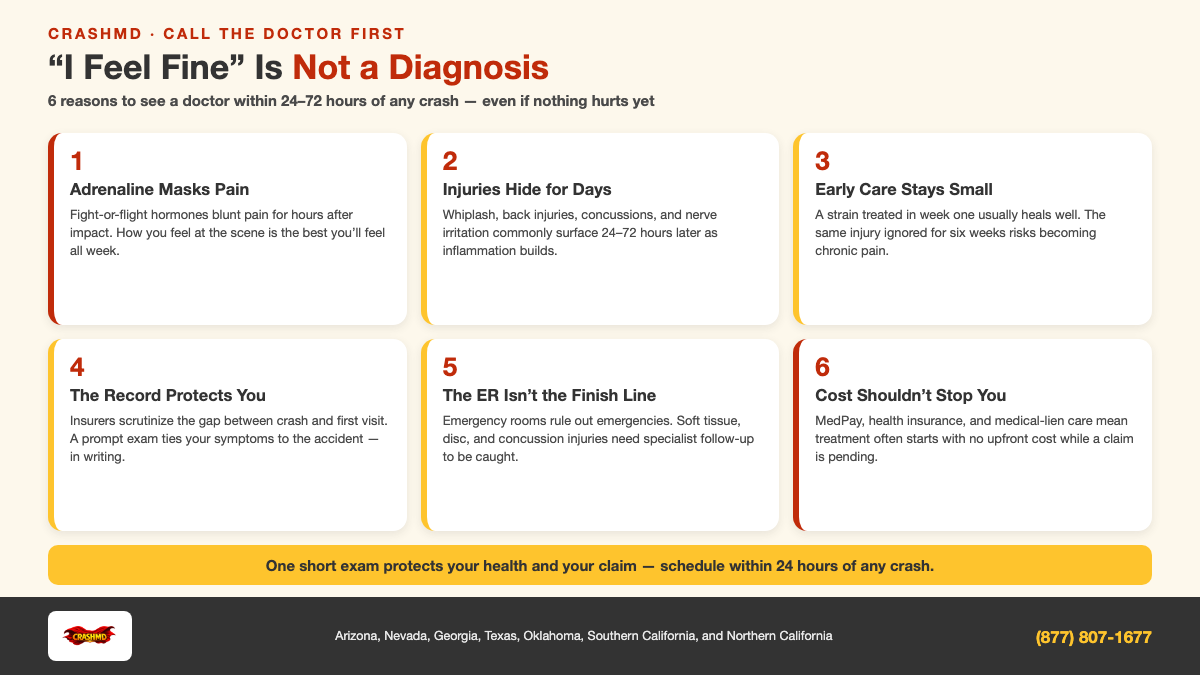
“I feel fine” is the most honest wrong statement in crash medicine. You aren’t lying — you genuinely feel fine. The problem is that in the hours after a collision, your body is chemically incapable of giving you an accurate report.
A crash triggers your fight-or-flight response. Adrenaline, cortisol, and endorphins surge — and among their effects is suppressing pain. Meanwhile the injuries themselves, especially the soft tissue injuries that dominate car crashes, hurt mainly through inflammation, and inflammation takes 24 to 72 hours to build. So “fine” at the scene is not a diagnosis. It’s a snapshot taken before the film has developed.
An early medical visit solves both halves of this problem at once. Medically, a physician can detect what you can’t yet feel — restricted motion, guarding, neurological changes, tenderness patterns that predict trouble. Practically, the visit timestamps your condition, creating the baseline every later decision will be measured against. One short appointment, two large problems prevented.
The Injuries That Hide
These are the crash injuries I most often see arrive late — the reason “wait and see” is a strategy with a poor track record:
- Whiplash and neck injuries. The most common delayed presentation of all — stiffness and pain typically peaking two to three days after impact. Our article on whiplash after a car accident covers it in depth.
- Back injuries. Lumbar strains and disc injuries often announce themselves only when you bend, lift, or sit through a workday — days after the crash.
- Concussion and mild traumatic brain injury. You do not need to hit your head or black out; the brain can be injured by violent acceleration alone. Fog, headaches, irritability, and poor sleep can take days to surface and are easy to misattribute to stress.
- Nerve injuries. Tingling, numbness, or weakness in an arm or hand may appear as inflammation builds around an irritated nerve root.
- Internal injuries. Rare but serious — bruising to organs or slow internal bleeding can smolder before becoming an emergency. Worsening abdominal pain after a crash is always an urgent symptom.
- Psychological injuries. Driving anxiety, nightmares, and hypervigilance are genuine crash injuries, they respond to treatment, and they’re routinely ignored until they’ve taken root.
The full range of car accident conditions is long, and self-diagnosis in the adrenaline window is unreliable by design. That’s not a flaw in you; it’s how human physiology works.
Crashed recently and still “feeling fine”?
A baseline exam takes less than an hour and protects both your health and your claim. Our specialists see crash patients every day.
Or call (877) 807-1677 — serving Arizona, Nevada, Georgia, Texas, Oklahoma, Southern California, and Northern California.
The Medical Case for the Early Visit
Set the legal side aside entirely for a moment. Purely as a physician, here is why the early exam earns its keep:
- Small injuries stay small. A neck strain treated in week one with guided movement and therapy usually behaves. The same strain ignored for six weeks — guarded, compensated for, slept on badly — has a much better chance of becoming a chronic pain problem.
- Dangerous injuries get caught. The exam’s first job is ruling out the things that can’t wait: unstable injuries, neurological compromise, signs of internal trauma. Most patients pass this screen. The ones who don’t are very glad they came in.
- You get a plan instead of guesswork. Rest or move? Heat or ice? Work or no work? Patients managing themselves off the internet tend to do the wrong things in the wrong order. A written plan removes the guesswork.
- A baseline exists. If symptoms appear on day four, your doctor is comparing against a documented day-one baseline, not a memory. That changes the quality of every decision that follows.
The Documentation Case: Protecting Your Claim
Now the other half — the medical-legal gap that is CrashMD’s reason for existing. If another driver’s insurance will ever be asked to pay for your care, understand how that decision actually gets made: not on how much pain you were in, but on what the medical record shows.
Insurance adjusters look first at the gap between the crash date and your first medical visit. A visit within 24 to 72 hours creates a clean causal line: crash, exam, symptoms evolving exactly as crash injuries evolve. A three-week gap creates a vacuum, and vacuums get filled with the standard arguments — the injury came from somewhere else, it predated the crash, it can’t have been serious if you didn’t seek care. I have watched patients with entirely genuine injuries lose that argument for no reason except the calendar.
To be precise about what I’m saying: seeing a doctor early is not about manufacturing a claim. It’s about making sure the truth is written down while it’s fresh. Honest documentation protects honest people. How a particular gap or record plays in your specific case is an attorney’s question — and if your case has one, your doctor and your attorney will both be working from the same record, which is exactly why it needs to be complete.
“But the ER Checked Me Out” — Why That’s Not the Finish Line
Many people do go to the emergency room after a crash, get X-rays, and are discharged with a clean bill — then treat that as the end of the medical story. It isn’t. The ER’s job is to rule out emergencies: fractures, bleeding, unstable injuries. It does that job superbly. But soft tissue injuries, early disc problems, and concussions routinely pass an ER screen, because they aren’t emergencies — they’re the injuries that unfold over the following days and weeks.
Follow-up with a physician who specializes in crash injuries is the second half of the evaluation. That’s where evolving symptoms get tracked, where imaging is ordered when the exam actually calls for it, and where treatment — therapy, medication, targeted interventions — gets coordinated into one plan. If you’re unsure where to start, our guide to finding an accident pain specialist walks through what to look for.
What Happens at a CrashMD Evaluation
Patients are often surprised by how unceremonious the first visit is. Here’s what to expect from our motor vehicle accident doctors:
- A detailed history — the crash mechanics, your position, headrest and seatbelt, and every symptom, however minor it seems to you.
- A focused physical exam — spine, joints, strength, reflexes, sensation, range of motion.
- Imaging only when indicated — we order X-rays or MRI when the exam justifies them, not reflexively.
- A written diagnosis and treatment plan — what’s injured, what we’re doing about it, and what to watch for.
- Proper documentation — every finding recorded in the form that supports both your care and, if needed, your claim.
- A conversation about cost — including options for treatment with no upfront cost while a claim is pending. Money should never be the reason an injury goes untreated.
Our network physicians — profiled on our doctors page — are board-certified specialists in pain medicine and related fields who treat car accident patients every day, across Arizona, Nevada, Georgia, Texas, Oklahoma, Southern California, and Northern California.
When “See a Doctor” Means “Go Now”
Everything above concerns the non-emergency path. These symptoms, at any point after a crash, mean emergency care immediately:
- Severe or worsening headache, repeated vomiting, confusion, or unusual drowsiness
- Loss of consciousness, even briefly
- Weakness, numbness, or loss of coordination in any limb
- Loss of bladder or bowel control
- Chest pain or difficulty breathing
- Abdominal pain that is worsening, or a swollen, rigid abdomen
Don’t schedule an appointment for these. Go to the emergency room or call 911.
Frequently Asked Questions
How soon should I see a doctor after a car accident?
Within 24 hours is ideal, and within 72 hours matters both medically and for documentation. Medically, that window is when hidden injuries declare themselves and when early treatment changes the trajectory. Practically, insurers scrutinize the gap between crash and first visit, and a prompt exam creates the clean timeline that protects your claim. If it’s already been longer — go now. Late is still far better than never, for your health above all.
What kind of doctor should I see after a car accident?
For emergencies, the ER, always. For everything else, a physician experienced with crash injuries — pain management specialists, physical medicine physicians, and orthopedic or spine specialists, depending on the injury. If you see doctor after car accident injuries through a crash-focused practice, evaluation, treatment, referrals, and documentation are coordinated in one plan, rather than scattered across providers who each see one piece of you.
Can I see a doctor after a car accident without paying upfront?
In many cases, yes. Depending on your state and coverage, options include MedPay or personal injury protection on your auto policy, your health insurance, and — when a claim against an at-fault driver is pending — treatment on a medical lien, where the provider is paid from the eventual settlement. At CrashMD, walking patients through these options is routine. Ask before you assume care is unaffordable.
What happens if I wait too long to see a doctor after an accident?
Two things, usually. Medically, injuries that would have responded to simple early treatment get a head start — and untreated soft tissue and nerve injuries are more likely to become chronic pain problems. Practically, a long gap gives an insurer room to argue your injuries came from something other than the crash, which can complicate getting care covered. Neither is guaranteed to happen, but both are common enough that I’ve never once heard a patient say they regretted coming in early.
The Bottom Line
You wear a seatbelt not because you expect to crash, but because the cost of being wrong is too high. The early medical visit is the same bet in reverse: an hour of your time against the possibility that “fine” was just adrenaline talking. See doctor after car accident — within a day or two, feeling fine or not. It is the single highest-leverage decision you’ll make in your recovery, and it’s one of the few you can only make early.
Injured in a car crash? Call the doctor first.
Board-certified crash injury specialists. Same-week evaluations. Treatment options with no upfront cost.
Or call (877) 807-1677 — serving Arizona, Nevada, Georgia, Texas, Oklahoma, Southern California, and Northern California.
— Dr. Adam Savage is a pain management physician with CrashMD in Oklahoma, where every treatment journey starts with a comprehensive history, exam, and a personalized multimodal plan. Connect with him on LinkedIn.
This article is for educational purposes only and is not medical advice. It does not create a doctor-patient relationship, and it is not legal advice. Consult a licensed physician about your injuries and a licensed attorney about any legal questions.