

Whiplash symptoms have a cruel habit: they frequently don’t show up until one, two, even three days after the crash — right after you’ve told everyone, including the insurance adjuster, that you feel fine. I’m Dr. Adam Savage, a CrashMD pain management physician, and in my years of treating car accident injuries I have heard some version of the same story hundreds of times: “I walked away from the accident. The next morning I could barely turn my head.” In this article I’ll explain exactly why whiplash behaves this way, which symptoms to watch for, when delayed symptoms signal something more serious, and why the gap between crash and symptoms matters for both your recovery and your claim.
A quick note before we start: this article is educational and is not medical advice — only an in-person exam can evaluate your specific injury. And where I mention insurance or legal claims, that’s general information, not legal advice.
What Whiplash Actually Is
Whiplash is the common name for a neck injury caused by rapid acceleration and deceleration of the head — classically in a rear-end collision, though it occurs in side impacts, front impacts, and even low-speed crashes. In a fraction of a second, your head whips backward and then forward, moving through a range and speed your neck was never designed for.
Physicians call the result whiplash-associated disorder, because it’s rarely just one injured structure. The sudden motion can strain muscles, sprain the ligaments that stabilize the spine, irritate the small facet joints at the back of the neck, compress or inflame nerve roots, and in some cases injure the discs between the vertebrae. That’s why whiplash after a car accident can produce such a wide range of symptoms — and why two people in the same crash can have completely different experiences.
Here’s the detail that matters most for this article: almost none of those injured structures announces itself immediately. Which brings us to the delay.
Why Whiplash Symptoms Take Days to Appear
There are three overlapping reasons the pain shows up late, and understanding them is the best inoculation against the dangerous conclusion of “I must not be hurt.”
1. Adrenaline and stress hormones mask pain
A car crash triggers your fight-or-flight response. Adrenaline and related stress hormones surge, and one of their effects is blunting pain perception — a survival feature that let our ancestors flee danger on an injured leg. That chemistry doesn’t switch off the moment you exchange insurance information. For hours after a crash, many people genuinely cannot feel the full extent of their injuries.
2. Inflammation builds slowly
When muscle fibers and ligaments are overstretched or torn at a microscopic level, the body mounts an inflammatory response — fluid, immune cells, and chemical signals flooding the injured tissue to begin repair. That process ramps up over roughly 24 to 72 hours. The swelling and chemical irritation are a large part of what actually hurts, which is why whiplash pain so often peaks on day two or three rather than day one. The soreness you feel two days after a hard workout follows the same timeline, for the same reason.
3. Guarding and stiffness develop overnight
After an injury, the muscles around your neck reflexively tighten to splint and protect the area. You often don’t notice this guarding until you’ve been still for hours — which is why so many patients tell me the first unmistakable symptom was waking up the morning after the crash unable to turn their head.
Put those three together and the pattern makes sense: the crash happens, you feel shaken but intact, and the true picture emerges over the following days. The injury was there the whole time. Your body just hadn’t finished telling you about it.
Whiplash Symptoms: The Full Checklist
Neck pain is the headline, but whiplash symptoms extend well beyond the neck. Over the first several days after a crash, watch for:
- Neck pain and stiffness — often worse with movement, and frequently most severe in the morning
- Reduced range of motion — difficulty turning your head to check a blind spot is a classic early sign
- Headaches — typically starting at the base of the skull and radiating forward; see our guide to whiplash headaches after rear-end collisions
- Shoulder, upper back, or arm pain — the muscles involved span far more than the neck itself; plain neck strain and whiplash often overlap
- Numbness or tingling in the arms or hands — a sign a nerve root may be irritated or compressed
- Dizziness or unsteadiness
- Jaw pain — the TMJ can be strained by the same whipping motion
- Fatigue and poor sleep
- Blurred vision or ringing in the ears — less common, worth reporting promptly
- Difficulty concentrating, irritability, or memory problems — these can accompany whiplash or signal a concussion, and they deserve their own evaluation
No single patient has all of these. But if you’ve been in a crash and two or three of them creep in over the following days, that is a textbook delayed whiplash presentation — and a reason to be examined, not to wait and see.
Neck pain showing up days after your crash?
That’s the most common whiplash pattern we see. Our board-certified specialists can evaluate you this week — often with no upfront cost.
Or call (877) 807-1677 — serving Arizona, Nevada, Georgia, Texas, Oklahoma, Southern California, and Northern California.
The Typical Timeline: Day by Day
Every injury is different, but after thousands of patient visits, here is the pattern I see most often:
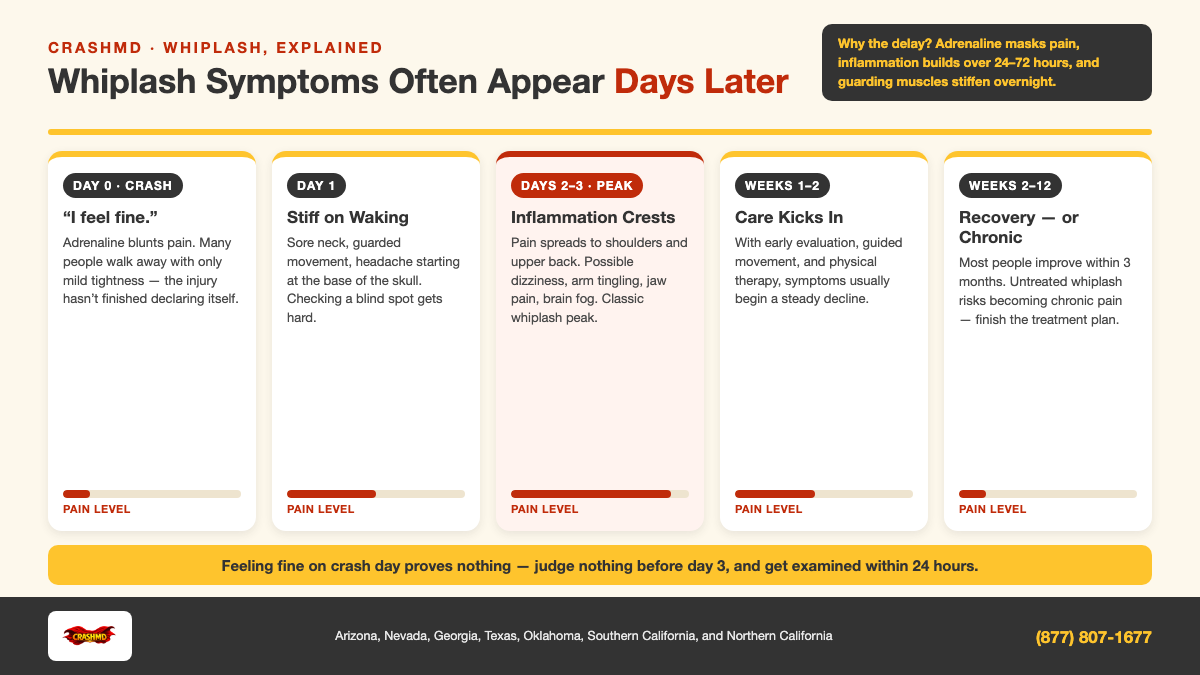
- Day 0 (crash day): Shock and adrenaline. Many people feel shaken but physically “fine,” or notice only mild tightness.
- Day 1: Stiffness on waking. The neck feels sore and movement is guarded. Headache often begins at the base of the skull.
- Days 2–3: Symptoms typically peak as inflammation crests. Pain may spread to the shoulders and upper back; turning the head becomes genuinely difficult.
- Week 1–2: With appropriate care, symptoms usually begin a steady decline. This is when guided movement and physical therapy earn their keep.
- Weeks 2–12: Most people improve substantially within this window. A meaningful minority — studies suggest it is not a small number — have symptoms that persist beyond three months, which is when whiplash risks becoming a chronic pain problem.
Two points about that timeline. First, a symptom-free day one tells you very little — judge nothing before day three. Second, the patients who do best, in my experience, are the ones evaluated early and moving appropriately soon after, not the ones who waited weeks to see whether it would resolve on its own.
When Delayed Symptoms Signal Something More Serious
Most whiplash is a soft tissue injury that heals well with proper treatment. But the same crash mechanics can cause injuries that need urgent attention, and some of them also present late. Seek immediate medical care — an emergency room, not an appointment next week — if you develop:
- Severe or rapidly worsening headache, or repeated vomiting
- Weakness in your arms or legs, or numbness that is spreading
- Confusion, unusual drowsiness, or slurred speech
- Loss of bladder or bowel control
- Electric, shooting pain down an arm with a drooping grip or clumsiness
- Any neck pain accompanied by fever
These can point toward problems beyond simple whiplash — among them a cervical disc herniation pressing on a nerve or the spinal cord, an unstable ligament injury, or a brain injury. Persistent or unusual headaches after a crash likewise deserve a proper workup; our overview of post-traumatic headache explains how we distinguish muscular headaches from more concerning ones.
Why the Delay Matters for Your Insurance Claim
Here is the medical-legal gap I spend a great deal of time helping patients navigate. Insurance adjusters know the medical literature on delayed whiplash symptoms as well as physicians do — but a delay in symptoms and a delay in seeking care are treated very differently.
If you’re examined within a day or two of the crash, your record shows a crash, an exam, and symptoms that evolved exactly the way whiplash evolves. The connection is clean. If you instead wait two or three weeks, the record shows a gap — and gaps get filled with arguments: maybe you were hurt at work, maybe it’s an old injury, maybe you’re exaggerating. I have watched honest patients with genuine injuries struggle to get care covered for exactly this reason.
The practical takeaway is simple: get examined promptly even if symptoms haven’t fully arrived, and when symptoms do appear or change, report them to your doctor right away so the record reflects their actual onset. You are not building a case — you are keeping an accurate diary in the one place it counts. For how any of this affects a specific claim, please talk to a licensed attorney; that’s their lane, not mine.
How Whiplash Is Diagnosed and Treated
When you come in with suspected whiplash, the evaluation starts with a detailed history and physical exam — range of motion, tenderness patterns, strength, reflexes, and sensation. Imaging is used selectively: X-rays when a fracture is possible, MRI when the exam suggests disc or nerve involvement. Much of whiplash is a clinical diagnosis; normal imaging does not mean the pain isn’t real.
Treatment is tailored to the injury and the person, and modern whiplash care has moved firmly away from stiff collars and strict rest. Depending on your exam, a plan may include:
- Early, guided movement — gentle range-of-motion work beats immobilization for most patients
- Physical therapy — the backbone of whiplash recovery, restoring strength and normal movement patterns
- Short-term medication — anti-inflammatories and muscle relaxants where appropriate
- Heat, ice, and massage therapy for symptom control
- Targeted interventions for persistent pain — such as trigger point injections, facet joint injections, or nerve-focused procedures when conservative care isn’t enough
The physicians in the CrashMD network are board-certified pain specialists who treat crash injuries every day, coordinate the entire plan under one roof, and document each step properly — which protects both your recovery and your claim.

Frequently Asked Questions
How long after an accident can whiplash symptoms appear?
Most commonly within 24 to 72 hours of the crash — that’s the window in which adrenaline fades and inflammation peaks. Some symptoms, like headaches, arm tingling, or difficulty concentrating, can emerge a week or more afterward. Symptoms appearing days later are still very plausibly from the crash, but the longer the gap before your first medical visit, the harder that connection becomes to document.
Can you get whiplash from a minor, low-speed crash?
Yes. Whiplash is caused by the rapid whipping motion of the head, not by vehicle damage, and research has long shown that occupants can be injured in collisions that leave bumpers nearly untouched. Headrest position, body position at impact, whether you were braced, and your individual anatomy all matter more than the repair bill. Don’t let “the car barely got scratched” talk you out of an evaluation.
How long does whiplash take to heal?
Most people improve substantially within a few weeks to three months with appropriate care. A meaningful minority develop symptoms lasting beyond three months, and early evaluation and active treatment appear to be among the better predictors of a good outcome. The pattern I warn every patient about: feeling better at week two, abandoning therapy, and relapsing at week six. Finish the plan.
Should I see a doctor for whiplash if the pain is mild?
Yes, for two reasons. Medically, mild day-two pain can still be early in its build, and an exam can catch nerve involvement or other complications you can’t self-assess. Practically, an early exam creates the medical record linking your symptoms to the crash — which matters enormously if your pain worsens and you later need your care covered. A short visit now is cheap insurance in every sense.
The Bottom Line
Delayed whiplash symptoms aren’t suspicious, and they aren’t in your head — they are the predictable product of adrenaline, inflammation, and muscle guarding playing out on a 72-hour clock. The mistake isn’t feeling fine on crash day. The mistake is treating “fine on crash day” as the final answer. Get examined early, watch the window, report what you feel, and give your neck the treatment it needs to heal fully the first time.
Don’t wait out the pain.
Board-certified pain specialists who treat whiplash every day — with documentation done right and no upfront cost options.
Or call (877) 807-1677 — serving Arizona, Nevada, Georgia, Texas, Oklahoma, Southern California, and Northern California.
— Dr. Adam Savage is a pain management physician with CrashMD in Oklahoma, where every treatment journey starts with a comprehensive history, exam, and a personalized multimodal plan. Connect with him on LinkedIn.
This article is for educational purposes only and is not medical advice. It does not create a doctor-patient relationship, and it is not legal advice. Consult a licensed physician about your symptoms and a licensed attorney about any legal questions.