

Why Your Scapula Fracture Court Appearance Can Make or Break Your Claim
A scapula fracture court appearance can be one of the most complex legal situations an accident victim will ever face — and being underprepared can cost you everything.
Here is what you need to know right now:
Key legal impacts of a scapular fracture claim:
| Factor | Why It Matters in Court |
|---|---|
| Missed diagnosis (43% of cases) | Delayed treatment weakens causation arguments |
| Associated injuries | Proves high-energy trauma — strengthens liability |
| Surgical complications (nonunion, hardware failure) | Directly increases general damages value |
| Medical record gaps | Courts draw adverse inferences against the party with poor records |
| Permanency of injury | Drives compensation for pain, suffering, and lost wages |
| Honest, documented limitations | Exaggerated claims risk contempt of court charges |
The scapula — your shoulder blade — is one of the most protected bones in the human body. It takes enormous force to break it. That very fact is both your greatest medical reality and your strongest legal asset.
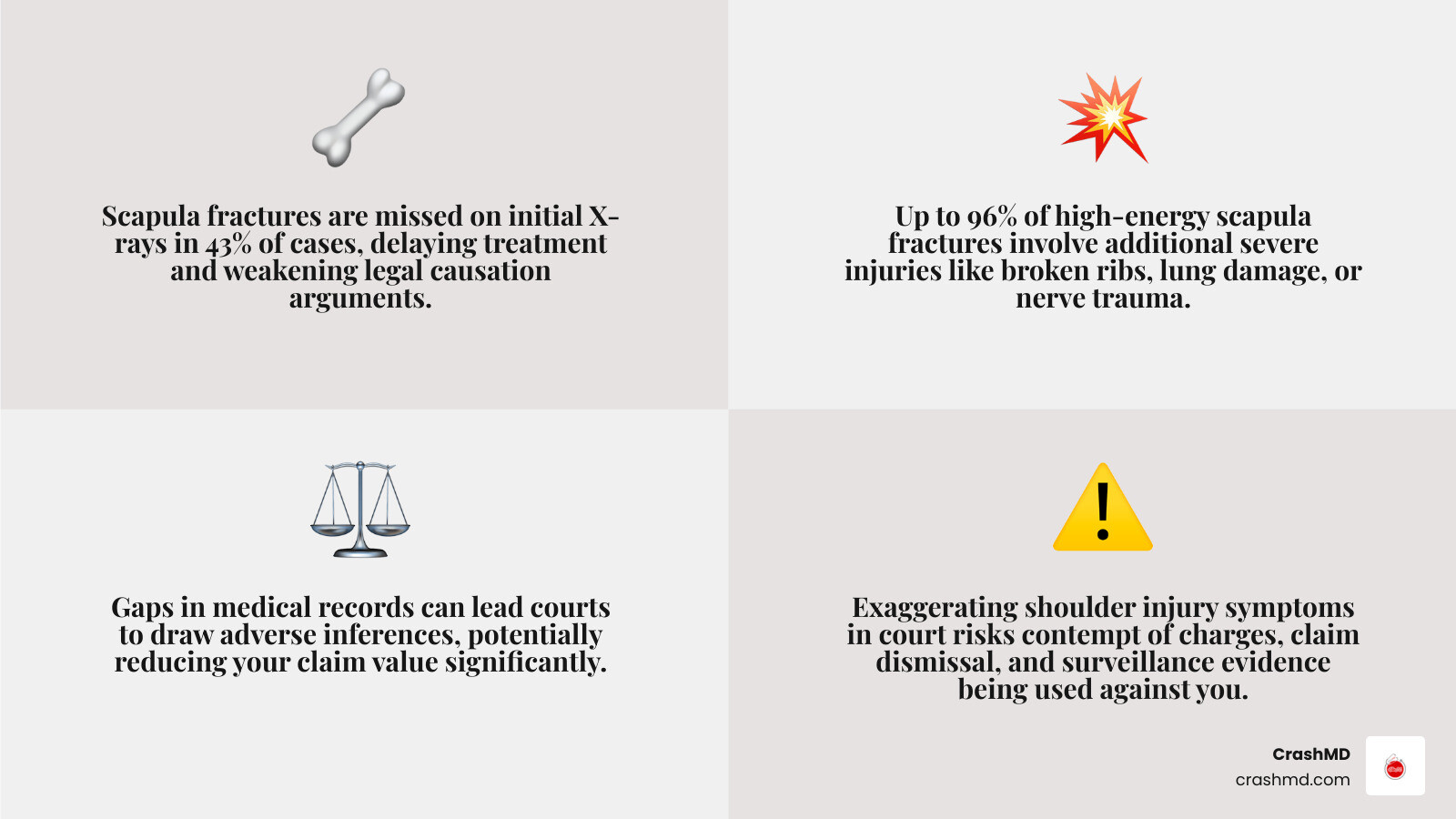
When it does fracture, the consequences are serious. Up to 96% of patients with high-energy scapular fractures have other severe injuries alongside it — broken ribs, lung damage, nerve injuries. That cascade of trauma is exactly what courts need to understand to fairly value your claim.
But here is the problem: the medical and legal picture is complicated. Fractures get missed in emergency rooms. Surgeries fail. Records go undocumented. And insurance companies will exploit every gap.
I’m Dr. Adam Savage, and in this guide I’ll walk you through exactly what you need to prepare, prove, and protect in a scapular fracture legal claim.
Scapula fracture court appearance terms explained:
Understanding Scapular Fractures: Medical Mechanisms and Diagnostic Challenges
Scapular fractures are remarkably rare, accounting for less than 1% of all broken bones and only 3% to 5% of all shoulder girdle injuries. Because the shoulder blade is cocooned in a thick envelope of muscle, fracturing it requires massive, high-energy impact. In fact, research shows that 52% of these injuries result from motor vehicle collisions, while the rest are caused by motorcycle crashes, pedestrian impacts, or severe falls.
Because of this violent mechanism of injury, up to 96% of patients present with serious associated injuries, such as rib fractures, pulmonary contusions, or head trauma. In an emergency room, doctors are often so focused on saving your life or treating a collapsed lung that the scapula fracture itself is completely missed.
Statistically, an astonishing 43% of scapula fractures are missed on initial supine chest X-rays. Standard radiographs simply cannot handle the overlapping shadows of the thoracic bones. If you are experiencing persistent posterior shoulder pain, localized bruising, or a grating sensation when you breathe, a standard X-ray isn’t enough. You need a 3D CT scan to truly see what is going on. For a detailed breakdown of what to watch out for, check out our Ultimate Guide to Fractured Scapula Symptoms.
To understand how these injuries manifest in different populations, you can also review the Scientific research on scapular body fractures.
Preparing for Your Scapula Fracture Court Appearance: The Legal Checklist
When you step into a courtroom or a deposition, the defense will try to downplay your injury. To protect your claim, you must arrive armed with objective, undeniable medical evidence.
Use this legal checklist to prepare:
- Confirm you have a definitive diagnostic scan (preferably a CT scan) showing the fracture lines.
- Secure all contemporaneous clinical notes from your first emergency room visit to establish immediate post-accident symptoms.
- Gather objective functional assessments, such as physical therapy progress reports.
- Obtain a formal medical nexus letter linking the scapula fracture directly to the accident.
Having a clear picture of your medical path is essential. Learn how to build this foundation by reading about Injury Assessment What You Need to Know for Your Legal Case.
Essential Medical Records for Your Scapula Fracture Court Appearance
In the legal world, if it wasn’t documented, it didn’t happen. Your clinical notes, surgical reports, and radiological images are the bedrock of your case. Contemporaneous records — those written by your treating physicians at the exact time of your visits — carry the most weight in court. If you wait months to report shoulder pain, the defense will claim your injury happened somewhere else.
To ensure you have everything ready for your legal team, see our guide on How to Get Medical Records for Your Injury Claim Fast.
Proving Employer Negligence and Liability in Court
If your injury occurred on a job site, such as a construction zone in Texas, Arizona, or California, proving liability requires showing that your employer breached their duty of care. This often involves documenting OSHA violations, a lack of fall protection harnesses, or poorly maintained scaffolding.
Because the scapula is so well-protected, breaking it in a fall usually means falling from a significant height. Documenting the scene immediately and securing witness testimonies is vital to showing that employer negligence directly caused your high-impact trauma. For more strategies on establishing liability, read our advice on How to Win Your Injury Claim Process.
Surgical vs. Conservative Management: Complications and Treatment Failures
Deciding how to treat a scapula fracture depends on stability and displacement. Roughly 90% of scapular body fractures are treated conservatively with temporary sling immobilization and progressive physical therapy. However, if the fracture is highly displaced, involves the joint (intra-articular glenoid fractures), or causes the bone to shift into the chest cavity, surgery is required.
Surgical intervention typically involves Open Reduction and Internal Fixation (ORIF). This complex procedure can require plate fixation, sometimes involving double plating (using multiple reconstruction and locking plates) and bone grafting to secure the bone.
But surgery carries risks. Hardware can fail, plates can irritate the skin, and in rare cases, a nonunion (where the bone fails to heal) can occur. A failed treatment can also lead to a “pseudorupture” of the rotator cuff, where the shoulder muscles pull the unhealed bone fragments downward, destroying your ability to lift your arm.
| Treatment Path | Indications | Potential Complications | Legal Impact |
|---|---|---|---|
| Conservative Management | Minimally displaced fractures, stable joint | Malunion, chronic stiffness, impingement | Focuses on long-term functional loss |
| Surgical Management (ORIF) | Highly displaced, joint involvement, unstable neck | Hardware failure, infection, nonunion, nerve damage | High medical costs, clear proof of severity |
To learn more about what to expect during recovery, read The Definitive Guide to Healing Time for Broken Scapula. For an extreme example of what can happen when displacement goes untreated, you can read this Case study on intrathoracic displacement of scapular fractures.
Assessing Medical Negligence and Standard of Care in Shoulder Surgery
Not all complications are unavoidable accidents; some are the result of medical malpractice. In orthopedic shoulder surgery, a common area of negligence is the premature removal of surgical hardware. Standard practice generally dictates leaving plates and screws in place for at least a year, or until complete bone union is radiographically confirmed. Removing hardware too early significantly increases the risk of a painful re-fracture.
When assessing medical negligence, courts look at whether the physician breached the standard of care. This includes failing to obtain informed consent regarding the risks of early hardware removal or failing to keep detailed, contemporaneous medical records.
In the legal precedent Kotorashvili v. Lee, 2024 ONSC 1495 — SCJ, the court highlighted how poor record-keeping by a surgeon can lead to adverse legal inferences, as judges prioritize written clinical notes over a doctor’s memory years after the fact.
Expert Medical Testimony and the Scapula Fracture Court Appearance
To win a medical malpractice or personal injury case, you need an expert medical witness. The expert must explain causation (how the accident or negligent surgery caused your current state) and permanency (whether you will suffer from chronic pain or limited mobility forever).
Experts often use standardized tools like the DASH (Disabilities of the Arm, Shoulder and Hand) score to turn your daily struggles into objective, numerical evidence that a jury can easily understand. To learn more about how medical evidence translates to the courtroom, see Beyond the Scene Understanding the Legal Side of Your Car Accident.
Calculating Damages: Compensation Brackets for Shoulder Girdle Injuries
If your scapula fracture court appearance is successful, the court will award damages. These are divided into two main categories:
- Special Damages: Measurable financial losses, including emergency room bills, surgical expenses, physical therapy costs, and lost wages from missed work.
- General Damages: Compensation for non-monetary losses, such as pain, suffering, loss of enjoyment of life, and permanent physical impairment.

While compensation varies depending on your jurisdiction (such as Texas, California, Nevada, Arizona, or Oklahoma), serious shoulder girdle injuries are highly valued due to the joint’s complexity. Serious shoulder injuries can attract general damages awards ranging from €40,000 to €75,000, while severe, life-altering shoulder injuries with permanent disability can range from €100,000 to €150,000 in comparable international frameworks.
To help you navigate this financial recovery process, read How to File a Personal Injury Claim Without Losing Your Mind.
Special Legal Considerations: Pediatric Scapular Fractures and Non-Accidental Injury
In pediatric cases, a scapular fracture is treated with extreme caution. Because a child’s bones are highly flexible, fracturing the scapula requires an immense, concentrated force. In the absence of a documented high-energy car accident, a pediatric scapula fracture is highly suspicious for non-accidental injury (child abuse).
Courts and medical professionals look for specific radiological indicators, such as classic metaphyseal lesions (CML) or healing rib fractures. During legal proceedings, pediatric radiologists play a critical role.
For example, in the Sportsman trial: Radiologist describes ‘grating’, ‘crackly’ sound of infant’s 13 rib fractures, expert testimony regarding the physical sensation of crepitus (grating bone fragments) was pivotal in establishing the sheer force inflicted on a child, showing how clinical findings dictate legal outcomes.
Frequently Asked Questions about Scapula Fracture Court Appearances
Why are scapula fractures frequently missed on initial emergency room X-rays?
Up to 43% of scapula fractures are missed on initial supine chest X-rays because the flat, triangular bone overlaps with the ribs and thoracic spine on a 2D image. Furthermore, life-threatening emergency trauma (like a punctured lung or internal bleeding) often overshadows shoulder pain, making a 3D CT scan essential for an accurate diagnosis.
What are the legal consequences of exaggerating a shoulder injury in court?
Exaggerating an injury can completely destroy your legal claim and lead to criminal charges. Defense teams routinely use surveillance and social media monitoring to catch dishonest plaintiffs.
As seen in the case of a Mum who sued NHS for £7.3m and lied about daughter’s ‘disability’ spared jail – Grimsby Live, fabricating physical limitations can result in a conviction for contempt of court, a suspended prison sentence, and the complete dismissal of the compensation claim.
How does a secondary minor accident affect an ongoing scapular fracture lawsuit?
A secondary minor accident can severely complicate an active lawsuit. If you are involved in a minor fender bender while recovering, the defense will argue that any hardware failure or delayed healing (nonunion) was caused by the second impact, rather than the original accident. Meticulous, daily medical documentation is required to prove the timeline of your injuries.
Conclusion
Navigating a scapula fracture court appearance requires a careful balance of medical recovery and legal preparation. Because these injuries are rare, complex, and frequently missed, you cannot rely on basic medical charts to win your case. You need comprehensive, objective documentation that clearly demonstrates the high-energy impact of your accident and the long-term reality of your recovery.
At CrashMD, we specialize in guiding accident victims through this exact journey. We prioritize your health with expert pain management and tailored treatment plans, while simultaneously building the bulletproof medical documentation your legal team needs to secure the compensation you deserve.
If you are recovering from a shoulder injury in Texas, California, Arizona, Nevada, or Oklahoma, do not leave your recovery or your lawsuit to chance. Visit our Pillar Page: Scapula Fracture Crash MD today to learn how we can advocate for your health and your rights.