

Start Your Texas Injury Claim Documentation the Right Way
For strong injury claim documentation Texas, start collecting proof on day one. Keep a single file with:
- Accident evidence: photos, video, police or incident reports, witness names, and employer notices.
- Medical proof: visit notes, test results, imaging, prescriptions, treatment plans, work restrictions, and itemized bills.
- Claim records: insurer letters, claim numbers, forms, receipts, payment records, and every message about your injury.
- A simple timeline: record the accident date, symptoms, missed work, appointments, and changes in pain or function.
This documentation helps connect your injuries to the crash or workplace event, shows what treatment was necessary, and supports the costs you are seeking. Save originals, request copies promptly, and do not rely on an insurer or provider to preserve the full record for you.
Texas deadlines can be strict. For example, a workers’ compensation claimant generally must file DWC Form-041 within one year of the injury or, for an occupational disease, within one year of when they knew or should have known it was work-related. Medical providers also face separate billing deadlines, and missing records or coding errors can lead to delayed payment or denial.
I’m Dr. Adam Savage, and this guide will walk you through the evidence to gather, organize, and protect while you focus on recovery.

Simple injury claim documentation Texas word guide:
Having the right injury claim documentation Texas is crucial for your case.
Essential Rules for Injury Claim Documentation Texas Claimants Must Follow

Navigating a bodily injury or workplace claim requires strict adherence to statutory deadlines and evidence standards. Insurance adjusters will not take your word on how an incident occurred; they demand verifiable paper trails. Knowing how to properly document injuries protects your physical recovery and financial compensation.
In Texas, injury claims generally fall into two broad categories: workers’ compensation administrative claims and third-party personal injury lawsuits. Each path requires establishing whether trauma resulted from a single acute incident (like a slip and fall or collision) or an occupational disease caused by repetitive stress over time. If an employer is notified late or clinical evidence is sparse, carriers often issue immediate denials.
Streamlining Injury Claim Documentation Texas Workers’ Compensation Filings Require
To formally initiate a workplace claim with the Texas Department of Insurance, Division of Workers’ Compensation (DWC), you must complete the Employee’s Claim for Compensation for a Work-Related Injury or Occupational Disease. This form must be filed within one year from the date of the injury or one year from the date you knew or should have known your illness was work-related.
Submitting DWC Form-041 triggers the state to generate a formal DWC claim number and notifies your employer and their workers’ comp insurance carrier. Essential documentation includes:
- Exact date, time, and county of the incident.
- Pre-tax wage statements to calculate accurate temporary income benefits.
- Clear designation of work status: “Regular” (full duty) or “Restricted” (with doctor-mandated limitations).
- Detailed contact information for witnesses and supervisor incident reports.
- Designation of the Treating Doctor (TD) and verification of network participation under Texas Insurance Code Chapter 1305.
Medical Billing Standards and the 95-Day Rule Under Texas Labor Code
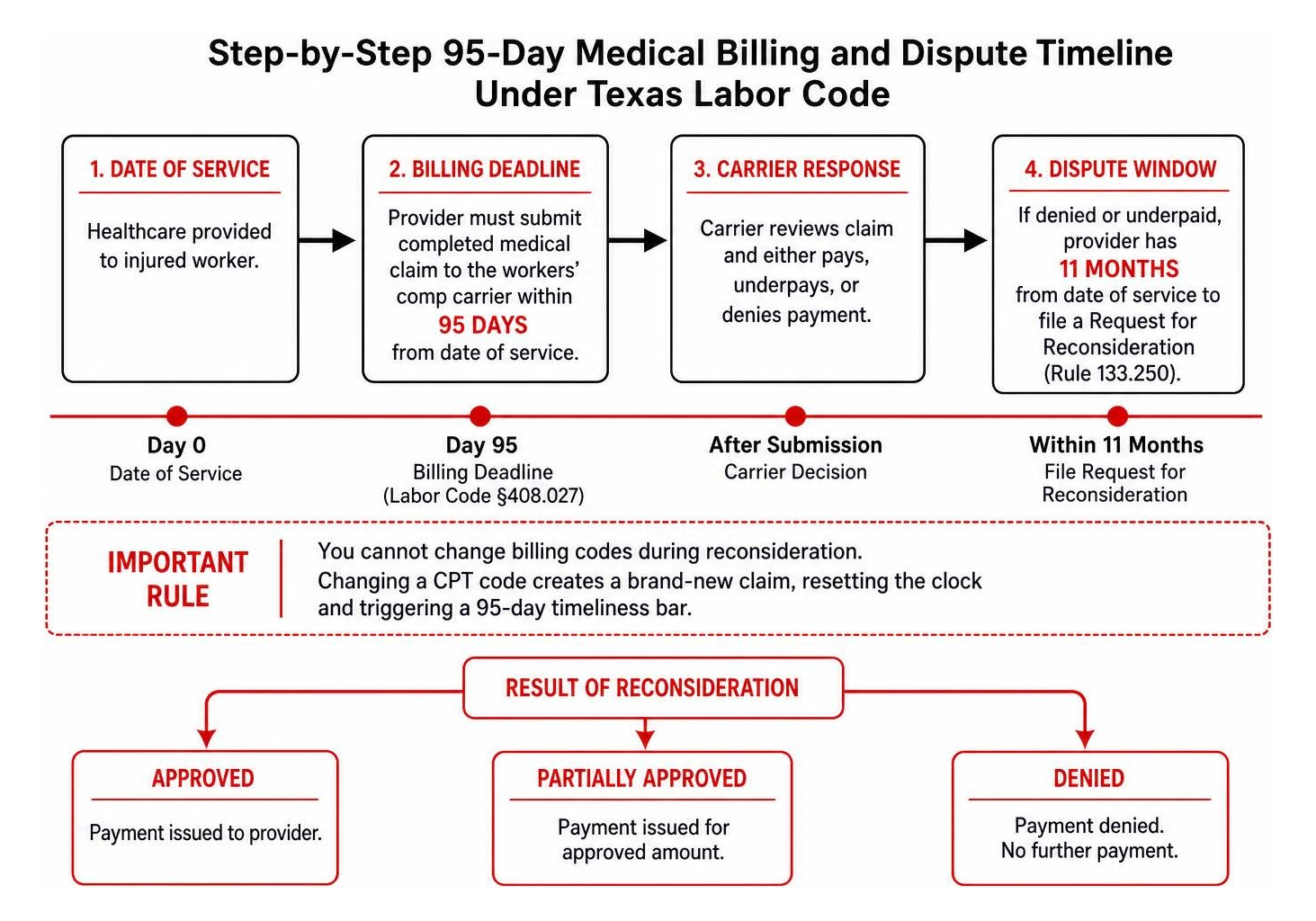
Under Texas Labor Code §408.027, healthcare providers face an unforgiving 95-day statutory deadline to submit completed medical claims to the workers’ compensation carrier from the date of service. A single clearinghouse error can lead to a total forfeiture of reimbursement.
Bills must be complete, featuring valid National Provider Identifiers (NPI), correct CPT coding, and proper diagnostic pointers. When a carrier denies payment or underpays, providers have an 11-month window under Rule 133.250 to file a formal Request for Reconsideration. However, you cannot switch billing codes during reconsideration; changing a CPT code legally creates a brand-new claim, resetting the clock and triggering a 95-day timeliness bar. Staying compliant starts by promptly submitting an accident injury report and tracking every billable interaction.
Core Medical Evidence and Statutory Billing Compliance
In any Texas injury claim, treatment records must establish medical necessity and proximate causation. Adjusters scrutinize Evaluation and Management (E&M) codes, requiring physicians to detail subjective complaints, objective physical findings, clinical assessment, and clear treatment plans (SOAP notes).
Referrals are equally vital. In Texas workers’ compensation cases, non-emergency specialty care must originate from an authorized Treating Doctor referral. For example, failing to obtain a formal referral can lead to outright billing denials, leaving thousands of dollars in dispute.
Clinical Notes, Operative Reports, and Section 133.210 Requirements
State administrative rules establish clear baselines for clinical proof. Under 28 Tex. Admin. Code § 133.210, medical documentation includes narrative reports, progress notes, hospital records, and diagnostic imaging (like MRIs and CT scans).
Key compliance standards under Section 133.210 include:
- Surgical Thresholds: An operative report is mandatory for surgical services rendered on the same date when total Division fee guideline fees exceed $500.
- Evaluation & Management: The two highest levels of E&M codes require comprehensive, AMA-compliant office visit notes attached directly to the initial bill.
- Hospital Services: Healthcare facilities must provide a complete, itemized statement of charges rather than flat lump-sum invoices.
- Carrier Record Requests: When an insurer requests additional clinical files, they must issue a written request explaining the exact clinical relevance to the specific episode of care.
Having seamless access to your clinical narrative is essential, which is why gathering clinical medical records systematically protects your case from premature denials.
Pharmaceutical Pricing Formulas and Medicare Fee Interactions
Texas establishes strict fee guidelines for prescription medications under Rule 134.503. The Maximum Allowable Reimbursement (MAR) for pharmaceuticals is calculated using the Average Wholesale Price (AWP) per unit:
- Generic Medications: $(text{AWP} times text{Units} times 1.25) + $4.00text{ dispensing fee}$
- Brand-Name Medications: $(text{AWP} times text{Units} times 1.09) + $4.00text{ dispensing fee}$
While Texas administrative fee rules incorporate federal Medicare Relative Value Units (RVUs) for many professional services, Texas Labor Code and DWC rules maintain ultimate legal supremacy. For instance, Texas rules require the treating provider’s physical or electronic signature on reports, superseding conflicting Medicare “incident to” supervisory billing conventions.
Resolving Medical Fee Disputes and Out-of-Pocket Reimbursements

When insurance carriers improperly deny or reduce payments, providers and injured workers can access administrative dispute channels through Medical Fee Dispute Resolution (MFDR).
Navigating Form DWC-60 and Medical Dispute Resolution Deadlines
Under Rule 133.307(c)(1)(A), a party seeking MFDR must file Form DWC-60 no later than one year after the disputed date of service. The filing must contain the completed DWC-60 table listing the disputed services, clear position statements, medical records, and Explanation of Benefits (EOB) copies.
Once submitted, the respondent has 14 calendar days under Rule 133.307(d)(1) to file a formal response with the Division. Furthermore, under the Medical Contested Case Hearing Decision Manual, carriers are legally restricted to the defense reasons articulated prior to the MDR filing; they cannot fabricate new denial grounds during proceedings.
If a party disagrees with an MFDR decision, they must appeal within 20 calendar days:
- Disputes of $2,000 or less proceed to a DWC Medical Contested Case Hearing (MCCH).
- Disputes exceeding $2,000 fall under the jurisdiction of the State Office of Administrative Hearings (SOAH).
Securing Out-of-Pocket Expense Reimbursements and Data Matching
Injured workers who pay out of pocket for medical care or prescriptions can seek reimbursement under Rule 133.270. To prevail, the employee must submit Form DWC-60, itemized pharmacy or clinic receipts, proof of payment, and the carrier’s written denial letter.
Additionally, Rule 133.307(c)(3) enforces strict data-matching requirements. If prescription NDC numbers, provider identifiers, or service dates do not match carrier billing systems perfectly, reimbursement requests will be rejected. Subclaimants (such as private group health plans that mistakenly paid for work injuries) and Designated Doctors (appointed by the state to evaluate Maximum Medical Improvement and impairment ratings) must satisfy these same rigorous evidentiary standards to secure payment.
Workers’ Compensation vs. Personal Injury Lawsuit Documentation
Building evidence for a third-party car crash or slip-and-fall involves different legal burdens than an administrative workers’ comp claim. When navigating the legal side of car accidents, you are proving negligence and liability rather than statutory compensability.
| Evidentiary Factor | Texas Workers’ Compensation Claim | Texas Personal Injury Lawsuit |
|---|---|---|
| Legal Framework | Texas Labor Code / DWC Administrative Rules | Texas Civil Practice & Remedies Code (CPRC) |
| Fault Requirement | No-fault administrative system | Must prove third-party negligence / liability |
| Key Intake Forms | DWC Form-041, Employer Injury Report | Police Crash Report (CR-3), HIPAA Waivers |
| Initial Filing Limits | 1 year for DWC-041; 95 days for medical bills | 2-year general personal injury statute of limitations |
| Medical Proof Rules | 28 TAC § 133.210 / Division Fee Guidelines | CPRC § 18.001 Billing Affidavits / Expert Reports |
| Dispute Venue | DWC Benefit Review / MCCH / SOAH | Texas County/District Courts |
Managing Injury Claim Documentation Texas Personal Injury Cases Demand
In auto collision cases, claim files must quickly incorporate police crash reports (Form CR-3), dashcam footage, and formal spoliation letters sent to preserve electronic trucking data. Claimants should explore first-party Personal Injury Protection (PIP) and Uninsured/Underinsured Motorist (UM/UIM) coverage while building third-party liability demands. Reviewing comprehensive Texas personal injury practice workflows helps injured parties organize liability proofs when pursuing avenues for recovering accident damages in Texas.
Letters of Protection, Billing Affidavits, and Lien Resolution
When health insurance is unavailable following an accident, medical providers often deliver care via Letters of Protection (LOP), which secure payment directly out of future settlement funds.
Under Texas Civil Practice and Remedies Code § 18.001, plaintiffs can submit formal Billing Records Affidavits from medical custodians to prove that treatment costs were reasonable and medically necessary, avoiding the expense of live expert testimony at trial. Before final settlement disbursement, attorneys negotiate hospital lien reductions and statutory health insurance subrogation claims, often utilizing formal Stowers doctrine liability demands to hold recalcitrant insurers accountable.
Frequently Asked Questions About Texas Injury Claims
What is the deadline to file DWC Form-041 in Texas?
Injured employees must file Form DWC-041 with the Texas Division of Workers’ Compensation within one year from the date of the injury. For occupational diseases or repetitive trauma, the one-year window begins on the date the worker knew, or reasonably should have known, that the condition was job-related.
What happens if a medical provider alters billing codes on reconsideration?
Under Rule 133.250(d)(1), a request for reconsideration must retain the exact CPT billing codes and dates of service from the original bill. Changing or correcting a billing code legally creates a new claim submission, which is then barred if it exceeds the mandatory 95-day deadline from the original date of service under Texas Labor Code §408.027.
How do personal injury billing records affidavits work under Texas law?
Under Texas Civil Practice and Remedies Code § 18.001, a plaintiff can introduce itemized medical bills accompanied by a sworn affidavit from the healthcare provider’s records custodian. This serves as sufficient legal evidence that the medical expenses were reasonable and necessary at the time service was provided, unless the defense files a timely counter-affidavit.
Conclusion
A successful personal injury or workers’ compensation claim depends entirely on the strength and accuracy of your medical records. Gaps in care, missed administrative filing deadlines, or incomplete billing codes can undermine your case before it ever reaches a hearing officer or jury.
At CrashMD, we guide accident victims through complete physical recovery with expert pain management and tailored, post-accident rehabilitation plans. We advocate for patients across Texas, Arizona, Nevada, Oklahoma, and California, delivering the meticulous clinical documentation needed to substantiate your case. If you have been injured, explore our Texas injury evaluation and treatment services to safeguard your health and your legal rights.