

A concussion after car accident trauma is the injury you can’t point to. There’s no cast, no bruise, no X-ray finding to show your family — and often nothing you can see in a mirror. I’m Dr. Adam Savage, a pain management physician with CrashMD in Oklahoma, and some of the most frustrated patients I meet are the ones whose brain injury went unrecognized for weeks: they never lost consciousness, the ER CT was normal, everyone said they were fine — and yet they can’t concentrate at work, lights feel like an assault, and they’ve snapped at their kids more in two weeks than in the previous two years. In this article I’ll cover how a concussion happens in a crash, the invisible symptoms to watch for, the red flags that mean the ER, and why documenting a brain injury early matters more than almost any other injury on your claim.
A quick note before we start: this article is educational and is not medical advice — a suspected brain injury always deserves an in-person evaluation. And where I touch on insurance or claims, that’s general information, not legal advice.
How a Concussion Happens Without Hitting Your Head
Here’s the misconception I correct most often: you do not need to hit your head to sustain a concussion after car accident forces are applied to your body. A concussion is a mild traumatic brain injury caused by the brain moving rapidly inside the skull. In a collision, your vehicle stops abruptly — but your brain, floating in cerebrospinal fluid, keeps moving until it is decelerated by the inside of your skull and the whipping of your neck. Pure acceleration-deceleration, the same mechanism that produces whiplash after a car accident, can injure the brain with zero head contact.
Two more myths worth retiring. First, most concussions involve no loss of consciousness — per the CDC’s overview of traumatic brain injury, blacking out is not required for the diagnosis. Second, a normal CT scan does not rule out a concussion. CT looks for bleeding and fractures; a concussion is a functional injury, a disruption in how brain cells work, and it is usually invisible on standard imaging. “Your CT was clean” means you probably don’t have a brain bleed. It does not mean your brain is uninjured.
Concussion After Car Accident: The Symptoms You Can’t See
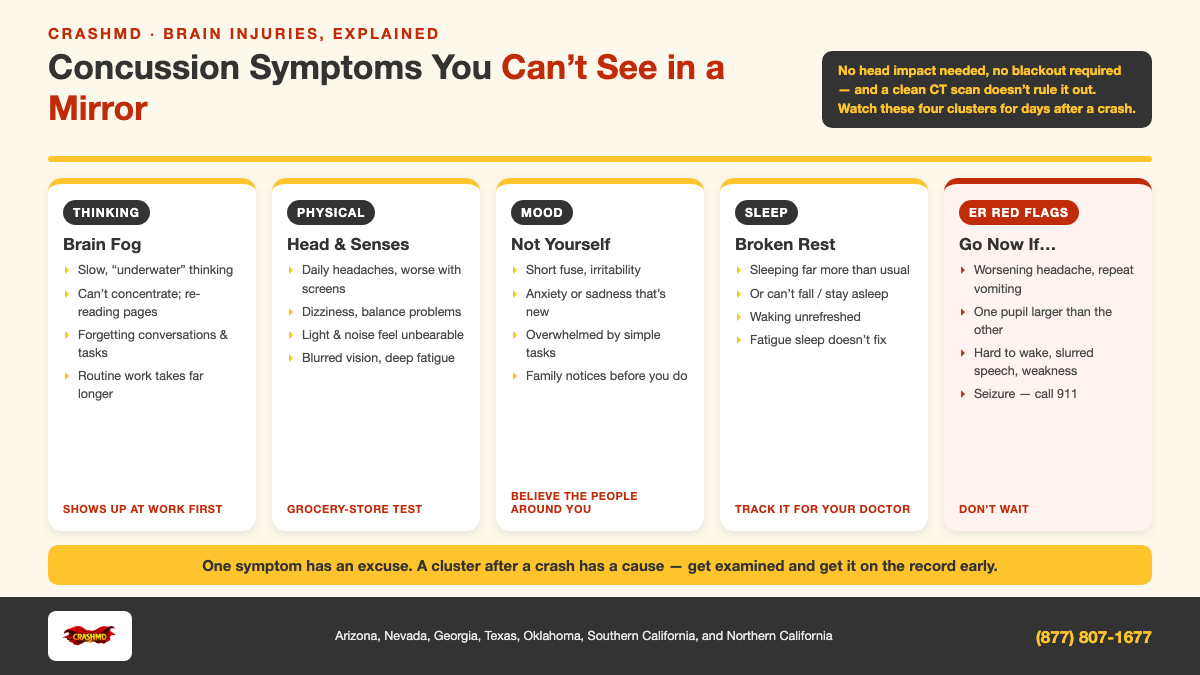
The visible signs — a dazed look, vomiting, stumbling — get attention at the scene. The invisible ones emerge over hours to days, and they’re the ones patients dismiss, hide, or blame on stress. Watch for symptoms in four clusters:
Thinking and memory
- Brain fog — thinking feels slow, effortful, “underwater”
- Trouble concentrating; reading a page twice and retaining nothing
- Forgetting conversations, appointments, why you walked into a room
- Taking far longer to finish routine tasks at work
Physical
- Headaches — often daily, often worse with screens or effort; persistent ones deserve a proper post-traumatic headache workup
- Dizziness, lightheadedness, or balance problems
- Sensitivity to light and noise — the grocery store suddenly feels unbearable
- Blurred vision, eye strain, trouble focusing
- Nausea, fatigue that sleep doesn’t fix
Mood and personality
- Irritability out of proportion — the “short fuse” family notices before you do
- Anxiety, sadness, or emotional swings that don’t feel like you
- Feeling overwhelmed by tasks that used to be automatic
Sleep
- Sleeping much more than usual — or struggling to fall or stay asleep
- Waking unrefreshed no matter how long you slept
Here’s the pattern that makes a concussion after car accident injuries so easy to miss: no single symptom is dramatic. Each one, alone, has an innocent explanation — stress, poor sleep, a hard week. It’s the cluster, arriving in the days after a crash, that tells the story. If the people around you say “you haven’t been yourself since the accident,” treat that sentence as a symptom.
Foggy, irritable, or headachy since your crash?
Those are concussion symptoms, not character flaws. CrashMD physicians can evaluate you this week — often with no upfront cost.
Or call (877) 807-1677 — serving Arizona, Nevada, Georgia, Texas, Oklahoma, Southern California, and Northern California.
Red Flags: When a Head Injury Is an Emergency
Most concussions are managed outside the hospital. But some symptoms after a crash point toward bleeding or swelling in the brain, and they mean the emergency room immediately — not an appointment this week:
- A headache that is severe and getting worse, or one that wakes you from sleep
- Repeated vomiting
- One pupil larger than the other
- Worsening confusion, unusual drowsiness, or difficulty waking up
- Slurred speech, weakness, numbness, or loss of coordination
- Seizures or convulsions
- Any loss of consciousness after the initial event
The risk is higher — and the threshold for the ER lower — for anyone over 65, anyone on blood thinners, and anyone who has had a prior brain injury. When in doubt, go. For a deeper look at the spectrum from concussion to severe injury, see our guide to traumatic brain injury after a car accident.
Why Concussion Symptoms Show Up Late — and Get Dismissed
Like so much crash trauma, a concussion after car accident impacts often declares itself on a delay. Adrenaline and the sheer cognitive noise of a crash — police, tow trucks, insurance calls — mask subtle symptoms for a day or two. Then the demands of normal life expose them: the first full workday reveals the concentration problem, the first grocery run reveals the light sensitivity, the first family dinner reveals the fuse.
And because the symptoms are invisible and self-reported, patients systematically downplay them. Nobody wants to say “my brain isn’t working right.” I’ve had patients describe debilitating brain fog as “just tired” for three visits before their spouse finally spoke up. Please skip that stage: report cognitive, mood, and sleep changes to your doctor in plain words, early. The exam room runs on what you say out loud.
How a Concussion Is Diagnosed and Treated
Diagnosis is clinical: a detailed history of the crash and symptoms, a neurological exam, and standardized cognitive and balance screening. Imaging is used selectively to rule out bleeding when red flags or risk factors are present. There is no blood test or scan that “proves” a routine concussion — which is exactly why a documented early exam matters so much.
Treatment has changed meaningfully in the last decade. The old advice — sit in a dark room until you feel normal — is out. Modern concussion care looks like:
- Relative rest for 24–48 hours, physically and cognitively — then gradual reintroduction of activity
- A stepwise return to work, school, screens, and exercise, advancing as symptoms allow rather than all at once
- Targeted treatment of the pieces: post-traumatic headaches, neck injury (which almost always rides along), vestibular therapy for dizziness and balance, and sleep management
- Monitoring for the minority whose symptoms persist beyond a month — post-concussion syndrome deserves active management, not reassurance alone
Because concussion and neck injury overlap so heavily after a crash, it takes a coordinated plan to untangle which symptoms come from which structure — headaches alone can originate from either. That coordination, across the full range of car accident conditions, is precisely what the physicians in the CrashMD network do every day.
The Medical-Legal Gap: Documenting an Invisible Injury
Here is the hard truth about brain injuries and insurance claims: an injury that doesn’t appear on imaging and relies on self-reported symptoms is the easiest injury to dispute. A concussion after car accident trauma that goes undocumented for three weeks is, on paper, barely distinguishable from no concussion at all — no matter how real your symptoms are.
Early, specific documentation changes that completely. An exam within days of the crash that records “patient reports brain fog, light sensitivity, and new daily headaches since the collision” creates a contemporaneous medical record tying the symptoms to the event. Follow-up visits that track the symptoms’ course turn a deniable story into an evidence trail. This is the same medical-legal gap CrashMD was built around — delayed symptoms, invisible injuries, and records that either protect you or don’t — applied to the one organ where it matters most. And as always: for how any of this affects your specific claim, talk to a licensed attorney. My job is the medicine and the record; the legal strategy is theirs.

Frequently Asked Questions
Can you get a concussion after car accident trauma without hitting your head?
Yes. A concussion is caused by the brain accelerating and decelerating inside the skull, and crash forces can do that through whiplash motion alone — no head contact required. If you have concussion symptoms after a crash, the absence of a bump, bruise, or airbag strike does not rule anything out. Report the symptoms and get examined.
How long after a car accident can concussion symptoms appear?
Many people notice symptoms within hours, but it commonly takes one to several days — adrenaline masks the early signs, and some problems only surface when you return to work, screens, and normal cognitive load. Symptoms emerging within the first week of a crash are very plausibly connected to it; the sooner they’re documented, the more clearly that connection holds.
How long does a concussion after car accident injuries take to heal?
Most adults recover within two to four weeks with appropriate management — early relative rest, then a stepwise return to activity. A meaningful minority have symptoms lasting beyond a month (post-concussion syndrome), and co-existing neck injury or post-traumatic headaches can stretch the timeline. Persistent symptoms warrant active treatment, not just waiting.
Do I need a brain scan after a car accident concussion?
Not always. CT scans exist to rule out bleeding and fracture when red flags or risk factors are present — they do not show a typical concussion, and a normal scan doesn’t exclude one. The diagnosis is made clinically, from your history, symptoms, and neurological exam. Your physician will decide whether imaging is warranted; your job is to report every symptom honestly, including the invisible ones.
The Bottom Line
A concussion after car accident forces is real, common, and routinely missed — because it hides behind a clean CT, an intact scalp, and symptoms you can explain away one at a time. Don’t grade your brain injury in a mirror. If thinking, mood, sleep, or sensory tolerance changed in the days after your crash, say so out loud, get examined, and get it on the record — early. Your recovery and your claim both depend on the injury being seen, even though it can’t be.
The injury is invisible. The record shouldn’t be.
CrashMD physicians evaluate and document crash-related concussions every day — with coordinated care and no upfront cost options.
Or call (877) 807-1677 — serving Arizona, Nevada, Georgia, Texas, Oklahoma, Southern California, and Northern California.
— Dr. Adam Savage is a pain management physician with CrashMD in Oklahoma. Connect with him on LinkedIn.
This article is for educational purposes only and is not medical advice. It does not create a doctor-patient relationship, and it is not legal advice. Consult a licensed physician about your symptoms and a licensed attorney about any legal questions.