

What You Need to Know About a Fractured Scapula
A fractured scapula — also called a broken shoulder blade — is a serious injury that almost always results from extreme force.
Quick answers:
- What is it? A break in the scapula, the triangular bone that sits at the back of your shoulder
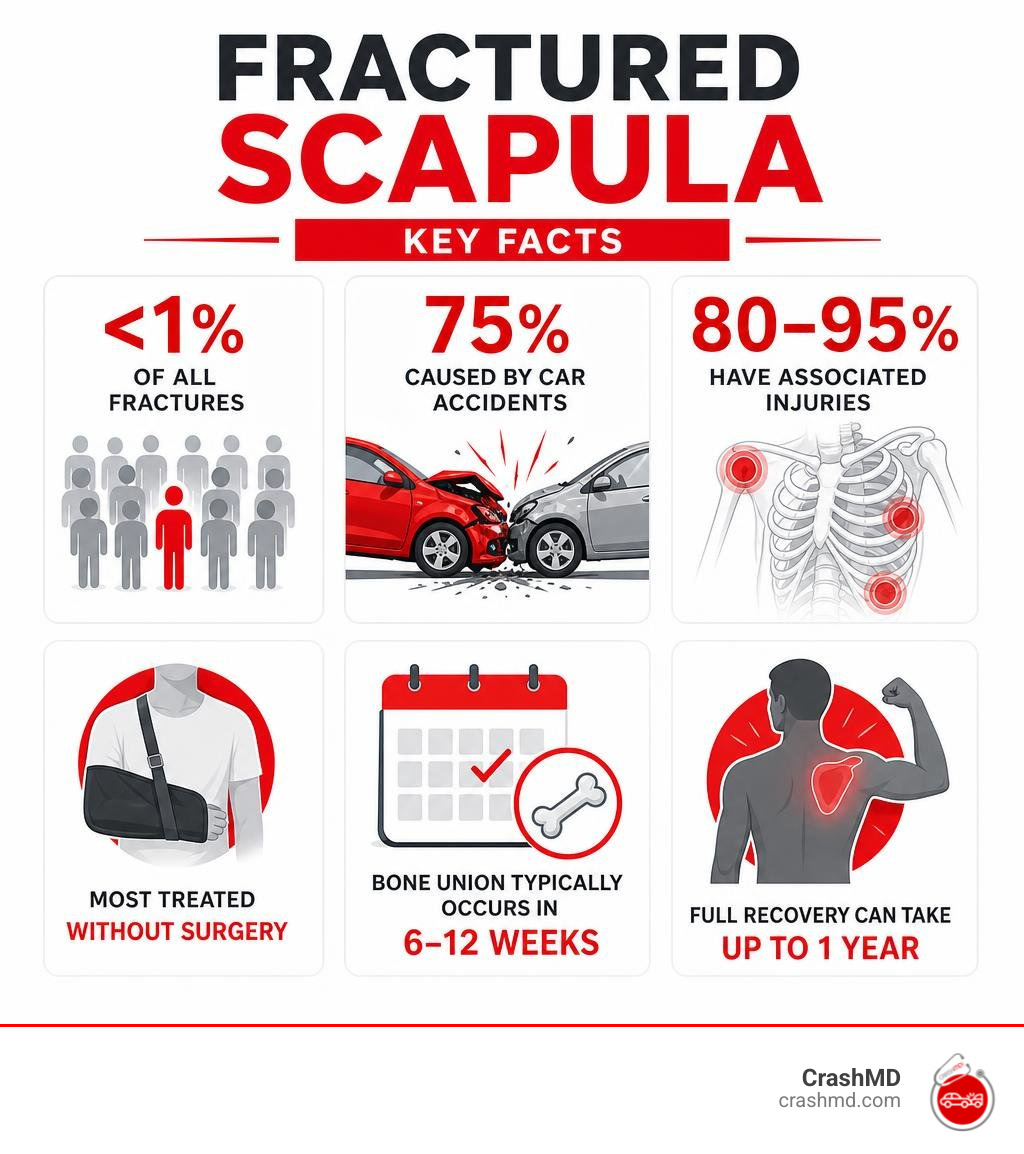
- How common is it? Fewer than 1% of all fractures — it takes significant trauma to break this bone
- What causes it? Mostly high-speed car and motorcycle collisions (about 75% of cases)
- Main symptoms? Severe pain when moving the arm, swelling, bruising, and limited shoulder mobility
- How is it treated? Most cases heal without surgery, using a sling and physical therapy
- How long to recover? Bone union typically occurs in 6–12 weeks; full strength and mobility can take up to a year
I’m Dr. Adam Savage, and I see this injury regularly in patients who’ve been through serious car accidents. What makes scapula fractures so significant isn’t just the broken bone itself — it’s what usually comes with it.
In roughly 80–95% of cases, a fractured scapula is accompanied by other injuries. Rib fractures, lung injuries, head trauma, and nerve damage are all common companions. That means the shoulder blade injury is often just one piece of a much larger, more complex picture.
The scapula is deeply protected by layers of muscle and sits nestled against your ribcage. It takes enormous force to fracture it. So if you’re dealing with this injury, your body has been through something significant — and you deserve a clear understanding of what’s happening and what comes next.
What is a Fractured Scapula and What Causes It?
The scapula is a flat, triangular bone located at the upper back that connects the humerus (upper arm bone) to the clavicle (collarbone). It plays a vital role in shoulder movement, serving as the anchor point for 18 different muscles. Because the scapula is encased in a thick, highly vascular cushion of rotator cuff and chest muscles, it is incredibly well-protected.
In fact, according to Scientific research on scapula fractures, these injuries represent less than 1% of all broken bones and only 3% to 5% of all shoulder girdle fractures. When a fracture does occur, it is a clear indicator that a massive amount of kinetic energy has been transferred to the patient’s body. If you want to dive deeper into identifying these signs immediately after an accident, check out our Ultimate Guide To Fractured Scapula Symptoms.
Common Causes of a Fractured Scapula
Because of its natural muscular armor, a fractured scapula is almost always the result of high-energy, blunt-force trauma. The most common mechanisms include:
- Motor Vehicle Collisions: High-speed car crashes, motorcycle accidents, and pedestrian-versus-car impacts account for over 70% of these fractures.
- Falls from Heights: Falling from a ladder, roof, or scaffolding directly onto the back or side of the shoulder.
- Direct Impact: A heavy blow from a falling object or sports-related impacts (such as high-impact equestrian or skiing accidents).
- Associated Injuries: Because of the sheer force required to break the scapula, up to 95% of patients present with other traumatic injuries. It is incredibly common to see ipsilateral rib fractures (occurring in 53% of cases), pulmonary injuries like a pneumothorax or hemothorax (in over 30% of cases), head trauma, spine fractures, or a fractured clavicle.
Anatomy of the Shoulder Blade and Fracture Locations
The shoulder girdle is a complex anatomical structure where the scapula acts as the central hub. To understand how a fractured scapula impacts your mobility, we have to look at its specific regions.
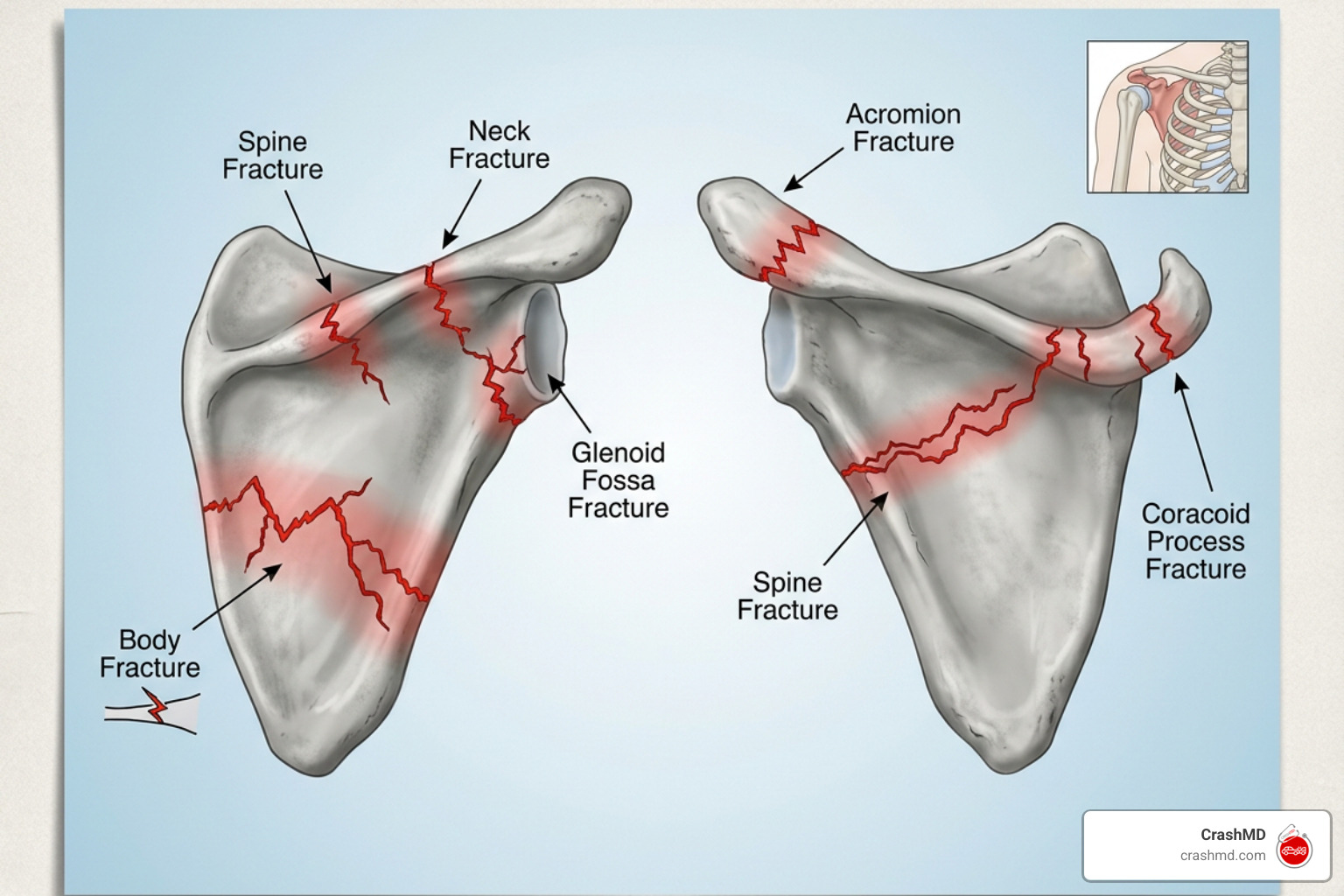
The anatomy of a scapular break is highly variable. According to a Detailed review of scapular anatomy, fractures are classified based on where they occur on the bone:
- Scapular Body and Spine: This is the flat, broad part of the bone. Fractures here are the most common, accounting for 50% to 60% of all cases. Fortunately, because of the rich blood supply from the surrounding muscles, these fractures heal remarkably well.
- Scapular Neck: Accounting for roughly 25% of cases, these fractures occur just below the shoulder socket.
- Glenoid Fossa: This is the “socket” of the shoulder’s ball-and-socket joint. Glenoid fractures make up about 10% to 30% of cases and are particularly complex because they involve the cartilage of the joint surface.
- Acromion Process: The bony projection at the top of the shoulder that connects to the collarbone, representing about 8% of fractures.
- Coracoid Process: A hook-like projection on the front of the scapula, accounting for roughly 7% of cases.
Extra-Articular vs. Intra-Articular Fractures
The most critical distinction an orthopedic specialist makes is whether a fracture is extra-articular (outside the joint) or intra-articular (inside the joint).
Extra-articular fractures, such as those of the scapular body, do not affect the smooth cartilage of the shoulder joint. Because the joint itself remains intact, these fractures have high displacement thresholds and are almost always treated conservatively.
Intra-articular fractures involve the glenoid socket. If the fracture fragments are displaced, they create a step-off in the joint. Even a minor misalignment of more than 4 to 5 millimeters can disrupt joint stability, restrict movement, and lead to early-onset arthritis if not surgically corrected.
Recognizing the Symptoms of a Broken Shoulder Blade
Following a major accident, a fractured scapula presents with immediate, unmistakable physical signs.
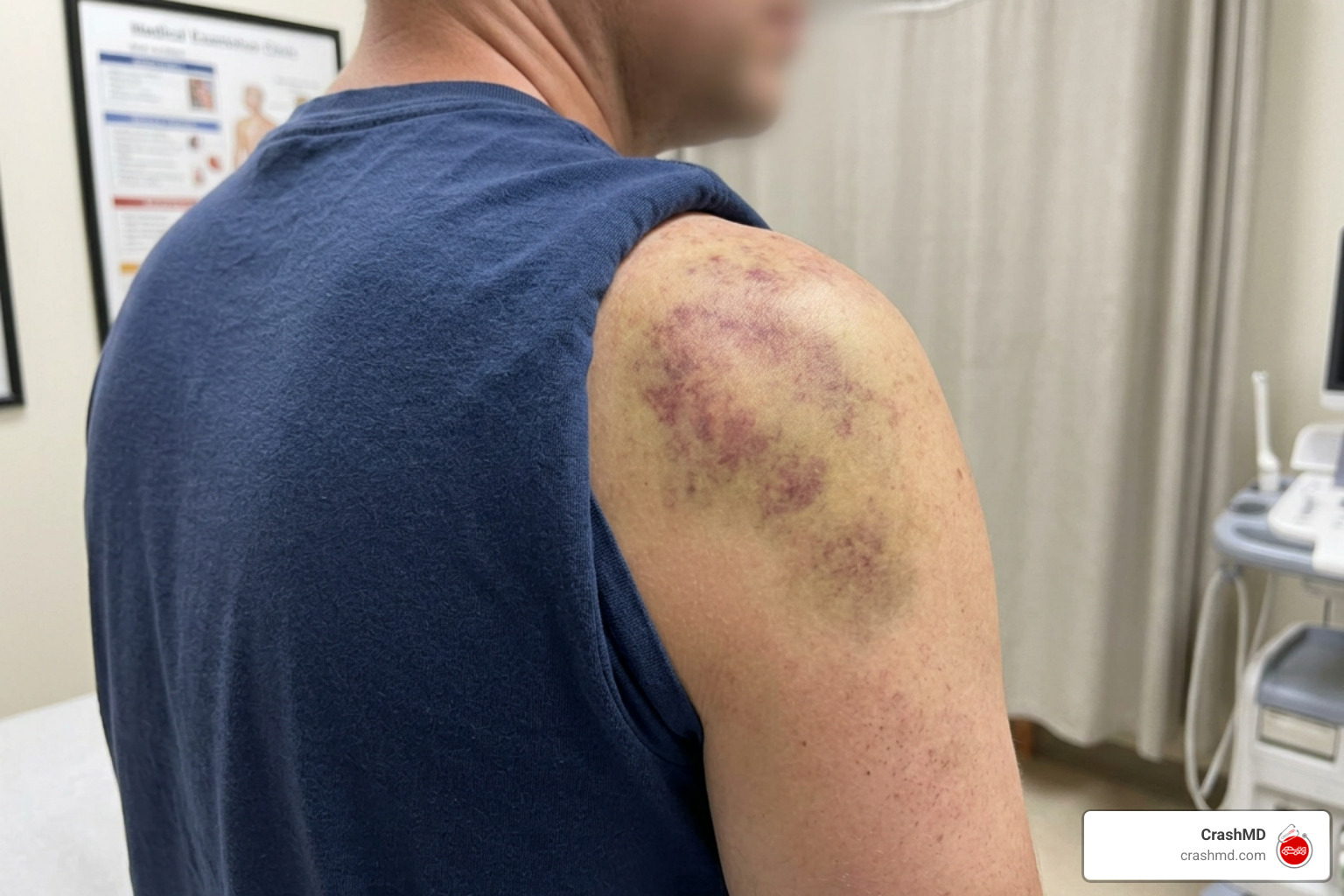
The most common signs include:
- Extreme Pain: Severe pain that spikes instantly upon injury, even when the arm is at rest.
- Swelling and Bruising: Rapid swelling and severe bruising over the back of the shoulder blade, which may spread down the back or arm over several days.
- Limited Mobility: An absolute inability to lift or move the injured arm.
- Popping or Grating Sound: A distinct grinding or cracking sensation (crepitus) when attempting to move the shoulder.
Primary Symptoms of a Fractured Scapula
Beyond the general signs of trauma, there are specific clinical symptoms that point directly to a scapular injury:
- Pain with Arm Movement: Any attempt to abduct (lift) the arm away from the body causes agonizing pain. Patients will instinctively hold their injured arm tightly against their side.
- Localized Tenderness: Extreme tenderness when pressing directly on the bone at the back of the shoulder.
- Shoulder Deformity: In displaced fractures, the shoulder may appear slumped, flattened, or asymmetrical compared to the uninjured side.
- Numbness and Nerve Assessment: Because the brachial plexus (the main nerve bundle supplying the arm) passes close to the shoulder blade, 5% to 13% of scapular fractures involve nerve injuries. Doctors must carefully assess the arm for numbness, tingling, or weakness.
How Doctors Diagnose and Classify Scapular Fractures
Diagnosing a scapular fracture requires a high index of suspicion, especially in polytrauma patients. Because emergency room doctors are often focused on life-threatening chest or head injuries, scapular fractures are a well-documented diagnostic pitfall. In fact, a Clinical review on scapula fractures notes that up to 43% of scapular fractures are initially missed on standard chest X-rays.
Imaging Protocols (X-Ray, CT, and MRI)
To ensure an accurate diagnosis, specialized imaging is required:
- X-Rays: A dedicated “scapula series” is performed. This includes a true Anteroposterior (AP) view, a Grashey AP view (to look directly at the joint space), a scapular Y view, and an axillary lateral view.
- CT Scans: If a fracture is detected or highly suspected, a 3D Computed Tomography (CT) scan is the gold standard. CT scans allow surgeons to visualize the exact fracture lines, measure displacement, and check for joint involvement.
- MRI: While rarely used for the bone itself, an MRI may be ordered if there is suspected soft-tissue damage, such as a rotator cuff tear or a labral tear.
Classification Systems Guiding Treatment
Orthopedic specialists rely on specific classification systems to guide treatment decisions:
- Ideberg Classification: Used exclusively for intra-articular glenoid fractures (Types I through VI) to determine if the shoulder socket requires surgical reconstruction.
- AO-OTA System: A comprehensive system used by trauma surgeons to categorize fractures based on location and complexity.
- Kuhn (Acromion) & Ogawa (Coracoid) Classifications: Specialized systems that evaluate fractures of the scapular projections.
- Glenopolar Angle (GPA): A critical radiographic measurement. A normal GPA is between 30° and 45°. If a fracture causes the GPA to drop below 20° to 22°, it indicates severe rotational deformity of the socket, which usually requires surgery.
Treatment and Rehabilitation for a Scapular Fracture
The good news is that over 90% of scapular fractures are minimally displaced and can be successfully treated without surgery. For a detailed breakdown of what to expect during recovery, read The Definitive Guide To Healing Time For Broken Scapula.
Below is a comparison of how non-surgical and surgical treatment pathways differ:
| Feature | Non-Surgical Treatment | Surgical Treatment (ORIF) |
|---|---|---|
| Indications | Minimally displaced body/neck fractures | Displaced joint fractures, “floating shoulder” |
| Primary Method | Sling immobilization (2–3 weeks) | Plates and screws (internal fixation) |
| Initial Movement | Passive motion within 1st week | Guided passive motion at 2–6 weeks |
| Hospital Stay | Outpatient / Conservative monitoring | 1–2 days post-op |
| Active Therapy | Starts around week 6 | Starts around week 6 |
| Expected Outcome | 86% good to excellent functional recovery | Excellent restoration of joint mechanics |
Indications for Surgical Intervention (ORIF)
While conservative care is the norm, surgical intervention via Open Reduction and Internal Fixation (ORIF) is absolutely necessary under specific circumstances. According to the Orthobullets Scapula Fracture Guide, surgical indications include:
- Articular Step-off: A displacement of 4 to 5 millimeters or more within the glenoid socket.
- Severe Neck Displacement: Translation of greater than 1.5 to 2 centimeters, or angulation greater than 40°.
- Low Glenopolar Angle: A GPA of less than 20°.
- Floating Shoulder: A double disruption of the superior shoulder suspensory complex (SSSC) — typically a combined clavicle fracture and scapular neck fracture — which leaves the shoulder joint completely unstable.
Rehabilitation Protocol and Recovery Timeline
Recovering from a fractured scapula is a gradual process. Whether you have surgery or heal conservatively, a structured physical therapy program is essential.
- Phase 1 (Weeks 0–3): Focuses on pain management and immobilization. However, to prevent a “frozen shoulder,” patients are encouraged to perform gentle, passive pendulum exercises and active movement of the elbow, wrist, and hand.
- Phase 2 (Weeks 3–6): Active-assisted exercises begin. Patients use their uninjured arm or a pulley to gently guide the injured shoulder through its range of motion.
- Phase 3 (Weeks 6–12): Active range-of-motion exercises progress. This is also when bone union typically occurs, and patients can begin light, daily functional activities.
- Phase 4 (Months 3+): Once imaging confirms complete bone healing, progressive strength training begins. For a comprehensive guide on recovering after a motor vehicle accident, refer to our Car Accident Physical Therapy Guide.
During the recovery phase, proper nutrition is key. Many patients find it highly beneficial to review The Complete Guide To Supplements For Fractures and consult an In-Depth Guide To Calcium Tablets For Bone Healing to optimize their bone health.
Frequently Asked Questions about Scapular Fractures
How long does it take for a scapula fracture to heal?
The bone itself typically achieves union within 6 to 12 weeks. However, because the surrounding muscles undergo significant trauma and atrophy during immobilization, recovering full muscle strength, flexibility, and joint mobility usually takes 6 months to a year.
Can you fully recover from a broken shoulder blade without surgery?
Yes. Over 90% of patients recover fully without surgery. Because the scapula is surrounded by a robust network of muscles, the body can adapt remarkably well. With dedicated physical therapy, the vast majority of non-surgical patients achieve excellent functional outcomes with little to no long-term limitations.
What are the long-term complications of a scapula fracture?
Potential complications include malunion (the bone healing in an abnormal position), which can alter shoulder mechanics and cause chronic pain or rotator cuff weakness. Displaced intra-articular fractures that are left untreated can lead to post-traumatic arthritis in the shoulder joint. Additionally, initial nerve stretching can sometimes lead to prolonged weakness in the arm, though most mild nerve injuries resolve on their own over several months.
Conclusion
A fractured scapula is a clear signal that your body has endured a high-impact trauma. Because these injuries are so frequently accompanied by other serious medical issues, getting a prompt, highly accurate diagnosis from a specialist is absolutely critical.
I’m Dr. Adam Savage, and at CrashMD, we specialize in guiding accident victims through the complex journey of post-accident medical care. We don’t just focus on immediate pain management and creating tailored treatment plans — we also understand the legal and logistical hurdles you face. Our team specializes in patient advocacy and meticulously documenting your injuries to support your legal case, ensuring you can focus entirely on a comprehensive physical recovery.
If you or a loved one are recovering from a car accident in Arizona, Nevada, Texas, Oklahoma, or California, don’t leave your recovery to chance. Schedule a consultation with CrashMD today, and let us help you rebuild your strength and protect your future.