

Why Medical Records Can Make or Break Your Injury Claim
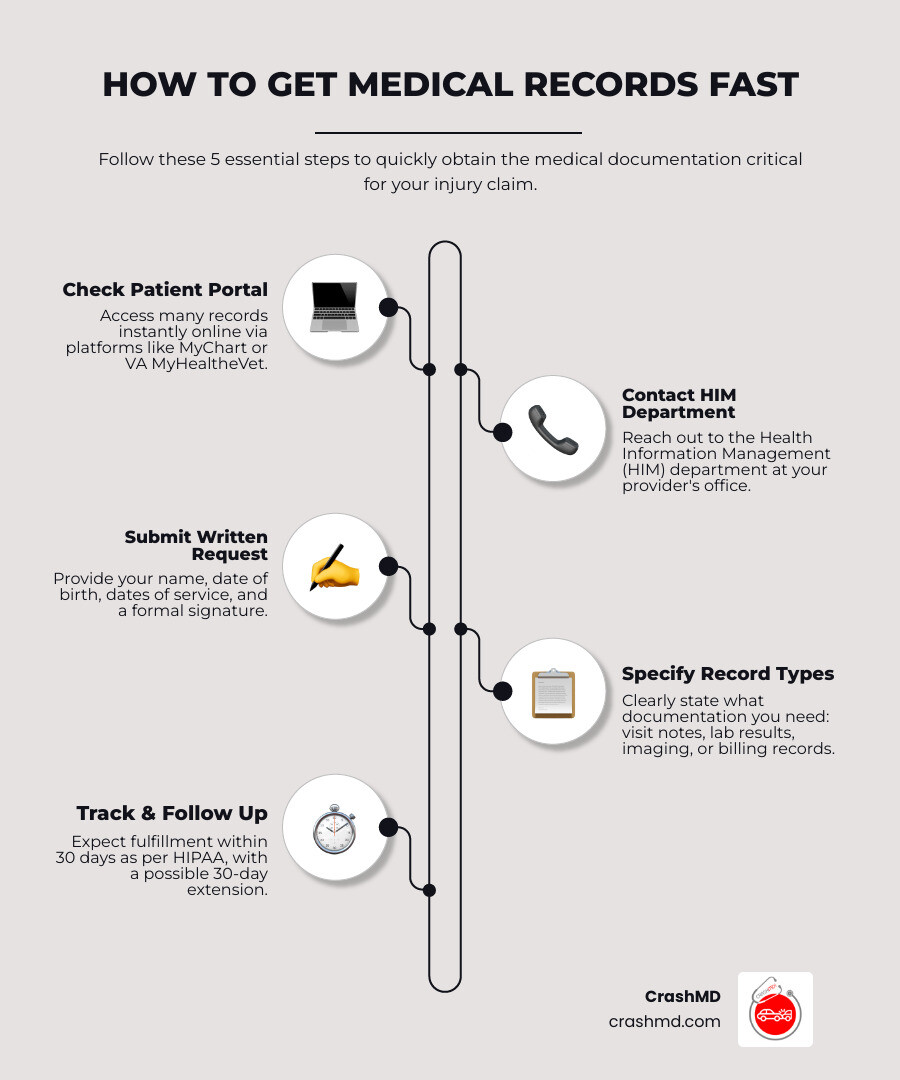
To get medical records, follow these steps:
- Check your patient portal first (e.g., MyChart) — many records are available instantly online
- Contact the Health Information Management (HIM) department at your provider’s office or hospital
- Submit a written request with your name, date of birth, dates of service, and a signature
- Specify what you need — visit notes, lab results, imaging, billing records
- Wait up to 30 days for fulfillment (HIPAA’s legal deadline), though electronic records often arrive much faster
I’m Dr. Adam Savage, and I’ve seen how a missing page in a medical file can derail an entire injury claim.
After a car accident, you’re already dealing with pain, stress, and a flood of paperwork. The last thing you need is a bureaucratic maze standing between you and the documentation that proves your injuries are real.
Your medical records are the foundation of your case. Without them, insurance companies can — and will — question the severity of your injuries, dispute treatment costs, or deny your claim entirely.
The good news? Under federal law (HIPAA), you have a clear legal right to access your own medical records. Providers are required to give you copies. They cannot refuse just because you have an unpaid bill. And in most cases, electronic records are free or very low cost.
But knowing your rights and knowing how to act on them quickly are two different things. This guide walks you through both.
Essential get medical records terms:
Understanding Your Legal Right to Get Medical Records

The cornerstone of your ability to get medical records is the Health Insurance Portability and Accountability Act, commonly known as HIPAA. Specifically, the HIPAA Privacy Rule grants you the right to inspect and obtain copies of your health information.
Under federal law, this information is stored in what is called a “Designated Record Set.” This isn’t just a fancy term for your doctor’s notes; it includes a wide array of data that we use to make decisions about your care.
What is Included in Your Records?
When you request your files, you are entitled to:
- Clinical Notes: The actual observations and treatment plans written by your doctors.
- Billing Records: Crucial for proving the financial “damages” in your injury claim.
- Radiology Images: X-rays, MRIs, and CT scans (often provided on a CD or via a digital link).
- Lab Results: Blood work and diagnostic tests.
- Wellness Program Info: Any data related to your participation in health programs.
Who Can Request These Records?
Generally, only you or your personal representative has the legal right to access your health information. A personal representative is someone with the legal authority to make healthcare decisions for you, such as a parent of a minor or someone with a healthcare Power of Attorney.
| Access Type | Who Can Request | Fee Limits Apply? |
|---|---|---|
| Patient Access | You or your legal guardian | Yes (Strictly Limited) |
| Third-Party Authorization | An attorney or insurance company | No (Higher Fees Possible) |
It is important to note that while a provider can share your information with other doctors for treatment or payment without a specific form, they must give you a copy if you ask for it. Even if you have an outstanding balance on your medical bill, the provider cannot legally withhold your records as leverage for payment.
The Fastest Ways to Access Documentation Online
You don’t always have to wait for a packet in the mail. The fastest way to get medical records is through a patient portal.
Using Patient Portals (MyChart and Beyond)
Most major health systems in states like Texas, California, and Arizona use platforms like MyChart. If you login to your patient portal, you can often see clinical notes the moment they are signed and lab results within hours of finalization.
For those who need to share this data with a new specialist or a chiropractor immediately, features like “Share Everywhere” allow you to generate a temporary code. This gives a provider one-time access to your records without a formal, weeks-long request process.
Veteran and Military Records
If you are a Veteran or an active-duty service member, your process is slightly different but very streamlined.
- VA Patients: You can use MyHealtheVet to download your “Blue Button” report, which contains a comprehensive history of your VA care.
- Mobile Access: You can also get the Share My Health Data app to track and share your vitals and records directly with your care team.
Digital downloads are almost always free and are usually the preferred method for injury claims because they are easy to organize and transmit to your legal team.
How to Submit a Formal Request to Get Medical Records
While portals are great for quick reviews, an injury claim often requires a “certified” or “complete” medical record that a portal might not provide. In these cases, you must submit a formal written request to the Health Information Management (HIM) department (sometimes called the Release of Information or ROI office).
What to Include in Your Request
To ensure your request isn’t rejected, it must be complete. You can often find a specific form on the provider’s website (available in English and Español), or you can write a letter. Your request must include:
- Patient Identification: Your full name, date of birth, and Social Security number (optional but helpful).
- Contact Information: Your current address and phone number.
- Specific Date Ranges: Don’t just ask for “everything.” Specify the dates related to your accident to speed up the process.
- Type of Records: Be specific if you need radiology images, billing, or itemized statements.
- Format Preference: State whether you want them via email, fax, CD, or paper.
- Signature: This is non-negotiable. It must be a “wet” signature or a verified electronic signature.
Where to Send the Request
Each hospital system has a centralized office. For example, some large systems prefer you use an online Public Records Portal or a specific PO Box. If you are a legal guardian or have Power of Attorney, you will need to upload your notarized verification documents alongside the request.
Timelines, Fees, and State-Specific Regulations
How long will it take to get medical records? HIPAA sets the “outer limit” at 30 calendar days. If the records are archived off-site, the provider can request one 30-day extension, but they must notify you in writing of the reason for the delay.
Understanding the Costs
The days of being charged $5.00 per page are mostly over for patients.
- Electronic Records: HIPAA suggests a flat fee of approximately $6.50 for electronic copies of records maintained electronically.
- Paper Records: Providers can charge for the actual labor of copying and the cost of supplies (toner, paper) and postage.
- Prohibited Fees: A provider can never charge you a “search and retrieval” fee. They can only charge for the actual creation and delivery of the copy.
State-Specific Caps
While HIPAA provides a federal baseline, some states have even stricter protections. For instance, while we operate in the Southwest and California, it’s helpful to know that some regions limit fees to as little as $0.65 per page. In states like Texas and California, the standard processing time is often closer to 15 business days rather than the full 30 allowed by federal law.
If you receive an invoice, many systems now allow you to pay online via credit card to speed up the release of your files.
Frequently Asked Questions About Medical Documentation
Can I be denied access to get medical records?
Yes, but only in very narrow circumstances. You generally do not have a right to access:
- Psychotherapy Notes: These are kept separate from your medical and billing records.
- Legal Proceedings: Information compiled specifically for use in a civil, criminal, or administrative action.
- Safety Concerns: If a licensed professional determines that giving you the records is “reasonably likely to endanger the life or physical safety” of you or someone else.
If you are denied, the provider must give you a written explanation. Some denials are “reviewable,” meaning you can ask for a second opinion from a different healthcare professional. You can also refer to State law (RCW 70.02) or similar statutes in your specific state for additional protections.
What if I get medical records that are incorrect?
It happens more often than you’d think—a wrong date of birth, a typo in the accident description, or a missed diagnosis. If you spot an error, you have the right to request an amendment. The provider must respond to your request. If they agree the info is wrong, they will update it. If they disagree, they must still allow you to submit a “statement of disagreement” that becomes a permanent part of your health record. This is vital because your health information, your rights include ensuring that the story told by your records is accurate.
How do I direct records to my attorney?
You have the right to direct your records to any third party, including your lawyer. To do this, you must provide a written, signed request that clearly identifies the recipient and where to send the files. When you initiate this request, the HIPAA fee limits (like that $6.50 flat fee) still apply. However, if your attorney initiates the request on their own with your authorization, the provider may charge higher “commercial” rates. Always learn how to protect your personal information before sending sensitive data to third parties.
Conclusion
Getting your medical records shouldn’t be the hardest part of your recovery. These documents are the lifeblood of a successful injury claim—they provide the “proof” that transforms your pain and suffering into a documented legal case.
At CrashMD, we understand that you should be focused on healing, not chasing down hospital administrators. We specialize in advocating for accident victims in Arizona, Nevada, Texas, Oklahoma, and California. Our goal is to ensure your injuries are comprehensively documented from day one, giving you the best possible foundation for your recovery and your claim.
If you’re struggling to navigate the aftermath of an accident, don’t go it alone. Schedule a consultation with our motor vehicle accident doctors today, and let us help you put the pieces back together.