

Knowing what to do after a car accident can shape the next six months of your life — your health, your recovery, and, if it comes to that, your legal claim. I’m Dr. Adam Savage, a CrashMD pain management physician, and in my years of treating crash injuries I’ve learned that the first 72 hours are where good outcomes are won or lost. Not because every injury is an emergency, but because the decisions you make in those three days — whether you get examined, what gets written down, and who writes it — tend to echo for a very long time. This guide walks you through those 72 hours, hour by hour, from a physician’s point of view.
One note before we begin: this article is educational and is not medical advice. Every crash and every body is different, and nothing here replaces an in-person evaluation by a licensed physician. Where I touch on insurance and injury claims, that is general information, not legal advice — for legal questions, talk to a licensed attorney in your state.
What to Do After a Car Accident: Why the First 72 Hours Matter
Here’s the pattern I see over and over in my clinic. A patient walks away from a collision feeling shaken but “fine.” They skip the medical visit. Three days later their neck locks up, the headaches start, and now they’re facing two problems instead of one: an injury that got a head start, and a gap in the medical record that an insurance adjuster may later point to as evidence the crash didn’t hurt them.
The biology behind this is well known to anyone who treats car accident injuries. In the moments after a crash, your body is often flooded with adrenaline and other stress hormones, which can mask pain. Inflammation from soft tissue injuries — strained muscles, stretched ligaments, irritated joints and nerves — typically builds over 24 to 72 hours, not minutes. So the way you feel at the scene is often the best you will feel all week. That’s why the first 72 hours deserve a plan.
Let’s walk through it.
Hour 0 to 1: At the Scene
Your health comes first, before photos, before phone calls, before anything.
- Check yourself and your passengers. If anyone has severe pain, trouble breathing, heavy bleeding, confusion, or lost consciousness — even briefly — call 911 and let emergency responders take over. Don’t try to tough out symptoms like these.
- Move to safety if you can. If the vehicles are drivable and you’re on an active roadway, getting out of traffic prevents a second collision, which is a real and underappreciated danger.
- Accept the paramedic evaluation. If EMS arrives, let them look you over even if you feel okay. Their run report becomes the first entry in your medical record, and declining evaluation at the scene can later be framed as evidence you weren’t hurt.
- Document the scene. Once you’re safe, photograph vehicle damage, the positions of the cars, skid marks, road conditions, and any visible injuries. Exchange insurance and contact information, and get names of witnesses.
- Report the crash. A police report creates an official record of what happened, when, and to whom. Requirements vary by state, but in general a documented crash is far easier to deal with later than an undocumented one.
What I ask patients to avoid at the scene: declaring “I’m fine” repeatedly and on camera. You don’t need to dramatize anything — just be honest and measured. “I’m shaken up and I’ll be getting checked out” is accurate, and it doesn’t commit you to a conclusion about your body that no one, including you, can responsibly make within an hour of impact.
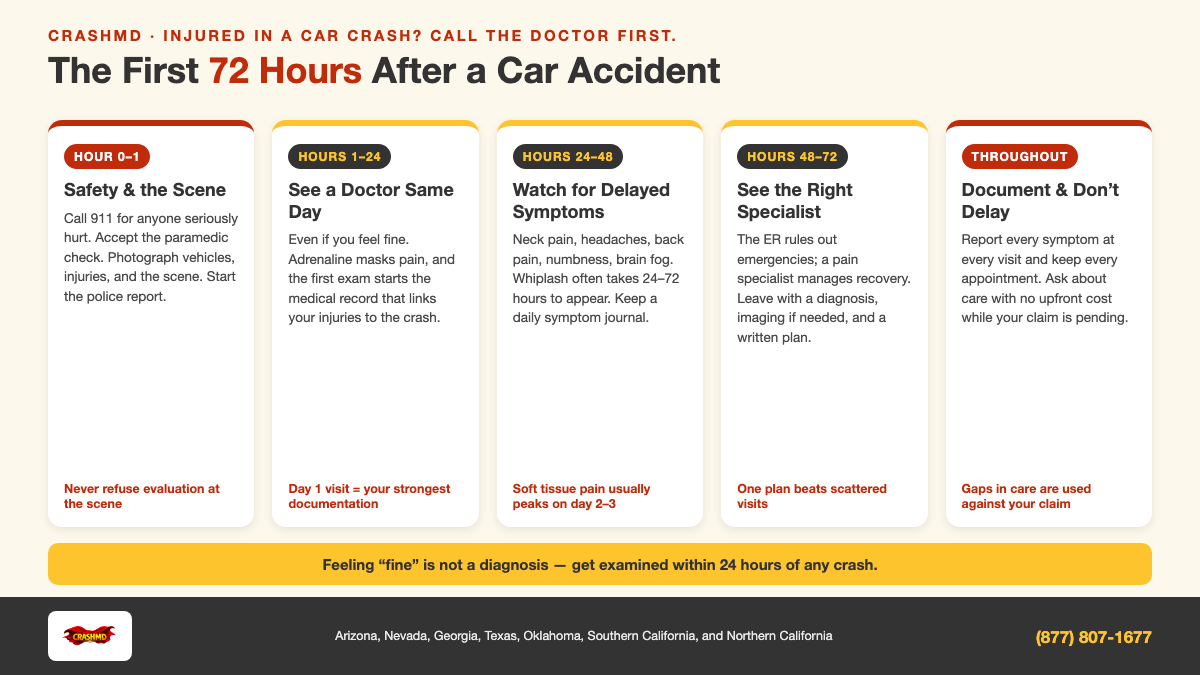
Hours 1 to 24: Get Examined Even If You Feel Fine
This is the single most important step in the entire 72-hour window, and it’s the one most people skip. See a doctor on day one — the same day as the crash whenever possible.
Where you go depends on how you feel:
- Emergency room: for red-flag symptoms — severe or worsening headache, repeated vomiting, confusion or unusual drowsiness, weakness or numbness in your arms or legs, loss of bladder or bowel control, chest pain, shortness of breath, or abdominal pain that’s getting worse. These can signal injuries that need imaging and immediate attention, including traumatic brain injury or internal trauma.
- Urgent care or a crash-injury physician: for everything else — soreness, stiffness, mild headache, anxiety, or simply “I was in a crash and want to be checked.” A physician who regularly treats car accident injuries knows what to look for and, just as importantly, what to write down.
During that first visit, be thorough and honest about every symptom, however minor it seems. The sore spot on your knee, the ringing in your ears, the fact that you feel foggy — mention all of it. Symptoms that seem trivial on day one sometimes turn out to be the first sign of something that needs treatment, and a symptom that was never recorded is, from a documentation standpoint, a symptom that never happened.
Been in a crash in the last 72 hours?
Our physicians evaluate car accident injuries, build a treatment plan, and document everything properly — often with no upfront cost to you.
Or call (877) 807-1677 — serving Arizona, Nevada, Georgia, Texas, Oklahoma, Southern California, and Northern California.
Hours 24 to 48: Watch for Delayed Symptoms
Day two is when the adrenaline is gone and inflammation is arriving. This is typically when delayed symptoms show up, and it’s why part of knowing what to do after a car accident is simply knowing what to watch for:
- Neck pain and stiffness — often the first sign of whiplash, which frequently takes 24 to 72 hours to fully declare itself.
- Headaches — can reflect muscle strain, a concussion, or irritation of the joints and nerves of the upper neck.
- Back pain — low back strain and disc irritation commonly worsen on day two or three.
- Numbness or tingling in the arms or hands — can suggest a nerve is being irritated or compressed and deserves prompt evaluation.
- Bruising and swelling — deep bruising often surfaces a day or more after impact.
- Cognitive and mood changes — brain fog, irritability, poor sleep, or anxiety behind the wheel. These are real injuries too, and they respond better to early care.
Keep a simple symptom journal starting day one. A few lines each day — what hurts, how much on a 0-to-10 scale, what makes it better or worse, how you slept. In my experience this helps your physicians tune your treatment, and it creates a contemporaneous record that’s far more credible than trying to reconstruct your symptoms from memory weeks later.
If new symptoms appear during this window, don’t wait for your scheduled follow-up. Call your doctor and report them, so the record reflects when they actually started.
Hours 48 to 72: See the Right Specialist
By day three, you should have a sense of what your body is telling you. This is the point where the right specialist matters. Emergency rooms are outstanding at ruling out life-threatening injuries, but their job ends there — they are not set up to manage the weeks of recovery that follow a crash. A pain and musculoskeletal specialist picks up where the ER leaves off.
At this stage, a specialist evaluation typically includes:
- A detailed physical exam focused on the spine, joints, and nervous system
- Imaging when the exam calls for it — X-rays for suspected fractures, MRI when disc or nerve injury is a concern
- A working diagnosis and a written treatment plan, which may include physical therapy, medication, targeted injections, or referral to other specialists
- Clear documentation connecting your injuries to the crash
Our CrashMD physicians are board-certified specialists who focus on exactly this phase of care, and the full range of car accident treatments — from conservative therapy through advanced interventional options — can be coordinated through one plan rather than a scattering of disconnected visits.
Documentation: The Step That Protects Your Health and Your Claim
I call this the medical-legal gap, and it’s the part of crash recovery almost nobody explains to patients. Insurance claims and injury cases are decided largely on the medical record. Not on how much pain you were truly in — on what was documented, when, and by whom.
Three documentation principles I give every patient:
- Start the record early. A medical visit within 72 hours creates a timeline that links your symptoms to the crash. Long gaps between the accident and your first visit are routinely used to argue that something else caused your injury.
- Be complete and consistent. Report every symptom at every visit. Records that mention neck pain on day one, omit it on day ten, and bring it back on day thirty read as inconsistent — even when the real story is simply that nobody asked.
- Follow the plan. Missed appointments and abandoned therapy are read as evidence that you weren’t really hurt. If cost or logistics are getting in the way, tell your care team — there are usually options.
To be clear, none of this is about building a case — it’s about telling the truth in a form that holds up. Good documentation protects honest patients. And again: for how documentation plays into any specific claim, that’s a question for an attorney, not a blog post.
Treatment Without Upfront Cost: Don’t Let Money Delay Care
The second reason people skip early care — after “I feel fine” — is money. They’re worried about deductibles, or they’re uninsured, or they assume nothing can happen until insurance companies finish arguing about fault.
Please don’t let that delay your evaluation. Depending on your state and situation, there are several paths to getting treated now rather than later: medical payments coverage on your own auto policy, your health insurance, and — for people with a pending injury claim — treatment on a medical lien, where the physician agrees to be paid from the eventual settlement rather than upfront. At CrashMD, helping patients find the path that fits their situation is a routine part of what we do, because an injury that goes untreated for financial reasons tends to become a bigger injury, and a bigger bill, later.
Worried about the cost of care after your crash?
Ask us about treatment options with no upfront cost while your claim is pending. Recovery shouldn’t wait on paperwork.
Or call (877) 807-1677 — serving Arizona, Nevada, Georgia, Texas, Oklahoma, Southern California, and Northern California.
Red Flags: When to Go Straight to the ER
Everything above assumes you’re dealing with the common, non-emergency injuries that follow most crashes. But some symptoms mean you should stop reading articles and get emergency care now:
- Loss of consciousness, confusion, or worsening drowsiness
- Severe or rapidly worsening headache, or repeated vomiting
- Weakness, numbness, or paralysis in any limb
- Loss of bladder or bowel control
- Chest pain, shortness of breath, or coughing up blood
- Severe abdominal pain or a rigid, swollen abdomen
- Any symptom that is getting rapidly worse
These may indicate brain injury, spinal cord injury, or internal bleeding — conditions where hours matter. When in doubt, err on the side of the emergency room. No physician will ever fault you for being checked.
Your 72-Hour Checklist
If you remember nothing else about what to do after a car accident, remember this sequence:
- Hour 0–1: Safety first. Call 911 for anyone seriously hurt. Accept EMS evaluation. Photograph everything. Get the police report started.
- Hours 1–24: See a doctor the same day, even if you feel fine. Report every symptom. Start a symptom journal.
- Hours 24–48: Watch for delayed symptoms — neck pain, headaches, back pain, numbness, brain fog. Report anything new right away.
- Hours 48–72: Get established with a specialist who treats crash injuries. Leave with a written treatment plan.
- Throughout: Keep every appointment, keep every record, and don’t let cost stop you — ask about no-upfront-cost options.

Frequently Asked Questions
Should I see a doctor after a car accident even if I feel fine?
Yes — and ideally within 24 hours. Adrenaline and the slow build of inflammation commonly hide injuries for one to three days after a crash. An early exam catches problems before they worsen and creates a medical record tying any symptoms to the accident. In my practice, “I felt fine at first” is one of the most common sentences I hear from patients whose pain showed up on day two or three.
How long after a car accident can injuries appear?
Soft tissue injuries like whiplash most often declare themselves within 24 to 72 hours, which is why this article focuses on that window. Some problems — certain disc injuries, post-concussion symptoms, or psychological effects like driving anxiety — can take a week or longer to become obvious. The later a symptom appears, the more valuable an early baseline exam becomes, because it documents the crash and your condition from day one.
What should I not do after a car accident?
Don’t refuse medical evaluation at the scene, don’t announce “I’m not hurt” as a settled fact, and don’t give recorded statements about your injuries to an insurance company before you’ve actually been examined — you can’t accurately describe injuries you don’t yet know about. Medically, don’t return to heavy lifting or strenuous exercise until a physician clears you, and don’t abandon your treatment plan early just because you’re starting to feel better.
Who pays for my medical care after a car accident?
It depends on your state and your coverage — options can include medical payments (MedPay) coverage, personal injury protection, your health insurance, the at-fault driver’s insurance, or treatment on a medical lien while a claim is pending. The practical point: there is usually a way to be treated now without paying out of pocket upfront, so cost should never be the reason you skip the first visit. For questions about fault and claims, speak with a licensed attorney; our team can walk you through the payment options for care itself.
The Bottom Line
The crash is the part you couldn’t control. The 72 hours after it are the part you can. Get examined early, report everything, follow the plan, and let the documentation take care of itself. Your body — and, if it ever comes to that, your claim — will both be better for it.
If you or someone you love has been in a crash, our team of board-certified pain and injury specialists is ready to help you take the right first steps.
Call the doctor first.
Same-week appointments with physicians who specialize in car accident injuries.
Or call (877) 807-1677 — serving Arizona, Nevada, Georgia, Texas, Oklahoma, Southern California, and Northern California.
— Dr. Adam Savage is a pain management physician with CrashMD in Oklahoma, where every treatment journey starts with a comprehensive history, exam, and a personalized multimodal plan. Connect with him on LinkedIn.
This article is for educational purposes only and is not medical advice. It does not create a doctor-patient relationship, and it is not legal advice. Consult a licensed physician about your injuries and a licensed attorney about any legal questions.