

Torn Rib Cartilage Symptoms That Make Breathing Hurt
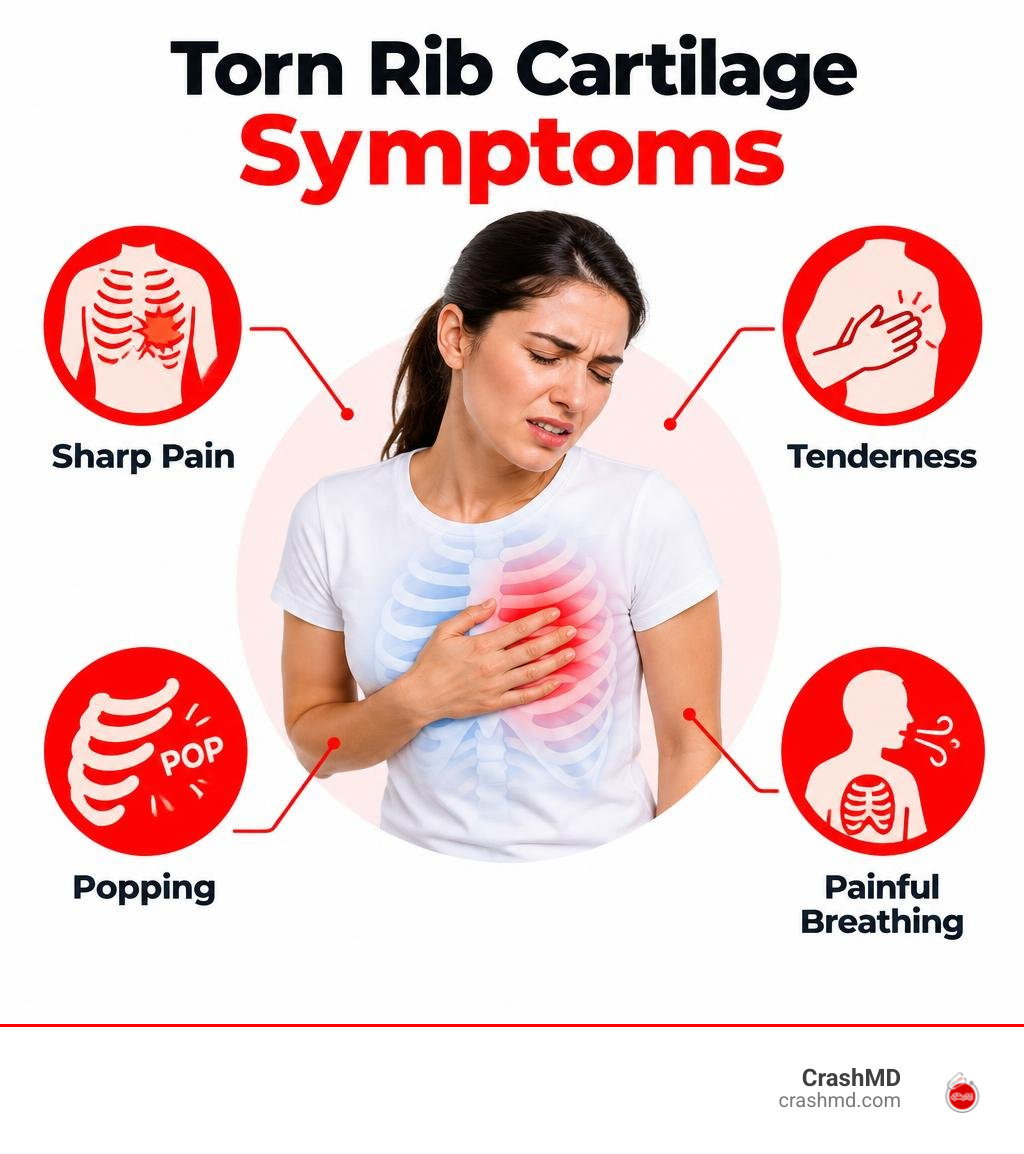
The main symptoms of torn rib cartilage are sharp, focused chest pain, tenderness when you press the area, and pain that gets worse with a deep breath, cough, sneeze, laugh, twist, or reach. Some people feel or hear a pop, click, or grinding sensation when the injury happens or when the rib cage moves. Swelling, bruising, and a feeling that part of the rib is moving can also occur.
After a car accident, do not assume chest pain is “just a bruise.” Rib cartilage can tear where a rib connects to cartilage or where cartilage connects to the breastbone. Unlike a broken rib, this injury may not appear on a standard X-ray, even though every breath can hurt.
Get urgent medical care for shortness of breath, fast or worsening breathing, faintness, chest pressure, coughing up blood, or severe pain after a crash. These signs can point to a lung or internal chest injury, not only damaged cartilage.
I’m Dr. Adam Savage, and this guide explains how to recognize a possible rib cartilage tear, seek the right evaluation, and protect your breathing while you heal.
Similar topics to what are the symptoms of torn rib cartilage:
Understanding Costal Cartilage Tears vs. Broken Ribs
To understand why this injury hurts so much, look at the anatomy of your chest wall. The human rib cage consists of 12 pairs of ribs. The first seven pairs (“true ribs”) attach directly to the sternum (breastbone) via segments of hyaline cartilage known as costal cartilage. Ribs 8 through 10 (“false ribs”) connect to the cartilage of the rib immediately above them, while ribs 11 and 12 (“floating ribs”) have no anterior attachment.
Costal cartilage provides the elasticity your chest needs to expand and contract thousands of times a day. When blunt trauma strikes the chest, force can fracture the bony rib shaft or tear the flexible cartilage away from the bone or sternum.

A tear at the junction where bone meets cartilage is called a costochondral separation. While our comprehensive detailed guide to rib cartilage injury explores these anatomical junctions further, here is how a cartilage tear contrasts with an osseous bone fracture:
| Feature | Torn Rib Cartilage (Costochondral Tear) | Broken Rib (Bone Fracture) |
|---|---|---|
| Primary Location | Anterior chest near the breastbone | Lateral or posterior rib cage |
| Tissue Involved | Flexible hyaline cartilage | Dense cortical bone |
| X-Ray Visibility | Invisible on standard X-rays | Typically visible (unless hairline) |
| Mechanical Sensation | Clicking, popping, or slipping | Sharp bone crepitus, severe rigid pinpoint pain |
| Average Healing Time | 6 to 12 weeks (up to 6 months) | 6 to 12 weeks |
| Blood Supply | Avascular (slow nutrient delivery) | Highly vascularized (faster primary callus) |
What Are the Symptoms of Torn Rib Cartilage vs a Broken Rib?
Both injuries cause agonizing discomfort, but their clinical presentations differ slightly. A broken rib often produces sharp, localized pain directly over the bone on the side or back of the torso. Pressing on that specific bone causes acute distress. Osseous fractures carry specific risks depending on whether upper, middle, or lower ribs break.
In contrast, torn cartilage presents with localized anterior tenderness along the front of the chest where the ribs meet the breastbone. Rather than rigid bone stability, patients frequently report a mobile clicking feeling or a persistent grinding sensation known as crepitus when twisting or taking a deep breath.
What Are the Symptoms of Torn Rib Cartilage?
When costal cartilage tears, everyday movements become challenging. Because the chest wall expands during respiration, the torn edges pull apart with every breath.
Common symptoms include:
- Sharp, localized anterior chest pain: Concentrated along the sternal border or lower costal margin.
- Pain aggravated by thoracic movement: Bending, lifting, reaching overhead, and twisting the torso trigger immediate discomfort.
- Respiratory distress during exertion: Inhaling deeply, sneezing, or coughing creates sharp spikes in pain. You quickly realize that when every laugh hurts your rib cage cartilage, your chest wall needs immediate stabilization and rest.
- Audible or palpable popping: A distinct click when turning in bed or taking a sudden breath.
- Localized swelling and tenderness: Mild soft-tissue swelling or a small bump over the costochondral junction.
What Are the Symptoms of Torn Rib Cartilage After a Traumatic Impact?
Around 30% of people who experience blunt chest trauma suffer a thoracic skeletal injury. In a motor vehicle collision, the rapid deceleration locks the seatbelt across the chest, concentrating immense force directly over the costal arch and sternochondral joints.
A high-energy collision can cause sudden costochondral separation, tearing the cartilage midsubstance or ripping it from the bone. If you wonder why your chest still aches weeks after a sudden collision, a torn costal cartilage is frequently the hidden cause, remaining painful long after superficial seatbelt bruising fades.
Warning Signs of Slipping Rib Syndrome and Sternal Junction Tears
When cartilage tears along the 8th, 9th, or 10th ribs, the interchondral fibrous attachments destabilize. This allows the rib tip to subluxate (slip out of place), irritating nearby intercostal nerves.
This condition—known clinically as slipping rib syndrome—accounts for roughly 5% of all chest wall pain cases evaluated by specialists. Patients describe a stabbing ache that radiates around the lower rib border into the back and flank. Reviewing our practical guide to understanding floating ribs pain and relief can help clarify lower rib margin instability.
Common Causes and Diagnostic Challenges for Rib Cartilage Tears
Cartilage injuries stem from both acute traumatic events and chronic mechanical strain:
- Motor vehicle accidents: Direct steering wheel or seatbelt impact.
- Contact sports: Heavy tackles in football, rugby, or direct blows in martial arts.
- Repetitive rotational strain: Excessive torque during rowing, golf swings, or swimming.
- Violent coughing fits: Prolonged bronchitis or respiratory infections straining the costochondral junctions.

One of the greatest challenges with torn rib cartilage is obtaining an accurate diagnosis. Standard plain-film X-rays easily miss cartilage tears because non-calcified hyaline cartilage is radiolucent. A doctor relying solely on an initial negative X-ray might dismiss your condition as a simple strain, leaving you to wonder what lingering rib pain after an injury really means.
To confirm a torn rib cartilage, healthcare providers utilize:
- Physical Examination: Palpation of the sternocostal joints and provocative maneuvers (such as the hooking maneuver for slipping ribs).
- Dynamic Musculoskeletal Ultrasound: Allows real-time visualization of cartilage subluxation while you breathe or twist.
- Chest MRI or High-Resolution CT: MRI highlights soft-tissue edema and chondral disruption on fat-suppressed T2-weighted sequences, while CT detects subtle chondral calcification breaks and rules out underlying rib fractures.
Treatment, Pain Management, and Healing Timeline
Cartilage is an avascular tissue, meaning it lacks a direct blood supply. It receives nutrients via slow diffusion from surrounding synovial fluid and perichondrium. Consequently, complete recovery from a rib cartilage tear takes approximately 6 to 12 weeks, and severe tears can take up to 6 months to fully resolve. By comparison, bruised ribs heal in 4 to 8 weeks, while simple broken ribs heal in about 6 to 12 weeks.
Treatment relies on conservative, supportive care to manage discomfort and promote recovery:
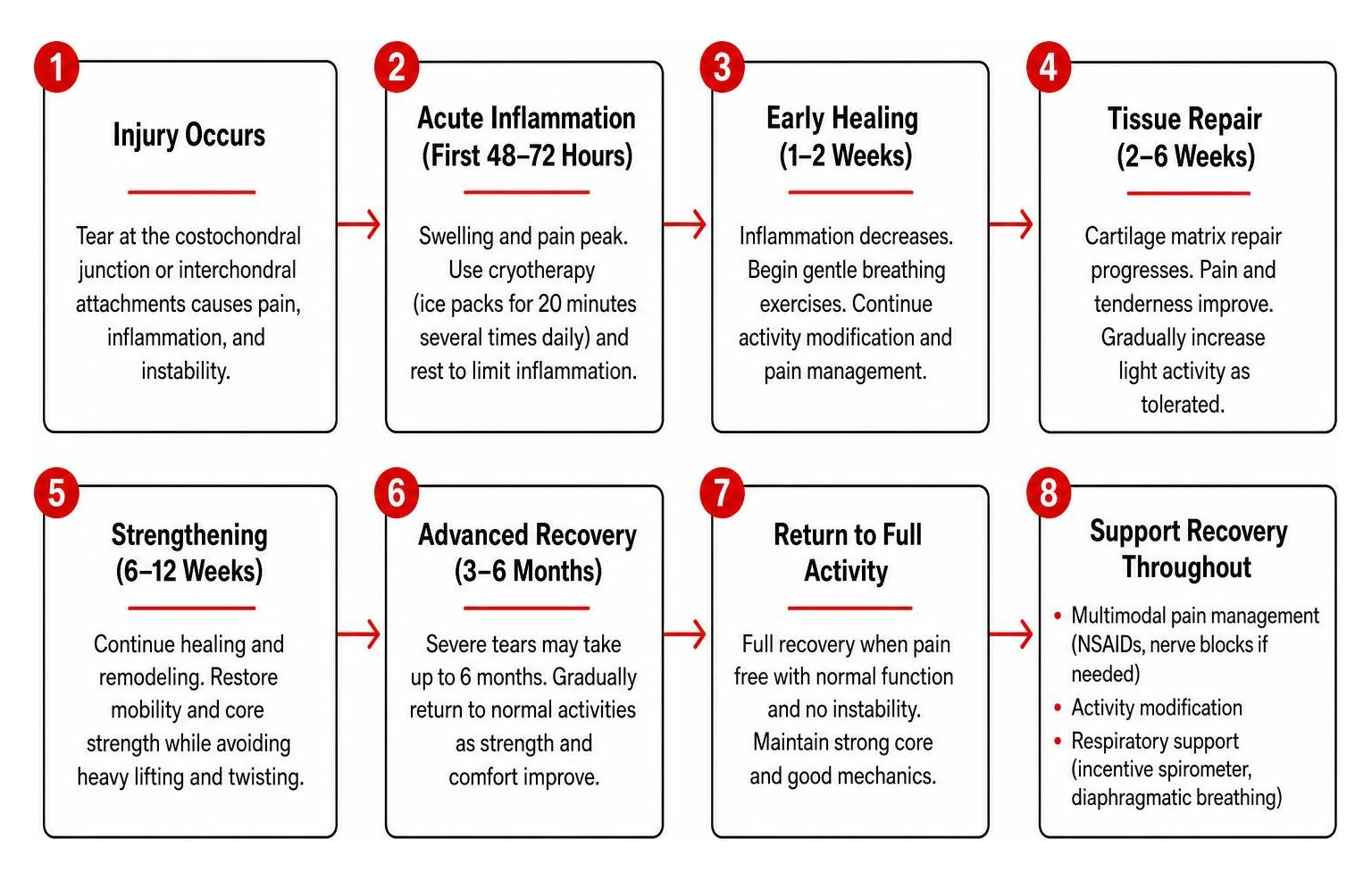
- Multimodal Pain Management: Nonsteroidal anti-inflammatory drugs (NSAIDs) such as ibuprofen or naproxen help manage localized swelling and pain. For severe nerve irritation, intercostal nerve blocks provide targeted relief.
- Cryotherapy: Applying ice packs for 20 minutes several times daily during the first 48 to 72 hours limits acute inflammation.
- Activity Modification: Restricting heavy lifting, core twisting, and overhead reaching protects the repairing chondral matrix.
- Respiratory Support: Using an incentive spirometer and practicing gentle diaphragmatic breathing ensures the lungs stay clear.
You can monitor your expected recovery stages using our ultimate guide to rib cartilage injury recovery timeline and our essential guide to rib contusion recovery timeline and care.
Avoiding Complications and Dangerous Chest Restrictions
The most critical mistake after a rib cartilage tear is tightly wrapping or binding the chest. While compression may temporarily dull movement pain, it restricts lung expansion, leading to hypoventilation, alveolar collapse (atelectasis), and secondary pneumonia.
Instead of tight binders, use a supportive pillow pressed gently against your chest when coughing or sneezing, and review our practical guide to immediate broken rib pain relief for safe pain-management strategies.
Frequently Asked Questions About Rib Cartilage Injuries
Can torn rib cartilage heal on its own without surgery?
Yes. The vast majority of costochondral separations and cartilage fractures heal spontaneously within 2 to 3 months with conservative management. Surgery (such as chondral plating or resection) is reserved for severe chest wall deformities, chronic non-union, or slipping ribs that fail non-surgical care. You can follow our in-depth guide to rib cartilage injury recovery steps for everyday recovery protocols.
When should you seek emergency medical attention for rib pain?
Seek immediate emergency medical care if you experience:
- Sudden, severe shortness of breath or rapid breathing
- Dizziness, faintness, or a racing pulse
- Radiating chest tightness or pressure into your jaw, neck, or left arm
- Coughing up blood or frothy pink sputum
- Asymmetrical chest movement, which may indicate a collapsed lung (pneumothorax) or flail chest
What exercises or movements should you avoid during recovery?
Avoid heavy weightlifting, rotational athletic sports (golf, tennis, baseball), high-impact running, and intense core movements like sit-ups or planks. Gradually reintroduce light walking and gentle thoracic mobility exercises only after acute pain resolves.
Conclusion: Getting the Right Diagnosis and Recovery Support
A torn rib cartilage is a painful, slow-healing injury that can disrupt your daily routine. Because cartilage injuries do not appear on standard X-rays, proper diagnostic imaging and clinical documentation are essential—especially if your injury occurred in a motor vehicle collision.
At CrashMD, we advocate for accident victims across Arizona, Nevada, Texas, Oklahoma, Southern California, and Northern California. We coordinate specialized imaging, deliver personalized pain management plans, and document your chest injuries to support your recovery before any legal steps are taken.
If you are dealing with persistent chest pain after a collision, visit our rib cartilage injury evaluation after a car accident page today to connect with our medical team and begin your recovery.