

Car Accident Orthopedic Care: Start With a Prompt, Complete Evaluation
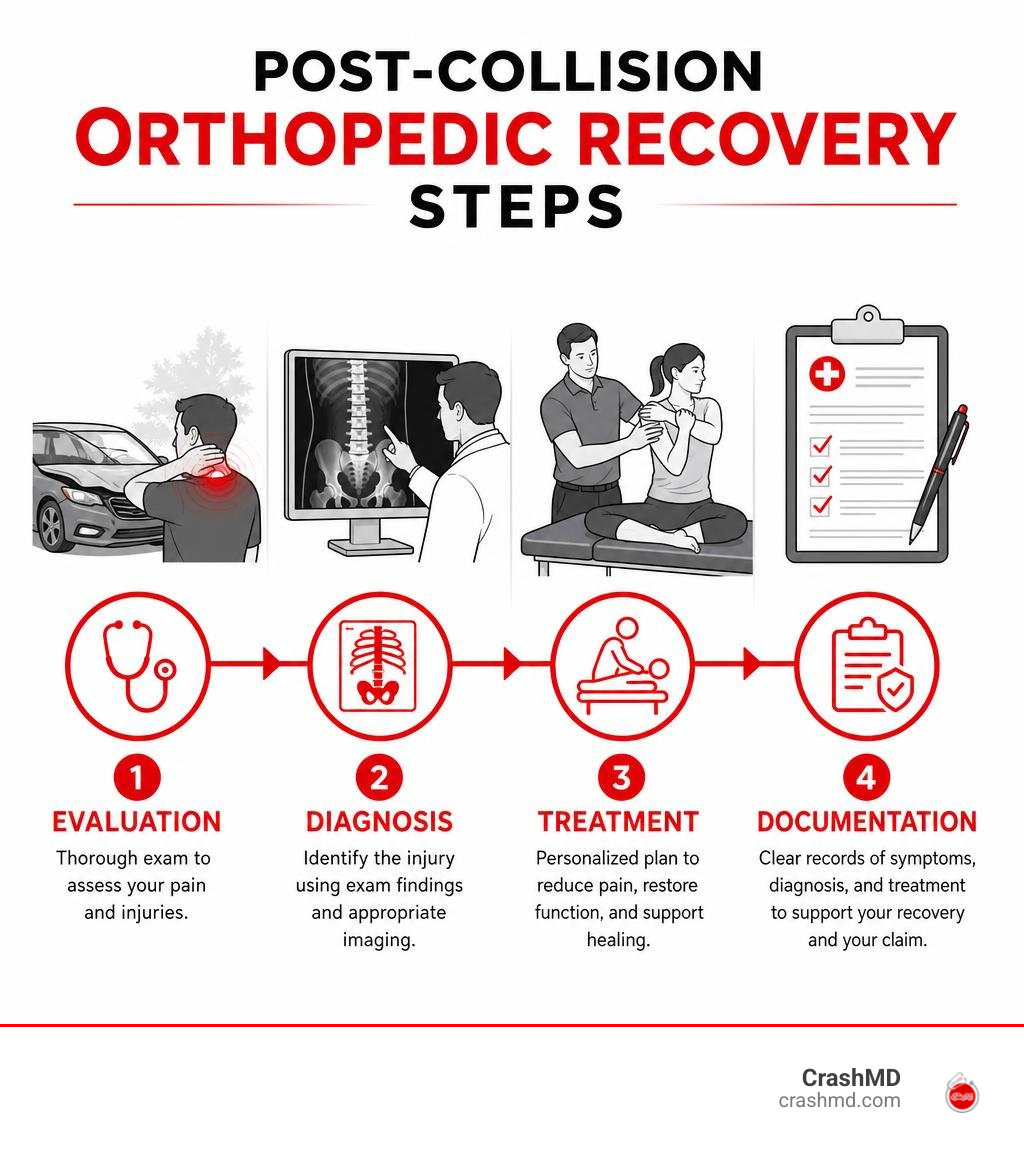
Car accident orthopedic care helps identify and treat injuries to bones, joints, muscles, ligaments, and the spine after a collision. Seek medical attention as soon as possible, especially if you have neck, back, joint, or limb pain. If symptoms continue or imaging suggests a musculoskeletal injury, an orthopedic specialist can perform a focused exam, order appropriate tests, and create a treatment plan.
After a crash, some injuries are obvious, such as fractures or dislocations. Others, including whiplash, torn ligaments, herniated discs, and joint damage, may worsen or become clear over the following days. Do not assume pain will simply go away because the collision seemed minor.
Prompt orthopedic evaluation also creates a clear medical record. Your doctor can document your symptoms, diagnosis, treatment needs, and whether the injury is consistent with the crash. That record can matter if an insurer later questions the severity of your injury, the need for treatment, or the connection to the accident.
I’m Dr. Adam Savage, and this guide explains how to find the right orthopedic care, follow a treatment path, and protect the medical documentation needed during recovery.
Car accident orthopedic care terms you need:
Why Car Accident Orthopedic Care Is Essential for Recovery and Legal Claims
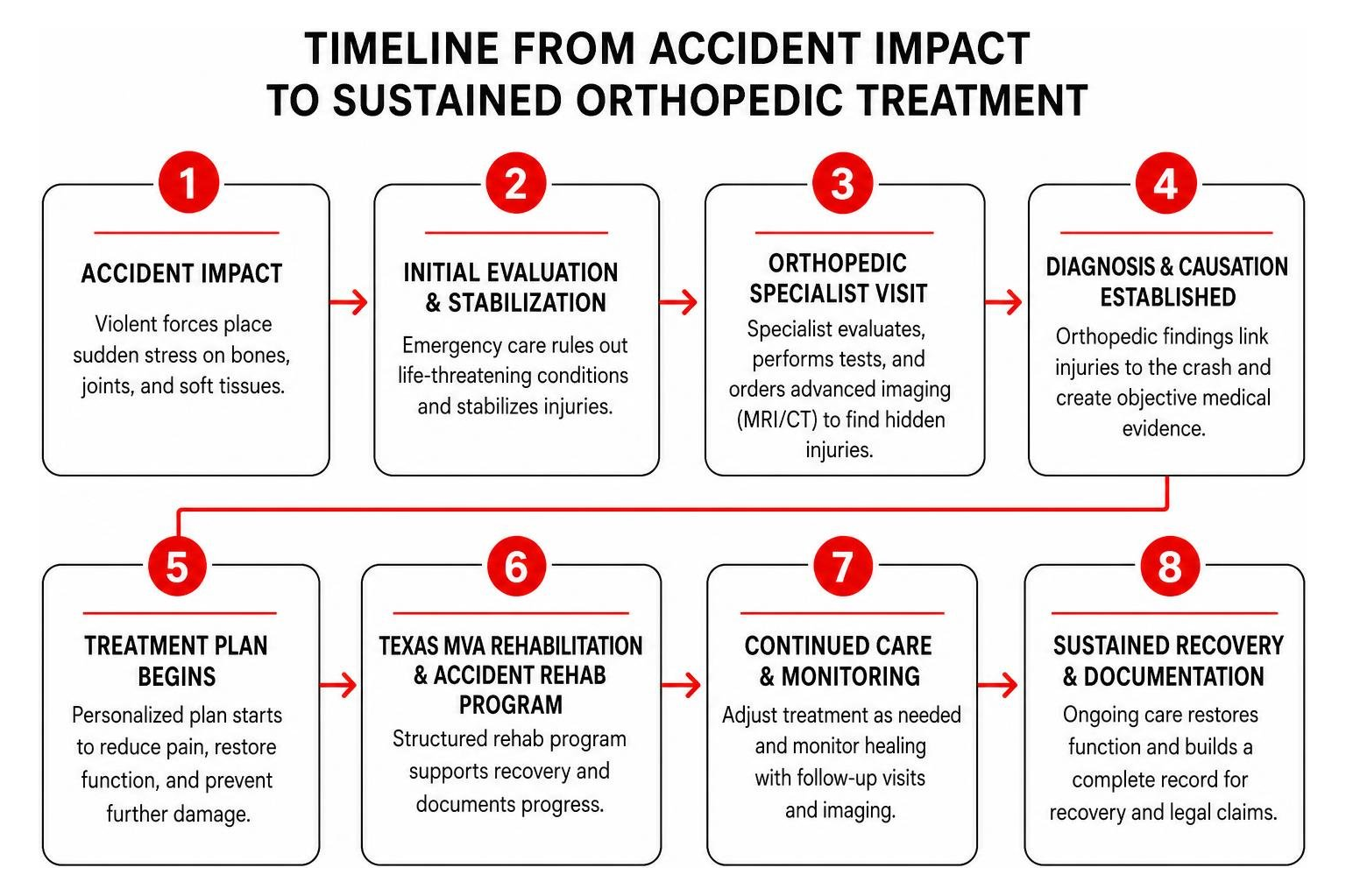
When an automobile collision occurs, the violent transfer of kinetic energy places sudden, immense stress on the human skeleton and its supporting soft tissues. While emergency rooms excel at ruling out life-threatening conditions, their role is primarily stabilization rather than long-term musculoskeletal restoration. This is where specialized orthopedic medicine steps in.

An orthopedic specialist focuses directly on the complex mechanics of bones, joints, ligaments, tendons, and nerves. The role of orthopedic doctors in car accident recovery goes beyond simply interpreting standard X-rays; specialists utilize targeted clinical evaluations, specialized physical stress tests, and advanced imaging like high-resolution MRIs or CT scans to diagnose injuries that basic initial screenings often miss.
Beyond physical healing, early specialist intervention establishes an unbroken chain of medical evidence. From an insurance standpoint, your clinical notes serve as the primary currency determining claim valuation. When an orthopedic physician documents objective structural damage, it transforms subjective complaints of soreness into clear medical facts.
How Car Accident Orthopedic Care Establishes Medical Causation
Proving that a crash directly caused your specific physical trauma requires demonstrating medical causation. Insurance adjusters frequently attempt to minimize payouts by claiming that spinal disc bulges or joint degeneration were pre-existing conditions rather than the result of the crash.
Orthopedic physicians overcome these defense strategies through biomechanical correlation:
- Correlating Impact Forces: Evaluating vehicle damage patterns alongside anatomical trauma to show how the collision forces produced the injury.
- Differentiating Pre-Existing Conditions: Utilizing imaging to distinguish between natural, age-related degeneration and acute, trauma-induced tears, micro-fractures, or inflammation.
- Establishing Timelines: Documenting the exact onset and progression of symptoms from the date of the incident.
The Danger of Treatment Gaps and Delayed Specialist Visits
Adrenaline and shock often mask severe pain for hours, days, or even weeks following an accident. Waiting until pain becomes unmanageable before booking a specialist visit creates a noticeable gap in care.
Insurers exploit treatment delays to argue that an injury happened during a separate, unrelated activity after the wreck. A consistent treatment timeline preserves your physical prognosis by catching progressive soft tissue tears early while preventing insurance adjusters from dismantling your injury claim.
Traumatic Musculoskeletal Injuries Requiring Orthopedic Intervention
Vehicular collisions unleash multi-directional forces that can damage nearly any joint or bone in the body. Certain traumatic injuries require immediate orthopedic intervention to prevent chronic instability or permanent functional loss:
- Complex Fractures: Bone breaks spanning joints, comminuted fractures, or high-impact pelvic fractures after car accident collisions that require anatomical realignment.
- Severe Soft Tissue Ruptures: Complete tears of tendons or ligaments that destabilize knees, shoulders, or ankles.
- Joint Dislocations: High-energy disruptions that damage articular cartilage and surrounding neurovascular pathways.
Spine and Neck Trauma Following Collision Impact
The rapid acceleration-deceleration motion of a crash places extreme strain on the cervical, thoracic, and lumbar spine. Beyond basic neck strain, collisions frequently trigger severe disc herniations, nerve impingement (radiculopathy), and vertebral subluxations.
When conservative adjustments are insufficient to relieve acute neural compression, non-surgical modalities like traction therapy for spine and limb fractures can decompress affected nerve roots and restore axial alignment.
Complex Joint and Extremity Damage
When drivers grip the steering wheel or brace their legs against the floorboards during an impact, the energy travels directly into the extremities. This frequently causes rotator cuff tears, labral tears in the hip, and meniscus or cruciate ligament damage in the knee.
When conservative therapies do not restore joint stability, minimally invasive arthroscopic surgery for joint injuries allows orthopedic surgeons to repair torn cartilage and reconstruct damaged ligaments with minimal disruption to surrounding tissue.
Comprehensive Treatment Modalities for Crash Victims
Orthopedic treatment uses a tiered approach, starting with non-invasive stabilization before considering surgical procedures.

Initial conservative stabilization protects vulnerable tissues from further damage. Depending on the location and severity of the injury, doctors may apply casting and splinting car accident treatment to immobilize broken bones. In cases of spinal or joint instability, medical-grade bracing for spinal, knee, and ankle injuries supports healing tissues while allowing controlled, safe mobility.
Determining When Car Accident Orthopedic Care Requires Surgery
Deciding between operative and non-operative care depends on structural stability, nerve involvement, and how the injury responds to conservative treatment.
| Injury Type | Conservative Protocol | Surgical Protocol |
|---|---|---|
| Stable Bone Fractures | Closed reduction, rigid casting, progressive loading | Surgical intervention for car accident fractures (internal plates, screws, intramedullary rods) |
| Severe / Open Fractures | Temporary splinting, wound care management | External fixation of fractures for complex structural alignment |
| Ligament & Tendon Tears | Targeted physical therapy, bracing, therapeutic injections | Open or arthroscopic reconstructive repair |
| Herniated Spinal Discs | Decompression traction, epidural injections, rehab exercises | Microdiscectomy, laminectomy, or spinal fusion |
When weighing physical therapy vs surgery after accident scenarios, our orthopedic physicians prioritize conservative methods whenever safe, reserving surgical reconstruction for cases with structural compromise or persistent nerve compression.
Maximizing Claim Settlement Value Through Clinical Documentation
Insurance settlements rarely reflect how much pain you feel; they reflect what is documented in your medical records. Orthopedic doctors provide the objective clinical data required to substantiate injury claims:
- Detailed Diagnostic Narrative: Clear medical explanations linking clinical findings and advanced imaging directly to the crash mechanics.
- Functional Capacity Measurements: Objective measurements of lost range of motion, muscle weakness, and weight-bearing limitations.
- Future Medical Cost Projections: Itemized outlines detailing future care needs, such as prospective surgeries, ongoing physical therapy, replacement hardware, or long-term medication.
- Permanent Impairment Ratings: Standardized ratings assigned once you reach Maximum Medical Improvement (MMI), establishing permanent loss of bodily function.
By coordinating closely with your legal team, our physicians ensure that all clinical evidence is organized to support your case throughout settlement negotiations.
Frequently Asked Questions About Post-Collision Orthopedic Care
Do I need to see an orthopedic doctor after every car accident?
Not every minor fender-bender requires an orthopedic surgeon, but an orthopedic evaluation is strongly advised if you experience persistent pain in your joints, back, neck, or limbs, or if you feel numbness or structural instability. General practitioners provide great baseline care, but they often lack the diagnostic tools and specialized training needed to identify subtle musculoskeletal tears or direct a comprehensive injury rehabilitation plan.
What happens if I waited several weeks before seeing an orthopedic specialist?
While waiting several weeks introduces challenges—such as insurance pushback and the risk of acute conditions turning into chronic pain—it does not ruin your personal injury claim. An experienced orthopedic specialist can perform a detailed retrospective evaluation, comparing your current imaging against the mechanics of the collision to build a clear medical case for causation.
How does an orthopedic doctor’s opinion affect my final insurance settlement?
An orthopedic specialist’s opinion carries significant weight with insurance adjusters, judges, and juries. Because specialists hold advanced credentials in musculoskeletal trauma, their documentation of your injuries, recovery timeline, and potential permanent impairment provides authoritative evidence that can substantially improve your settlement value compared to basic medical records alone.
Conclusion: Securing Comprehensive Orthopedic Recovery
Recovering from an auto collision requires a medical team that treats your physical injuries while protecting your rights during the claims process. At CrashMD, we provide comprehensive, patient-first post-accident care designed to relieve pain, restore functional mobility, and accurately document your injuries from day one.
If you or a loved one has suffered musculoskeletal injuries in an automobile crash, do not leave your physical and financial recovery to chance. Contact our team today for expert Texas car accident medical care and take the first step toward getting your health and life back on track.