

What a Headache From Expert Testimony Crash Actually Means — and Why It Matters
If you’re dealing with a headache from expert testimony crash, here’s what you need to know right away:
- Post-traumatic headaches are among the most common — and most disputed — injuries after a car accident.
- Expert medical testimony is often the key factor that links your headache to the crash in a legal case.
- Delayed-onset headaches (appearing days or even weeks later) are medically recognized and legally compensable.
- Insurance companies routinely challenge these claims because headaches are “invisible” injuries without obvious imaging evidence.
- The right medical documentation and expert witnesses can make or break your case.
A headache after a car accident can feel like a minor inconvenience. But it often isn’t.
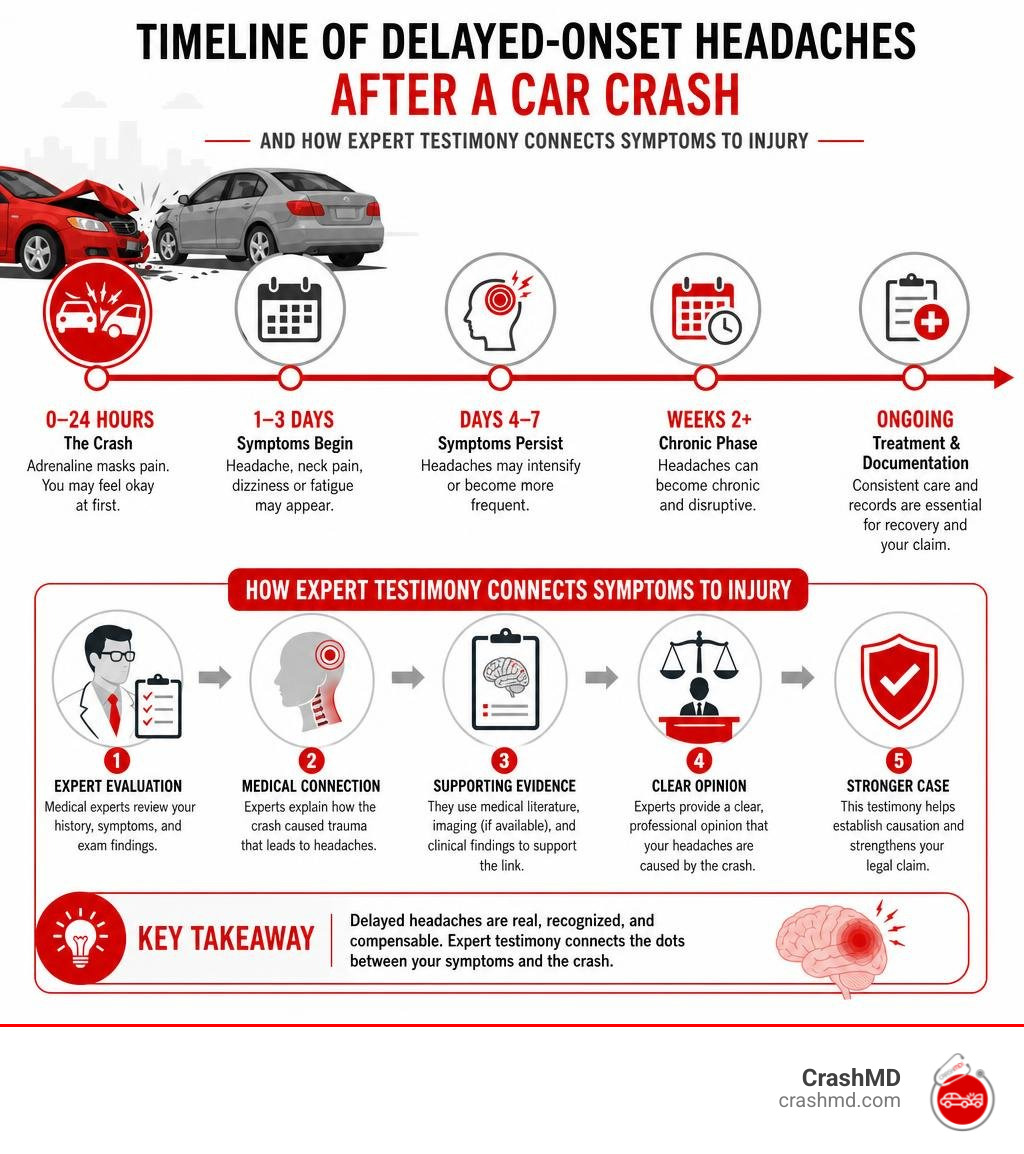
Up to half of all accident victims develop delayed symptoms — headaches, dizziness, cognitive fog — hours or days after a crash. That’s not coincidence. It’s biology. Adrenaline masks pain immediately after impact. Inflammation builds slowly. And brain injuries don’t always show up on a standard X-ray.
Here’s where things get complicated: when you file a personal injury claim for chronic headaches, the insurance company doesn’t just take your word for it. They want proof. They’ll question whether your headache existed before the crash, whether it’s “serious enough,” and whether it’s really connected to the accident at all.
That’s exactly where expert medical testimony becomes critical — and exactly where many victims feel completely lost.
This guide walks you through how post-traumatic headaches develop, how medical experts establish causation in court, how insurers fight these claims, and what you can do to protect yourself.
Headache from expert testimony crash vocab explained:
Understanding Post-Traumatic Headaches After a Car Accident
When your vehicle is struck, your body absorbs a massive amount of kinetic energy. Even if your head does not physically strike the steering wheel or window, your brain can violently collide with the inside of your skull. This sudden motion can stretch, tear, or damage delicate neural pathways and cervical structures.

Post-traumatic headaches can stem from several distinct physiological sources:
- Concussion or Traumatic Brain Injury (TBI): A concussion is a mild form of TBI. Even without direct head contact, the brain can suffer chemical changes and micro-tears, leading to persistent head pain, light sensitivity, and cognitive issues.
- Whiplash and Cervicogenic Headaches: These headaches originate in the neck. Damage to the muscles, ligaments, and joints of the upper spine refers pain upward into the back of the head, temples, or behind the eyes.
- Occipital Neuralgia: The occipital nerves run from the top of the spinal cord up through the scalp. During a crash, these nerves can be pinched, stretched, or crushed between bones, causing sharp, electric-like shooting pains.
- Tension Headaches: The sheer stress of a collision combined with muscle guarding in the shoulders and neck frequently leads to chronic, band-like tension headaches.
The onset of these symptoms is frequently delayed. Research on delayed-onset post-traumatic headache after a motor vehicle collision shows that symptoms can take days or even weeks to fully manifest. This delay is heavily driven by initial adrenaline surges and the gradual buildup of localized tissue inflammation.
To help you understand the differences, explore our detailed guide to head pain after car accident and refer to the table below:
| Headache Type | Primary Symptoms | Anatomical Cause |
|---|---|---|
| Concussion / mTBI | Throbbing pain, dizziness, nausea, light sensitivity, brain fog | Brain tissue acceleration/deceleration, chemical changes |
| Cervicogenic | One-sided dull ache, neck stiffness, pain radiating forward | Damaged joints, ligaments, or muscles in the upper cervical spine |
| Occipital Neuralgia | Shooting, burning, or electric shock-like pain from neck to scalp | Compression or irritation of the occipital nerves |
| Tension-Type | Constant dull pressure, band-like tightness around forehead | Muscle spasms and stress response in neck and scalp |
Proving Your Headache From Expert Testimony Crash
In a personal injury lawsuit, you cannot simply stand in front of a jury and say, “My head hurts.” You must prove that the crash directly caused your chronic headaches. This is where a headache from expert testimony crash legal strategy becomes essential.

Under the legal standards used in federal and many state courts (often referred to as the Daubert standard), an expert witness’s testimony must be grounded in reliable scientific principles and methods.
In cases like Neurology Expert Witness’ Injury Causation Testimony Admitted, courts have repeatedly ruled that board-certified neurologists are highly qualified to offer injury causation opinions. They do not need to be biomechanical engineers to explain how a collision injured your brain or nervous system; their clinical expertise, review of medical records, and understanding of injury patterns are legally sufficient. For deeper insights, you can read how headache after crash specialists share their advice to protect both your health and your legal claim.
How a Neurologist Establishes a Headache From Expert Testimony Crash
A neurologist uses a combination of clinical evaluations, diagnostic imaging, and objective testing to construct a bulletproof medical narrative. Because chronic headaches are subjective, a neurologist builds credibility by:
- Conducting detailed neurological exams: Testing reflexes, cranial nerve function, balance, and cognitive processing.
- Utilizing diagnostic imaging: Ordering MRIs or CT scans to rule out structural hemorrhages, while explaining to the jury that a “normal” scan does not mean the brain is uninjured.
- Identifying localized nerve damage: Pinpointing physical anomalies, such as damaged occipital nerves.
In the landmark case Lennig v. CRST, et al. | AMFS, expert medical testimony was pivotal in demonstrating how a truck crash victim’s occipital nerves were crushed between cervical bones. The neurologist explained that even if a brain injury heals over its typical two-year window, the physical damage to surrounding anatomic structures can cause permanent pain and cognitive inefficiency, demonstrating how physical trauma causes long-term suffering.
Overcoming Preexisting Conditions in a Headache From Expert Testimony Crash
If you had a history of occasional migraines before your car accident, the defense will almost certainly try to blame your current pain on your history. However, the law protects you under the “eggshell skull” doctrine: a negligent driver is responsible for the additional harm they cause, even if you were more susceptible to injury due to a preexisting condition.
To defeat the defense’s arguments, your medical expert must carefully review your complete medical history. In cases like Honsinger v. Egan, the court examined how a history of prior symptoms (such as pre-accident headaches or psychological trauma) affects causation. A skilled expert can differentiate between your baseline pre-accident migraines and the severe, persistent post-traumatic headaches triggered by the crash. For more on this, read about beyond the impact what headaches after a car crash tell you.
Why Insurance Companies Dispute Chronic Headache Claims
Insurance companies are profit-driven entities. Because headaches cannot be photographed like a broken bone, adjusters routinely label them as “soft tissue” or “invisible” injuries to justify lowball settlement offers.
If you want to protect your recovery, you need to understand their playbook. For a deeper look, check out our guide: dont let a car crash headache drive you crazy.
Common arguments insurance companies use to deny or devalue headache claims include:
- “There is a gap in treatment.” If you waited several days to see a doctor because you hoped the headache would go away, the insurer will claim the headache was caused by something else.
- “The diagnostic scans are normal.” Insurers love to point to clean CT scans or MRIs, ignoring the fact that concussions and nerve damage rarely show up on standard structural imaging.
- “It is a preexisting condition.” They will dig through years of your medical records to find any mention of a headache, sinus pain, or stress to shift the blame away from their driver.
- “The impact was too minor.” In low-speed “fender benders,” adjusters argue that the physical forces involved were insufficient to cause lasting neurological damage.
Calculating Compensation and Legal Damages for Post-Crash Headaches
Chronic headaches do not just cause physical pain; they disrupt every aspect of your life. In a personal injury claim, you are entitled to seek compensation for both economic and non-economic damages.
- Economic Damages: These are quantifiable financial losses, including medical bills, prescription medications, specialized neurological care, physical therapy, and lost wages. If your headaches prevent you from working, you can seek compensation for lost earning capacity.
- Non-Economic Damages: These address the human cost of your injury, such as physical pain, mental anguish, loss of enjoyment of life, and loss of companionship.
Calculating these damages requires precise methodology. In Jauregui v. Daimler Truck North America LLC et al, the court highlighted that economic projections must be grounded in verified, reliable data rather than simple extrapolation. The case also demonstrated that damages like “loss of companionship” can be quantified using tangible, real-world market rates (such as the cost of professional companion care). To understand how these damages are constructed, read our post trauma headache causes treatments guide.
State-Specific Laws and Statutes of Limitations
Because CrashMD serves clients across specific Western and Southern regions, it is crucial to understand how local laws impact your recovery:
- Texas: Follows a modified comparative fault rule (51% bar). If you are found to be more than 50% responsible for the accident, you cannot recover damages. The statute of limitations for personal injury claims is generally two years from the date of the crash.
- Arizona: Operates under a pure comparative fault system. Even if you are 99% at fault, you can still recover 1% of your damages. The statute of limitations is two years from the crash date.
- Nevada: Applies a modified comparative fault rule (51% bar). The statute of limitations for personal injury claims is two years.
- Oklahoma: Follows a modified comparative fault system (51% bar) with a two-year statute of limitations.
- California: Follows a pure comparative fault system. The statute of limitations is two years from the date of the injury.
In complex product liability or multi-vehicle crash cases, such as Favia v. Ford Motor Co., establishing the exact mechanics of the crash and the resulting physical trauma is vital to securing fair compensation under these state-specific frameworks.
Steps to Take Immediately After a Crash to Protect Your Rights
If you are experiencing headaches after a car accident, taking swift action is vital for your physical recovery and your legal protection.
- Seek an Immediate Medical Evaluation: Do not wait. Go to an emergency room, urgent care, or a post-accident specialist like CrashMD right away. Tell the doctor about every symptom, no matter how minor.
- Keep a Detailed Symptom Journal: Write down the frequency, duration, and intensity of your headaches. Note how they affect your ability to work, sleep, and care for your family.
- Follow Your Treatment Plan Consistently: Attend all physical therapy, neurology, and chiropractic sessions. Gaps in medical care give insurance adjusters an excuse to deny your claim.
- Consult a Personal Injury Attorney: Before speaking to insurance adjusters or signing any settlement offers, speak with an experienced lawyer who can safeguard your rights.
For more detailed advice on handling post-crash symptoms, read the aches and pains after your accident what to know about headaches and more.
Frequently Asked Questions About Crash-Related Headaches
Can a headache that starts days after a crash indicate a serious brain injury?
Yes. Delayed-onset headaches are highly common. Immediately after a collision, your body is flooded with adrenaline, which naturally masks pain. As the adrenaline wears off and inflammatory responses develop over the following days, symptoms of a concussion or traumatic brain injury can emerge. For more information, read why you shouldn’t ignore headaches after a car accident.
How does a medical expert prove a headache was caused by a car accident?
A medical expert establishes causation by performing comprehensive clinical evaluations, reviewing emergency room records, analyzing accident mechanics, and ruling out alternative causes. They use their medical expertise to directly link the physical trauma of the impact to your neurological symptoms. Learn more about diagnosing these injuries by reading about headache & dizziness after accident | Radius Nevada City.
What compensation can I recover for chronic post-traumatic headaches?
You can recover compensation for all medical expenses (including specialist visits, imaging, and physical therapy), lost wages, future medical treatment, and pain and suffering. To learn more about how medical treatments and legal compensation interact, explore everything you need to know about headache from nerve block crash.
Conclusion
At CrashMD, we believe that your health must always come first. Chronic post-traumatic headaches are serious, life-altering injuries that deserve dedicated medical care and rigorous documentation. We act as your patient advocate, ensuring your injuries are thoroughly evaluated, treated, and documented by medical experts before you pursue legal action.
“I’m Dr. Adam Savage,” and our mission is to guide you step-by-step through a comprehensive recovery process so you can reclaim your life without the constant pain of post-crash headaches.
If you or a loved one is struggling with headaches after a car accident in Arizona, Nevada, Texas, Oklahoma, or California, do not wait for the pain to get worse. Visit the CrashMD Homepage today to schedule a consultation and take your first step toward real relief.