

What You Need to Know About a Bruise on Lung After Chest Trauma
A bruise on lung — known medically as a pulmonary contusion — is one of the most common and potentially serious injuries that follows blunt chest trauma, such as a car accident.
If you’re trying to understand what this injury means for you, here’s a quick overview:
Key facts about a bruised lung:
- What it is: Bleeding and fluid buildup inside lung tissue, caused by a hard blow to the chest
- Common cause: Motor vehicle collisions, falls, or sports impacts
- Main symptoms: Chest pain, shortness of breath, coughing, and sometimes coughing up blood
- When symptoms appear: Can show up within hours — or be delayed 24 to 48 hours after injury
- How it’s diagnosed: Chest X-ray, CT scan, or ultrasound
- Typical recovery: Most cases resolve in 5 to 7 days with proper care
- Serious risk: Up to 20% of patients develop pneumonia; complications can become life-threatening
I’m Dr. Adam Savage, and I see this injury regularly in trauma patients — especially those who’ve been through high-impact accidents. What makes a bruised lung so dangerous is that it can look minor at first. You might feel okay right after a crash, only to find yourself struggling to breathe hours later.
The absence of visible injury on the outside doesn’t mean the inside is fine.
This guide will walk you through everything you need to know — from how this injury happens, to what warning signs to watch for, to what treatment and recovery actually look like.
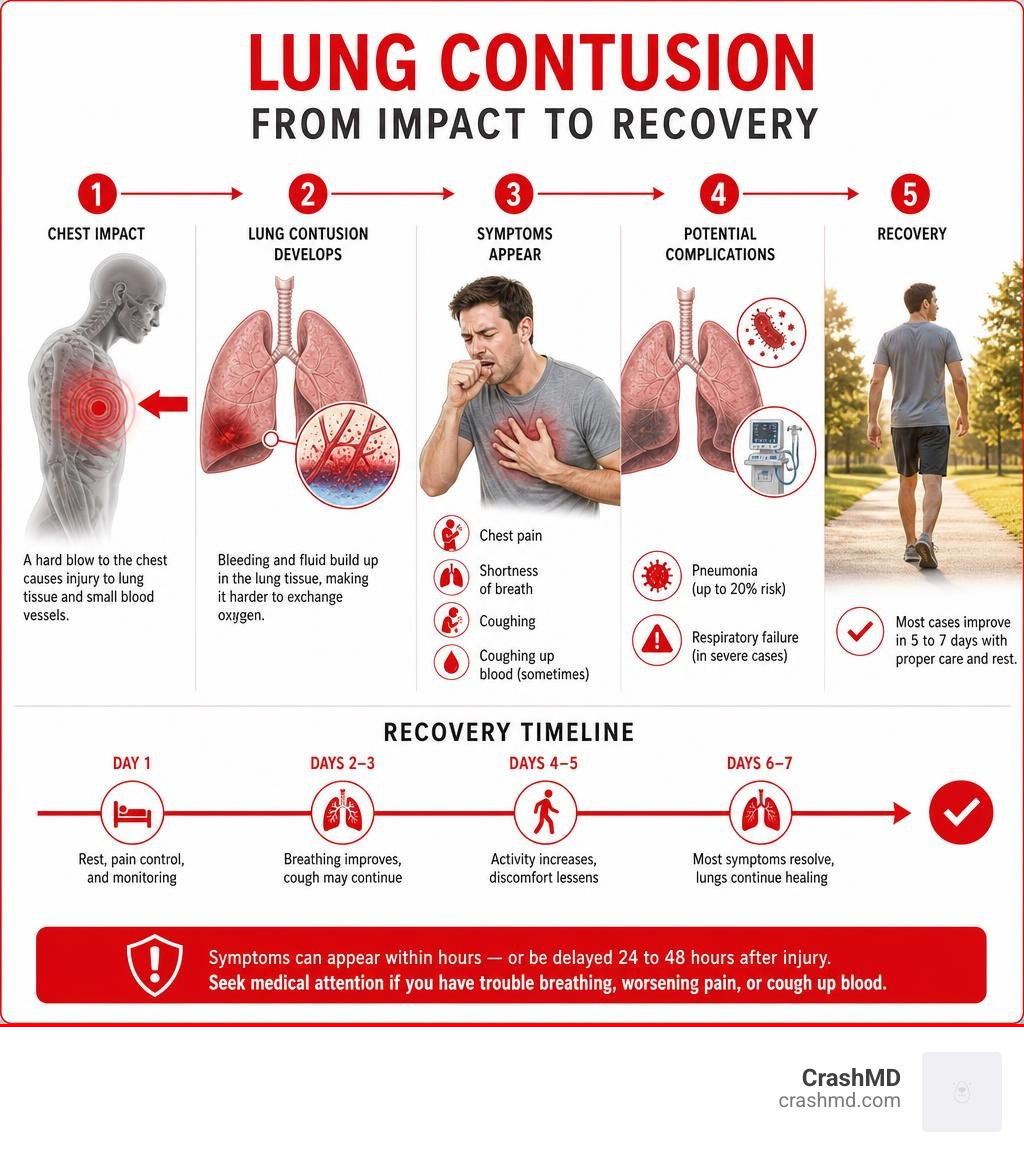
Bruise on lung terms explained:
What is a Bruise on Lung (Pulmonary Contusion)?
To put it simply, a bruise on lung occurs when a sudden impact damages the delicate tissues of the lung without actually tearing or cutting them. Medically, this is called a pulmonary contusion.
Unlike a typical skin bruise, which is mostly a cosmetic nuisance, a bruise on your lung directly affects how you breathe. The injury harms the lung parenchyma — the functional part of the lung involved in gas exchange. When blunt force strikes the chest, it ruptures the tiny capillaries that make up the blood-air barrier.
This barrier disruption triggers a cascade of events:
- Alveolar Edema: Blood and fluid leak directly into the alveoli (the tiny air sacs in your lungs).
- Surfactant Loss: The fluid dilutes and destroys surfactant, a crucial substance that keeps the air sacs open.
- Ventilation-Perfusion Mismatch: Because the air sacs are filled with fluid instead of air, blood passing through the lungs cannot pick up oxygen, leading to dangerously low oxygen levels in your body.
To understand how a pulmonary contusion differs from other common thoracic injuries, look at the comparison table below:
| Injury Type | What It Involves | Impact on Lung Structure |
|---|---|---|
| Pulmonary Contusion | Bleeding and fluid accumulation in the lung tissue | No physical tear or cut to the tissue |
| Lung Laceration | A physical cut, tear, or puncture in the lung tissue | Disruption of tissue; often causes air leaks |
| Pulmonary Hematoma | A localized collection of blood (clot) within the lung | Forms a distinct sac or pool of blood |
If you want to read more about the clinical definition, you can check out Wikipedia’s overview of lung contusion. For a practical breakdown of how these injuries impact daily life and recovery, take a look at our resource, A Practical Guide to Pulmonary Contusion.
Common Causes and Mechanisms of Thoracic Trauma

A bruise on lung is the most common injury found in blunt chest trauma, showing up in 25% to 35% of these cases. Overall, it occurs in 30% to 75% of severe chest injuries.
The most common causes include:
- Motor vehicle collisions: Hitting the steering wheel, dashboard, or being compressed by a seatbelt or deploying airbag accounts for roughly 70% of cases.
- Falls: Falling from a height, which is particularly dangerous for older adults.
- Blast injuries: Shockwaves from explosions can bruise the lungs without leaving a single mark on the chest wall.
- Sports injuries: High-impact collisions in contact sports.
Pediatric Risk: Why Kids Are Different
Children face a uniquely high risk when it comes to severe lung contusions. Kids have highly flexible ribs and chest walls. While this flexibility means they are less likely to break a rib, it also means the force of a crash is transmitted directly through the chest wall into the delicate lung tissue. A child can have a life-threatening bruise on lung without a single broken bone or external bruise.
Physics of a Bruise on Lung: Spalling, Inertial, and Implosion Effects
The physics behind how a lung bruises during a trauma are fascinating — and terrifying. Three distinct physical forces combine to damage the tissue:
- The Spalling Effect: When a shockwave transitions from a dense medium (like the liquid-heavy lung tissue) to a less dense medium (like the air inside the alveoli), it shears and bursts the tissue boundary.
- The Inertial Effect: Different tissues inside the chest have different densities. During a sudden deceleration (like a car crash), lighter alveolar tissues stop moving faster than heavier, blood-filled vessels. This difference in speed causes the tissues to strip and tear away from one another.
- The Implosion Effect: The pressure wave of an impact compresses the gases inside the lungs. As soon as the wave passes, these gases rapidly expand (implode), bursting the delicate walls of the air sacs.
Additionally, a contrecoup injury can occur. This is when the force of the impact travels through the chest, reflects off the back wall, and causes a second bruise on the opposite side of the initial blow. For a deep dive into the clinical physics behind these forces, you can read this clinical review of pulmonary contusion mechanisms.
Signs, Symptoms, and Diagnostic Evaluation

Recognizing the symptoms of a bruise on lung early can save lives. The most common signs of a pulmonary contusion include:
- Dyspnea: Severe shortness of breath or struggling to breathe.
- Chest Pain: Pain that usually gets much worse when you try to take a deep breath.
- Hemoptysis: Coughing up blood or blood-tinged mucus.
- Hypoxia and Cyanosis: Low blood oxygen levels, which can cause a bluish tint on the lips, skin, or under the fingernails.
- Rapid Heart Rate and Low Blood Pressure: Signs that the body is struggling to distribute oxygen.
Identifying a Bruise on Lung: Delayed Symptoms and Imaging
One of the trickiest aspects of a lung contusion is its delayed onset. In mild to moderate cases, symptoms can start subtle and take 24 to 48 hours to fully develop as fluid slowly accumulates in the lungs.
Because of this delay, initial diagnostic tests are critical:
- Physical Exam: Checking blood pressure, breathing rate, and listening for “crackling” sounds in the lungs.
- Chest X-ray: Often the first-line test, though it only detects about 47% of contusions immediately. Up to 92% become visible on X-ray within 24 hours.
- E-FAST Bedside Ultrasound: A rapid, highly useful tool for emergency rooms to look for fluid and lung sliding.
- Chest CT Scan: The gold standard. High-resolution CT scans can detect a bruise on lung immediately after trauma.
Using advanced CT volumetry, doctors can measure the exact volume of the contusion. Research shows that if the contusion volume exceeds 20% of the total lung volume, the risk of severe complications like pneumonia and Acute Respiratory Distress Syndrome (ARDS) increases dramatically. You can read the detailed clinical data in this CT quantification research.
Understanding these medical details is also crucial for insurance and legal purposes after an accident. If you want to know how doctors classify and code these injuries for your medical records, check out Everything You Need to Know About ICD-10 Code for Pulmonary Contusion.
Potential Complications and Treatment Strategies
A severe bruise on lung requires careful, proactive medical management. There is no magic pill to cure a bruised lung; instead, treatment focuses entirely on supportive care to help your body heal itself.
Key treatment strategies include:
- Pain Control: Managing pain is critical. If your chest hurts, you won’t breathe deeply. This lack of deep breathing causes the air sacs to collapse (atelectasis). Doctors use targeted pain medications or nerve blocks so you can cough and perform deep breathing exercises.
- Fluid Management: Fluid balance is a delicate tightrope. Dehydration is bad, but overhydrating is worse. Excess IV fluids can leak directly into the bruised lung tissue, worsening the swelling and edema.
- Oxygen and Ventilation Support: For mild cases, supplemental oxygen via a nasal cannula is enough. For severe cases, non-invasive ventilation (like CPAP or BiPAP) or mechanical ventilation with low tidal volumes and High Positive End-Expiratory Pressure (PEEP) is required to keep the lungs open.
Key Complications to Watch For:
- Pneumonia: Up to 20% of people with a pulmonary contusion develop pneumonia because the pooled fluid in the lungs is a breeding ground for bacteria.
- Acute Respiratory Distress Syndrome (ARDS): Severe, life-threatening inflammation that prevents oxygen from reaching the bloodstream.
- Respiratory Failure: The inability of the lungs to perform basic gas exchange.
For a comprehensive look at how these complications are managed in a hospital setting, read Cleveland Clinic’s guide to pulmonary contusion complications. If you are currently navigating the aftermath of an accident, you can learn more about what to expect from your medical team in The Road to Recovery: What to Expect from Medical Care After a Car Accident.
Rare Complications: Post-Traumatic Pulmonary Pseudocyst
In rare cases, the extreme pressure of a chest impact can cause a shearing of the lung tissue without tearing the outer lining (the pleura). This can create a cavity filled with air or fluid, known as a post-traumatic pulmonary pseudocyst. These cavitary lesions can cause delayed symptoms like coughing up blood weeks after the accident, but they often resolve with targeted antibiotic therapy. You can read a fascinating medical analysis of this condition in this case study on post-traumatic pseudocysts.
Recovery Timeline, Long-Term Prognosis, and Prevention
The good news is that the lungs are incredibly resilient. Most mild to moderate pulmonary contusions heal within 5 to 7 days, and abnormal markings on chest X-rays typically clear up within 10 to 14 days.
However, recovery is an active process. Even when your chest hurts, you must practice “pulmonary hygiene.” This means taking deep breaths, using an incentive spirometer, and forcing yourself to cough to clear mucus out of your airways.
For home recovery guidance, you can refer to Kaiser Permanente’s care instructions.
Long-Term Prognosis
While the physical bruise heals quickly, some patients experience long-term respiratory effects. Studies on Rib Fracture and Lung Contusion: Impact on Pulmonary Function Tests | Springer Nature Link show that severe thoracic trauma can cause a decrease in vital capacity and functional residual capacity. Up to 90% of patients report some level of breathing difficulty or chest tightness in the first six months following a severe contusion.
To support your body’s healing process, we highly recommend reading From Broken Ribs to Bad Dreams: A Guide to Natural Recovery and exploring The Complete Guide to Supplements for Fractures to optimize your nutritional recovery.
Preventing Lung Contusions
While you can’t always avoid accidents, you can significantly reduce the risk of a severe bruise on lung:
- Always wear your seatbelt: Proper seatbelt placement distributes impact forces across your strong pelvic and shoulder bones rather than your chest.
- Ensure working airbags: Airbags cushion the blow, preventing direct impact with the steering wheel.
- Use proper child safety seats: Keep kids in age-appropriate car seats to protect their highly flexible chests.
- Wear protective gear: Always wear chest protectors and high-quality safety gear during high-impact sports.
Frequently Asked Questions about Pulmonary Contusions
How long does it take for a bruised lung to heal?
For most mild to moderate cases, a bruise on lung heals within 5 to 7 days. More severe cases, or those accompanied by multiple broken ribs, can take several weeks to recover. Radiographic signs on an X-ray or CT scan usually disappear completely within 10 to 14 days.
Is a bruised lung life-threatening?
It can be. While mild lung contusions resolve easily, severe contusions have an overall mortality rate ranging from 14% to 40%, depending on accompanying injuries (like a flail chest or head trauma). Complications like pneumonia and ARDS are the primary life-threatening risks. Immediate medical evaluation after any major chest impact is vital.
Can a bruised lung be detected on a standard chest X-ray?
Yes, but with a major catch: chest X-rays often miss lung contusions immediately after an injury. Only about 47% are visible on the first X-ray. It can take up to 24 hours for the fluid to build up enough to show up clearly on a standard film. A CT scan is far more sensitive and can detect a contusion instantly.
Conclusion
Sustaining a bruise on lung after a car accident or a severe fall is a serious medical event. Because symptoms can be delayed and complications like pneumonia can develop rapidly, getting immediate, specialized medical care is absolutely essential.
At CrashMD, we specialize in guiding accident victims through the complex road to recovery. We do more than just offer expert pain management and tailored medical treatment plans; we act as your dedicated patient advocates. We thoroughly document your injuries for insurance and legal cases, ensuring your physical recovery is fully supported and legally protected before you take any next steps.
If you or a loved one are recovering from a chest injury after an accident, don’t wait for symptoms to worsen. Reach out to CrashMD to learn how we can help you heal and navigate your recovery journey.