

Why Seeing a Headache After Crash Specialist Matters
If you’re dealing with head pain following a collision, finding a headache after crash specialist is one of the most important steps you can take for your recovery. The right specialist can identify injuries that standard emergency room visits often miss — and get you on a path to real relief.
Who should you see for a headache after a car accident?
- Neurologist — diagnoses brain, spine, and nerve-related headache causes; best for concussion, TBI, and occipital neuralgia
- Pain management doctor — specializes in nerve blocks, trigger point injections, and chronic pain relief
- Physical therapist — treats muscle tension, cervicogenic headaches, and whiplash-related neck dysfunction
- Sports neurologist — trained specifically in concussion and post-concussion syndrome recovery
- Orthopedic specialist — evaluates fractures or structural damage contributing to headache pain
Headaches are reported in up to 90% of people with mild traumatic brain injuries after car accidents. Yet many victims brush off the pain — or get sent home from the ER without answers.
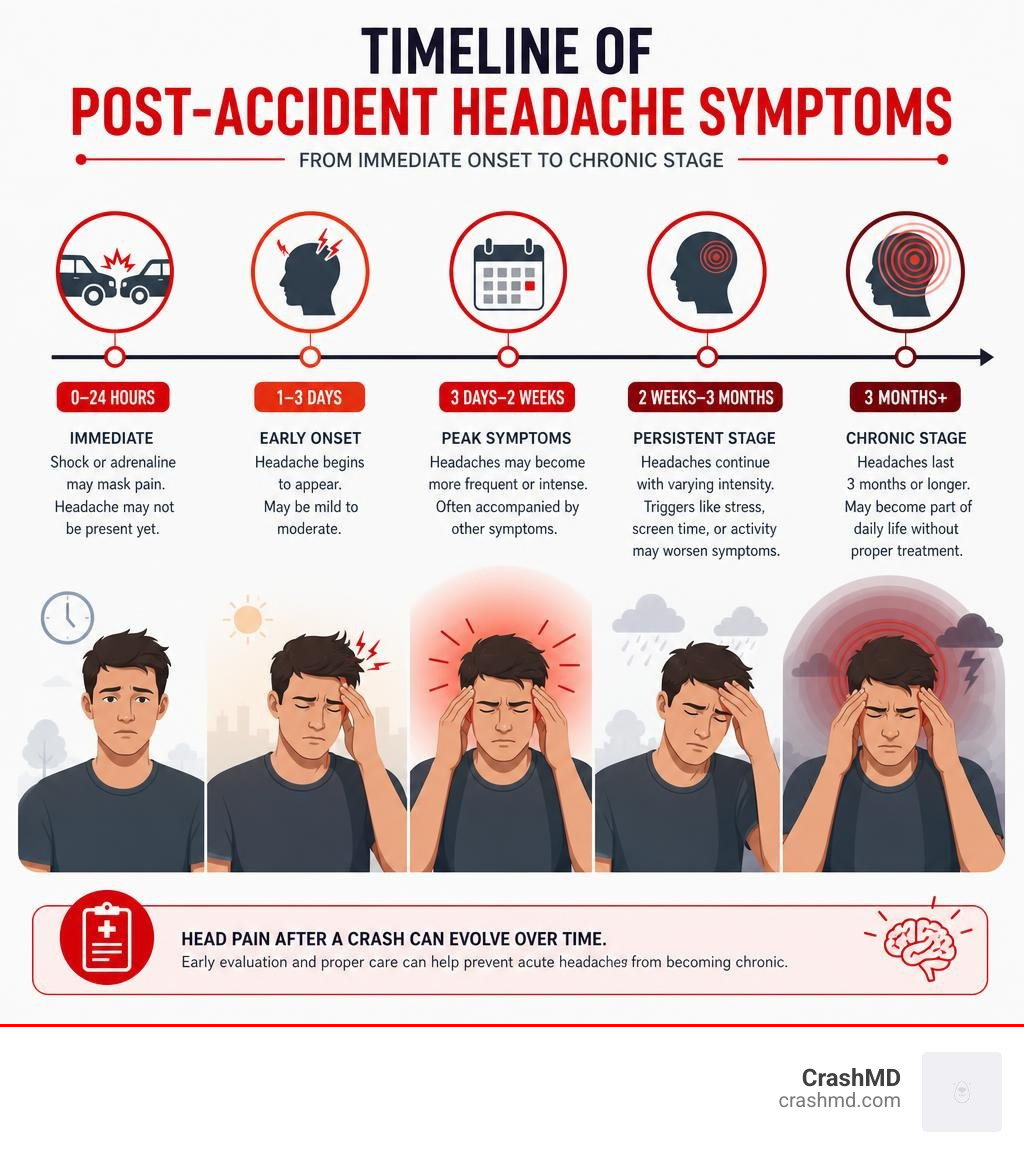
Here’s the thing: headaches after a crash can appear hours, days, or even weeks later. Adrenaline released during a collision can mask pain signals in the immediate aftermath. By the time the headache sets in, many people don’t connect it to the accident at all.
That delay doesn’t mean the injury is minor. It often means the opposite.
Whether your head pain started the morning after the crash or gradually built over several weeks, it deserves a proper evaluation — not just a wait-and-see approach.
Essential headache after crash specialist terms:
Understanding Post-Traumatic Headaches and Delayed Symptoms

When your body goes through the violent forces of a car crash, it absorbs a massive amount of kinetic energy. Even if you do not strike your head directly against the steering wheel or window, the rapid acceleration and deceleration can cause your brain to jolt inside your skull. This sudden movement can trigger delayed inflammation, micro-tears in soft tissues, and intense muscle spasms in your neck and upper back.
Immediately after a collision, your body enters a “fight or flight” survival mode. The massive adrenaline rush and spike in cortisol temporarily block pain receptors. It is only when your nervous system begins to settle down—hours, days, or even weeks later—that the underlying damage makes itself known. This is why a delayed headache is incredibly common.
To explore how these injuries develop beneath the surface, you can read our Detailed Guide to Head Pain After Car Accident and discover more about what your body is trying to tell you in our article Beyond the Bump: What Headaches After a Car Crash Tell You.
Common Types of Post-Accident Headaches
Understanding the specific nature of your head pain is the first step toward targeted relief. Post-accident headaches rarely fall into a single category. Instead, they are usually caused by a combination of nerve irritation, muscle tension, and joint dysfunction.
- Tension Headaches: These are caused by severe muscle strain and spasms in the neck, shoulders, and scalp. They typically feel like a tight, squeezing band wrapped around your forehead.
- Cervicogenic Headaches: These headaches originate from damage to the joints, ligaments, or discs in your cervical spine (neck). The pain radiates upward, usually starting at the base of the skull and spreading to the temples or behind the eyes.
- Occipital Neuralgia: This occurs when the occipital nerves running from the top of the spinal cord through the scalp are pinched, bruised, or inflamed. It causes a distinct, shooting, electric-shock-like pain.
- Migraine Activation: The physical trauma and intense stress of a crash can trigger new migraines or severely worsen existing migraine disorders, resulting in throbbing pain, nausea, and extreme sensory sensitivity.
| Headache Type | Primary Symptoms | Typical Onset |
|---|---|---|
| Tension | Dull, aching pain; sensation of tightness or pressure across the forehead | Hours to 2 days post-accident |
| Cervicogenic | One-sided pain radiating from the neck to the front of the head; neck stiffness | Days to weeks post-accident |
| Occipital Neuralgia | Sharp, stabbing, or electric-shock sensations at the base of the skull | Days to weeks post-accident |
| Migraine Activation | Throbbing pain; sensitivity to light/sound; nausea or cognitive fog | Immediate to days post-accident |
When Head Pain Signals a Serious Brain or Neck Injury
A persistent headache after a crash is rarely “just a headache.” It is often a key clinical indicator of a mild traumatic brain injury (mTBI), such as a concussion, or severe whiplash trauma. When your neck is whipped back and forth, the violent motion stretches and damages the delicate cervical nerves and soft tissues, leading to chronic referred pain.
At the same time, the metabolic changes in the brain following a jolt can disrupt normal cognitive function, sleep, and emotional regulation. To learn how to spot these subtle but serious signs, check out The Silent Impact: Recognizing Concussion After Your Car Wreck and read about how minor collisions can cause major issues in Fender Bender Headaches: When a Small Bump Becomes a Big Pain.
Red Flags: When to Seek Emergency Medical Care
While many post-traumatic headaches can be managed through scheduled specialist care, certain symptoms indicate a medical emergency, such as intracranial bleeding or brain swelling. Seek immediate emergency medical attention if your headache is accompanied by:
- Sudden, explosive pain (a “thunderclap” headache)
- Persistent vomiting or nausea
- Double vision, blurred vision, or unequal pupil sizes
- Severe dizziness, loss of balance, or difficulty walking
- Slurred speech, confusion, or memory loss
- Weakness, numbness, or tingling on one side of your body
- A history of losing consciousness, even briefly, during the crash
If you are experiencing balance issues or spatial disorientation alongside your head pain, find out why in our guide, More Than Just a Bump: Why You’re Dizzy After an Accident.
Why You Must See a Headache After Crash Specialist

Emergency rooms are built to save lives by identifying and stabilizing life-threatening emergencies like skull fractures or active brain bleeds. However, once those acute crises are ruled out, ER doctors often discharge patients with basic pain relievers and instructions to rest. They rarely diagnose the subtle soft-tissue damage, nerve compressions, or mild concussions that cause chronic, long-term headaches.
A dedicated headache after crash specialist takes a comprehensive, multidisciplinary approach to your recovery. By consulting specialists who understand the complex mechanics of crash injuries, you receive a highly targeted treatment plan designed to heal the root cause of your pain rather than simply masking your symptoms with prescription drugs.
To understand why specialized care is so vital, read Why You Need a Head Injury Specialist After a Crash. You can also learn about advanced, patient-centric neurological care models by reading about the work of leading specialists like Stephanie F. Alessi-LaRosa, MD | The Hospital of Central Connecticut | CT .
How a Headache After Crash Specialist Diagnoses Your Pain
To build an effective treatment plan, a specialist must first pinpoint the precise origin of your pain. This process begins with an in-depth neurological screening to evaluate your cognitive function, cranial nerves, reflexes, and balance.
Next, they perform a detailed cervical spine evaluation to check for joint restrictedness, muscle spasms, and localized nerve tenderness. Advanced diagnostic imaging is then used to rule out structural injuries. While X-rays can show bone fractures, MRI and CT scans are crucial for visualizing soft tissues, herniated discs, and subtle brain changes.
To learn more about what to expect during your initial medical assessment, read The First Look: How Doctors Assess Traumatic Brain Injuries.
Finding the Right Headache After Crash Specialist for Long-Term Recovery
Your recovery journey may require a combination of medical disciplines. Sports neurologists, pain management physicians, and physical therapists often work together to coordinate your rehabilitation. Finding a program that integrates these specialties ensures that your cognitive, neurological, and physical recovery are addressed simultaneously.
To explore how to choose the best recovery program for your needs, see our guide on Concussion Care: Finding the Right Program for Your Healing Journey.
Advanced Treatment Options and Self-Care Strategies
Modern medicine offers highly effective, targeted treatments for post-traumatic headaches that go far beyond standard over-the-counter pain medications. A headache after crash specialist can provide interventional treatments designed to stop pain at its source:
- Occipital Nerve Blocks: An injection of a local anesthetic and corticosteroid near the occipital nerves to instantly soothe inflammation and block pain signals.
- Trigger Point Injections: Targeted injections into painful knots of muscle in the neck and shoulders to break up muscle spasms and restore normal blood flow.
- Specialized Physical Therapy: Manual therapy, cervical stabilization exercises, and dry needling to correct posture and relieve tension in the neck.
- Vestibular Rehabilitation: Exercises designed to retrain the brain and inner ear to resolve dizziness, balance issues, and visual headaches.
To learn more about how interventional pain procedures work, read Everything You Need to Know About Headache From Nerve Block Crash and find additional ways to manage your symptoms in Don’t Let a Car Crash Headache Drive You Crazy.
At-Home Recovery and Prevention Tips
While professional medical treatment is essential, your daily habits play a massive role in how quickly your nervous system heals. Incorporate these self-care strategies to support your recovery:
- Prioritize Cognitive Rest: Limit screen time, loud environments, and mentally taxing work during the initial weeks of recovery to give your brain a chance to heal.
- Maintain Strict Sleep Hygiene: Keep a consistent sleep schedule to help regulate your brain’s healing processes and reduce tension-related headaches.
- Practice Stress Management: Use gentle breathing exercises or meditation to calm your nervous system and reduce muscle clenching.
- Stay Hydrated: Dehydration shrinks brain volume slightly, which can trigger or worsen post-traumatic migraines.
The Role of Medical Documentation in Legal and Insurance Claims
Beyond your physical recovery, seeking prompt medical care is absolutely vital for protecting your legal and financial rights. Insurance companies are notoriously skeptical of “invisible” injuries like headaches and concussions. If you delay seeking treatment, insurance adjusters will often argue that your headaches were not caused by the crash, or that your injuries are not as severe as you claim.
A headache after crash specialist provides the detailed, objective medical records, diagnostic imaging reports, and formal prognoses required to build a strong personal injury claim. For instance, while Michigan law allows up to three years to file a lawsuit for pain and suffering damages, our primary service states of California, Texas, Nevada, Arizona, and Oklahoma have strict, often shorter statutes of limitations and specific personal injury protection (PIP) rules.
Having comprehensive, continuous medical documentation linking your head pain directly to the collision is the single best way to secure a fair insurance settlement or support a legal case. To find out how we can help advocate for both your health and your legal documentation, Learn more about CrashMD’s patient advocacy services.
Frequently Asked Questions About Post-Crash Headaches
Can a headache start weeks after a car accident?
Yes. Delayed headaches are very common. It can take weeks for slow-building soft tissue inflammation, muscle guarding, or cervical spine misalignment to irritate nerves and produce noticeable pain.
How long do post-traumatic headaches typically last?
For many people, post-traumatic headaches resolve within a few weeks with proper rest and therapy. However, for about 10% to 30% of patients, symptoms can persist for months or even years, developing into chronic post-traumatic headache syndrome if left untreated.
Do I need an MRI if the emergency room discharge was normal?
Yes, quite often. Emergency room CT scans are designed to detect acute life-threatening emergencies like skull fractures and major brain bleeds. They do not show the subtle soft-tissue damage, nerve compressions, or micro-tear damage that a specialized MRI or a comprehensive neurological exam can identify.
Conclusion
Recovering from a car accident requires a careful balance between physical healing and nervous system rebalancing. Ignoring a persistent headache or trying to “tough it out” can turn a highly treatable acute injury into a debilitating, chronic pain condition. Early intervention by a dedicated specialist is the key to reclaiming your health, protecting your legal rights, and getting back to your normal daily life.
“I’m Dr. Adam Savage,” and our mission at CrashMD is to ensure that no accident victim has to navigate this challenging journey alone. We are here to connect you with top-tier specialists, advocate for your recovery, and provide the meticulous medical documentation you need for peace of mind. Reach out to us today, and let us help you take your first step toward a pain-free future.