

Why Blurry Vision and Headache After a Car Accident Are Warning Signs You Can’t Ignore
Blurry vision and headache after a car accident are not something to brush off or “wait and see” about. These symptoms can signal serious injuries — from concussions and traumatic brain injuries (TBIs) to retinal detachment and optic nerve damage. It’s crucial to seek medical attention if you experience these symptoms after an accident.
Quick answer: Blurry vision and headaches after a crash are not normal. They are warning signs of potential brain or eye trauma that require prompt medical evaluation.
Experiencing blurry vision and headache after a car accident can impact your daily life and should be taken seriously.
Common causes include:
- Concussion or traumatic brain injury (TBI)
- Whiplash and cervicogenic nerve strain
- Direct eye trauma (corneal abrasion, orbital fracture)
- Retinal detachment
- Optic nerve damage from brain swelling
- Subdural hematoma (a blood clot on the brain)
What you should do right away:
- Seek medical attention — even if symptoms seem mild
- Document when symptoms started and how they change over time
- Follow up with a specialist if symptoms persist or worsen
- Contact a personal injury attorney to protect your legal rights
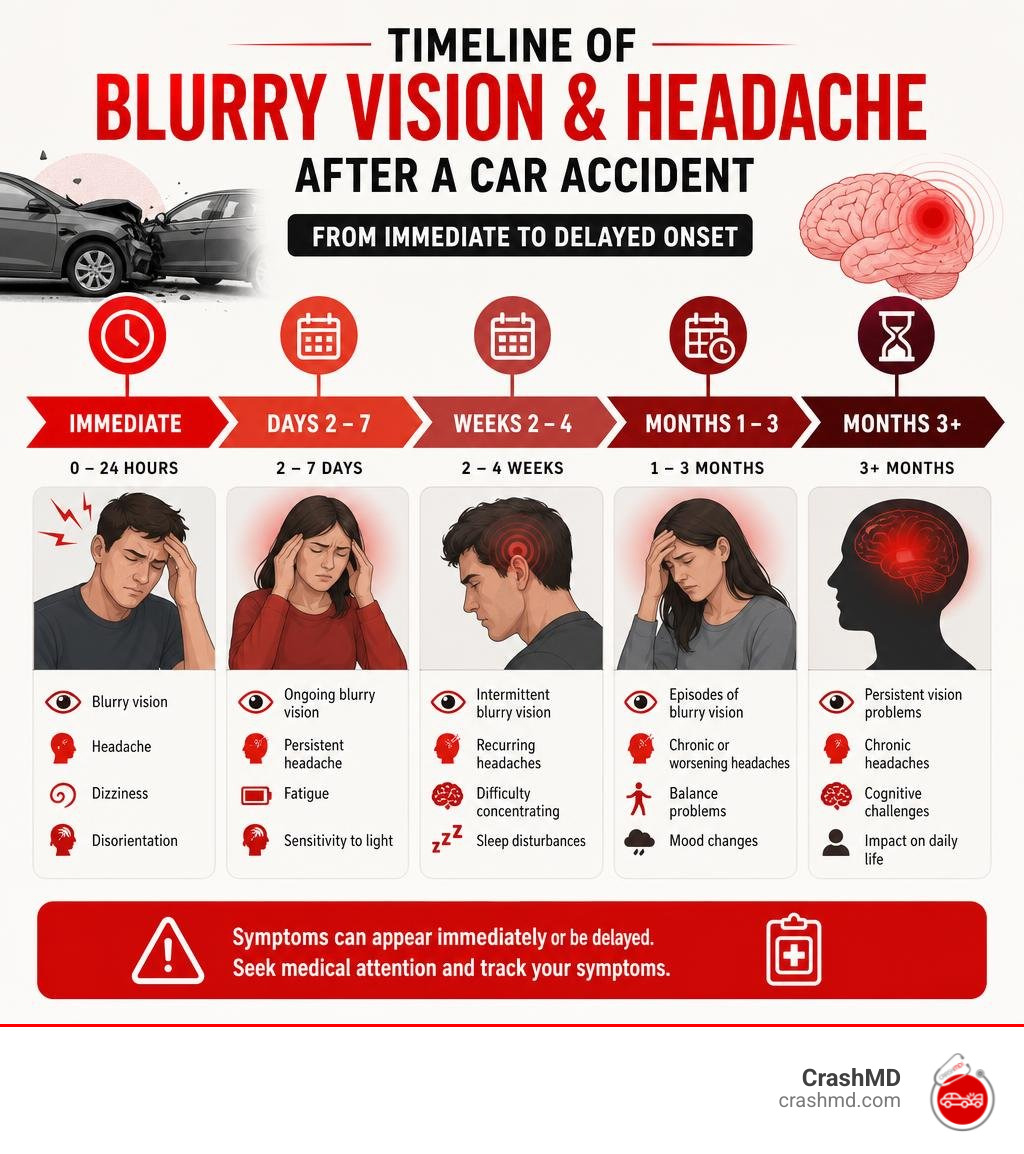
The tricky part? These symptoms don’t always show up immediately. Research shows that some people develop headaches and vision problems weeks or even months after the initial crash. That delay can make injuries harder to diagnose — and harder to link to the accident in a legal claim.
Over 90% of people who sustain a concussion in a car accident experience visual symptoms. Car accidents also account for roughly 17% of all traumatic brain injuries each year. These are not rare outcomes — they are common consequences of crashes that too many people dismiss as “just a headache.”
This guide walks you through the causes, warning signs, diagnosis, treatment, and legal steps you need to know.
Related content about blurry vision and headache after car accident:
What Causes Blurry Vision and Headache After Car Accident?

When you are involved in a motor vehicle collision, your body is subjected to violent, sudden forces. Even if you do not strike your head directly against the steering wheel or window, the rapid whipping motion of your neck and head can cause significant internal trauma.
The primary cause of a blurry vision and headache after car accident is often neurological. The brain is suspended in cerebrospinal fluid inside your skull. When a crash occurs, the brain can slam violently against the hard interior walls of the skull. This sudden impact can result in microscopic tearing of brain tissue, chemical imbalances, and localized brain swelling.
As the brain swells, it increases intracranial pressure. This pressure can compress the optic nerve—the vital pathway that transmits visual information from your eyes to your brain. When the optic nerve is compressed or damaged, the visual signals become distorted, leading to hazy, double, or blurry vision.
At the same time, this trauma triggers inflammatory responses and muscle tension, resulting in severe post-traumatic headaches. According to Healthline’s guide on post-accident headaches, these headaches can stem from nerve compression, vascular changes, or muscle spasms in the neck and scalp.
To help understand what you might be dealing with, it is helpful to look at how direct eye injuries differ from neurological vision issues:
| Feature | Direct Eye Trauma | Neurological Vision Issues |
|---|---|---|
| Primary Cause | Physical impact to the face, airbag deployment, shattered glass | Brain acceleration/deceleration, brain swelling, optic nerve pressure |
| Common Diagnoses | Corneal abrasion, retinal detachment, orbital fracture | Concussion, Traumatic Brain Injury (TBI), whiplash |
| Key Symptoms | Localized eye pain, redness, bleeding, sudden floaters or flashes | Double vision, light sensitivity, difficulty focusing, accompanying headache |
| Primary Specialist | Ophthalmologist | Neuro-optometrist, Neurologist, Head Injury Specialist |
Key Injuries Behind Blurry Vision and Headaches
Understanding the specific injuries that cause these symptoms is the first step toward getting the right treatment. According to Oatley Vigmond’s analysis of serious post-crash symptoms, ignoring persistent headaches and visual disturbances after a collision can lead to long-term, irreversible complications.
Concussions and TBIs: The Leading Cause of Blurry Vision and Headache After Car Accident
A concussion is a form of mild traumatic brain injury (mTBI) caused by the rapid acceleration and deceleration of the brain inside the skull. Approximately 300,000 concussions are attributed to car accidents in the United States every year.
When you suffer a concussion, the neural pathways that coordinate eye movements and process visual data are disrupted. Common concussion symptoms include:
- Persistent, throbbing headaches
- Light sensitivity (photophobia)
- Double or blurry vision
- Balance issues and dizziness
- Cognitive fog and memory problems
If you are experiencing these symptoms, it is critical to learn about recognizing concussions after a wreck to ensure you don’t overlook subtle signs of brain trauma. Failing to treat a concussion early can lead to post-concussion syndrome, where symptoms last for months or even years. You can read more about these long-term risks in our guide on the long-term risks of concussions.
Whiplash and Cervicogenic Headaches
Whiplash is a neck injury caused by the rapid back-and-forth movement of the head during a rear-end or side-impact collision. This motion damages the soft tissues, ligaments, and muscles in your neck.
Whiplash frequently causes cervicogenic headaches—headaches that originate in the neck but radiate pain upward into the back of the head, temples, and behind the eyes. This referred pain can easily be accompanied by cervicogenic dizziness and temporary visual blurriness, as the nerves in your upper cervical spine are closely linked to your body’s balance and visual tracking systems.
To explore how neck injuries translate into head pain, review our guide to post-trauma headaches as well as our head pain after a car accident resources.
Direct Eye Injuries and Retinal Detachment
Not all vision issues after a crash are neurological. The physical impact of a deploying airbag, seatbelt tension, or flying debris can cause direct trauma to the eye socket.
- Retinal Detachment: This is a medical emergency. The force of the crash can pull the retina (the light-sensitive layer at the back of the eye) away from its normal position. Symptoms include sudden blurry vision, flashes of light, and a shadow or “curtain” falling over your field of vision.
- Corneal Abrasions: Scratches on the surface of the eye, often caused by airbag dust or debris, which cause sharp pain, redness, and blurry vision.
- Vitreous Hemorrhage: Bleeding into the clear gel inside your eye, blocking light and causing dark spots or hazy vision.
- Orbital Fractures: Broken bones around the eye socket that can trap eye muscles, leading to painful double vision.
Untreated retinal detachment or severe eye trauma can lead to permanent vision loss, making immediate ophthalmological evaluation crucial.
Medical Diagnosis, Treatment, and Protecting Your Rights

When dealing with a complex issue like a blurry vision and headache after car accident, you need a comprehensive approach that addresses both your physical recovery and your legal rights. Navigating the medical system while building an insurance claim can be overwhelming, which is why consulting motor vehicle accident doctors who specialize in personal injury cases is so important.
How Doctors Diagnose Blurry Vision and Headache After Car Accident
A proper diagnosis goes far beyond a basic physical exam. Because these symptoms can indicate everything from a mild concussion to a life-threatening brain bleed, a specialist will perform a series of targeted evaluations:
- Comprehensive Neurological Exam: Assessing your reflexes, cranial nerves, balance, and cognitive function.
- Advanced Neuroimaging: Ordering a CT scan or MRI to check for brain swelling, skull fractures, or a subdural hematoma. Learn more about how these imaging tools are utilized in our article on how doctors assess traumatic brain injuries.
- Specialist Referrals: If standard tests are inconclusive but symptoms persist, you may need to see a neuro-optometrist or neurologist. Find out why this specialized care is vital in our guide on why you need a head injury specialist.
Treatment Options and Visual Rehabilitation
Once the underlying cause of your blurry vision and headache is identified, a personalized recovery plan can begin.
For neurological vision issues, neuro-optometric rehabilitation therapy is highly effective. This evidence-based treatment leverages neuroplasticity—the brain’s ability to reorganize and form new neural connections to recover lost function. Treatment may include:
- Science-based eye exercises to improve tracking, focusing, and eye coordination.
- Prism lenses to temporarily realign visual inputs and eliminate double vision.
- Specialized physical therapy to address neck tension and cervicogenic headaches.
For expert medical perspectives on managing these symptoms, read our specialist advice on post-crash headaches.
Documenting Symptoms for Your Personal Injury Claim
In states like Arizona, Nevada, Texas, Oklahoma, and California, obtaining compensation for your injuries requires concrete, undeniable proof linking your symptoms directly to the accident. Insurance companies are notorious for claiming that delayed-onset headaches or blurry vision are pre-existing conditions or unrelated to the crash.
At CrashMD, our unique approach focuses on patient advocacy and meticulous medical documentation. We ensure that every symptom, diagnostic test, and specialist recommendation is thoroughly recorded. This detailed medical trail is essential for securing both economic damages (medical bills, lost wages) and non-economic damages (pain, suffering, and reduced quality of life).
To understand how your symptoms translate to a legal claim, read about understanding what headaches tell you after a crash.
Frequently Asked Questions About Post-Accident Vision Issues
Is it normal to have blurry vision after a car accident?
No, blurry vision is never normal after a car accident. While it is a common symptom—affecting up to 9 out of 10 people who experience head trauma in a crash—it is a warning sign of an underlying injury, such as a concussion, brain swelling, or direct damage to the optic nerve. It requires immediate medical investigation.
How soon can blurry vision and headaches appear after a crash?
While some people experience symptoms immediately, others experience a delayed onset. Headaches and blurry vision can take days, weeks, or even months to surface.
In some cases, a delayed headache is a sign of a subdural hematoma—a slow accumulation of blood between the brain and the skull that develops as bridging veins slowly tear. This occurs in about 0.5% to 1% of mild head injuries. To learn more about symptom timelines, check out our guide on the aches and pains after your accident.
When should I seek emergency medical attention for these symptoms?
You should go to the nearest emergency room immediately if your blurry vision or headache is accompanied by any of these “red flag” symptoms:
- Loss of consciousness, even briefly
- Worsening, progressive headaches that do not respond to medication
- Focal neurological deficits (unilateral weakness, numbness, or tingling in your limbs)
- Confusion, slurred speech, or difficulty communicating
- Repeated vomiting or severe nausea
- Pupils of unequal size
For a deeper dive into emergency symptoms, read all about headache after car wreck.
Conclusion
“I’m Dr. Adam Savage, and I want to emphasize that ignoring visual disturbances and headaches after a car accident is one of the most dangerous decisions an accident victim can make. What feels like a minor, lingering headache today could be the warning sign of a serious brain injury or a progressive visual complication that, left untreated, could permanently alter your quality of life.”
At CrashMD, we guide accident victims in Arizona, Nevada, Texas, Oklahoma, and California through every step of their recovery. We offer expert pain management, coordinate with leading specialists, and advocate for your health. Most importantly, we document your injuries thoroughly to support your legal case, ensuring your physical recovery is prioritized before any legal settlements are finalized.
Do not wait for your symptoms to get worse. Reach out to us today to schedule an appointment with motor vehicle accident doctors who put your recovery first.