

Anatomy, Causes, and How a Rib Contusion Differs from a Fracture
A rib contusion (bruised rib) typically takes 4 to 6 weeks to heal, with the most severe pain and swelling occurring in the first week. Core home care focuses on cold therapy, over-the-counter pain management, and proactive deep-breathing exercises to prevent lung complications, while strictly avoiding restrictive chest wraps.
Understanding the biomechanics of the thoracic cage helps explain why chest trauma is so painful. Your rib cage consists of 12 pairs of ribs that protect vital organs, anchored by costal cartilage and cushioned by intercostal muscles. Between each rib lies the intercostal neurovascular bundle—a sensitive network of nerves and blood vessels. When blunt trauma strikes this area, the periosteum (the nerve-rich outer sheath of the bone) sustains microscopic damage.
While a rib contusion involves severe microvascular bruising to the bone and surrounding soft tissue, a rib fracture represents a complete or partial break in the structural integrity of the bone. For detailed clinical diagnostic frameworks, the Rib Fracture – StatPearls – NCBI Bookshelf provides deep medical insights into thoracic trauma management.
| Feature | Rib Contusion (Bruised Rib) | Rib Fracture (Broken Rib) |
|---|---|---|
| Primary Structural Damage | Periosteal micro-bleeding and muscle trauma | Disruption/break of the cortical bone structure |
| Pain Level | Moderate to severe; sharp during inhalation | Severe to excruciating; intense point tenderness |
| Diagnostic Sensitivity | Clinical evaluation; MRI or bone scan shows bone edema | Chest X-ray detects ~50%; CT scan is the gold standard |
| Average Recovery Time | 4 to 6 weeks | 6 weeks to several months |
| Severe Risks | Muscle guarding, atelectasis, secondary pneumonia | Pneumothorax, hemothorax, organ laceration, flail chest |
What Is a Rib Contusion and What Causes It?
A contusion happens when direct force crushes the tiny capillaries in the periosteum and adjacent musculature, causing blood to pool beneath the tissue. This triggers localized swelling and ecchymosis (discoloration). Common causes include:
- Motor vehicle collisions: Blunt steering wheel or seatbelt impact during rapid deceleration.
- Contact sports: Hard direct hits in sports like football, rugby, or martial arts.
- Accidental falls: Direct chest strikes against hard objects or edges.
- Repetitive strain or coughing: Severe bronchitis or violent coughing spells that strain chest attachments.
When chest wall muscles suffer blunt force, you are also dealing with soft tissue injury and why it hurts so much, as intercostal fibers become inflamed.
Clinical Differences and Imaging Limitations
Telling a contusion from a simple hairline fracture based on symptoms alone is notoriously difficult because both present with sharp pain, swelling, and difficulty taking deep breaths.
Medical imaging helps clarify the diagnosis, but standard tests have limitations. Plain chest radiographs (X-rays) detect only about 50% of isolated rib fractures. Hairline cracks or injuries to the anterior costal cartilage are frequently invisible on standard X-rays. In trauma settings, point-of-care ultrasound or a high-resolution chest CT scan serves as the gold standard to assess subtle fractures, cartilage tears, or pulmonary issues. If your trauma involves the cartilage connecting your ribs to the sternum, reviewing the ultimate guide to rib cartilage injury recovery timeline can help you navigate the specific demands of cartilage healing.
Recognizing Symptoms, Intercostal Spasms, and Organ Risks
A bruised rib produces localized point tenderness and pleuritic chest pain—a sharp, stabbing discomfort that spikes whenever the chest wall expands during inhalation, coughing, or twisting. To protect the injured area, your body naturally responds with splinting: your intercostal muscles involuntarily contract and spasm to immobilize the chest. While this natural reflex limits movement, sustained muscle spasms cause dull, aching referred pain across the mid-back and make normal respiration difficult. For a professional medical summary of thoracic wall trauma, see the Rib Fracture – Injuries; Poisoning – MSD Manual Professional Edition.
Right-Side vs. Left-Side Internal Injury Risks
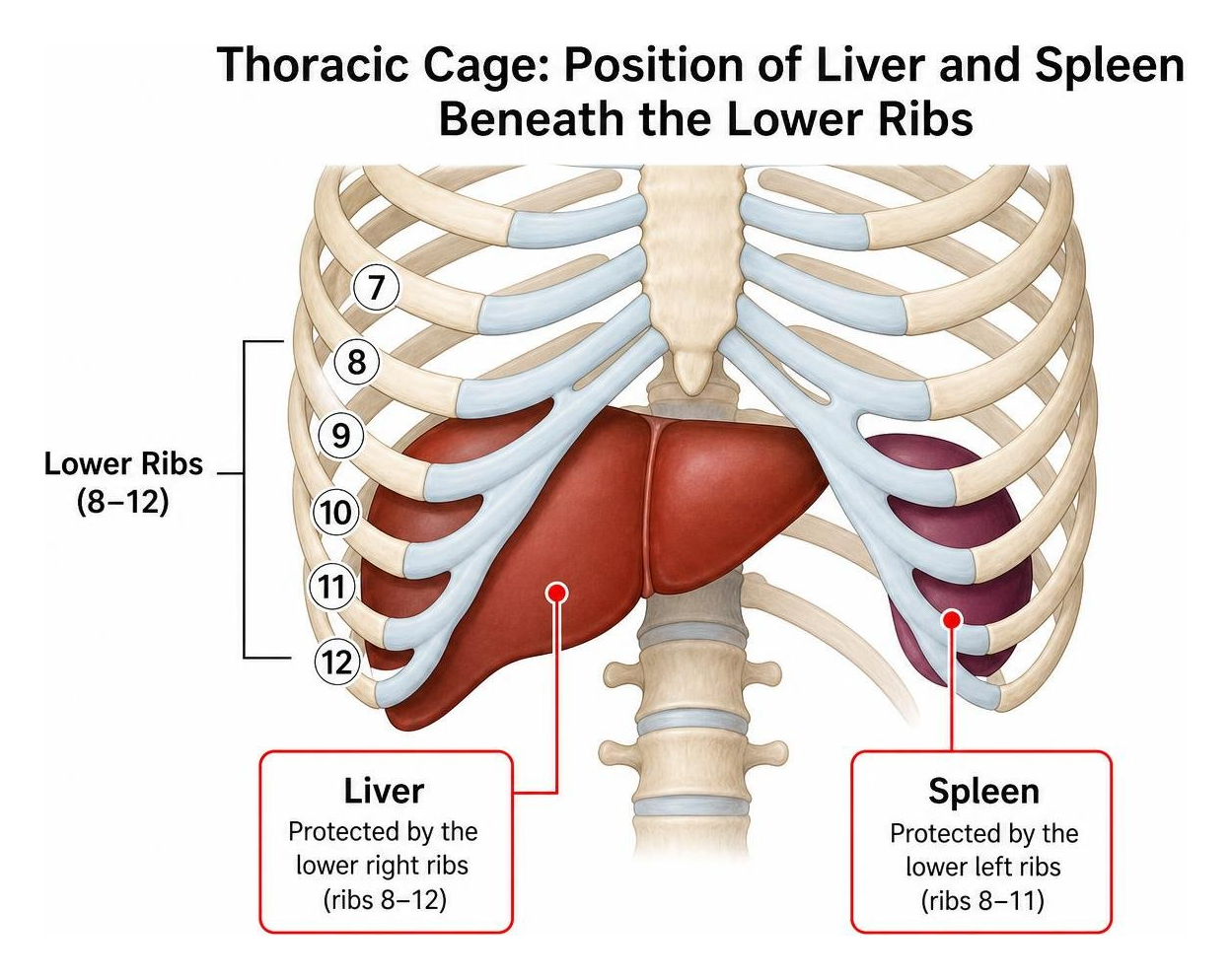
The lower ribs (ribs 8 through 12) shield vital solid organs in your upper abdomen. Depending on which side sustained trauma, specific internal complications must be evaluated:
- Right-Side Injuries (Liver Risk): Blunt trauma to the right lower ribcage can cause hepatic contusion or laceration. Warning signs include localized pain in the right upper quadrant of the abdomen, abdominal rigidity, and referred pain to the right shoulder.
- Left-Side Injuries (Spleen Risk): The spleen sits directly beneath the left lower ribs. Traumatic impact can lead to splenic laceration or subcapsular hematoma. A key indicator is Kehr’s sign—referred pain at the tip of the left shoulder caused by blood irritating the diaphragm. Delayed splenic rupture can develop 24 to 72 hours post-injury.
For a deeper look into how soft-tissue and internal contusions progress, refer to our step-by-step guide to internal chest bruising.
Severe Complications and Emergency Red Flags
Certain chest trauma signs demand immediate emergency medical intervention. Seek immediate emergency care if you experience any of the following red flags:
- Sudden, worsening shortness of breath or rapid, shallow breathing (tachypnea)
- Coughing up bright red blood or pink frothy sputum (hemoptysis)
- Feeling lightheaded, dizzy, cold, or fainting (signs of internal hemorrhage or hypotension)
- Bluish discoloration of the lips, nail beds, or skin (cyanosis)
- A section of the chest wall moving in the opposite direction during breathing (paradoxical motion indicating flail chest, which carries a 10% to 15% mortality rate)
- Development of fever, productive cough with colored phlegm, or chills (warning signs of secondary pneumonia)
Trauma can also bruise underlying lung tissue directly. Understanding the diagnosis and medical coding of these thoracic conditions is covered in our resource on ICD-10 code for pulmonary contusion.
Step-by-Step Recovery Timeline and Healing Milestones

Week-by-Week Rib Contusion Healing Timeline
Healing follows a structured physiological path from acute inflammation to tissue remodeling:
- Week 1 (Acute Inflammatory Phase): The first 3 to 4 weeks are generally the most uncomfortable, with days 1 to 7 presenting the highest peak in swelling, muscle spasms, and sharp pain. Rest, cryotherapy, and intentional breathing exercises are vital during this phase.
- Weeks 2 to 3 (Subacute Healing Phase): Pain begins to decrease during gentle daily tasks. Capillary remodeling and cellular repair stabilize the periosteum, though laughing, sneezing, and sudden torso twists will still cause discomfort.
- Weeks 4 to 6 (Remodeling and Functional Recovery): Most simple rib contusions resolve within this window. Deep inhalation becomes comfortable, swelling subsides, and normal activity can be steadily resumed. In older adults or individuals with underlying conditions, full resolution may take several additional weeks.
Safe Resumption of Work and Physical Activity
Returning to your routine requires a measured approach to prevent re-injury:
- Light Activity (Weeks 1 to 2): Gentle walking around the home is encouraged to promote lung expansion and prevent blood clots. Avoid lifting anything over 5 to 10 pounds.
- Desk Work and Light Lifting (Weeks 3 to 4): Return to non-physical work when pain is manageable without sedating medications. Practice good posture to reduce thoracic fatigue.
- Cardiovascular Conditioning (Weeks 4 to 5): Reintroduce stationary cycling or light jogging once you can breathe deeply without sharp pain. Avoid sudden torso rotations.
- Full Contact Sports and Heavy Manual Labor (Week 6+): Do not return to contact sports, heavy weightlifting, or vigorous physical labor until you are completely pain-free upon firm palpation and cleared by your medical provider.
Comprehensive Home Care, Pain Management, and Breathing Protocols
Managing recovery at home focuses on balancing comfortable pain relief with active lung protection. For established clinical self-care instructions, review the Bruised rib care: MedlinePlus Medical Encyclopedia guidelines.
- Cold and Heat Therapy: Apply an ice pack wrapped in a cloth for 15 to 20 minutes, 2 to 3 times daily for the first 48 hours to minimize inflammation. After the initial swelling subsides, gentle moist heat can help soothe tight intercostal muscles.
- Over-the-Counter Pain Relief: Use acetaminophen or nonsteroidal anti-inflammatory drugs (NSAIDs) such as ibuprofen or naproxen as directed by your physician.
- Clinical Interventions: If severe pain prevents deep breathing despite oral medication, physicians can perform intercostal nerve blocks to temporarily disrupt pain signals along the chest wall.
Essential Breathing Exercises and Lung Expansion Techniques
When rib pain makes breathing hurt, people naturally take shallow breaths. This under-inflation causes the tiny air sacs in the lungs to collapse (atelectasis), creating a prime environment for secondary bacterial pneumonia. To keep your lungs clear:
- Controlled Deep Breathing: Every hour while awake, take 5 to 10 slow, deep breaths. Inhale gently through your nose, hold the breath for 2 to 3 seconds, and exhale slowly through pursed lips.
- Supported (Splinted) Coughing: Clear secretions from your airway by hugging a firm pillow tightly against your injured ribs. The counter-pressure stabilizes the chest wall and significantly reduces sharp pain while coughing.
- Incentive Spirometry: Use an incentive spirometer device several times a day to visually monitor your lung volume and encourage full alveolar recruitment.
Sleep Positioning and Daily Movement Adaptations
Lying flat on your back or rolling onto the injured side increases pressure on the thoracic cage and restricts nighttime lung expansion.
- Elevate Your Torso: Sleep in a semi-Fowler’s position (head and torso elevated 30 to 45 degrees) using a wedge pillow or recliner chair during the first 1 to 2 weeks.
- Support Your Movement: When getting out of bed, roll onto your uninjured side, use your arms to push your upper body upright, and keep your core braced to avoid twisting your chest.
Frequently Asked Questions About Rib Injuries
How can I tell if my rib injury is affecting my spleen or liver?
Trauma to the lower ribs (ribs 8 through 12) warrants close observation. Suspect liver involvement (right side) or spleen involvement (left side) if you develop persistent abdominal pain, rigid abdominal muscles, dizziness, or referred pain to the top of either shoulder. Left shoulder tip pain (Kehr’s sign) is a classic indicator of diaphragmatic irritation from splenic bleeding. If any of these signs appear, seek emergency medical evaluation immediately for diagnostic imaging.
Why is it dangerous to wrap or bandage a bruised rib?
In past decades, wrapping the chest with elastic bandages or rib belts was common practice. Modern medicine strongly advises against this. Tight chest wraps restrict thoracic expansion, preventing the lower lobes of the lungs from filling with air. This mechanical restriction rapidly leads to alveolar collapse (atelectasis) and significantly increases the risk of developing life-threatening pneumonia.
What over-the-counter medications are safest for rib injury pain?
Acetaminophen and NSAIDs (like ibuprofen or naproxen) are the most effective over-the-counter options for controlling chest wall inflammation. However, take NSAIDs with food to avoid gastrointestinal upset, and avoid them if you have a history of stomach ulcers, kidney disease, or cardiovascular concerns unless approved by your doctor. Always consult your healthcare provider to confirm which medications are safe for your specific health profile.
Conclusion
Recovering from a bruised rib takes patience, consistent self-care, and proactive lung protection. By managing your pain effectively, avoiding restrictive chest wraps, and practicing regular deep-breathing exercises, you can support a smooth, complication-free healing process over the typical 4 to 6-week recovery window.
If your injury occurred as the result of a motor vehicle collision, timely medical care and thorough documentation are essential for both your physical recovery and any future personal injury claims. We specialize in diagnosing traumatic crash injuries, providing personalized rehabilitation plans, and maintaining precise clinical records throughout your care. To learn more about protecting your health and your legal rights after a crash, explore our practical guide to car accident injury documentation.