

Understanding Costochondritis After Car Accident Trauma
Persistent chest pain after a collision is commonly costochondritis, an inflammation of the costal cartilage connecting your ribs to your breastbone (sternum). During a crash, rapid compression, blunt impact, or seatbelt tension can strain, stretch, or cause micro-tears across these costochondral junctions. When evaluating a rib cartilage injury after a car accident, doctors examine these specific points because even minor cartilage damage can produce sharp, persistent discomfort that mimics cardiac conditions.
When a vehicle suddenly stops, your torso absorbs intense kinetic energy. The rib cage is a semi-flexible structure engineered to protect vital organs, relying on bands of tough connective tissue to absorb force. When those joints are strained by rapid deceleration, prolonged inflammation often follows.
What Causes Costochondritis After Car Accident Impacts?
Even the safety features that save our lives can leave lasting physical reminders. A locked seatbelt distributes massive restraint force across your clavicle, sternum, and rib cage. While it prevents ejection or severe head trauma, that concentrated tension can crush or wrench the anterior chest wall.
Other direct causes include:
- Airbag Deployment: An airbag inflating at speeds up to 200 mph can deliver a blunt blow to the sternum.
- Steering Wheel or Dashboard Contact: Direct impact in higher-speed collisions can compress the rib cage inward.
- Rapid Deceleration: Sudden deceleration violently pulls the muscles and cartilage supporting the thoracic cage.
These physical forces frequently result in extensive soft tissue damage throughout the chest wall, irritating the surrounding nerves and triggering a chronic inflammatory cycle.
Costochondritis vs. Tietze Syndrome: Key Differences
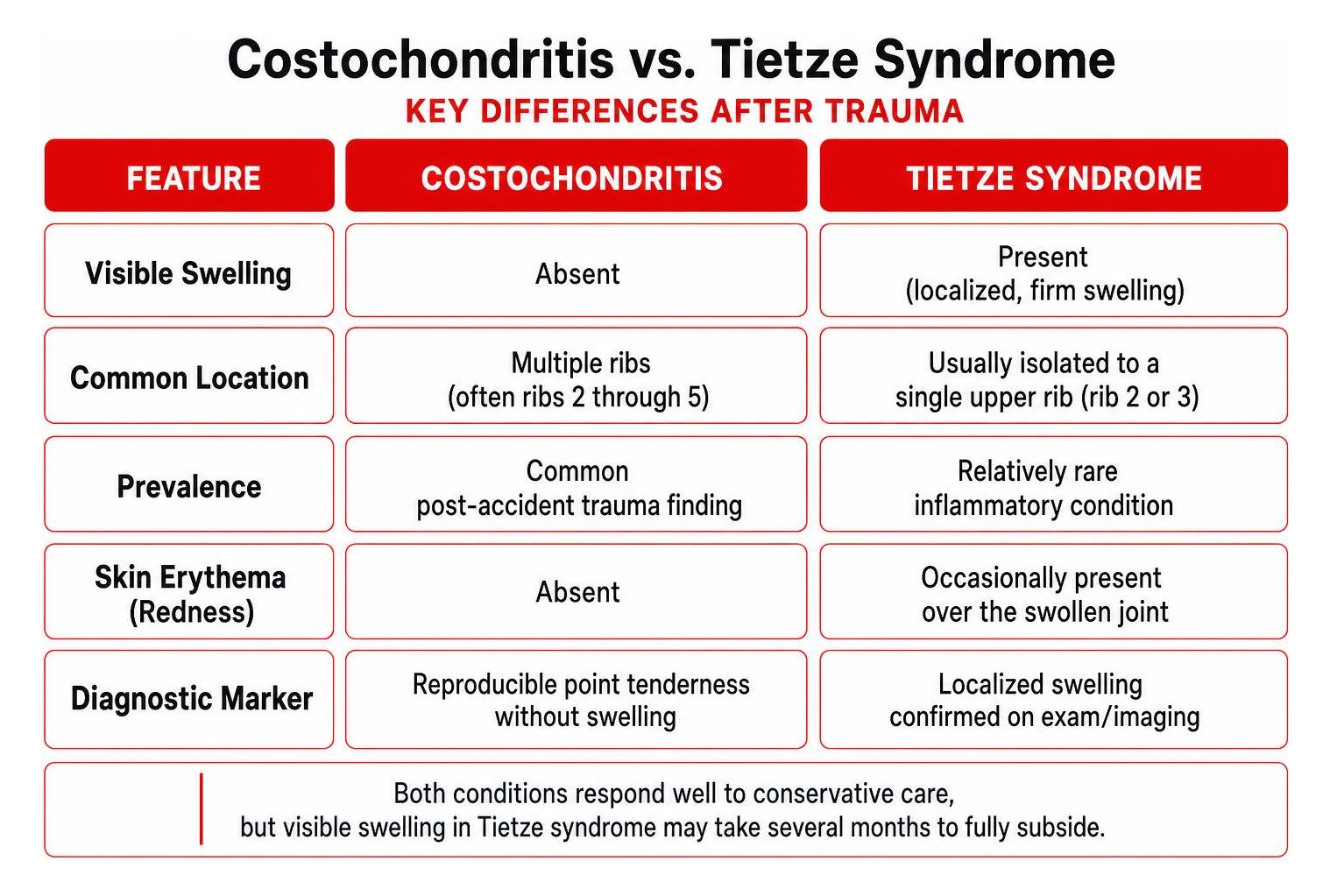
While costochondritis is a frequent finding after motor vehicle trauma, it is sometimes confused with a closely related condition called Tietze syndrome. Differentiating between the two helps guide proper medical intervention:
| Feature | Costochondritis | Tietze Syndrome |
|---|---|---|
| Visible Swelling | Absent | Present (localized, firm swelling) |
| Common Location | Multiple ribs (often ribs 2 through 5) | Usually isolated to a single upper rib (rib 2 or 3) |
| Prevalence | Common post-accident trauma finding | Relatively rare inflammatory condition |
| Skin Erythema (Redness) | Absent | Occasionally present over the swollen joint |
| Diagnostic Marker | Reproducible point tenderness without swelling | Localized swelling confirmed on exam/imaging |
Both conditions respond well to conservative care, but visible swelling in Tietze syndrome may take several months to fully subside.
Identifying Symptoms and Critical Warning Signs
Common Symptoms of Costochondritis After Car Accident Injuries
Costochondritis symptoms can range from a dull, persistent ache to sharp, stabbing sensations. The hallmark feature of this condition is reproducible tenderness: pressing directly on the junction where your rib meets the sternum will recreate the exact pain you feel.
Other common symptoms include:
- Pain that intensifies during deep inhalation, sneezing, or coughing.
- Discomfort that worsens when twisting your torso, lifting items, or lying on your front or side.
- A sensation of chest tightness or pressure that fluctuates throughout the day.
- Aching that radiates outward to your back, shoulders, or abdomen.
Red Flag Symptoms Requiring Immediate Emergency Care
Because chest pain can indicate catastrophic, life-threatening internal damage, you must never assume post-crash chest wall pain is purely musculoskeletal. Seek emergency medical attention immediately if you experience any of the following:
- Shortness of breath, difficulty catching your breath, or wheezing (potential sign of a pneumothorax or collapsed lung).
- Crushing chest pressure or pain that radiates into your left arm, neck, jaw, or upper back.
- Sudden dizziness, lightheadedness, confusion, or fainting.
- Coughing up blood or pink-tinged sputum.
- An irregular or racing heartbeat (palpitations), which could indicate a myocardial contusion (bruised heart muscle).
For guidance on identifying critical symptoms after collisions, reputable health resources provide comprehensive insights into what to do if you have chest pain after a car crash.
Diagnostic Process and Ruling Out Severe Injuries
Chest wall pain can take hours, days, or even weeks to fully manifest. High levels of adrenaline immediately following a collision frequently mask musculoskeletal pain, leading many victims to believe they escaped unharmed. Learning why delayed symptoms after collisions occur highlights why early medical screening is vital.
A physician begins with a thorough physical examination, methodically palpating each costochondral junction. To make a safe differential diagnosis, doctors must systematically rule out cardiac ischemia, aortic dissection, pulmonary embolism, and fractured ribs. An electrocardiogram (EKG) and baseline blood tests are commonly performed to ensure your heart is functioning normally.
Clinical Examinations and Advanced Imaging
One frustrating aspect of costochondritis is that cartilage does not show up clearly on standard X-rays. An X-ray is primarily used to confirm that you do not have fractured bones or a collapsed lung.
To visualize soft-tissue injuries or confirm severe cartilage tears, advanced imaging may be ordered:
- Computed Tomography (CT) Scans: Provide detailed cross-sectional views of both bone and subtle cartilage disruptions.
- Magnetic Resonance Imaging (MRI): Excellent for visualizing active soft-tissue inflammation and joint effusion at the sternocostal junctions.
Undergoing a comprehensive post-crash medical evaluation ensures that no hidden thoracic injuries are overlooked. For clinical perspectives on specialized care, you can read more from Acibadem Health Point on post-accident costochondritis.
Potential Complications of Untreated Chest Wall Inflammation
Ignoring persistent chest wall inflammation can lead to prolonged discomfort. When breathing deeply hurts, patients instinctively take shallow, guarded breaths. This protective mechanism (hypoventilation) prevents the lower lobes of the lungs from fully expanding, significantly increasing the risk of secondary respiratory infections such as atelectasis or pneumonia.
Chronic costochondritis can also cause long-term thoracic stiffness, altered spinal mechanics, and postural compensations that trigger chronic neck and upper back pain.
How to Treat and Manage Costochondritis Pain at Home and Beyond
Immediate Relief and Lifestyle Adjustments
Recovering from costochondritis requires reducing joint stress while keeping surrounding tissues mobile:
- Temperature Therapy: Use ice packs over the sore area for 15–20 minutes at a time during the first 48 hours to blunt acute swelling. Afterward, apply moist heat to loosen tight intercostal and pectoral muscles.
- Activity Modification: Temporarily avoid strenuous pushing, pulling, heavy lifting, or repetitive torso rotation. Even a tight seatbelt can feel like a “hug that hurts” after a crash, so adjust your seating posture to avoid slouching.
- Ergonomic Support: Maintain an upright posture with your shoulders back to relieve compressive pressure across the anterior chest wall.
- Gentle Diaphragmatic Breathing: Practice slow, controlled belly breathing to maintain lung capacity without forcefully expanding the upper rib cage.
Clinical Rehabilitation and Medical Interventions
When home remedies provide insufficient relief, structured medical care can accelerate healing:
- Nonsteroidal Anti-Inflammatory Drugs (NSAIDs): Medications like ibuprofen or naproxen help quiet cartilage inflammation.
- Targeted Physical Therapy: Engaging in targeted accident rehabilitation allows clinicians to guide you through gentle thoracic mobilization, pectoral stretches, and scapular stabilization exercises.
- Corticosteroid Injections: In severe cases where pain limits daily life and does not respond to standard measures, a physician may administer a localized corticosteroid injection directly into the inflamed joint space to provide rapid relief.
Recovery Timelines, Documentation, and Insurance Protection
Expected Recovery Duration and Healing Milestones
Cartilage has a limited blood supply compared to bone, meaning it heals more slowly.
- Weeks 1 to 2 (Acute Phase): Focus is on pain control, inflammation reduction, and ruling out structural complications.
- Weeks 3 to 6 (Subacute Phase): Pain typically diminishes. Patients begin gentle stretches and resume light daily activities.
- Months 2 to 3+ (Resolution/Chronic Phase): Most uncomplicated cases resolve within 4 to 6 weeks. However, severe seatbelt or airbag trauma may take several months to achieve full, symptom-free mobility.
Protecting Injury Claims Through Timely Medical Records
Beyond your physical recovery, sustaining an injury in an auto collision brings practical financial and legal considerations. Insurance adjusters frequently scrutinize soft-tissue and cartilage claims because they do not appear as obvious breaks on standard X-rays.
Securing legal medical documentation early protects your rights. Maintain a detailed daily symptom log noting your pain levels and daily limitations. Keep copies of diagnostic reports, specialist referrals, and therapy receipts. Prompt clinical documentation directly connects your chest trauma to the collision, helping your legal or insurance representative establish the true impact of your injury.
Frequently Asked Questions About Post-Accident Chest Pain
Can delayed chest pain after a collision indicate costochondritis?
Yes. Adrenaline surges and shock post-crash often mask localized soreness for several days. As muscle spasms settle and initial swelling localizes around the injured costochondral joints, sharp or aching pain can gradually emerge weeks after the accident.
How long does post-collision rib cartilage inflammation last?
Most mild-to-moderate cases improve within 4 to 6 weeks with proper rest, anti-inflammatory treatment, and light activity modification. Severe injuries involving extensive soft-tissue trauma can take 3 months or longer to completely heal.
Will costochondritis show up on an X-ray?
No. Costal cartilage is radiolucent and does not show up on standard plain-film X-rays. Doctors use X-rays primarily to rule out cracked ribs, sternal fractures, or lung pathology. Diagnosis is made clinically and may be supported by MRI or CT scans.
Conclusion
Lingering chest pain following a motor vehicle collision should never be ignored or dismissed as simple soreness. Whether your discomfort stems from seatbelt compression, airbag deployment, or sudden blunt trauma, addressing costochondritis early helps prevent chronic inflammation and protects your respiratory health.
At CrashMD, we advocate for accident victims across Arizona, Nevada, Texas, Oklahoma, Southern California, and Northern California by delivering accurate post-collision evaluations, personalized pain management, and thorough medical documentation to support your full recovery. If you are struggling with persistent chest pain after a crash, schedule a comprehensive evaluation with our team today and take the first step toward lasting relief.