

Don’t Let Your Claim Crash and Burn: How to Document Injuries Properly
Why Documenting Your Injuries Properly Can Make or Break Your Legal Claim
The best ways to document injuries for legal claims come down to a clear set of actions you need to take — starting from the moment the accident happens:
- Seek medical care immediately — even if you feel fine. Delayed treatment gives insurers a reason to dispute your injuries.
- Photograph everything — injuries, the accident scene, property damage, and hazard conditions.
- Get a police report and witness contacts — official, third-party accounts carry serious weight.
- Keep every medical record — ER notes, imaging, prescriptions, therapy notes, and bills.
- Start a daily injury journal — log pain levels, emotional impacts, and activity limitations.
- Track all financial losses — medical bills, lost wages, travel costs, and out-of-pocket expenses.
- Avoid social media — anything you post can be used against you.
- Consult a personal injury attorney — early involvement protects your evidence and your rights.
You’ve just been in an accident. You’re in pain, you’re overwhelmed, and the last thing on your mind is paperwork. But what you do in the hours and days after an injury can determine whether you receive fair compensation — or nothing at all.
Insurance companies are not on your side. Their adjusters are trained to find gaps in your story — missed appointments, vague symptoms, delayed treatment. Any inconsistency is an opportunity for them to minimize or deny your claim.
The hard truth? The injury itself isn’t always what wins or loses a case. The documentation is.
Medical records, photographs, journals, and financial records form the foundation that judges, juries, and insurance companies rely on to determine what your claim is worth. Without a solid paper trail, even a serious injury can be undervalued or dismissed.
This guide walks you through exactly how to build that paper trail — step by step.
The Best Ways to Document Injuries for Legal Claims Starting at the Scene
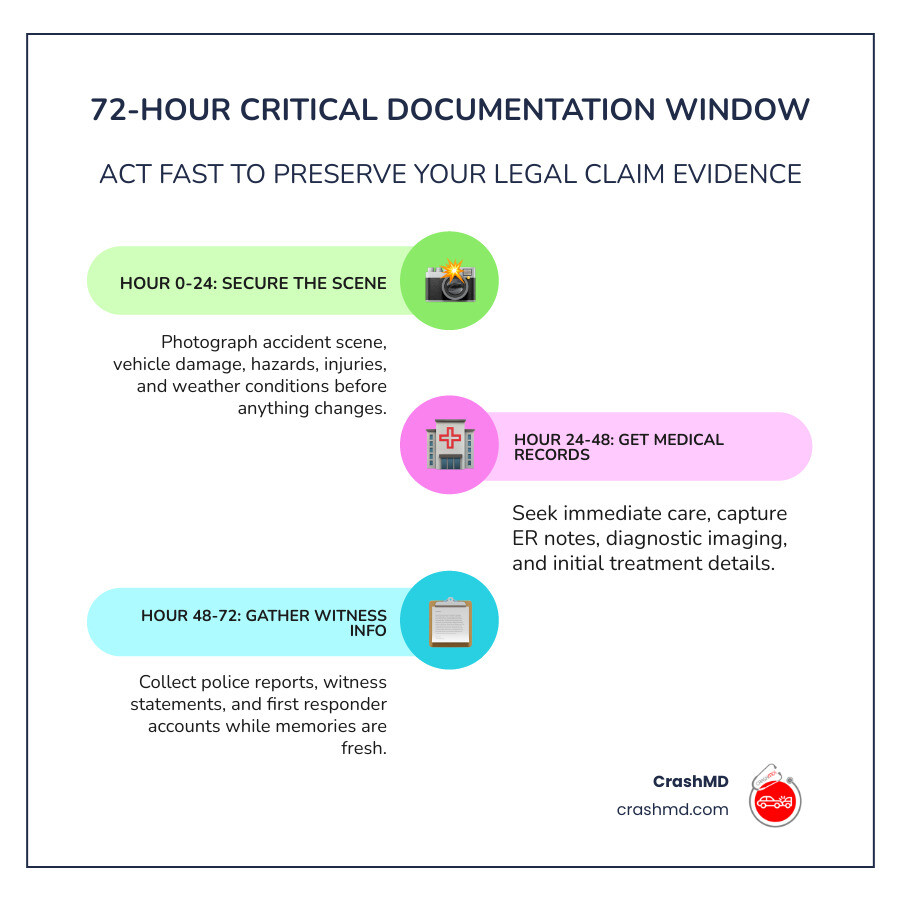
When an accident happens in April 2026, the clock starts ticking immediately. The first 72 hours are what we call the “critical window” for evidence preservation. In the legal world, there is a concept known as the spoliation doctrine. This essentially means that if evidence is lost, destroyed, or altered, it can hurt your case. For example, if a hazard at a slip-and-fall scene is repaired the next day, and you didn’t get a photo, proving the danger existed becomes much harder.
Knowing what to do immediately after a car accident is vital. Your first priority is safety, but as soon as you are stable, start documenting. Use your smartphone to capture the scene from multiple angles. Don’t just focus on your own car or the spot where you fell; look for the “why.”
Capture photos of:
- Vehicle damage: Close-ups and wide shots showing the force of impact.
- Road hazards: Skid marks, broken traffic lights, or lack of signage.
- Environment: Weather conditions, lighting (or lack thereof), and any debris.
- Scene defects: If you’re in a store, photograph the spill, the uneven rug, or the missing “Wet Floor” sign.
Official reports are the backbone of a claim. Always call the police so they can file a formal report. This provides an unbiased, third-party account of the incident. While you wait, collect contact information from any witnesses. A witness statement can be the “tie-breaker” if the other party lies about what happened.
Capturing Visual Evidence of Physical Trauma
One of the best ways to document injuries for legal claims is to create a visual timeline. Injuries change rapidly. A bruise might not appear until 24 hours later, and swelling might peak on day three.
Follow this full checklist for documenting injuries:
- Take timestamped photos: Ensure your camera settings show the date and time.
- Use scale references: Place a common object, like a coin or a ruler, next to a cut or bruise to show its size.
- Maintain lighting consistency: Try to take follow-up photos in the same room or lighting to show the true progression of healing or worsening.
- Document medical equipment: Take photos of yourself in your neck brace, using crutches, or with your arm in a sling. This visual proof of your “new normal” is incredibly persuasive.
Securing Official Reports and Witness Statements
Don’t rely on your memory alone. In the heat of the moment, adrenaline can mask pain and cloud your recollection. This is why a post-crash check-up is so important; it creates an official medical record that mirrors the police report.
When speaking with first responders, be factual. Get the officer’s name and badge number, and ask for the incident report number. If there are witnesses, ask them what they saw and write it down or record a voice memo on your phone (with their permission). These contemporaneous notes—notes made at the time of the event—are often viewed as more reliable than testimony given months later in a courtroom.

Building an Irrefutable Medical Paper Trail
In the legal system, if it isn’t written down in a medical record, it didn’t happen. To win a claim, you must prove causation—the direct link between the accident and your injury. Insurance companies love to argue that your pain is from a “pre-existing condition.”
Proper medical documentation for injury claims requires a comprehensive file. This includes your initial ER records, diagnostic imaging (like X-rays or MRIs), and physician notes. Following a strict post-accident protocol ensures that every symptom is logged from day one.
Even if you had a prior back injury, you can still seek damages under the eggshell plaintiff doctrine. This legal rule states that a defendant is responsible for the “extra” harm they caused you, even if you were more susceptible to injury than an average person. However, to win this argument, you need baseline medical history—records from before the accident—to show exactly how much worse your condition became after the crash.
Best Ways to Document Injuries for Legal Claims with a Daily Journal
While medical records track the “what,” an injury journal tracks the “how.” How does this injury affect your life? We recommend using the OLDCARTS method to describe your pain to both your doctor and your journal:
- Onset: When did the pain start?
- Location: Where exactly does it hurt?
- Duration: How long does the pain last?
- Characteristics: Is it sharp, dull, throbbing, or burning?
- Aggravating factors: What makes it worse (e.g., walking, sitting)?
- Relieving factors: What makes it better (e.g., ice, rest)?
- Timing: Is it worse in the morning or at night?
- Severity: Rate it on a scale of 0 to 10.
Your recovery roadmap should also include the emotional toll. Document sleep disruption, anxiety about driving, or the sadness of not being able to pick up your children. These “non-economic damages” are just as real as a broken bone, but they require consistent journaling to prove.
Maintaining Consistency Across All Medical Providers
One of the biggest mistakes people make is “doctor shopping” or having gaps in their treatment. If you stop going to physical therapy because you feel “mostly better,” an insurance adjuster will argue you are completely better.
To maintain a strong claim, you must:
- Attend all follow-up appointments: Even if you feel fine, go to the check-up.
- Be consistent with symptoms: If your neck and shoulder hurt, tell every provider (ER doc, PCP, and physical therapist) about both.
- Keep pharmacy records: Save your prescription bottles and receipts.
- Prepare for Independent Medical Exams (IMEs): The insurance company may send you to their doctor. Having your own detailed medical care records allows your attorney to counter any biased findings from the insurance doctor.
Tracking Economic Losses and Avoiding Pitfalls
Documenting injuries isn’t just about the physical pain; it’s about the financial “crash” that follows. You need to distinguish between economic and non-economic damages to ensure you are fully compensated.
| Damage Type | What it Includes | How to Document |
|---|---|---|
| Economic | Bills, lost wages, out-of-pocket costs | Invoices, pay stubs, receipts |
| Non-Economic | Pain and suffering, loss of enjoyment | Injury journal, witness statements |
To avoid getting wrecked twice, you must be meticulous. Save every receipt, from the hospital bill to the $10 bottle of Tylenol you bought at the pharmacy.
Best Ways to Document Injuries for Legal Claims by Tracking Economic Losses
A thorough guide to documenting damages highlights that the more “official” the document, the better.
- Lost Wages: Get an employer verification letter. This shouldn’t just show your hourly rate, but also missed overtime, used sick days, and lost bonuses.
- Travel Mileage: Keep a log of every mile driven to and from doctors, therapists, and pharmacies. In 2026, these costs add up quickly.
- Future Care Projections: If your injury is permanent, you may need vocational reports or life-care plans to estimate what you will need for the next 20 years.
- Home Modifications: If you had to install a ramp or grab bars, save those receipts.
seeking medical treatment is the primary way to justify these costs. If there is no medical record recommending a treatment, the insurance company won’t pay for it.
Common Mistakes That Devalue Your Case
Even with the best evidence, a few simple mistakes can sink your claim. We see it all the time:
- Treatment Gaps: Waiting weeks to see a doctor or skipping therapy sessions.
- Vague Descriptions: Telling a doctor “I feel okay” when you are actually in pain but trying to be polite.
- Social Media Posts: Posting a photo of yourself at a BBQ can be used to “prove” you aren’t really injured, even if you were sitting in a chair the whole time.
- Early Settlement Offers: Taking a “quick check” from an insurance company before you know the full extent of your injuries. Once you sign, you can never ask for more.
- Missing Statutes of Limitations: In states like Arizona, Texas, or California, you usually have two years to file, but some requirements (like claims against government entities) have much shorter windows.
Understanding why early intervention is key can help you avoid these traps.

Frequently Asked Questions about Documenting Injuries
Why is immediate medical documentation critical for proving causation?
Insurers look for any “intervening event.” If you wait five days to see a doctor, they will argue that you could have hurt your back lifting groceries or sleeping wrong in those five days. Immediate documentation creates a timestamped link between the accident and the physical trauma.
How do I document “invisible” injuries like whiplash or TBI?
Traumatic Brain Injuries (TBI) and soft-tissue injuries like whiplash don’t always show up on a standard X-ray. Documentation for these relies on specialist referrals (neurologists), advanced imaging (DTI or 3T MRIs), and your injury journal. Log symptoms like light sensitivity, irritability, memory loss, or “brain fog.”
What is the best way to organize my legal evidence for maximum impact?
We recommend a “Master File” approach. Use a physical accordion folder or a secure digital cloud drive. Categorize everything:
- Scene Evidence (Photos/Police Report)
- Medical Records (Chronological)
- Financial Records (Bills/Lost Wages)
- Personal Impact (Journal/Photos of recovery)
Conclusion
I’m Dr. Adam Savage, and at CrashMD, we’ve seen how the right documentation changes lives. We don’t just treat your pain; we act as your recovery advocates. Our mission is to provide you with a tailored recovery roadmap that ensures your health is restored and your injuries are documented with the precision a legal claim requires.
As of April 2026, the legal landscape is more data-driven than ever. Don’t leave your future to chance or a “vague” medical note. Whether you are in Arizona, Texas, Oklahoma, or across California, our team is here to guide you through the medical journey so you can focus on what matters most—getting better.
Don’t let your claim crash and burn. Start your recovery journey with CrashMD today and ensure you have the comprehensive documentation needed for a strong legal case.