

Dislocated Shoulder
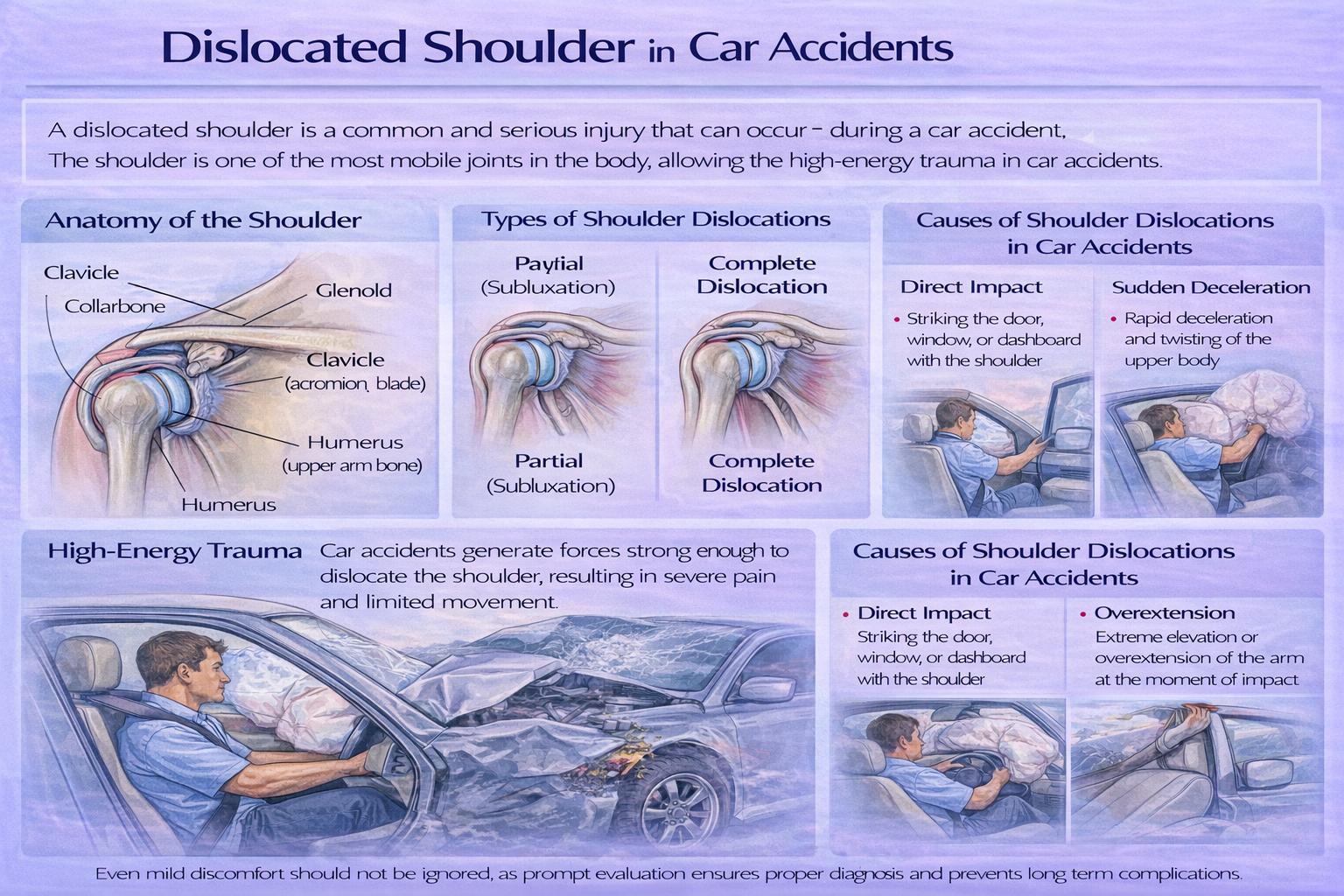
A dislocated shoulder is a common and serious injury that can occur during a car accident. The shoulder is one of the most mobile joints in the body, allowing the arm to move in many directions. Its mobility, however, makes it more vulnerable to injury.
The joint is formed by the humerus, or upper arm bone, the scapula or shoulder blade, and the clavicle or collarbone, all supported by a network of ligaments, tendons, and muscles. A shoulder dislocation occurs when the head of the humerus is forced out of its normal position in the socket of the scapula. Dislocations can be partial, where the bone is partially displaced, or complete, where the humeral head fully exits the joint.
Car accidents can generate forces strong enough to cause this injury, which often results in severe pain and limited movement. A dislocated shoulder can lead to long-term complications if not treated properly.
During a car accident, shoulder dislocations commonly result from high-energy trauma. The shoulder may suffer a direct impact from striking the door, window, or dashboard. Sudden movements of the upper body caused by rapid deceleration or twisting can also force the humeral head out of the socket.
Overextension or extreme elevation of the arm at the moment of impact can lead to dislocation. In severe collisions, compression forces on the shoulder may contribute to the injury. Even people wearing seat belts can experience a shoulder dislocation, as the shoulder may collide with interior surfaces or twist unnaturally under force.
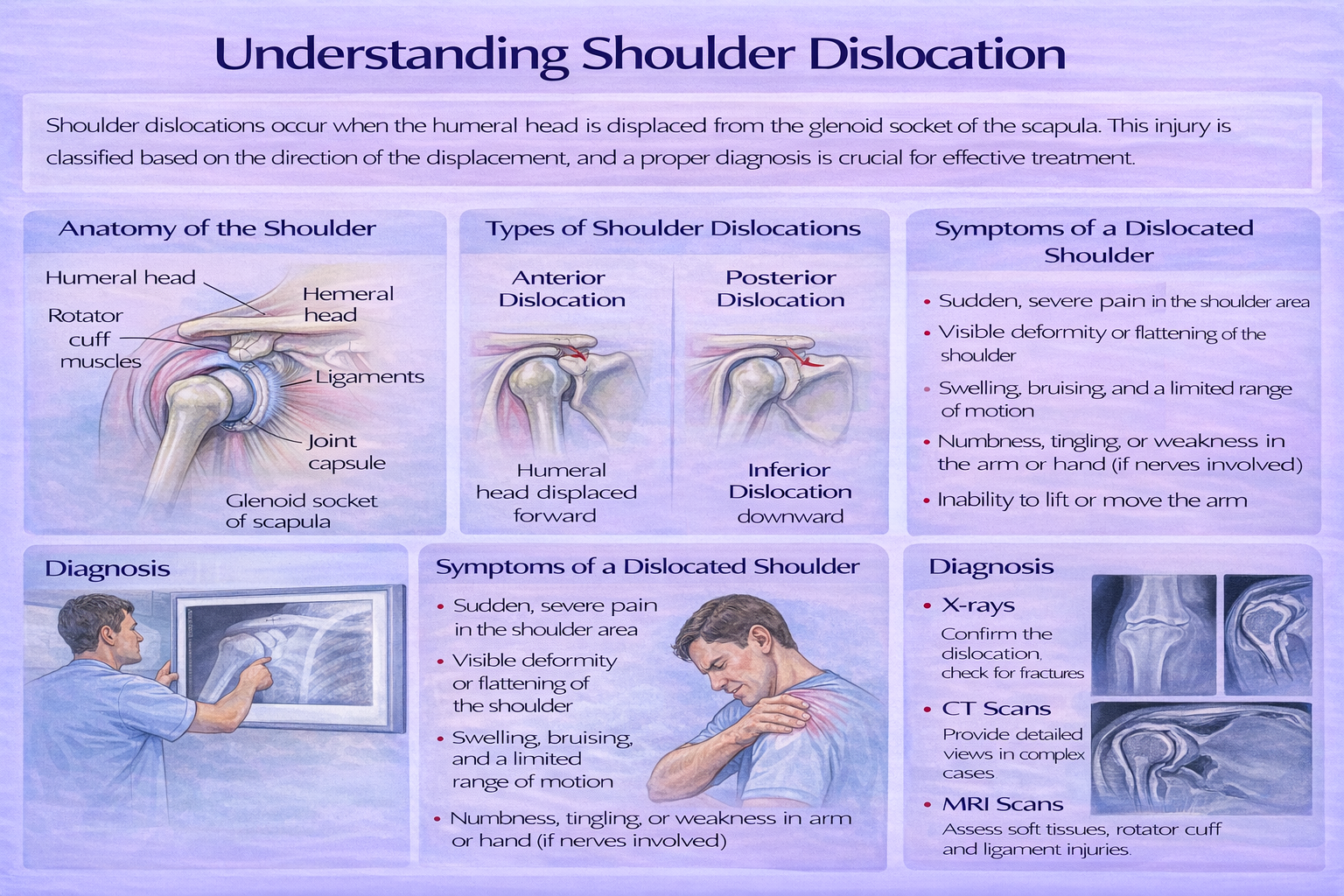
The shoulder is a ball-and-socket joint, with the humeral head forming the ball and the glenoid fossa of the scapula forming the socket. The joint is stabilized by ligaments, the joint capsule, and the rotator cuff muscles.
Shoulder dislocations are classified by the direction of displacement of the humeral head. Anterior dislocations, where the humeral head moves forward, are the most common and often result from the arm being extended or raised at the time of injury.
Posterior dislocations, which are less common, occur when the humeral head moves backward, sometimes after direct trauma or seizure activity. Inferior dislocations are rare and happen when the humeral head moves downward from extreme hyperabduction.
High-energy accidents may also cause fractures of the humerus, clavicle, or scapula alongside the dislocation, which can complicate treatment and recovery.
Symptoms of a dislocated shoulder are usually obvious and include sudden and severe pain in the shoulder area, visible deformity or flattening of the shoulder, swelling, bruising, and a limited range of motion.
Patients may also experience numbness, tingling, or weakness in the arm or hand if nerves are involved. There may be an inability to lift or move the arm. Associated injuries, such as fractures or ligament tears, can intensify symptoms and complicate recovery.
A dislocated shoulder requires prompt medical evaluation to assess these symptoms.
Diagnosis of a shoulder dislocation begins with a physical examination where the doctor evaluates deformity, swelling, tenderness, and the overall range of motion.
The neurovascular status of the arm is also assessed to ensure that nerves and blood vessels are not compromised. Imaging studies such as X-rays are used to confirm the dislocation and identify any associated fractures.
CT scans can provide detailed views for complex or recurrent dislocations, while MRI scans are particularly useful for assessing soft tissue injuries, including damage to the rotator cuff or ligaments.
Accurate diagnosis is essential for effective treatment and to prevent further injury. Treatment options vary based on the severity of the dislocated shoulder.
Treatment of shoulder dislocations depends on the severity of the injury, whether fractures are present, and the patient’s overall health. Non-surgical management is often appropriate for first-time dislocations without fractures.
Reduction, which is the process of carefully manipulating the humeral head back into its normal position, is typically performed under sedation or anesthesia.
Following reduction, the shoulder is immobilized with a sling or shoulder immobilizer for several weeks to allow healing. Pain medications such as acetaminophen or anti-inflammatory drugs may be prescribed.
Physical therapy is started once pain decreases to restore range of motion, strengthen shoulder muscles, and prevent recurrent dislocations. Education on managing a dislocated shoulder can improve recovery outcomes.
Surgery is indicated when the dislocation is recurrent, when fractures are present, or when there is significant soft tissue damage. Surgical procedures aim to restore stability to the shoulder and may include repairing torn ligaments, reconstructing bone in cases of significant damage, or repairing the rotator cuff if tendons are involved.
Surgery allows for proper alignment of the joint, reduces the risk of repeated dislocations, and facilitates earlier rehabilitation. Patients with a dislocated shoulder may benefit from personalized rehabilitation plans.
Rehabilitation is a critical component of recovery and focuses on restoring strength, stability, and mobility. Physical therapy begins with gentle range-of-motion exercises and gradually progresses to strengthening exercises for the rotator cuff and scapular stabilizers.
Functional training is also introduced to help patients return to daily activities and work. Recovery time varies, with mild first-time dislocations often healing within six to twelve weeks.
Surgical cases or dislocations associated with fractures may require three to six months of rehabilitation. Consistent adherence to therapy is essential for full recovery and reducing the likelihood of future dislocations.
Understanding the process of healing a dislocated shoulder helps in setting realistic recovery goals.
Complications from shoulder dislocations can occur, especially when associated with fractures or soft tissue injuries. Recurrent dislocations are more common in younger patients or those with ligament damage.
Chronic instability can lead to persistent pain and weakness. Nerve injuries may result in numbness or reduced strength in the arm, and post-traumatic arthritis can develop when the joint surface is damaged.
Early diagnosis, appropriate treatment, and careful rehabilitation are critical to minimizing these risks and ensuring optimal recovery from a dislocated shoulder.
Real-life scenarios illustrate the impact of shoulder dislocations in car accidents. A driver involved in a side-impact collision may experience an anterior dislocation when the arm is forced against the door.
Prompt reduction, followed by immobilization and physical therapy, can restore strength and mobility within weeks. In more severe cases, a passenger may sustain a dislocation along with a fracture of the humeral tuberosity.
Surgical repair stabilizes the joint, and a structured rehabilitation program ensures gradual recovery of function over several months.
Understanding the implications of a dislocated shoulder can help people make informed decisions about their care.
While car accidents cannot always be prevented, certain measures can reduce the risk of shoulder injuries. Proper use of seat belts, correct seating posture, functional airbags, and defensive driving all play a role in minimizing injury.
Avoiding distracted driving and following speed limits also contribute to safer outcomes. Taking preventive steps can help avoid a situation where a dislocated shoulder becomes a concern.
Anyone experiencing severe shoulder pain, visible deformity, inability to move the arm, or numbness and weakness after a car accident should seek immediate medical attention.
Early intervention ensures safe reduction of the dislocation, proper healing, and prevention of long-term complications that can arise from a dislocated shoulder.
With timely treatment and structured rehabilitation, most patients regain full function of the shoulder. Non-surgical cases often recover normal range of motion and strength, while surgical interventions provide stability for complex or recurrent dislocations.
Modern orthopedic techniques combined with dedicated physical therapy have significantly improved outcomes, allowing patients to return to work, sports, and everyday activities with confidence in their shoulder’s stability.
A shoulder dislocation after a car accident is a serious injury, but with prompt medical care, proper reduction, and rehabilitation, patients can achieve full recovery.
Early treatment minimizes complications, restores mobility, and helps patients regain strength, stability, and independence after facing the challenges of a dislocated shoulder.