

Why Medical Records Matter When Filing a Lawsuit
Medical records for lawsuit cases serve as the backbone of your legal claim. Without them, proving your injuries and damages becomes nearly impossible.
Here’s what you need to know:
- You have a legal right to access your medical records under HIPAA
- Request records in writing from all healthcare providers who treated you
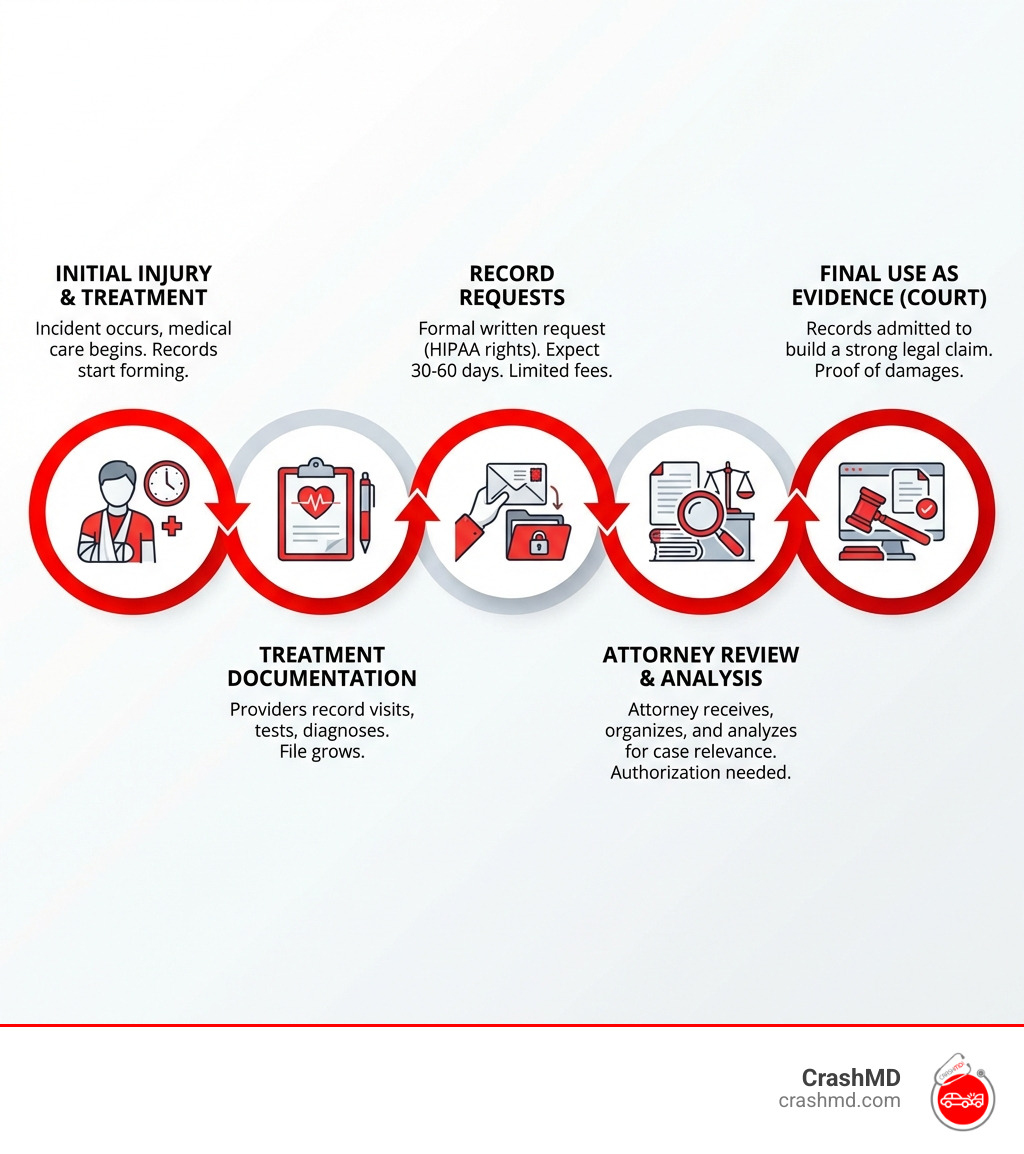
- Expect 30 days for providers to fulfill your request (sometimes up to 60 days)
- Fees are limited – typically $0.50 per page for paper copies or a flat $6.50 for electronic records
- Your attorney can help obtain records directly from providers with your written authorization
If you’ve been injured in an accident, your medical records will document every detail of your treatment – from the emergency room visit to follow-up appointments, test results, and medications. These records prove what happened to you, how severely you were hurt, and what it cost to heal.
But getting these records isn’t always straightforward. Healthcare providers have specific procedures, timelines, and fees. Some records might be denied. Others could take months to arrive. And if you’re already dealing with pain, medical bills, and insurance hassles, navigating this process can feel overwhelming.
The good news? You don’t have to do this alone. Understanding your rights under federal law and knowing the exact steps to take will help us build a strong case. Whether you’re filing a personal injury claim or preparing for trial, complete and accurate medical records are our most powerful evidence.
Understanding Your Rights: HIPAA and Medical Record Privacy
When you’re dealing with the aftermath of an injury, your privacy might feel like the last thing on your mind. However, understanding your rights regarding your medical information is crucial, especially when building a medical records for lawsuit case. The Health Insurance Portability and Accountability Act (HIPAA) is the federal law that stands as your primary protector.

What is HIPAA and How Does It Apply to Lawsuits?
Since 1996, all medical information disclosures in the United States have been governed by HIPAA. At its core, HIPAA is a federal law designed to protect the privacy of your health information. It establishes national standards for how healthcare providers, health plans, and other entities handle your Protected Health Information (PHI).
So, how does this apply to personal injury lawsuits? While HIPAA generally restricts the disclosure of your PHI, it does include specific provisions that allow for its release in legal proceedings. Essentially, if your health condition is central to a lawsuit—as it almost always is in personal injury claims—HIPAA permits the disclosure of relevant medical information under certain conditions, such as a court order or your explicit authorization. The key here is “relevance” and proper legal procedure.
What Medical Information is Protected?
HIPAA protects a broad range of information that can identify you and relates to your health. This includes virtually any demographic data that can be used to identify a patient. Think of it this way: if it can link back to you and your health, it’s likely protected. This extensive list includes:
- Your name
- Dates of birth
- Addresses
- Phone numbers and email addresses
- Social Security numbers
- Insurance ID numbers
- Your actual health care records (diagnoses, treatments, prognoses)
- Health plan information
- Even full facial photos
It’s also important to remember that this protection extends to sensitive areas like mental health records, including psychiatric treatment, prescriptions, and therapist’s notes. While these are highly sensitive, they can become relevant to a case if, for example, emotional distress or mental health impact is part of your claim.
Can My Medical Information Be Disclosed in a Personal Injury Lawsuit?
Yes, your medical information can be disclosed in a personal injury lawsuit, but only under specific conditions. When you file a personal injury lawsuit, you are effectively placing your health and injury history at issue. This acts as an implied waiver of your right to privacy for relevant medical records.
The opposing side (the defendant and their insurance adjusters and attorneys) will want to review your medical history to understand the nature and extent of your injuries, assess causation, and calculate damages. This findy can occur in two primary ways:
- Direct Records Production Requests: Your attorney may ask you to sign a medical records authorization, allowing your medical providers to release your records directly to the legal teams involved.
- Subpoenas: If you do not provide authorization, or if more comprehensive records are needed, the opposing party may issue a subpoena directly to your medical providers. A subpoena is a legal order requiring the production of documents.
The critical factor for disclosure is always relevance. Only medical information pertinent to the injuries you are claiming in the lawsuit should be disclosed. Our attorneys will advocate strongly for your privacy, fighting to limit disclosure to only what is truly relevant to your case. For instance, an old ankle injury might not be relevant if you’re suing for a spinal injury, and we would object to such an overbroad request.
For more detailed information on your rights, you can consult official resources like the Department of Health and Human Services’ guidance on Your Medical Records .
The Step-by-Step Process for Obtaining Your Medical Records
Obtaining your medical records for a medical records for lawsuit case is a critical step, but it can often feel like navigating a maze. Understanding the correct procedures, timelines, and potential costs will help us ensure we have all the necessary documentation to support your claim.

Your Right to Access and How to Exercise It
Under the HIPAA Privacy Rule, you have a legal and enforceable right to see and receive copies of your health information. This isn’t just a courtesy; it’s your right. This access applies to what’s known as your ‘designated record set,’ which is quite comprehensive. It includes:
- Medical records: Your doctor’s notes, diagnoses, test results (X-rays, MRIs, blood work), treatment plans, medication lists, and surgical reports.
- Billing records: All the financial information related to your healthcare services.
- Other records: Any other information used by your healthcare provider or health plan to make decisions about your care.
Exercising this right is relatively straightforward:
- Make a Request: While many providers offer electronic request options, it’s often best to make your request in writing. This creates a clear paper trail. You can request to inspect your records, receive a copy, or even have them sent directly to a third party, like your attorney.
- Verification of Identity: Your provider will need to verify your identity to ensure they are releasing your sensitive information to the correct person. This is a HIPAA requirement to protect your privacy.
- Timeliness: Covered entities generally have 30 calendar days to respond to your request. If they need more time, they can extend this by an additional 30 days, but they must inform you in writing of the reason for the delay and the expected completion date.
- Fees: While providers can charge a reasonable, cost-based fee for copies, they cannot charge for searching or retrieving your records. Fees typically cover the labor for copying, supplies (like paper or a CD), and postage if mailed. For electronic copies of PHI maintained electronically, a flat fee not exceeding $6.50 may be charged, inclusive of all labor, supplies, and postage.
If state laws in places like California, Texas, Arizona, Nevada, or Oklahoma provide you with greater access rights or lower fees than HIPAA, those state laws would apply as they are more protective of the individual. For example, you can explore specific statutes like Oklahoma Statutes §76-19 (2025) – Access to medical records or refer to resources like Medical Records – Privacy & Personal Information – Guides at Texas for state-specific guidance.
How to Request Your Medical Records for a Lawsuit
When preparing a medical records for lawsuit claim, requesting records needs to be thorough and strategic. Here’s a list of steps we recommend:
- Identify All Providers: List every healthcare provider, hospital, clinic, and pharmacy that treated you for the injuries related to your lawsuit, as well as any relevant pre-existing conditions. Don’t forget physical therapists, chiropractors, and specialists.
- Check Provider Websites: Before sending any documents, always check each facility’s website for specific instructions on how to request medical records. Some may have online portals, while others prefer fax or mail.
- Contact the Health Information Management (HIM) Department: Call the HIM department directly to confirm their preferred method for requests and any specific forms they require. This can save you a lot of time and frustration.
- Use a Comprehensive Authorization Form: Your attorney will provide you with a detailed authorization form. Ensure it includes all necessary patient identifiers (your full name, date of birth, Social Security Number, and account numbers), specifies the exact date range for records needed, and clearly states what types of records you are requesting (e.g., office notes, test results, billing records).
- Submit Your Request in Writing: A written request, whether mailed, faxed, or submitted through a secure online portal, provides proof of your request. Keep copies of everything you send.
- Follow Up Regularly: While HIPAA mandates a 30-day response time (with a possible 30-day extension), actual receipt can sometimes take longer, especially if records are archived or if the provider has a backlog. Be prepared to follow up diligently.
- Understand the Fees: As mentioned, reasonable, cost-based fees are permissible. You should be informed of any fees in advance. For electronic copies, a flat fee of $6.50 is an option for providers. Do not pay for search or retrieval costs.
- Consider Professional Retrieval Services: For complex cases involving multiple providers, or if you encounter significant delays, your attorney may use specialized record retrieval companies. These services can expedite the process and manage the administrative burden.
For additional guidance on this process, Nolo provides helpful insights on Releasing Your Medical Records in a Personal Injury Case . Another excellent resource for attorneys on obtaining records is the Attorney Request for Medical Records: The Ultimate Guide 2025 .
What if My Request is Denied or Delayed?
It’s frustrating when your access to your own health information is denied or significantly delayed. Here’s what you need to know and what steps we can take:
Grounds for Denial: HIPAA allows for denial of access in very limited circumstances. The two most common are:
- Psychotherapy Notes: These are notes made by a mental health professional during a counseling session and are kept separate from the rest of your medical record. They generally have heightened privacy protections and are often not accessible to you.
- Information Compiled for Legal Proceedings: If information was specifically compiled in reasonable anticipation of, or for use in, a civil, criminal, or administrative action or proceeding, it might be excluded from your right of access.
Additionally, a healthcare professional might deny access if they reasonably believe it would endanger your life or physical safety, or that of another person.
Review of Denial: If your request is denied, the covered entity must provide you with a written explanation of the denial, your right to have the denial reviewed, and instructions on how to exercise that right. For certain types of denials, you have the right to have a licensed healthcare professional, designated by the covered entity but not involved in the original denial, review the decision.
Dealing with Delays: While HIPAA gives providers 30 days (plus a potential 30-day extension), some records, particularly older ones stored off-site, can take months to receive. If you face delays:
- Follow Up: Continue to call the HIM department. Persistent but polite follow-up is often necessary.
- Re-send Requests: Sometimes requests get lost. Re-sending can help.
- Attorney Intervention: Your attorney can send a more formal letter or, if necessary, issue a subpoena to compel production. This often gets faster results.
- Outsourcing: As noted, specialized record retrieval services can be invaluable in overcoming administrative problems and expediting the process.
The Role of Medical Records for Lawsuit Success
Medical records aren’t just pieces of paper; they are the narrative of your injury, treatment, and recovery. In a medical records for lawsuit case, they are the undeniable truth that supports your claim.
How Medical Records Are Used as Evidence
Medical records are the bedrock upon which personal injury and medical malpractice cases are built. We use them for several critical purposes:
- Documenting Injuries: They provide objective proof of the injuries you sustained, detailing diagnoses, severity, and prognosis. This includes everything from initial emergency room reports to imaging results (X-rays, MRIs), specialist consultations, and surgical notes.
- Establishing a Timeline: Records carefully track the sequence of events, from the date of injury through every treatment, medication, and therapy session. This timeline is crucial for showing the progression of your condition and the continuity of care.
- Proving Causation vs. Pre-existing Conditions: One of the defense’s common tactics is to argue that your injuries were pre-existing or not caused by the incident in question. Medical records, especially those from before and after the incident, help us definitively prove that the accident caused or significantly aggravated your condition. For example, if you had a prior back injury but your records show it was stable until a car accident, we can use that to demonstrate causation.
- Calculating Economic and Non-Economic Damages: Medical bills and receipts quantify your economic damages (medical expenses, lost wages). Records also document the impact of your injuries on your daily life, providing evidence for non-economic damages like pain and suffering, emotional distress, and loss of enjoyment of life. Personal journal entries, while sensitive, can even be used to document daily pain levels and emotional anxiety.
- Supporting Expert Opinions: Medical records are the primary source material for medical experts. These experts review your records to form professional opinions on causation, prognosis, and the necessity of future treatments, which are vital for your case.
For medical records to be admissible in court, they must meet certain legal standards. The Federal Rules of Evidence (FRE) mandate that these records must be relevant, authenticated, compliant with exceptions to hearsay and business records standards, made available to the opposition with adequate time for inspection, and obtained legally. We ensure all these criteria are met. You can learn more about these rules at Federal Rules of Evidence. In medical malpractice cases, records are the most important evidence, crucial for proving misdiagnosis, surgical errors, medication errors, and birth injuries, and establishing the four elements of duty, breach, causation, and damages. More details are available in this article on The Importance of Medical Records in Malpractice Cases .
Who Will See My Medical Records?
This is a common concern, and it’s completely understandable to wonder who will have access to your private health information. When you pursue a medical records for lawsuit case, several parties will likely review your records:
- Your Attorney and Legal Team: We will review all your medical records thoroughly to understand your injuries, build your case, and identify key evidence.
- Opposing Counsel: The defendant’s attorneys have a right to review relevant medical records during the findy phase of a lawsuit.
- Insurance Adjusters: Before a lawsuit is even filed, insurance adjusters for the at-fault party will request your medical records to evaluate your claim.
- The Defendant: The party you are suing will have access to the records as part of their defense.
- Medical Experts: Both sides may hire medical experts to review your records and provide expert testimony.
- Judge and Jury: If your case goes to trial, the judge and jury will see the relevant portions of your medical records presented as evidence.
- Public Record (if trial): In states like Arizona, Nevada, Texas, Oklahoma, and California, if a lawsuit goes to trial, the information presented in court, including medical records, generally becomes part of the public record. However, settlements typically include non-disclosure agreements, keeping the details private.
While findy allows access, we will always work to protect your privacy, ensuring only relevant information is disclosed.
Challenges of Using Medical Records for a Lawsuit
While essential, using medical records in a lawsuit comes with its own set of challenges and risks:
- Disputes Over Relevance: One of the most frequent battles is over what constitutes “relevant” medical information. The defense might try to obtain records from decades ago or unrelated medical conditions, hoping to find something to undermine your claim. We will vigorously object to such overbroad requests and argue to limit disclosure to only what directly pertains to your injuries. If a disagreement arises, a judge may conduct an “in-camera” inspection, reviewing the records privately to determine their relevancy before any disclosure.
- Authenticity and Accuracy Concerns: Medical records are generally presumed authentic, but issues can arise. Errors in charting, illegible handwriting, or incomplete entries can create ambiguity. Law firms must also ensure HIPAA compliance, as inadvertent disclosure due to computer errors or lack of training can lead to liability.
- Incomplete or Missing Records: Sometimes, providers may have incomplete records, or older records might have been destroyed according to retention policies. This can complicate the evidentiary process, requiring us to piece together information from various sources.
- Presenting Complex Information Clearly: Medical records can be dense, full of jargon, and difficult for laypeople (like a jury) to understand. A key challenge is to transform this raw data into clear, compelling evidence. This often involves working with medical record professionals to create summaries, timelines, and visual aids that highlight the most important aspects of your case.
Despite these challenges, we are experts at navigating the complexities of medical record findy and presentation, ensuring your health story is told accurately and effectively.
Frequently Asked Questions about Medical Records in Legal Cases
We often hear similar questions from our clients about their medical records and how they’re handled during a lawsuit. Here are some of the most common ones:
What happens to my medical information after my lawsuit is over?
The fate of your medical information after a lawsuit depends on the outcome:
- If your case goes to trial: Any medical information presented in open court typically becomes part of the public record. This means it may be accessible to anyone.
- If your case settles or is withdrawn: The information generally remains private. Most settlement agreements include non-disclosure clauses, protecting the confidentiality of the terms and any medical details exchanged during findy. The parties involved (your attorney, opposing counsel, insurance companies) will retain copies of the records, but they are not made public. As your attorneys, we maintain secure, confidential copies of your case details and medical records for our records, adhering to strict privacy protocols.
What happens if there is a disagreement about the relevance of my medical information?
Disagreements about the relevance of medical information are very common during the findy phase of a lawsuit. Here’s how it typically plays out:
- Attorney Objections: If the opposing side requests medical information we believe is irrelevant or overly broad, we will formally object to the request. We’ll argue that the information sought does not pertain to the injuries or damages in your lawsuit and that its disclosure would violate your privacy rights.
- Court Intervention: If the parties cannot agree, the issue will be brought before the court. A judge will then decide whether the requested information is relevant and findable.
- In-Camera Inspection: For particularly sensitive or disputed records, a judge might conduct an “in-camera” inspection. This means the judge reviews the records privately, without disclosing them to either party, to determine their relevance before making a ruling. This protects your privacy while ensuring fairness in the findy process.
Our role is to fiercely advocate for your privacy, fighting to limit the scope of findy to only what is absolutely necessary and relevant to your claim.
Can I direct my doctor to send my records directly to my attorney?
Yes, absolutely! Under HIPAA, you have the right to direct your healthcare provider to send your Protected Health Information (PHI) directly to a third party of your choosing. This is a powerful right that can streamline the process of gathering medical records for lawsuit cases.
Here’s what’s involved:
- Written and Signed Request: You must provide your healthcare provider with a clear, written, and signed request. This request should explicitly identify the designated third party (your attorney) and precisely where the PHI should be sent.
- Identifying the Third Party: Ensure your attorney’s name, firm, and contact information (address, fax, email) are clearly stated in your request.
- Covered Entity Responsibilities: Once they receive your valid request, your healthcare provider (a “covered entity” under HIPAA) has the same responsibilities for timeliness, fees, and format as they would if you were requesting the records for yourself. They must provide the records within 30 days (with a possible 30-day extension) and can charge only reasonable, cost-based fees. They must also send the records in the form and format you requested if it’s readily producible.
This right is incredibly useful because it allows us to directly receive your records, ensuring a complete and efficient collection process for your case.
Conclusion: Securing Your Case with Proper Documentation
Navigating the complexities of medical records for lawsuit cases can be daunting, but understanding your rights and the processes involved empowers you. We’ve explored the critical role of HIPAA in protecting your privacy while also allowing for necessary disclosure in legal proceedings. We’ve outlined the steps to access your own medical information, the importance of these records as evidence, and the challenges we overcome to ensure your story is accurately represented.
At CrashMD, we guide accident victims through recovery, offering expert pain management and custom treatment plans. Our unique approach involves advocating for you every step of the way, carefully documenting your injuries, and ensuring you receive comprehensive care that supports your legal case. We believe in getting you healthy first, and then making sure your records are unimpeachable evidence.
Complete and accurate medical records are not just administrative documents; they are the foundation of your legal claim. They prove your injuries, justify your suffering, and quantify your losses. Proactive documentation and a clear understanding of your rights are your strongest allies in securing the justice and compensation you deserve.
If you’ve been injured and need expert post-accident medical care, combined with meticulous documentation for your legal claim, don’t hesitate to reach out. Let us help you put your health and your case on the path to recovery.