

Why Your Health and Legal Rights Depend on Immediate Medical Attention
Seeking medical treatment after car accident is one of the most critical decisions you’ll make—not just for your physical recovery, but for protecting your legal rights and financial future.
Here’s why immediate medical care matters:
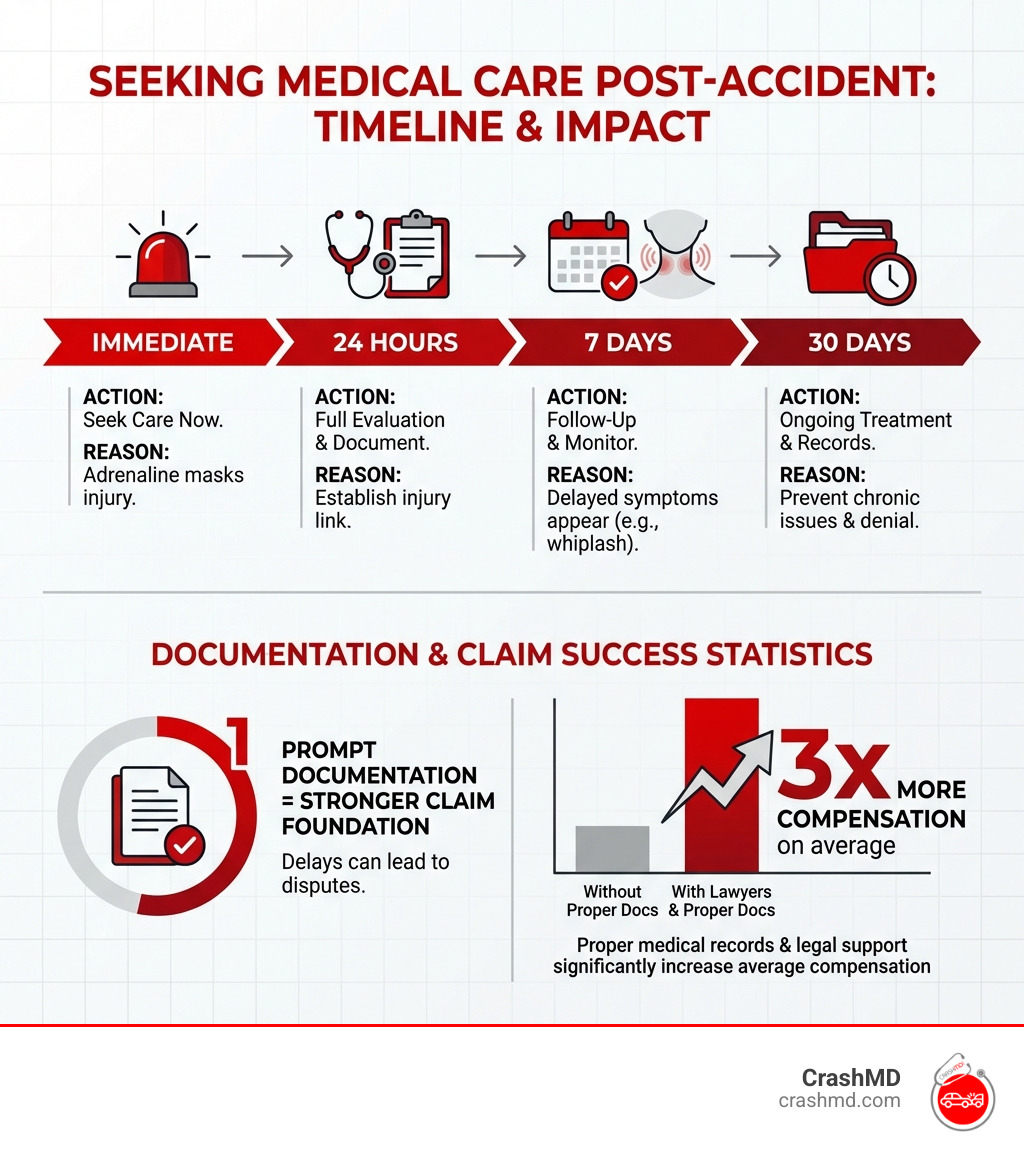
- Your health comes first – Adrenaline and shock can mask serious injuries for hours or even days after a crash
- Document your injuries – Medical records establish a clear link between the accident and your condition
- Protect your legal claim – Insurance companies use delayed treatment to dispute or deny claims
- Prevent long-term complications – Early diagnosis and treatment stop minor injuries from becoming chronic problems
- Maximize your compensation – Victims with lawyers and proper documentation receive 3x more compensation on average
The statistics are sobering. In 2022 alone, 118,853 individuals were injured in motor vehicle accidents. In Ontario, over 60,000 people sustain personal injuries from car crashes each year. Many of these victims felt fine immediately after their accidents—only to find serious injuries days or weeks later when it was too late to establish proper documentation.
Even if you walked away from the crash feeling okay, your body may be hiding the truth. Research shows it can take several hours, several days, or even a week for injuries or serious discomfort to register with a car accident victim. Common injuries like whiplash, concussions, and internal bleeding don’t always announce themselves with immediate pain.
But here’s what many accident victims don’t realize: seeking prompt medical care isn’t just about healing your body. It’s about protecting your right to fair compensation. Insurance companies are experts at finding reasons to reduce or deny claims, and one of their favorite tactics is pointing to delayed medical treatment. They’ll argue your injuries weren’t serious, weren’t caused by the accident, or were made worse by your delay in seeking care.
The good news? You have the power to protect both your health and your legal rights by taking action now.
Why You Must See a Doctor Immediately After a Collision
It’s a common scenario: you’ve just been in a car accident. Your heart is pounding, your mind is racing, and you might feel a strange mix of relief and anxiety. In this heightened state, your body releases a cocktail of chemicals—adrenaline and endorphins—that can act as natural painkillers. This is why many people report feeling “fine” or only experiencing minor discomfort right after a crash, even if they’ve sustained significant injuries.
This phenomenon, where adrenaline and shock mask pain, is a crucial reason why we always recommend seeking medical treatment after car accident as soon as possible. What might feel like a minor bump or bruise could be a symptom of a more serious, hidden injury brewing beneath the surface.
Think about it: your body has just endured a sudden, forceful impact. Even at low speeds, the forces involved can cause significant trauma. While a broken bone might be immediately obvious, many injuries are not. Soft tissue damage, for example, involving muscles, ligaments, and tendons, often doesn’t manifest with pain until hours or even days later, once the initial shock wears off and inflammation sets in. Concussions, which are traumatic brain injuries, can also have delayed symptoms like headaches, dizziness, confusion, or memory issues. In rare but critical cases, internal bleeding could be occurring without immediate external signs, posing a life-threatening risk.
By seeking prompt medical attention, you’re not just addressing immediate concerns; you’re establishing a clear medical timeline that links any present or future symptoms directly to the accident. This is vital for both your health and any potential legal claims. As Nolo.com advises, getting necessary medical care after your car accident is key to protecting your health and maximizing your potential injury claim. For more insights on this, you can refer to resources like Reasons to See a Doctor After a Car Accident.

The Dangers of “Waiting to See”
The temptation to “wait and see” if your pain improves is understandable, especially if you’re busy or if the discomfort seems mild. However, this delay can have severe consequences for your health and your injury claim.
From a health perspective, delaying treatment can lead to:
- Worsening injuries: A minor sprain left untreated could develop into a chronic condition. A small internal injury could become life-threatening without prompt diagnosis.
- Chronic pain development: Without proper intervention, acute pain can become chronic, leading to long-term suffering and reduced quality of life.
- Missed diagnosis window: Some injuries are easier to diagnose and treat effectively in the immediate aftermath of an accident. Delaying can make diagnosis more challenging and treatment less effective.
- Health complications: Untreated injuries can lead to secondary health issues, impacting other parts of your body or your overall well-being.
Legally, delaying treatment can significantly undermine your personal injury claim. Insurance companies are not your friends in this scenario; their goal is to minimize payouts. If you wait days or weeks to see a doctor, they can argue that:
- Your injuries weren’t serious enough to warrant immediate attention.
- Your injuries were caused by something else that happened between the accident and your doctor’s visit.
- You made your injuries worse by not seeking prompt care, reducing their liability.
This can result in reduced settlement offers or even outright claim denial. We’ve seen it happen time and again in Arizona, Nevada, Texas, Oklahoma, and California.
Common Injuries with Delayed Symptoms
While every accident is unique, some injuries are particularly notorious for their delayed onset. It’s crucial to be aware of these, as they underscore the importance of seeking medical treatment after car accident even without immediate pain:
- Whiplash: This common neck injury, caused by the rapid back-and-forth movement of the head, can take up to 24 hours or even longer to present symptoms. These might include neck pain and stiffness, headaches, dizziness, blurred vision, and shoulder pain. Early chiropractic care can be pivotal in preventing long-term issues from whiplash, as highlighted by HealthEngine’s advice on how soon you should see a doctor after a car accident.
- Headaches: While seemingly minor, persistent headaches after an accident can indicate a concussion, whiplash, or even a more serious brain injury.
- Dizziness or Vertigo: These symptoms could be linked to a concussion, inner ear damage, or neck injuries affecting balance.
- Numbness and Tingling: These sensations in your extremities often point to nerve damage or pinched nerves in your neck or back.
- Back Pain: Like whiplash, back pain can be delayed. It might indicate muscle strains, ligament sprains, herniated discs, or other spinal injuries.
- Emotional and Psychological Trauma: Car accidents are terrifying. It’s common for individuals to experience anxiety, fear, difficulty sleeping, or even Post-Traumatic Stress Disorder (PTSD) days or weeks after the event. These psychological responses are as real as physical injuries and also require professional help. For more about recovery, including emotional responses, you can check this guide.
If you experience any of these symptoms, even if they appear days after the accident, don’t hesitate to seek medical attention. Your body is telling you something important.
The Critical Role of Medical Documentation in Your Injury Claim
When it comes to a personal injury claim after a car accident, medical records are not just important—they are the backbone of your case. They serve as objective evidence, detailing your injuries, the treatment you’ve received, and the impact the accident has had on your health and life. Without thorough and accurate documentation, proving your injuries and their connection to the accident becomes incredibly difficult.
Medical records help us prove causation, meaning they establish a clear link between the accident and your injuries. This is where insurance companies often try to trip up claimants. As Nolo.com points out, if you delay treatment, insurance adjusters may argue that your injury wasn’t serious, wasn’t caused by the accident, or was worsened by your delay. This is a common tactic to dispute claims and reduce payouts.
We’ve seen that claimants who are represented by a lawyer and have robust medical documentation tend to fare much better. Statistics show that car accident claimants who worked with a lawyer received $44,600 on average, compared with an average payout of just $13,900 for self-represented claimants. This significant difference underscores the value of professional legal and medical support in strengthening your case.
By diligently documenting your injuries and treatment, you create an undeniable record that speaks volumes about the severity of your condition and the necessary steps you’ve taken toward recovery.

How a Delay in Treatment Can Weaken Your Case
We cannot stress enough how detrimental a delay in seeking medical treatment after car accident can be to your injury claim. Insurance adjusters are trained to look for any inconsistencies or gaps in your medical timeline to minimize or deny your compensation.
Here’s how a delay can weaken your case:
- “The injury wasn’t serious” argument: If you waited to see a doctor, the insurance company might argue that your injuries couldn’t have been that severe, or you would have sought immediate care.
- “The injury was caused by something else” argument: A gap between the accident and your first medical visit provides an opportunity for the insurance company to claim that an intervening event (e.g., another activity, a pre-existing condition) caused your injuries, not the car accident.
- “You made your injuries worse” argument: They might assert that your delay in treatment exacerbated your condition, and therefore, they are not responsible for the full extent of your damages.
These arguments can lead to significantly reduced settlement offers or even outright claim denial. For example, in Arizona, delaying medical treatment could complicate your claim, as highlighted by Hutzler Law. Similarly, in Nevada, the ability to afford medical treatment after an accident is a concern for many, as discussed by Ask Adams Kutner. This is why prompt documentation is essential to counter these tactics.
Establishing Causation: The Doctor’s Vital Role
Your doctor plays a vital role beyond just treating your injuries; they are key to establishing causation between the accident and your symptoms. When you seek medical attention promptly, your healthcare provider can:
- Provide expert medical opinion: They can formally link your injuries and symptoms directly to the car accident, based on their examination and diagnostic tests.
- Document the extent of injuries: Through detailed notes, test results (X-rays, MRIs, CT scans), and ongoing assessments, your doctor provides a comprehensive record of your physical condition.
- Offer a prognosis for recovery: Your doctor can estimate your recovery timeline, potential for long-term impairment, and future medical needs, which are all crucial for calculating fair compensation.
This medical documentation is precisely what we, at CrashMD, specialize in. Our network of medical professionals understands the specific needs of car accident victims, focusing not only on your comprehensive recovery but also on the meticulous documentation required to support your legal case. This ensures that when it comes time for legal action, you have all the necessary evidence to demonstrate the full impact of your injuries. For more on the recovery process, including physical and emotional responses, you can refer to After a car crash: What to expect on the road to recovery.
A Step-by-Step Guide to Seeking Medical Treatment After a Car Accident
In the chaotic aftermath of a car accident, it can be hard to think clearly. That’s why we’ve put together a step-by-step guide to help you steer the process of seeking medical treatment after car accident and protect your health and your rights.
First and foremost, prioritize safety. If you are able, move yourself and your vehicle to a safe location away from traffic. Check for injuries to yourself and any passengers. If anyone is seriously injured, or if there’s significant property damage, call 911 immediately.
Next, document the scene. Take photographs of everything: vehicle damage, the position of the cars, skid marks, road conditions, traffic signs, and any visible injuries. Exchange information with other drivers involved (name, contact, insurance, license plate). Gather witness contact information if possible. As Nolo.com advises, knowing what to do after a car accident is crucial.
Step 1: Know Where to Go for Medical Care
Once the immediate scene is handled, your next priority is medical evaluation. But where should you go?
- Emergency Room (ER): If you suspect serious injuries, such as broken bones, head trauma, internal bleeding, or severe pain, the ER is the right choice. They can provide immediate diagnostic tests and stabilize critical conditions.
- Urgent Care Clinic: For non-life-threatening but urgent concerns, an urgent care clinic can be a good option, often with shorter wait times than an ER.
- Family Doctor (GP): Your primary care physician can assess your condition, document injuries, and refer you to specialists if needed. Make sure to schedule an appointment as soon as possible, ideally within 24-72 hours.
- Post-Accident Medical Specialists: Depending on your injuries, your doctor might refer you to specialists like orthopedic surgeons, neurologists, chiropractors, physical therapists, or pain management experts. These specialized doctors are crucial for targeted treatment and comprehensive recovery. We, at CrashMD, connect you with a network of such specialized doctors who understand accident-related injuries and the importance of thorough documentation.
Step 2: What to Tell Your Healthcare Provider
When you see a healthcare professional, be thorough and honest. This is not the time to downplay your symptoms.
- Details of the accident: Provide a clear, concise description of how the accident happened. Mention the speed and direction of impact, and any specific movements your body made during the collision. For instance, in Texas, knowing what to do immediately after a car accident includes seeking medical attention.
- All symptoms (physical and emotional): Report every symptom you’re experiencing, no matter how minor it seems. This includes pain, stiffness, numbness, headaches, dizziness, fatigue, nausea, anxiety, or difficulty sleeping. Be specific about where the pain is, its intensity, and when it started.
- Pre-existing conditions: Be transparent about any pre-existing medical conditions, even if you don’t think they’re related. Your doctor needs a complete picture of your health to provide the best care and to accurately differentiate new injuries from old ones. This is particularly important for your legal claim, as insurance companies often try to attribute new injuries to pre-existing conditions.
The more detailed and accurate information you provide, the better your medical documentation will be, which in turn strengthens your potential claim. In Oklahoma, for example, understanding what to do immediately after a car accident emphasizes seeking medical attention.
Step 3: The Importance of Following Your Recommended Treatment Plan
Once you’ve seen a doctor and received a diagnosis, it’s absolutely critical to follow through with all recommended medical treatment. This isn’t just about getting better; it’s also about protecting your legal claim.
- Following doctor’s orders: Attend all appointments, take prescribed medications as directed, and adhere to any activity restrictions. If you miss appointments or deviate from your treatment plan, the insurance company can argue that you weren’t seriously injured or that you contributed to your own prolonged recovery.
- Attending physical therapy or rehabilitation: Many car accident injuries, especially soft tissue injuries, require ongoing physical therapy or rehabilitation. These sessions are vital for restoring function, reducing pain, and preventing long-term disability. Documenting your attendance and progress is essential.
- Impact on recovery: Consistent treatment ensures you receive the best possible chance for a full recovery. Your health is our top priority, and adhering to your medical plan is key to achieving it.
- Demonstrating mitigation of damages for a legal claim: From a legal standpoint, following your treatment plan demonstrates that you are actively working to mitigate your damages (i.e., minimize the extent of your injuries and associated costs). This shows the insurance company and potentially a court that you are a responsible patient and that your ongoing medical expenses are legitimate and necessary.
This commitment to your treatment plan is a critical component of ensuring comprehensive recovery before legal action, which is a core part of CrashMD’s philosophy.
Frequently Asked Questions about Post-Accident Medical Care
We understand that you might have many questions after a car accident. Here are some of the most common ones we encounter regarding seeking medical treatment after car accident.
What is the recommended timeframe for seeking medical treatment after a car accident?
While there’s no single “golden rule” for every case, we strongly recommend seeking medical attention as soon as possible after a car accident. Ideally, this means within 24 to 72 hours of the collision. The sooner you see a doctor, the clearer the link between the accident and your injuries becomes, both medically and legally. This promptness helps to counteract any insurance company arguments about delayed causation. Some sources, like HealthEngine, emphasize seeing a doctor “as soon as possible” even if an ambulance was at the scene or you feel fine initially, due to the masking effects of shock and adrenaline.
What should I do if I experience delayed symptoms days or weeks after a car accident?
It’s common for symptoms to appear days or even weeks after an accident. If you experience delayed symptoms:
- See a doctor immediately: Don’t wait. Schedule an appointment with your doctor or visit an urgent care clinic as soon as you notice new pain, stiffness, headaches, dizziness, numbness, or any other unusual physical or emotional changes.
- Document when symptoms started: Be precise with your healthcare provider about when you first noticed the symptoms and how they’ve progressed.
- Explain the connection to the accident: Clearly inform your doctor that these symptoms are a result of the car accident you were recently involved in. This helps ensure proper documentation.
- Do not ignore new or worsening pain: Your body is sending you a signal. Ignoring it can lead to worsening injuries and significantly complicate any future injury claim. As noted by Nolo.com, delaying treatment makes it easier for insurance adjusters to argue that your injury was not caused by the accident.
How are my medical bills paid after an accident?
Navigating medical bill payment after an accident can be confusing. Here are the common ways your medical treatment costs might be covered in our service areas (Arizona, Nevada, Texas, Oklahoma, Southern California, Northern California):
- At-fault driver’s insurance (Liability Coverage): If the other driver was at fault, their bodily injury liability coverage will eventually be responsible for your medical bills. However, this typically happens after a settlement or judgment, meaning you might need an interim solution for upfront costs.
- Your auto insurance (MedPay/PIP): Many auto insurance policies offer Medical Payments (MedPay) coverage or Personal Injury Protection (PIP), which can pay for your medical expenses regardless of who was at fault, up to your policy limits. We highly recommend utilizing this coverage if you have it.
- Personal health insurance: Your private health insurance or employer-provided plan can also cover your medical costs. Be aware that your health insurance company may have subrogation rights, meaning they can seek reimbursement from any settlement you receive from the at-fault driver’s insurance.
- Attorney liens: If you have retained a personal injury lawyer, they might be able to work with medical providers to treat you on a medical lien. This means the medical provider agrees to defer payment until your case settles, taking their payment directly from the settlement funds. This can be a crucial option if you lack other immediate payment sources.
It’s important to understand your specific insurance coverages and discuss payment options with your medical providers and legal counsel. For specific advice in California, resources like What Should I Do Immediately After a Car Accident in California? offer guidance.
Conclusion: Take Control of Your Recovery and Your Claim
In summary, seeking medical treatment after car accident is paramount. It’s not just about addressing immediate pain; it’s about safeguarding your long-term health and protecting your legal rights. The initial rush of adrenaline and shock can mask serious injuries, making immediate medical evaluation essential, even if you feel fine. Delaying treatment can lead to worsening conditions, chronic pain, and significant challenges when pursuing an injury claim.
Remember these key takeaways:
- Prioritize your health first: Your well-being is the most important thing. Don’t let perceived minor discomfort or a busy schedule prevent you from seeking prompt medical care.
- Documentation is power: Every medical visit, diagnosis, treatment, and symptom recorded creates a vital paper trail. This documentation is the foundation of your injury claim, proving the link between the accident and your injuries and countering insurance company tactics.
- Follow through with care: Adhering to your doctor’s recommended treatment plan, including therapy and medications, is crucial for your recovery and demonstrates your commitment to mitigating damages in a legal context.
At CrashMD, we guide accident victims through recovery, offering expert pain management and custom treatment plans. We advocate for our patients and carefully document injuries for legal cases, ensuring you achieve comprehensive recovery before considering legal action. Our network of specialized doctors across Arizona, Nevada, Texas, Oklahoma, Southern California, and Northern California is here to support you every step of the way.
Don’t leave your health or your future to chance. Take control by seeking prompt and thorough medical care. Find specialized motor vehicle accident doctors to guide your recovery today.