

Why Back Pain After a Car Accident Demands Immediate Attention
Back pain car accident injuries affect millions of Americans every year, yet many victims don’t realize the severity of their condition until days or weeks after the crash. According to the National Highway Traffic Safety Administration (NHTSA), 1.9 million people were injured in passenger vehicle crashes in 2022 alone.
Common causes of back pain after car accidents:
- Herniated discs – Impact forces compress vertebrae, causing disc material to bulge and press on nerves
- Whiplash and soft tissue damage – Rapid forward-backward motion tears muscles, ligaments, and tendons
- Lumbar sprains – Sudden twisting or hyperextension strains the lower back
- Facet joint injuries – Joint inflammation from hyperextension during rear-end collisions
- Spinal fractures – High-impact crashes can crack or compress vertebrae
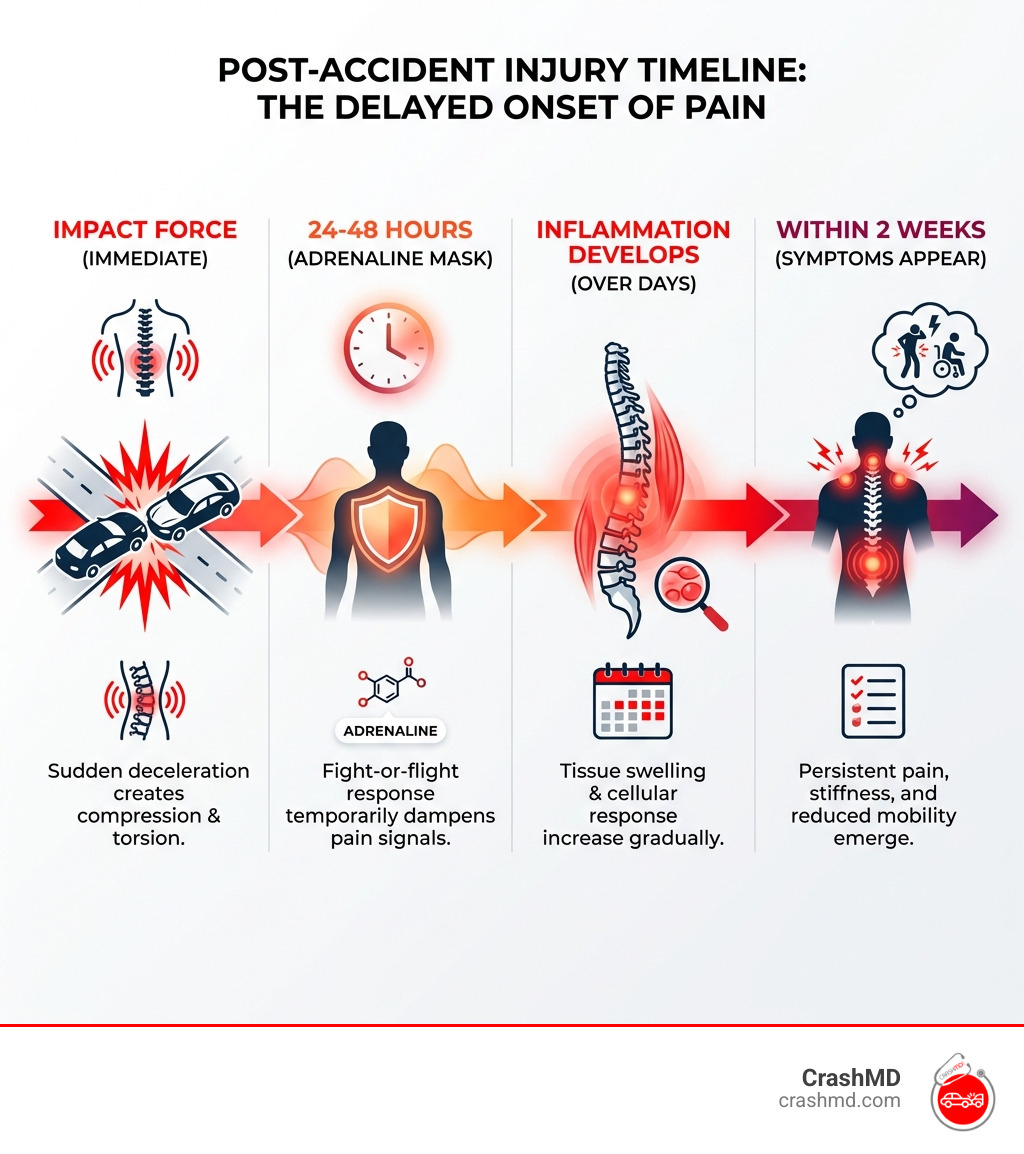
Here’s what makes post-accident back pain so complex: your body’s fight-or-flight response temporarily masks pain through adrenaline release. This biological reaction means you might walk away from a collision feeling fine, only to experience severe symptoms hours or days later when inflammation develops and adrenaline levels normalize.
The statistics are sobering. Research shows that 31 percent of car accident victims still report lower back pain one year after their crash. Even low-speed collisions—as slow as 10 mph—can cause significant injury. In fact, roughly 40 percent of all spinal cord injuries nationwide occur as a result of car accidents, totaling approximately 18,000 spinal cord injuries each year.
The forces involved in even “minor” accidents are substantial. Newton’s Laws of Motion explain what happens: when your vehicle suddenly decelerates, your body continues moving forward until restrained by seatbelts or airbags. This creates compression, torsion, and hyperextension forces that your spine wasn’t designed to handle. The lumbar region is particularly vulnerable, bearing the brunt of impact forces while supporting your upper body weight.
Understanding the injury timeline is crucial for proper treatment and documentation.
Understanding Back Pain Car Accident Mechanics
Car accidents are not just random events; they are complex interactions of physics that can wreak havoc on the human body, particularly the spine. Even a seemingly minor collision can generate immense forces that our bodies are ill-equipped to handle. The National Highway Traffic Safety Administration (NHTSA) reported that 1.9 million people were injured in passenger vehicle crashes in 2022. This staggering number underscores the pervasive risk of injury, including debilitating back pain car accident injuries.
Let’s break down how different types of collisions can impact your back:
- Rear-end Collisions: These are notorious for causing whiplash, but the impact isn’t limited to your neck. When struck from behind, your body is violently jolted forward and then backward. This rapid motion can hyperextend or hyperflex your lumbar (lower back) and thoracic (mid-back) regions, leading to muscle strains, ligament tears, or even disc herniations. The sudden forward acceleration can also cause your spine to compress, aggravating existing conditions or creating new ones.
- T-bone Impact (Side-Impact Collisions): Often considered one of the most dangerous types of crashes, T-bone collisions exert lateral forces that can severely twist and compress the spine. Unlike front or rear impacts, there’s less crumple zone protection on the sides of most vehicles, leaving occupants more vulnerable. This can result in significant damage to facet joints, discs, and the spinal cord itself, leading to intense back pain car accident injuries.
- Side-Impact Vulnerability: The vulnerability in side-impact crashes is heightened due to the lack of substantial structural protection compared to the front or rear of a vehicle. This means even a low-speed side impact can lead to major injuries. The sheer force can cause your body to be thrown against the side of the car, leading to direct trauma, or the twisting motion can cause severe spinal injuries.
- Deceleration Forces: In any collision, the abrupt stop or change in speed creates powerful deceleration forces. Your body, still moving at the pre-impact speed, is suddenly brought to a halt. This can cause your internal organs and skeletal structure to shift violently against seatbelts or the vehicle’s interior, leading to compression fractures, muscle strains, and other spinal trauma.
- Seatbelt Restraint and Airbag Deployment: While life-saving, seatbelts and airbags can also contribute to specific injury patterns. A seatbelt, designed to hold you in place, can exert immense pressure across your chest and pelvis during a crash. This can lead to what are known as Chance fractures in the lumbar spine, especially if your upper body continues to move forward while the lower body is restrained. Airbag deployment, though crucial for head and chest protection, can also cause sudden, forceful impacts that might strain the neck and upper back.
- Low-Speed Collision Risks: Don’t let the term “low-speed” fool you. Even collisions at speeds as low as 10 mph can cause significant back pain car accident injuries. Your body’s ability to absorb jarring impacts is limited, and the sudden, unexpected nature of even a minor bump can trigger muscle spasms, whiplash, and micro-traumas that develop into chronic pain. It’s often the sudden, unprepared movement rather than the sheer speed that causes much of the damage.
Understanding these mechanics helps us appreciate why immediate and thorough medical evaluation after any car accident is paramount, regardless of how minor the impact may seem.
Common Spinal and Soft Tissue Injuries
The human spine is a marvel of engineering, a complex stack of bones, discs, nerves, and muscles designed for both flexibility and support. However, it’s also incredibly vulnerable to the violent forces releaseed during a car accident. When we talk about back pain car accident injuries, we’re often looking at a range of issues, from mild muscle strains to severe spinal cord damage.

Here are some of the most common types of spinal and soft tissue injuries we see:
- Herniated Discs: Your spinal discs act as shock absorbers between your vertebrae. A car accident can exert such extreme pressure that a disc ruptures, or “herniates,” causing its jelly-like center to push out. This can press on nearby nerves, leading to pain, numbness, or weakness that radiates into your arms or legs. Research from 2017 found that bulging disks were most likely to result from head-on collisions, while nerve pain from a herniated disk was most common after side-swipe collisions. The same study also noted that 76.5% of people referred to a pain clinic for back pain had some sort of lumbar disk displacement. You can read more about this in scientific research on lumbar disk displacement.
- L5-S1 Injury: This refers specifically to injuries at the lowest lumbar disc, between the fifth lumbar vertebra (L5) and the sacrum (S1). This area is a common site for disc herniations and nerve compression, as it bears a significant amount of your body’s weight and is a major point of movement. An L5-S1 injury can cause intense lower back pain car accident symptoms, often radiating down the leg into the foot (sciatica).
- Lumbar Sprain: This is a soft tissue injury involving the ligaments that connect the bones of your lower back. A sudden, forceful movement, like the kind experienced in a car accident, can stretch or tear these ligaments. The result is often localized pain, stiffness, and muscle spasms. These are among the most common injuries, with 2023 research indicating that soft tissue injuries such as strains and sprains are more common in the neck but can still be experienced in the lower back, often being more than 10 times more common than any other lumbar injury.
- Whiplash: While commonly associated with neck injuries, the rapid back-and-forth motion of whiplash can extend down the entire spine. The sudden acceleration and deceleration can strain muscles, ligaments, and discs in the thoracic and lumbar regions, leading to mid-back or lower back pain car accident symptoms. Roughly 3 million people each year sustain whiplash injuries in the upper back and neck due to car accidents.
- Facet Joint Syndrome: Facet joints are small joints located between each vertebra that allow your spine to bend and twist. In a car accident, especially a rear-end collision, these joints can be hyperextended or compressed, leading to inflammation and pain. This pain can be localized or radiate to other areas like the buttocks or thighs.
- Spinal Stenosis: This condition involves the narrowing of the spinal canal, which can put pressure on the spinal cord and nerves. While often a degenerative condition, a car accident can acutely worsen existing stenosis or trigger its onset due to inflammation and disc displacement.
- Sciatica: This isn’t an injury itself but a symptom caused by compression or irritation of the sciatic nerve, the longest nerve in your body. It often manifests as sharp, shooting pain, numbness, or tingling that travels from the lower back, through the buttock, and down one leg. Disc herniations, spinal stenosis, or direct trauma to the nerve can all cause sciatica after a car accident.
- Chance Fractures: These are a specific type of vertebral fracture, often occurring in the lumbar spine. They happen when the body is forcefully flexed forward against a lap belt, causing a distraction injury to the vertebra. These are serious injuries that require immediate medical attention. Lumbar spine fractures are the second most common low back injury from car accidents.
- Knee and Hip Referred Pain: Sometimes, what feels like back pain car accident pain can actually be referred pain from injuries to other areas, such as the hips or knees. The body’s intricate nerve pathways mean that trauma in one area can manifest as discomfort elsewhere. For example, a pelvic fracture might cause lower back pain.
These injuries highlight the complex and often interconnected nature of post-accident pain. Early and accurate diagnosis is critical for effective treatment and long-term recovery.
Symptoms and the “Adrenaline Mask”
One of the most perplexing aspects of a back pain car accident is the delayed onset of symptoms. It’s not uncommon for individuals to walk away from a collision feeling surprisingly okay, only to wake up the next day (or even days later) with excruciating pain. What’s happening here? We call it the “adrenaline mask.”
When you’re involved in a car accident, your body instinctively switches into “fight or flight” mode. This primal response triggers the release of stress hormones, particularly adrenaline. Adrenaline acts as a natural painkiller, temporarily dulling your pain receptors and giving you a surge of energy. This can be incredibly deceptive, making you believe you’ve escaped serious injury. You might be able to move, talk, and even assist others, all while significant damage has occurred internally. You can learn more about how adrenal hormones and pain masking work.
Once the immediate danger has passed and your adrenaline levels begin to normalize, usually within hours or a couple of days, the true extent of your injuries starts to reveal itself. This is when inflammation sets in, muscles tighten, and nerve pain begins to surface.
Common delayed symptoms of back pain car accident injuries include:
- Inflammation: As your body begins the healing process, injured tissues become inflamed, leading to swelling and tenderness.
- Muscle Spasms: Muscles in your back may involuntarily contract and tighten as a protective mechanism, causing stiffness and sharp pain.
- Delayed Onset: Pain can appear hours, days, or even weeks after the accident. For instance, sciatica, a common nerve pain, often presents with a delay.
- Numbness: Nerve compression from disc herniations or spinal stenosis can lead to a loss of sensation in parts of your back, buttocks, or limbs.
- Tingling: A “pins and needles” sensation, also indicative of nerve irritation or damage.
- Stiffness: Your back may feel rigid and difficult to move, especially after periods of rest.
- Radiating Pain: Pain that travels from your back down into your legs or arms, a classic sign of nerve involvement.
Delayed pain is not a sign that you’re “making it up” or that the injury is less severe. In fact, it’s a common physiological response and a clear indicator that you need medical attention.
Identifying Serious Back Pain Car Accident Symptoms
While any post-accident pain warrants evaluation, certain symptoms signal a more serious underlying injury that requires immediate medical attention. Don’t hesitate to seek emergency care if you experience any of the following:
- Loss of Balance or Coordination: Difficulty walking, stumbling, or feeling unsteady on your feet could indicate spinal cord compression.
- Changes in Bowel or Bladder Function: Incontinence or difficulty urinating/defecating is a critical red flag for severe spinal cord or nerve damage (cauda equina syndrome).
- Significant Muscle Weakness: Sudden or profound weakness in your legs or arms, making it difficult to lift objects or stand.
- Intense Burning Sensation: A burning pain, particularly if it radiates down your limbs, can signify severe nerve damage.
- Difficulty Breathing: Thoracic spine injuries can sometimes impact the nerves that control breathing, making it hard to take a full breath.
- Unnatural Body Positioning: If your back or neck appears visibly deformed or you’re holding your body in an unusual way to alleviate pain, it could indicate a fracture or dislocation.
- Worsening Pain, Numbness, or Tingling: Any symptom that is rapidly progressing or becoming more severe.
These symptoms suggest potential damage to the spinal cord or major nerves, which could lead to permanent disability if not addressed promptly. When in doubt, always err on the side of caution and seek professional medical help.
Diagnosis and Treatment Pathways
When you’re dealing with back pain car accident injuries, getting an accurate diagnosis is the first crucial step toward recovery. We understand that navigating the medical system can feel overwhelming, especially when you’re in pain. Our goal at CrashMD is to guide you through this process with clarity and care.
Our diagnostic approach typically begins with a comprehensive evaluation:
- Physical Examination: A doctor will assess your range of motion, reflexes, muscle strength, and sensation. They’ll ask about the accident, your symptoms, and your medical history. This helps pinpoint the potential source of your pain.
- Imaging Tests: These are vital for visualizing the structures of your spine:
- X-rays: Primarily used to detect fractures, dislocations, or major alignment issues.
- CT Scan (Computed Tomography): Provides more detailed cross-sectional images than X-rays, excellent for bone injuries and some soft tissue issues.
- MRI (Magnetic Resonance Imaging): The gold standard for soft tissue injuries. An MRI can clearly show herniated discs, ligament tears, nerve compression, and spinal cord damage.
- Diagnostic Injections: In some cases, a doctor might use a local anesthetic injection into a specific area (like a facet joint or nerve root) to see if it temporarily relieves your pain. If it does, it helps confirm that location as the source of your discomfort.
Once a diagnosis is established, we can then tailor a treatment plan specifically for your needs. Treatment pathways often start conservatively and escalate if necessary:
- RICE Method: For acute muscle strains and sprains, the RICE (Rest, Ice, Compression, Elevation) method can be a good starting point to reduce inflammation and pain.
- Physical Therapy: This is a cornerstone of recovery for most back pain car accident injuries. A physical therapist will guide you through exercises to restore strength, flexibility, and range of motion, as well as teach you proper body mechanics to prevent re-injury.
- Chiropractic Care: For certain spinal misalignments or joint issues, chiropractic adjustments can help restore proper spinal function and reduce pain.
- Medications: We might prescribe non-narcotic pain relievers, anti-inflammatories, or muscle relaxants to manage pain and reduce swelling. For nerve pain, specific medications may be used.
- Injections:
- Epidural Steroid Injections: These reduce inflammation around irritated nerve roots, often providing significant pain relief for disc-related issues.
- Facet Injections: Targeting inflamed facet joints to alleviate localized back pain.
- Sacroiliac (SI) Joint Injections: Addressing pain stemming from the joint connecting your spine to your pelvis.
- Trigger Point Injections: Directly into muscle knots to release tension and reduce localized pain.
- Surgical Options: Surgery is typically reserved for severe cases where conservative treatments haven’t worked, or there’s neurological deficit, instability, or spinal cord compression. Procedures can include:
- Microdiscectomy: Removing a portion of a herniated disc that is pressing on a nerve.
- Laminectomy: Removing part of the vertebral bone (lamina) to relieve pressure on the spinal cord or nerves.
- Spinal Fusion: Permanently joining two or more vertebrae to stabilize the spine.
- Kyphoplasty/Vertebroplasty: Procedures to treat compression fractures by injecting bone cement into the fractured vertebra, often after using a balloon to restore height.
| Treatment Type | Description | Best For |
|---|---|---|
| Conservative care | Non-surgical options like activity modification, physical therapy, chiropractic care (when appropriate), and non-narcotic medications. | Most strains/sprains, many disc injuries without progressive neurologic deficits, and early-stage back pain after an accident. |
| Image-guided injections | Targeted injections such as epidural steroid, facet, SI joint, or trigger point injections to reduce inflammation and improve function. | Persistent pain that does not respond adequately to initial conservative care, especially when a specific pain generator is suspected. |
| Surgical treatment | Procedures such as microdiscectomy, laminectomy, fusion, or kyphoplasty/vertebroplasty when clinically indicated. | Significant or worsening neurologic symptoms, spinal instability, certain fractures, or pain that fails to improve after an appropriate trial of non-surgical care. |