

Why Immediate Medical Care After an Accident Can Save Your Life
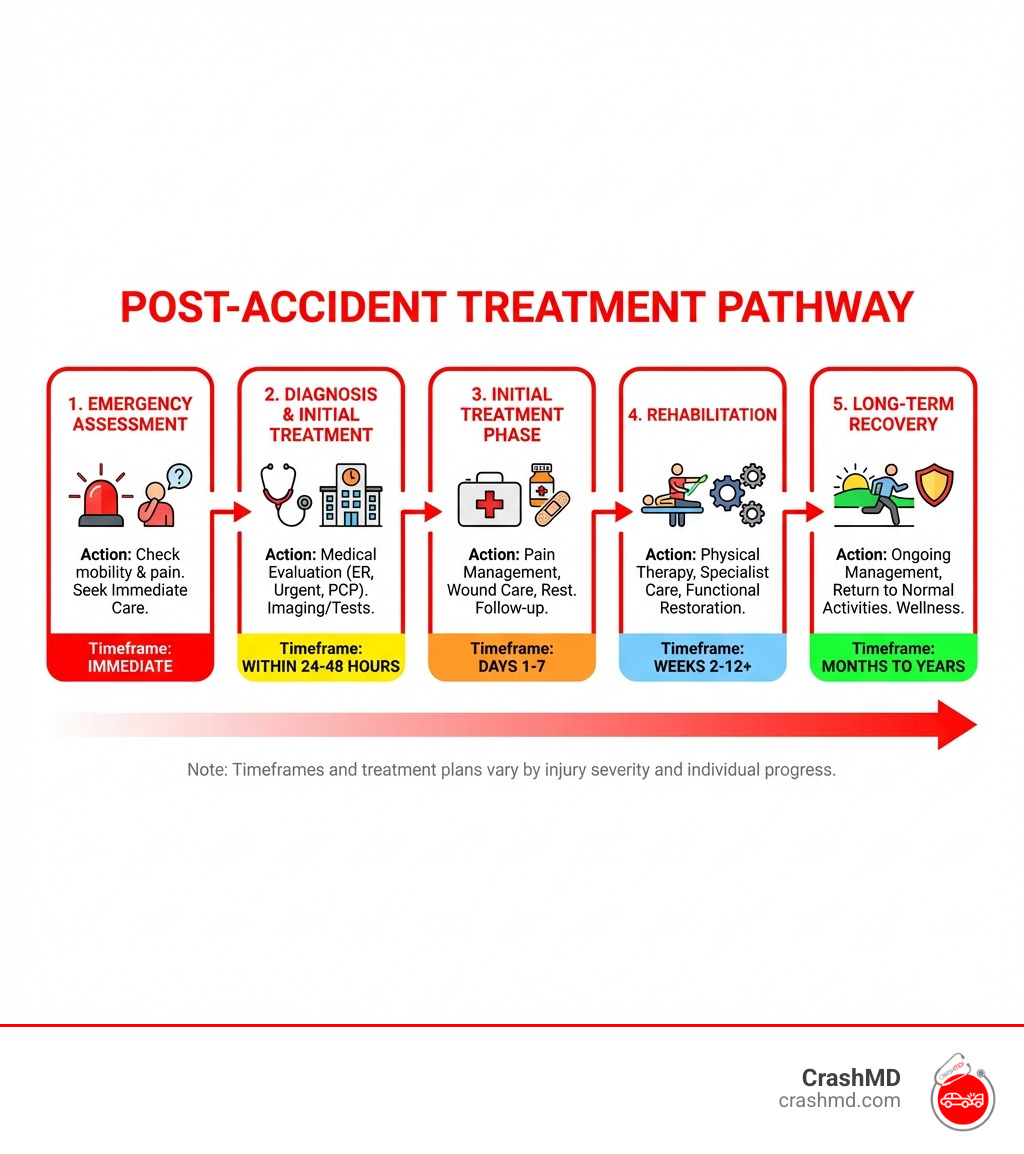
Treatment for accident injuries requires swift action, specialized care, and a comprehensive approach to address both visible and hidden damage. Here’s what you need to know right away:
Essential First Steps:
- Assess mobility – Check if you can move arms and legs without severe pain
- Seek immediate care – Visit ER for severe symptoms, urgent care for moderate injuries, or primary care within 24-48 hours
- Document everything – Medical records are crucial for insurance claims and legal protection
- Start treatment early – Delays can worsen injuries and complicate recovery
Where to Get Treatment:
- Emergency Room – Severe pain, suspected fractures, head injuries, internal bleeding
- Urgent Care – Moderate pain, visible wounds, suspected soft tissue damage
- Primary Care Physician – Follow-up exams, pain management, treatment coordination
- Specialists – Physical therapists, orthopedists, neurologists for ongoing care
Nearly 12 out of every 1,000 people visit the emergency room each year for crash-related injuries. But here’s the critical part most people miss: many serious injuries don’t show symptoms immediately.
Adrenaline rushes and endorphins can mask pain from concussions, internal bleeding, and soft tissue damage. What feels like minor soreness today could be a subdural hematoma or severe whiplash that surfaces days later. That’s why seeking prompt medical attention isn’t optional—it’s essential for your health and your legal protection.
The good news? Modern accident treatment combines multiple approaches to speed recovery. Physical therapy, pain management, psychological support, and advanced interventions work together to get you back to normal life. But it all starts with that first critical step: getting evaluated by a medical professional within 24-48 hours of your accident.
Immediate Steps and Assessment After a Collision
When the dust settles after a collision, your brain is often moving a million miles an hour while your body is trying to process the shock. We know it’s overwhelming, but the first few minutes and hours are the most critical for your long-term recovery.
Knowing what to do if you’re injured starts with a quick self-assessment. Before you even jump out of the car to check the bumper, take a second to breathe and do a “body scan.”
The Mobility and Sensation Check
- Can you move your arms and legs? If you can move your extremities without sharp, radiating pain, it’s a good sign for your spinal cord. However, any resistance or “catching” feeling should be noted.
- Where is the pain located? Be specific. Is it a dull ache in the neck? A sharp jab in the ribs? Even minor discomfort can be a clue for a Motor Vehicle Accident Doctor later on.
- Check for “The Big Three”: Numbness, tingling, or weakness. These are the classic red flags for nerve involvement.
If you are feeling intense neck or back pain, it is usually in your best interest to stay exactly where you are until emergency responders arrive. Moving incorrectly with a spinal injury can turn a treatable condition into a permanent one.
Once you are clear of the immediate danger, knowing what to do immediately after a car accident involves choosing the right level of care. If you have “road rash,” minor bruising, or a headache, urgent care might be your best bet. If you feel “okay” but know you took a hard hit, scheduling an appointment with Doctors who specialize in auto injuries is the smartest move you can make.
Signs Indicating Nerve Damage
- “Pins and Needles”: That prickly sensation you get when your foot falls asleep, but it doesn’t go away.
- Muscle Weakness: Finding it difficult to grip your steering wheel or step out of the car.
- Burning Sensations: A feeling of heat or “electricity” traveling down an arm or leg.
- Loss of Reflexes: A delayed or absent response when moving your limbs.
- Numbness: A total lack of sensation in specific patches of skin.
Common Injuries and the Importance of Prompt Treatment for Accident
We’ve all heard someone say, “I felt fine right after the crash, but the next morning I couldn’t get out of bed.” This isn’t just a cliché; it’s biology. During an accident, your body releases a massive surge of adrenaline and endorphins. These chemicals are designed to help you survive a “fight or flight” situation by temporarily blocking pain signals.
This masking effect is why Treatment for accident injuries must begin even if you feel “fine.” Hidden injuries are the most dangerous because they don’t give you a warning until they reach a crisis point.
The Danger of Hidden Injuries
One of the most serious delayed-onset injuries is a subdural hematoma. This occurs when blood collects between the skull and the surface of the brain. You might feel a slight headache or a bit of confusion, which many people dismiss as “just being shaken up.” However, subdural hematoma risks are life-threatening if the pressure isn’t relieved.
Similarly, internal bleeding in the abdomen can occur without any visible bruising. By the time you feel dizzy or faint, you may have already lost a significant amount of blood. This is why why early intervention is key for post-accident recovery—we want to catch these issues with diagnostics like CT scans or MRIs before they become emergencies.
Common Car Accident Injuries
- Whiplash: A soft tissue injury to the neck caused by the rapid “whip-like” motion of the head. It can affect muscles, ligaments, and even the discs in your spine.
- Soft Tissue Damage: Sprains, strains, and tears in the muscles and tendons. These often take 1–6 weeks to heal but can lead to chronic pain if ignored.
- Fractures: Broken bones are common in high-impact collisions. While a broken arm is obvious, “hairline” fractures in the ribs or feet might only show up on a professional X-ray.
- Concussions: A type of traumatic brain injury (TBI). Vehicle-related injuries are the third most common cause of TBIs, and around 17% of TBI-related deaths are due to car crashes.
- Herniated Discs: The impact can cause the “jelly” inside your spinal discs to leak out, pressing on nerves and causing intense pain.
Beyond your health, prompt treatment is vital for your insurance claim. Insurance companies are notoriously skeptical. If you wait two weeks to see a doctor, they will likely argue that your injuries were caused by something else that happened during those fourteen days. Accurate, immediate injury documentation by a medical professional creates an unbreakable link between the accident and your physical condition.
Specialized Physical Therapy and Rehabilitation Options

Once the initial “crisis phase” is over, the real work of recovery begins. Physical therapy (PT) is often the backbone of any successful Treatment for accident plan. It’s not just about “doing exercises”; it’s about re-teaching your body how to move correctly after a trauma.
Many victims suffer from muscle atrophy or joint stiffness because they naturally stop moving the injured area to avoid pain. This “guarding” behavior actually makes the injury worse over time. Specialized PT interventions are designed to break this cycle.
Advanced Rehabilitation Techniques
- Manual Therapy: This involves hands-on techniques where a therapist moves your joints and soft tissues. It’s excellent for reducing inflammation and restoring “range of motion” that you might have lost due to whiplash.
- Vestibular Rehabilitation Therapy (VRT): If you’ve suffered a concussion or head injury, you might feel dizzy or off-balance. Vestibular Rehabilitation Therapy (VRT) uses specific head, eye, and body movements to retrain the sensory system and fix balance issues.
- Gait Training: When an accident affects your legs, hips, or lower spine, you might find yourself walking differently. Gait training focuses on teaching or re-teaching proper walking patterns to prevent long-term hip or back problems.
- Functional Electrical Stimulation (FES): For those with nerve damage or severe muscle weakness, Functional Electrical Stimulation (FES) uses small electrical currents to make muscles contract. This helps prevent atrophy and “wakes up” the nerves.
Knowing the signs you need physical therapy after a car accident—like persistent stiffness, a limited range of motion, or pain that worsens with movement—can help you start these therapies sooner rather than later.
Effective Physical Therapy as a Treatment for Accident Injuries
The role of physical therapy in pain management is often more effective than medication alone. While pills mask the pain, PT addresses the source of the pain.
- Therapeutic Exercises: These aren’t your typical gym workouts. They are targeted movements designed to strengthen the tiny stabilizer muscles around your spine and joints.
- Aquatic Therapy: Sometimes, your body isn’t ready to handle its own weight. Doing exercises in a pool reduces the impact on your joints while providing gentle resistance.
- Ultrasound Therapy: This uses sound waves to create deep heat in your tissues, which improves blood flow and speeds up the healing of soft tissue tears.
- Flexibility Training: Restoring the “stretch” to your ligaments and tendons is key to preventing future injuries.
Advanced Medical Interventions and Pain Management
Sometimes, the “basics” like rest and ice aren’t enough to handle the complex pain that follows a high-speed wreck. This is where advanced medical interventions come into play. We believe in a “multimodal” approach—using a variety of tools to tackle pain from every angle.
RICE vs. Advanced Injection Therapy
| Feature | RICE Protocol | Injection Therapy |
|---|---|---|
| Best For | Initial 48-72 hours, minor swelling | Chronic pain, nerve impingement, severe inflammation |
| Method | Rest, Ice, Compression, Elevation | Targeted delivery of medication to the source |
| Recovery | 1–6 weeks for minor injuries | Immediate relief for some; long-term for others |
| Invasiveness | Non-invasive | Minimally invasive |
The RICE protocol is the gold standard for the first few days. It helps control the initial “fire” of inflammation. However, if you are dealing with a herniated disc or severe nerve pain, you might need something more direct.
Modern Pain Management Options
- Injection Therapy: This includes epidural steroid injections or Injection Therapy for Pain that delivers anti-inflammatories directly to the affected nerve root.
- Radiofrequency Ablation (RFA): For chronic neck or back pain, RFA uses heat to “turn off” the pain signals from specific nerves.
- Chiropractic Care: Many patients find that Chiropractic Care for Accidents helps realign the spine and reduce the pressure that causes headaches and localized pain.
- Acupuncture: This ancient technique has modern backing. Acupuncture for Injury Recovery can help stimulate the body’s natural pain-killing chemicals and improve circulation to damaged areas.
- Holistic Pain Management: We often combine traditional medicine with Holistic Pain Management like biofeedback or massage therapy to treat the “whole person” rather than just the injury.
In severe cases, surgical stabilization may be required. This could involve spinal surgery interventions to remove bone fragments, fuse broken vertebrae, or relieve pressure on the spinal cord. While we always try to avoid surgery through PT and injections, sometimes it is the necessary path to prevent permanent disability.
Psychological Support and Long-Term Recovery Timelines
Recovery isn’t just a physical journey; it’s a mental one. A car accident is a “traumatic event” in every sense of the word. While we focus on the broken bones and torn ligaments, we must also address the invisible scars.
Chronic pain after a car accident: what you need to know is that pain and mental health are deeply linked. Studies show that mental health struggles—like anxiety or depression—can actually increase the risk of developing chronic pain. It becomes a cycle: the pain makes you depressed, and the depression makes the pain feel more intense.
The Psychological Toll
- PTSD: Post-Traumatic Stress Disorder isn’t just for combat veterans. Many car accident victims experience “flashbacks,” a fear of driving, or intense anxiety when they hear a loud noise or screeching tires.
- Anxiety and Depression: The loss of independence or the inability to work can lead to a profound sense of hopelessness.
- Social Isolation: If you can’t leave the house due to pain or fear, your support network can begin to shrink.
This is why psychological and psychosocial interventions are a standard part of a modern recovery plan. Whether it’s through formal counseling or guided support groups, addressing the trauma early prevents it from becoming a lifelong burden.
Psychological Support: A Vital Treatment for Accident Trauma
The risk of psychological issues is much higher than most people realize. In fact, one in three statistics show that a third of car crash victims develop moderate to severe mental health problems.
Early intervention through Cognitive Behavioral Therapy (CBT) can help you process the event and build emotional resilience. Self-care—like getting enough sleep, eating balanced meals, and staying connected with friends—might sound simple, but it is a powerful Treatment for accident trauma.
Frequently Asked Questions about Accident Recovery
How long does whiplash recovery typically take?
According to the whiplash recovery timeline, most people recover within three months. However, this depends entirely on how quickly you start treatment. Using a combination of gentle neck exercises, heat/cold therapy, and professional Pain Management can significantly shorten this window. If ignored, whiplash can lead to chronic “cervicogenic” headaches that last for years.
Why should I see a doctor if I feel fine after a crash?
As we mentioned, the adrenaline rush is a master of disguise. Internal organ damage, slow-leaking brain bleeds, and soft tissue tears often have delayed symptoms. Beyond the medical risk, seeing a doctor provides the legal protection you need. Without a medical record dated shortly after the crash, proving your injuries to an insurance company becomes an uphill battle.
Does physical therapy help with insurance settlements?
Absolutely. When you choose Physical Therapy vs Surgery After Accident, you are creating a detailed paper trail of your recovery. PT records document your pain levels, your functional limitations, and the effort you are putting into getting better. This documentation is gold for your legal team when negotiating a settlement, as it proves the “medical necessity” of your care and the long-term impact on your life.
Conclusion
I’m Dr. Adam Savage, and I’ve seen how the right treatment plan can transform a victim back into a survivor. At CrashMD, we don’t just treat symptoms; we advocate for your entire recovery. Our mission is to guide you through the complex world of post-accident care—from the initial diagnosis to the final day of physical therapy.
We specialize in creating tailored treatment plans that focus on your unique needs, whether you’re in Arizona, Nevada, Texas, Oklahoma, or California. We also understand that recovery isn’t just about health—it’s about justice. By providing meticulous injury documentation, we ensure that your legal case is as strong as your physical recovery.
If you or a loved one has been involved in an accident, don’t wait for the pain to become unbearable. Take control of your future today. For more info about motor vehicle accident doctors and how we can help you get back on your feet, reach out to us. Your road to recovery starts with a single, smart decision. Let’s make it together.