

Why Accident Medical Records Can Make or Break Your Injury Claim
Accident medical records are the single most important piece of evidence you can collect after getting hurt in a crash. Without them, your pain is just your word against the insurance company’s.
Here is what you need to know right away:
- Get medical care immediately – even if you feel okay. Adrenaline can hide serious injuries for hours or days.
- Every visit creates a record – ER reports, imaging, specialist notes, and billing all count as evidence.
- Records prove causation – they link your injuries directly to the accident, not a pre-existing condition.
- You have a legal right to your records – under HIPAA, providers must give you copies, typically within 30 days.
- Do not sign a blanket medical release for the other driver’s insurance company without legal advice first.
You are dealing with real pain, real bills, and an insurance system that is not on your side. What many accident victims don’t realize is that how well your injuries are documented often determines how much compensation you receive – sometimes the difference between a lowball offer and a fair settlement.
Think of your medical records as the receipt for everything the accident has cost you. Lose the receipt, and it becomes very hard to get reimbursed.
This guide walks you through exactly what records matter, how to get them, and how to protect them.
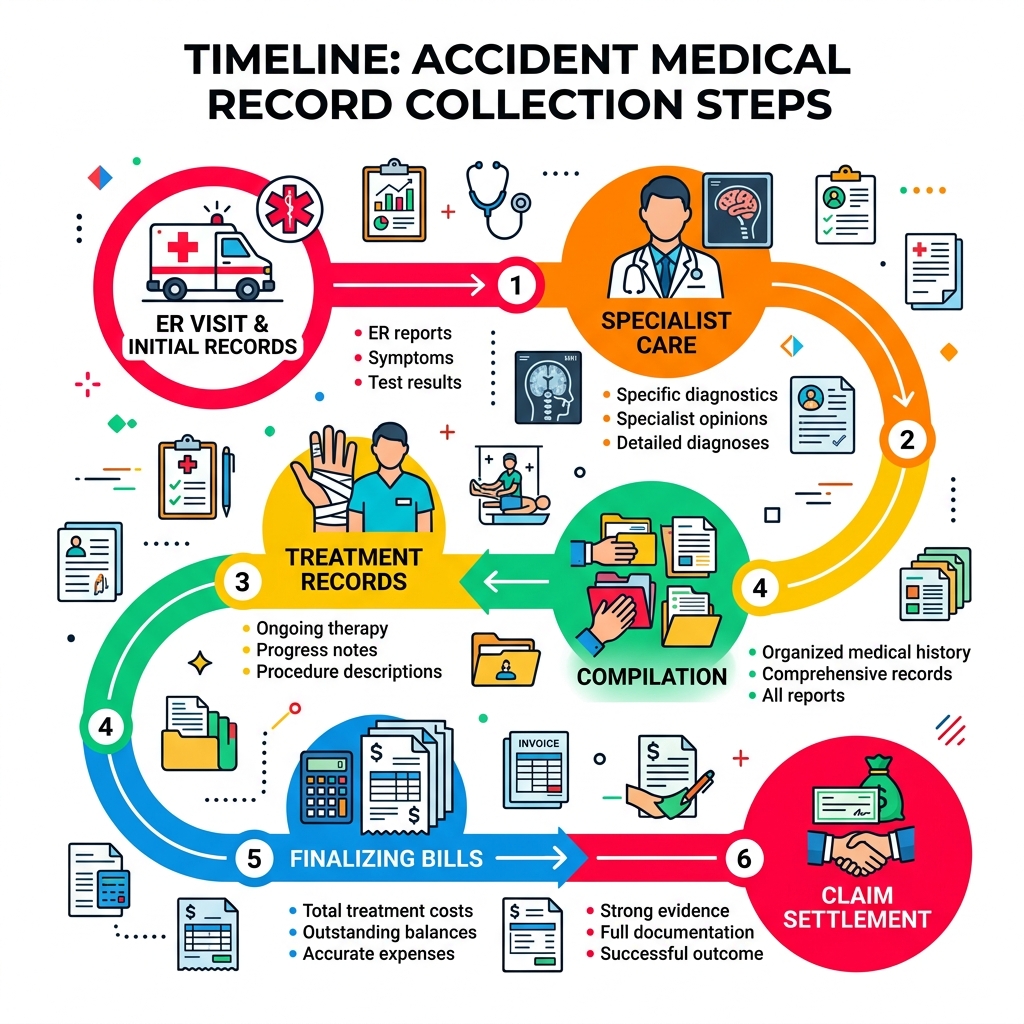
Basic Accident medical records glossary:
- Back pain after accident
- Symptoms after accident
- Soft tissue injury
The Critical Role of Documentation in Personal Injury

In personal injury law, if it isn’t written down, it didn’t happen. When we talk about Accident medical records, we aren’t just talking about a stack of paper; we are talking about the objective proof of your suffering. These documents serve three primary purposes: proving causation, demonstrating injury severity, and quantifying financial damages.
Insurance adjusters are trained to look for any reason to pay you less. One of the primary tactics insurance companies use to minimize settlements is to claim that your injuries were either not that serious or were caused by something other than the accident. Without a rock-solid medical trail, it is incredibly difficult to fight back against these assertions. This is why the importance of seeking medical treatment immediately after a crash cannot be overstated. A doctor’s note from the day of the accident is worth ten times more than a note from three weeks later.
Why Accident medical records are the Foundation of Your Claim
Your medical records provide an objective timeline that eyewitness testimony simply cannot match. While a witness might remember you “looking shaken up,” a medical record will note your elevated heart rate, limited range of motion in your neck, and the specific location of bruising.
These records also help eliminate “treatment gaps.” A treatment gap is a period where you didn’t see a doctor. Insurance companies love these gaps; they use them to argue that you must have been feeling fine, or that you got injured doing something else (like yard work) during that time. By maintaining consistent Accident medical records, you close those windows of doubt.
Beyond formal doctor notes, we often recommend keeping a pain journal. While the doctor records the clinical facts, your journal records the human impact—how the pain kept you from picking up your kids or prevented you from sleeping. When paired with clinical records, this creates a comprehensive picture of your recovery. Understanding the post-crash check-up importance is the first step in building this foundation.
Proving Long-Term Impact and Future Costs
Many accident injuries, such as whiplash, herniated discs, or traumatic brain injuries (TBIs), don’t just go away after a few weeks of physical therapy. They can have lifelong consequences. Your Accident medical records must do more than just show you were hurt; they must project your future needs.
A thorough medical record includes a “prognosis”—the doctor’s professional opinion on your recovery. If a specialist notes that you have a “permanent impairment” or will likely need surgery in five years, that information is vital for calculating the true value of your claim. We work to ensure that your records reflect the road to recovery expectations so that you aren’t left paying for future medical bills out of your own pocket.
Your Legal Rights: HIPAA and State-Specific Rules for Accident medical records
You own your health information. This right is protected by a federal law called the Health Insurance Portability and Accountability Act (HIPAA). HIPAA ensures that your Protected Health Information (PHI) stays private and that you have the right to inspect or obtain copies of your records from any healthcare provider.
However, while HIPAA is federal, different states have specific rules regarding how accidents are reported and how long you have to take legal action. Since we operate in states like Texas, Nevada, and Arizona, it is important to understand the local landscape. For example, in Texas, the statute of limitations for a personal injury claim is generally two years, whereas in Missouri, you might have up to five years.
| State | Reporting Threshold (Property Damage) | Reporting Deadline | Statute of Limitations (Injury) |
|---|---|---|---|
| Texas | $1,000 | 10 Days | 2 Years |
| Missouri | $500 | 30 Days | 5 Years |
| Nevada | $750 | 10 Days | 2 Years |
| California | $1,000 | 10 Days | 2 Years |
Step-by-Step: How to Request and Obtain Your Accident medical records
Getting your hands on your records shouldn’t be a headache, but it often requires persistence. Here is the post-accident protocol for requesting your files:
- Identify the Providers: Make a list of every place you received care, from the ambulance company and ER to your primary doctor and physical therapist.
- Submit a Written Request: Most hospitals have a specific HIPAA authorization form. You must sign this to prove you are who you say you are.
- Specify the Scope: You don’t always need your entire medical history from birth. Request records specifically related to the date of the accident and subsequent treatment.
- Choose Your Format: You can usually request digital copies (via a portal or CD) or paper copies. Digital is often faster and cheaper.
- Pay the Fee: Under federal HIPAA rules on record fees, providers can only charge a “reasonable, cost-based fee” for labor and supplies. In Texas, for instance, this is capped by the Texas Health and Safety Code.
Handling Delays and Provider Refusals
Under HIPAA, healthcare providers generally have 30 days to respond to your request. They can ask for one 30-day extension if they provide a reason. If a provider is dragging their feet, you have options.
In Missouri, Revised Statute 191.227 mandates that providers must provide these records upon written request. In Texas, the Health and Safety Code Section 181.001 requires a response within 15 business days. If you face a refusal:
- Contact the facility’s Privacy Officer.
- Cite the specific state or federal law (like HIPAA).
- File a complaint with the Department of Health and Human Services (HHS).
- Involve your attorney, as a letter from a law firm often speeds up the process.
Navigating Insurance Tactics and Medical Release Forms
Shortly after your accident, an insurance adjuster will likely call you with a friendly tone. They may ask you to sign a “Medical Authorization Release” so they can “verify your injuries” and “pay your bills faster.”
Stop. This is a trap.
These forms are often “blanket authorizations.” By signing one, you may be giving the insurance company permission to dig through your entire medical history—including that sports injury from high school or a mental health consultation from a decade ago. Their goal is to find a “pre-existing condition” they can blame for your current pain. Understanding your recovery roadmap means knowing when to share information and when to keep it private.
Protecting Your Privacy from Opposing Counsel
If your case goes to a lawsuit, the opposing side will try to obtain your records through the “discovery” process. This can involve subpoenas or court orders. However, even in a legal battle, you have rights.
You can often limit the scope of what is shared through “selective disclosure.” Your attorney can argue that only records relevant to the accident should be produced. For example, if you injured your back, the insurance company has no business looking at your dental records. This is why choosing the right accident doctor who understands the legal implications of documentation is so important.
Addressing Pre-Existing Conditions and Aggravation
One of the biggest myths in personal injury is that a pre-existing condition ruins your case. In reality, the law recognizes the “Eggshell Skull Rule.” This rule states that a defendant is liable for the full extent of the injuries they caused, even if the victim was more susceptible to injury due to a prior condition.
If you had a “bad back” before the crash, but the crash made it significantly worse (an “aggravation”), you are entitled to compensation for that increased pain and disability. The key is transparent documentation. You must be honest with your specialized motor vehicle accident doctors about your history so they can clearly document how the accident changed your baseline health.
Frequently Asked Questions about Accident Medical Records
Can an insurance company see my entire medical history?
Only if you let them. While they have a right to see records relevant to the injuries you are claiming, they do not have an automatic right to your entire life story. Never sign a broad release form without having it reviewed by a professional. If you are filing a claim against your own insurance (like a UIM claim), you may have a contractual duty to cooperate, but even then, the information should be limited to what is relevant.
How much do providers charge for copies of medical records?
Fees vary by state but must be “reasonable” under HIPAA.
- In Texas: Providers can charge up to $25 for the first 20 pages and $0.50 for each page thereafter.
- In Missouri: Fees are adjusted annually based on the cost of living.
- Digital Records: Requesting digital copies is usually significantly cheaper than requesting paper copies because it eliminates printing and mailing costs.
What should I do if my medical records contain errors?
Medical records are typed by humans, and humans make mistakes. If you see an error—such as a doctor claiming you said you weren’t in pain when you were—you have the right to request an amendment under HIPAA. The provider has 60 days to respond. Even if they refuse to change the record, they must allow you to add a “statement of disagreement” to your file.
Conclusion
I’m Dr. Adam Savage, and I believe that comprehensive documentation is the only way to ensure your physical and financial recovery are fully protected. At CrashMD, we specialize in bridging the gap between clinical excellence and the meticulous record-keeping required for legal success. We understand that your focus should be on healing, not on fighting with medical billing departments or insurance adjusters.
Our team ensures that every symptom is tracked, every diagnostic test is recorded, and every causal link is clearly stated in your file. We advocate for you so that the insurance company sees the full reality of your situation. Connect with our California car crash accident staff today to ensure your “receipt for pain” is never lost. Whether you are in Texas, Arizona, or Nevada, we are here to provide the specialized care and documentation you need to move forward.