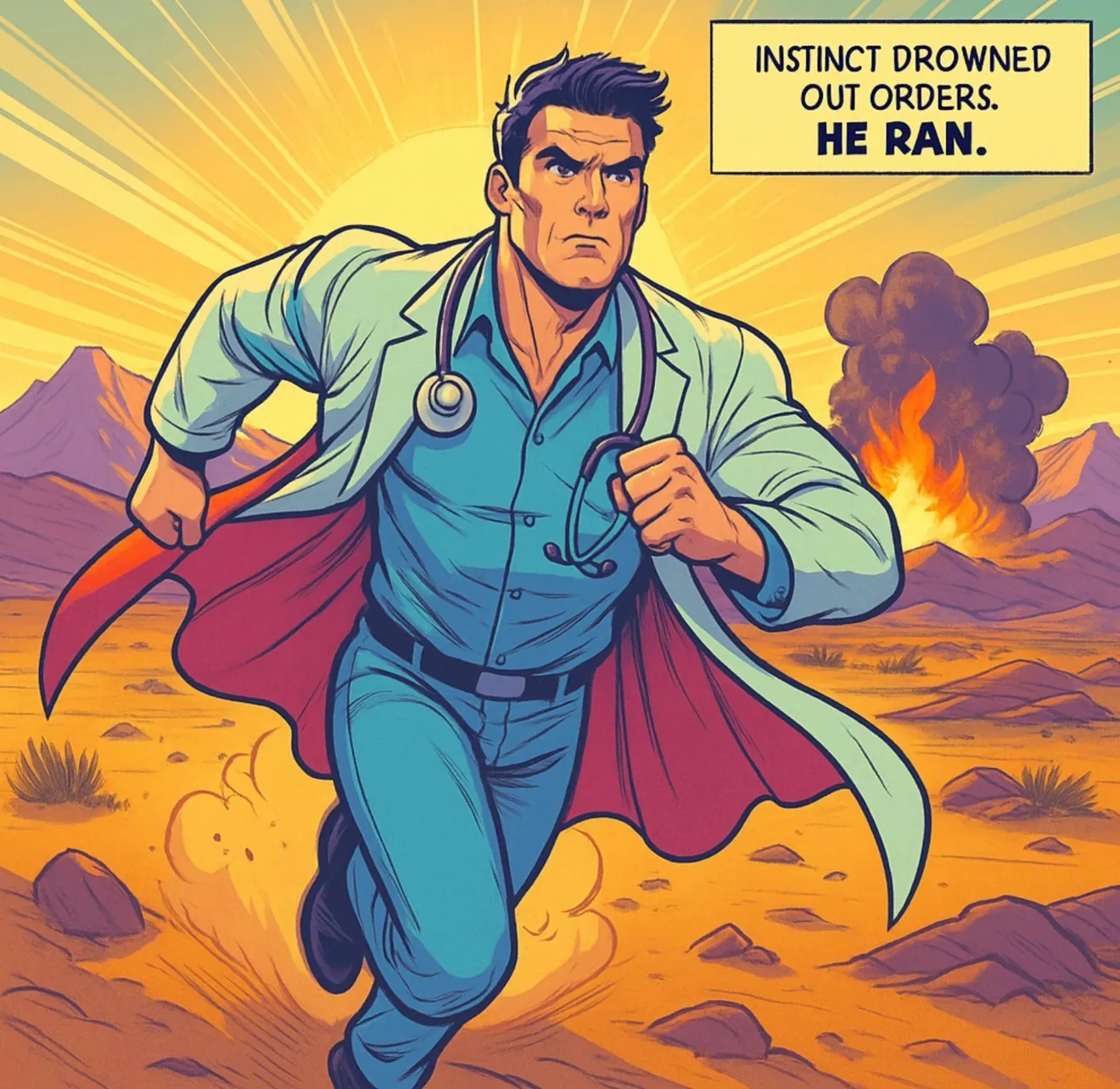
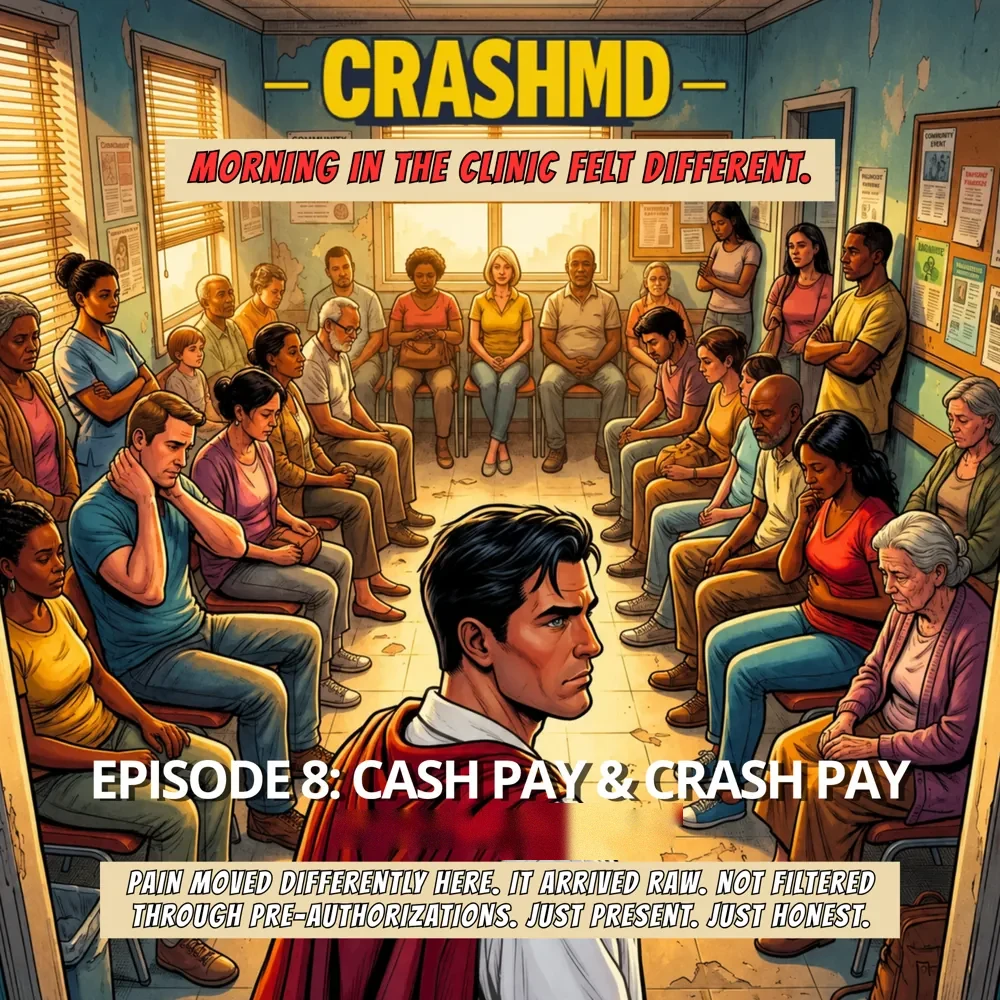
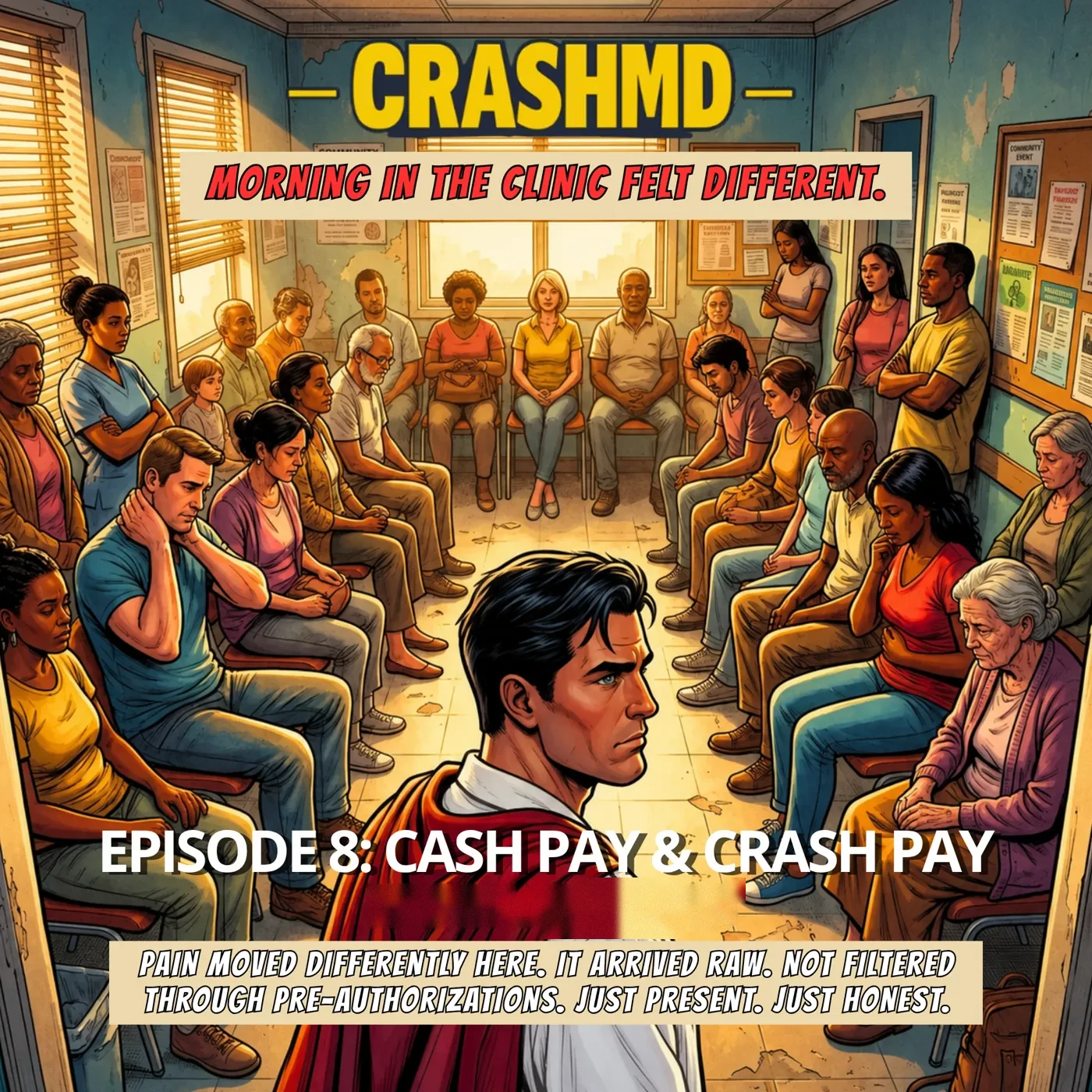
Morning in the clinic felt different.
The waiting room was full. Rear-end collisions. Side impacts. Light rail jolts. Slip-and-falls. Fender benders insurance would call minor.
Bodies that knew otherwise.
Crash stood at the threshold and watched.
Pain moved differently here. It arrived raw — not filtered through pre-authorizations, not staggered by denials, not scheduled three weeks out to satisfy a utilization review algorithm.
Just present. Just honest.
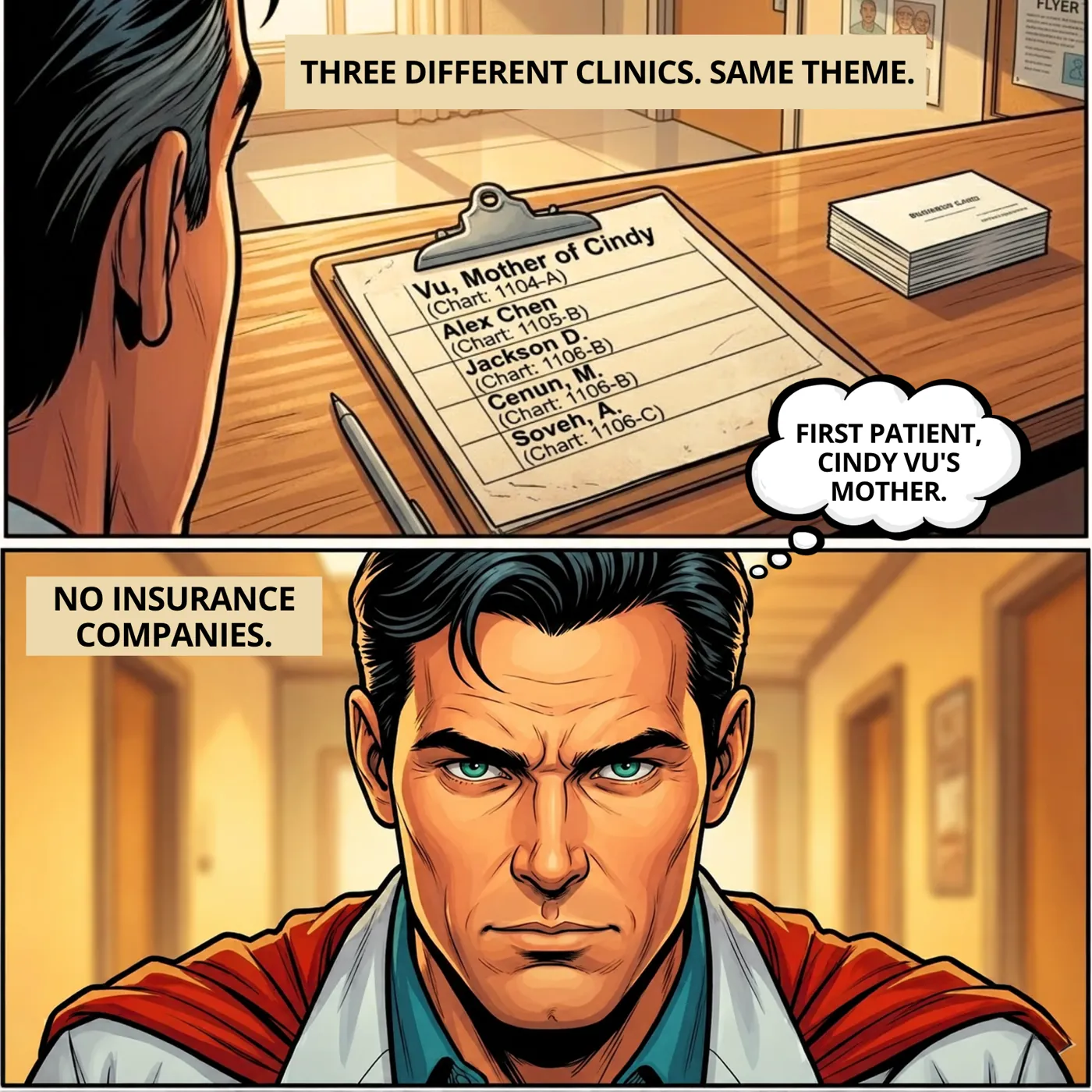
Crash hated dealing with insurance. Everyone who worked with him knew it. It was why he loved working in the free clinic a few days a week — the uninsured didn’t have a carrier to argue with. Patel had figured out early that a concierge cash pay practice and a PI clinic rounded out the week nicely. Three different clinics. Same theme.
No insurance companies.
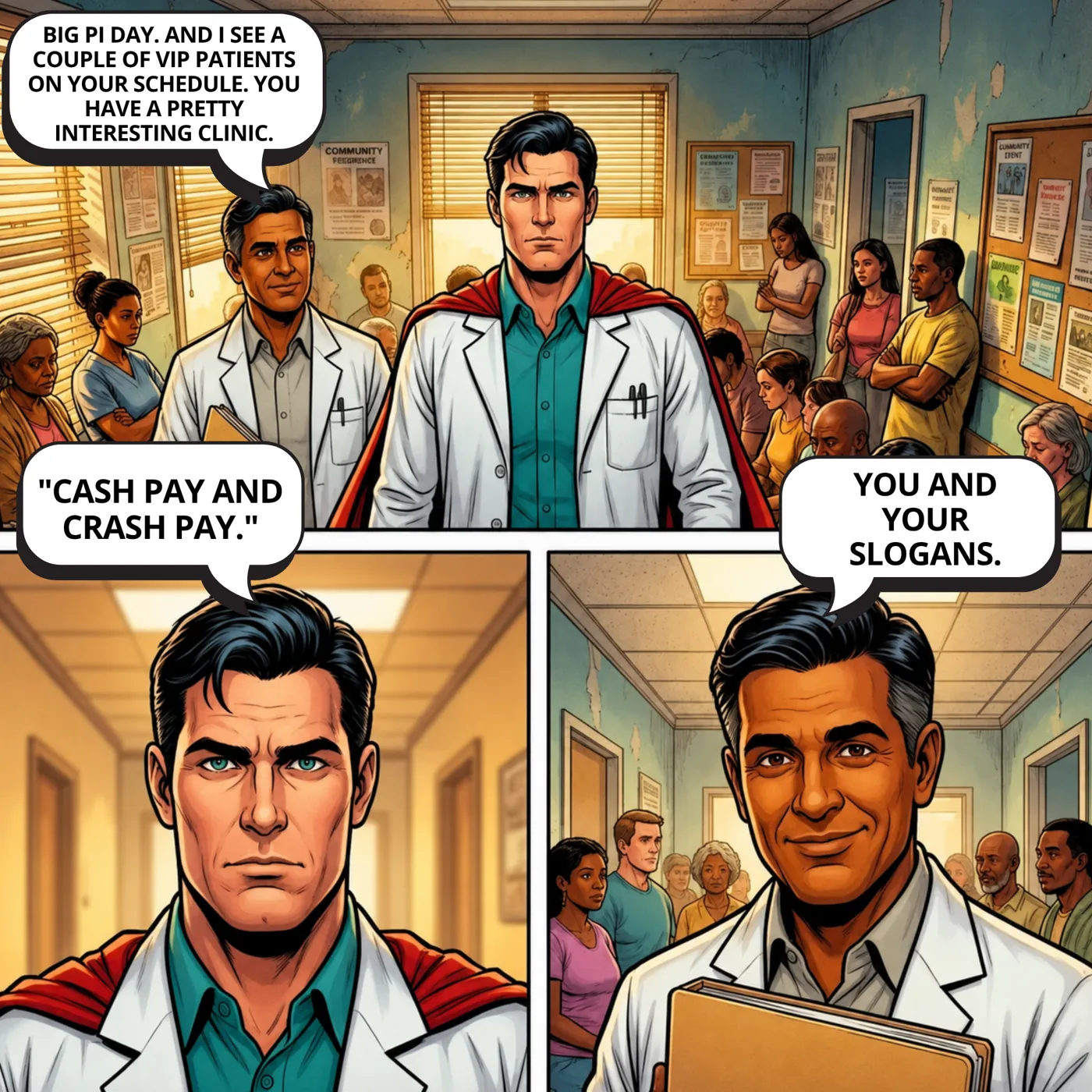
Patel stepped up beside him. “Big PI day. And I see a couple VIP patients on your schedule. You have a pretty interesting clinic.”
“Cash pay and crash pay,” Crash said.
Patel smirked. “You and your slogans.”
Crash didn’t smile back. He was already thinking about the first patient.
Cindy
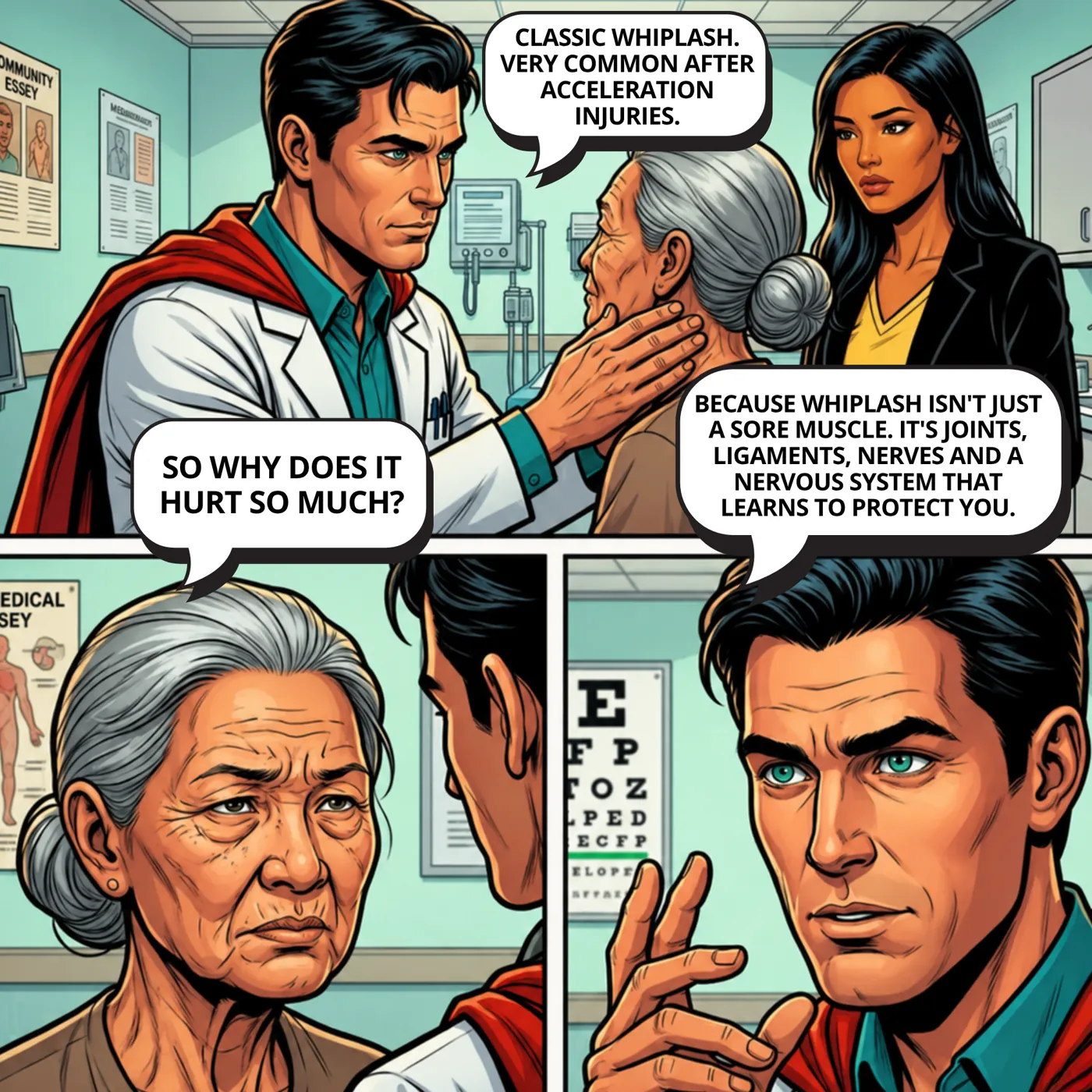
Cindy Vu walked in with her mother.
Her mother moved carefully. Every step was deliberate, every turn of the head rehearsed. The kind of caution you only see when someone’s body has taught them it can’t be trusted.
Crash looked up from the chart.
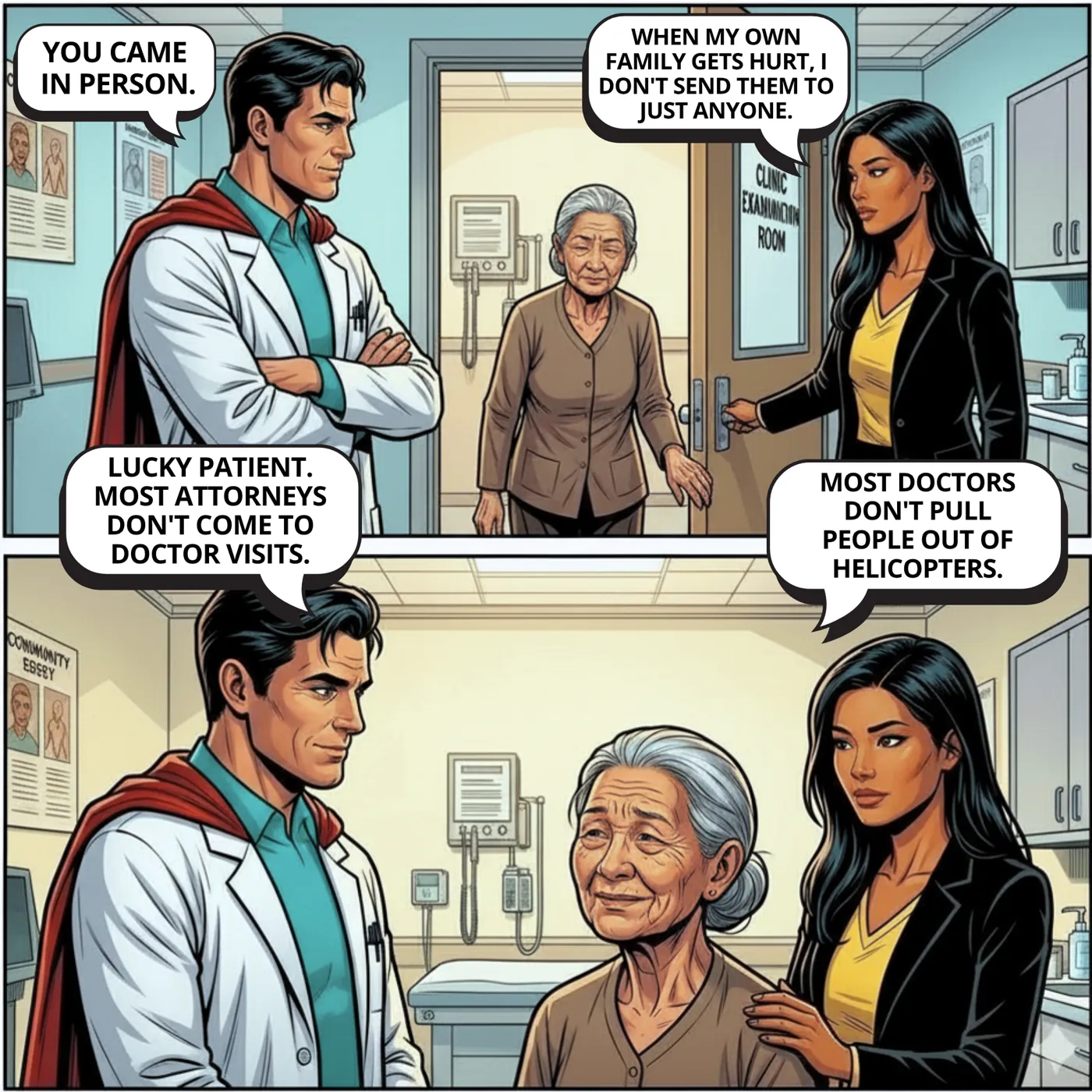
“You came in person.”
“When my own family gets hurt,” Cindy said, “I don’t send them to just anyone.”
Crash glanced at her mother. “Lucky patient. Most attorneys don’t come to doctor visits.”
“Most doctors don’t pull people out of helicopters.”
Her mother gave a small, tired laugh that turned into a wince.
Crash stepped closer. “Tell me what happened.”
Rear-ended. Low speed. Not that bad, according to the adjuster. The symptoms told a different story.
He examined her gently. Tender facets. Guarding. Limited rotation.
“Classic whiplash,” he said. “Very common after acceleration injuries.”
Her mother narrowed her eyes. “So why does it hurt so much?”
“Because whiplash isn’t just a sore muscle. It’s joints, ligaments, nerves, and a nervous system that learns to protect you.”
He looked at Cindy.
“This is why the right doctor matters. A lot of people get told to wait it out. Meanwhile the body stiffens, the fear grows, and the pain becomes a habit.”
“So what’s the plan?”
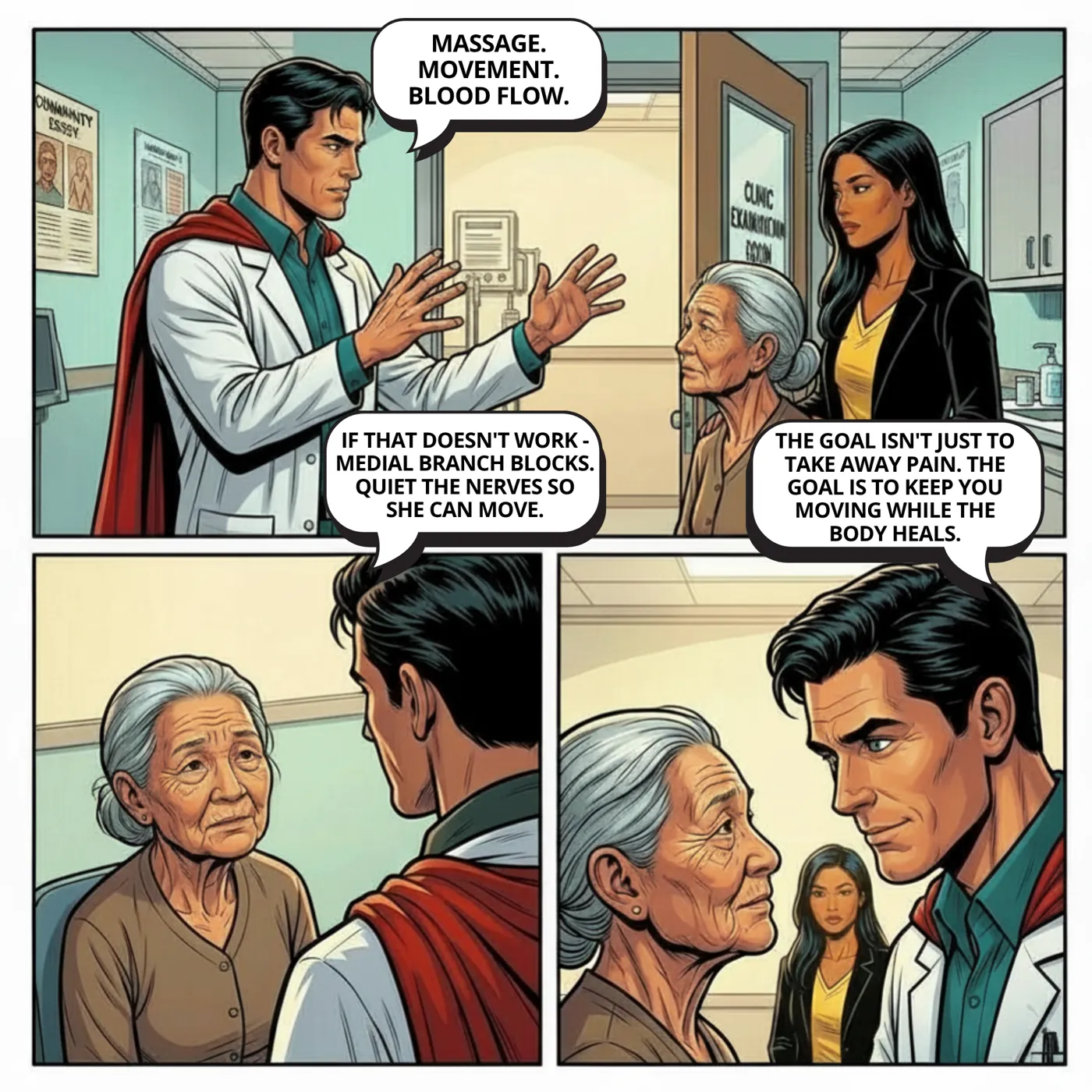
“That’s why we add the massage. Work on the movement while increasing the blood flow. If that doesn’t work, we intervene early. We talk about blocking the pain.”
Her mother frowned. “I’ve tried therapy before. It made me sore for days.”
“If pain blocks movement, we block the pain.”
“Block it how?”
“Medial branch blocks. Tiny nerves that supply the facet joints. Quiet them, and she can move. If that works well, we have a longer option.”
Cindy leaned in. “Which is?”
“Radiofrequency ablation. Advanced electrical treatment. A kind of precise neuromodulation. We quiet the overactive signaling for months at a time.”
He met the mother’s eyes.
“The goal isn’t just to take away pain. The goal is to keep you moving while the body heals.”
She exhaled slowly. “That makes sense.”
Cindy’s face softened. “Thank you.”
“We’ll take good care of her.”
Cindy’s mother stepped out to the front desk.
Cindy stayed.
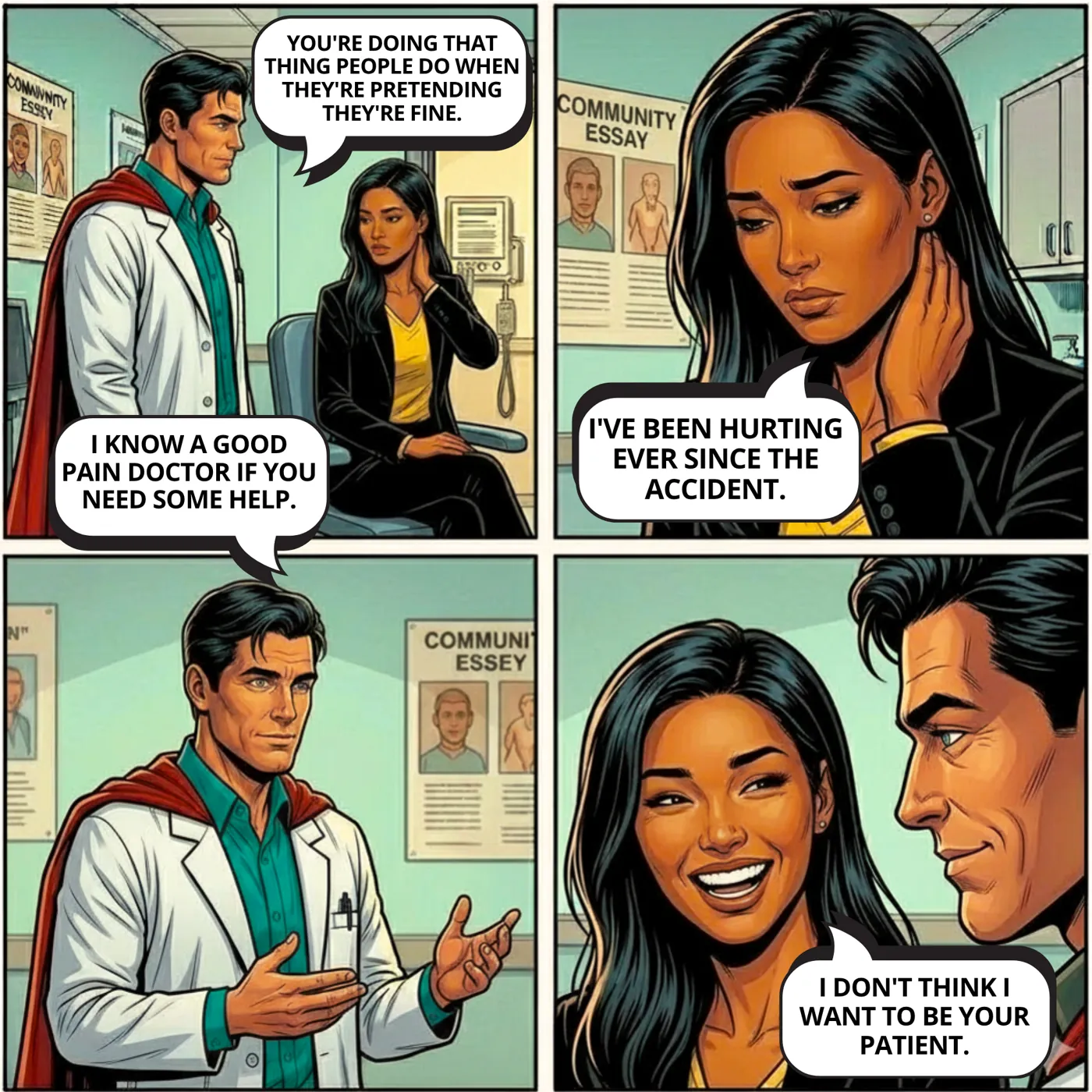
She rubbed her neck absentmindedly.
Crash noticed.
“You’re doing that thing people do when they’re pretending they’re fine.”
She laughed quietly. “Since the helicopter, my neck’s been tight. Not as bad as hers. But it’s there.”
“I can take a look. Just check in with the front desk.”
She tilted her head.
“I’m not sure I should be your patient.”
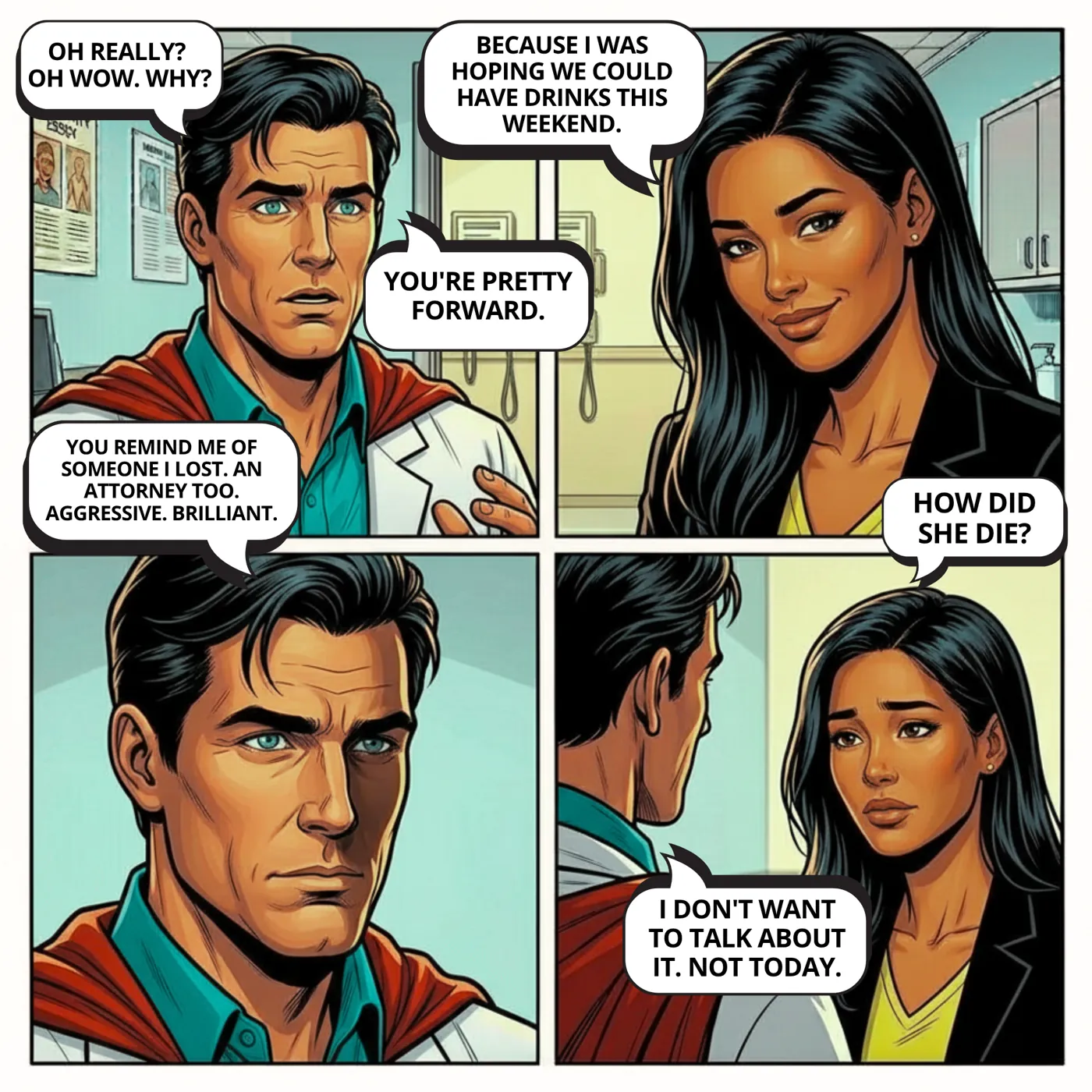
“Why not?”
“Because I was hoping we could have drinks this weekend.”
Crash paused.
“You’re pretty forward.”
“I am.”
He looked at her more carefully. Really looked.
“You remind me of someone I lost.”
She stilled. “I’m sorry.”
“She was an attorney too. Aggressive. Brilliant. Chose to focus her brilliance on helping the homeless. She pushed back against institutions until she couldn’t push back anymore.”
A beat.
“I think she’d like you.”
Cindy’s expression softened.
“How did she die?”
Crash held her gaze for a moment.
“I don’t want to talk about it. Not today.”
She nodded slowly. Didn’t push.
“So no drinks?”
“I don’t think I’m ready just yet. But just in case — I’ll send you to one of our other excellent doctors at the CrashMD clinic.”
She smiled.
“Fair enough. We’ll keep the door open.”
She left.
Crash watched her go.
For a second, the day felt lighter.
Donnie
Donnie was next.
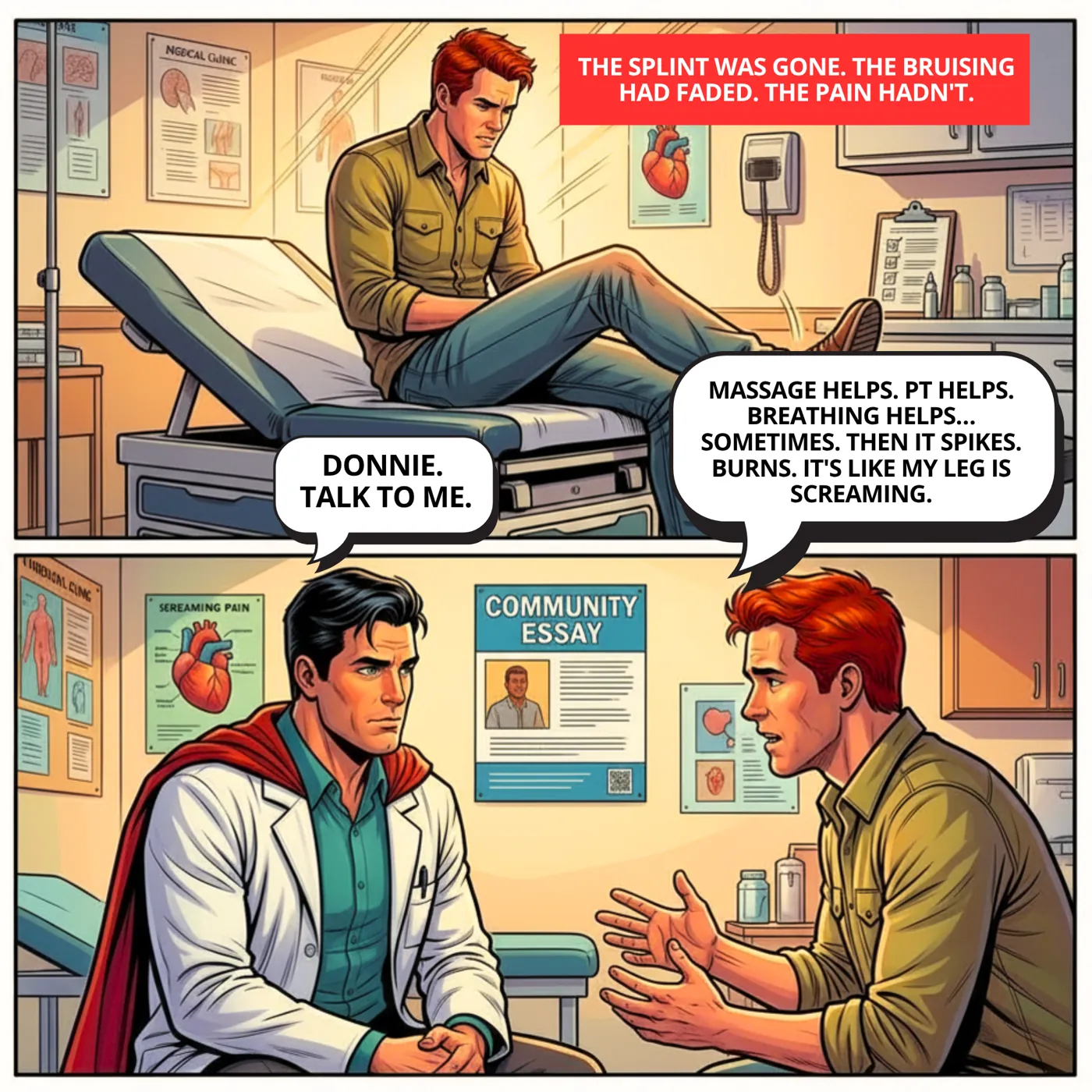
He was already seated when Crash walked in. Leg bouncing. Jaw tight. The splint was gone. The bruising had faded.
The pain hadn’t.
“Doc.”
“Donnie. Talk to me.”
Donnie exhaled. “The massage helps for a while. PT helps for a while. Breathing helps… sometimes. Then it spikes. Buzzes. Burns. It’s like my leg is screaming.”
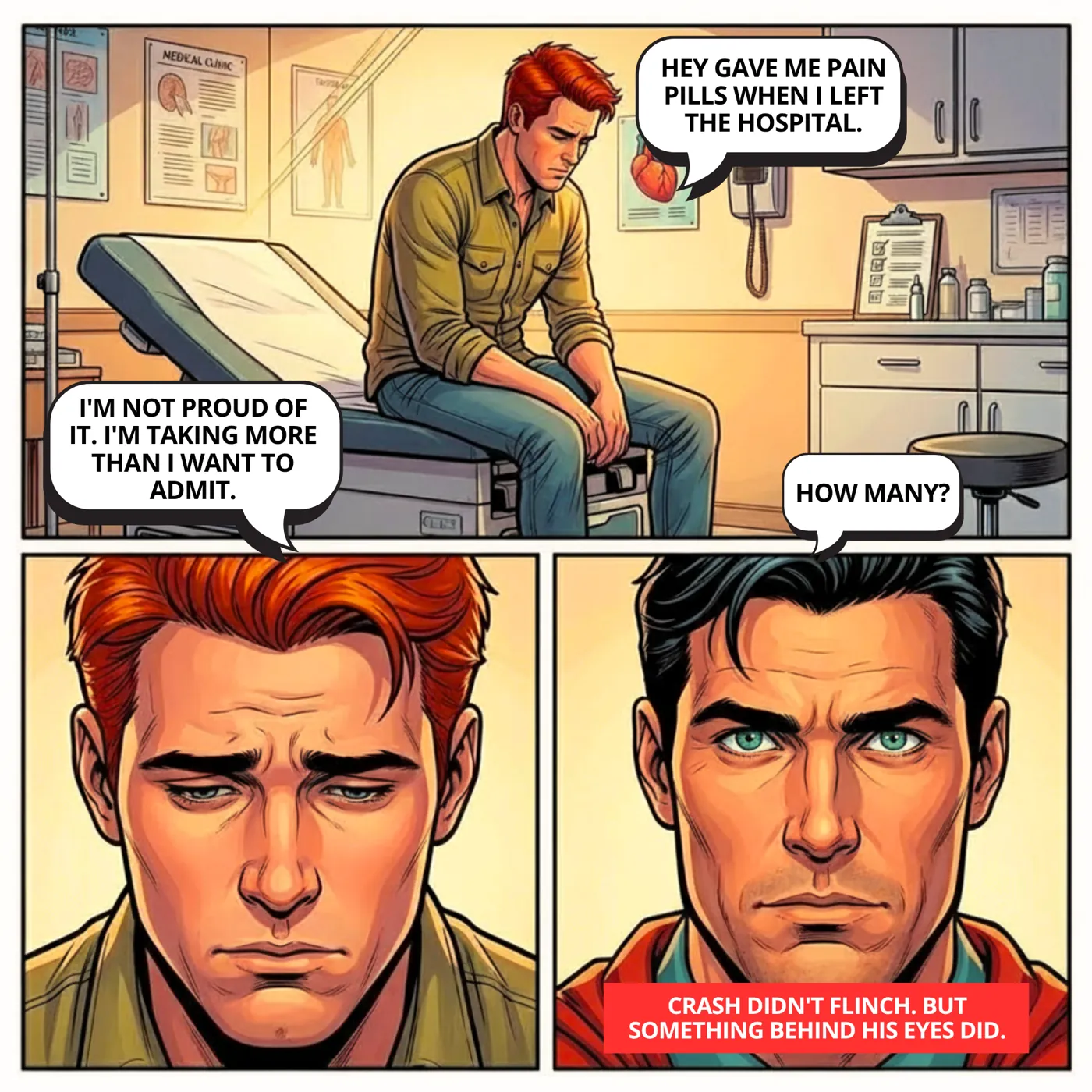
“They gave me pain pills when I left the hospital,” Donnie said. “I’m not proud of it. I’m taking more than I want to admit.”
“How many?”
Donnie told him.
Crash didn’t flinch. But something behind his eyes did.
“When are you taking extra?”
“At night. When it’s worse.”
Donnie swallowed.
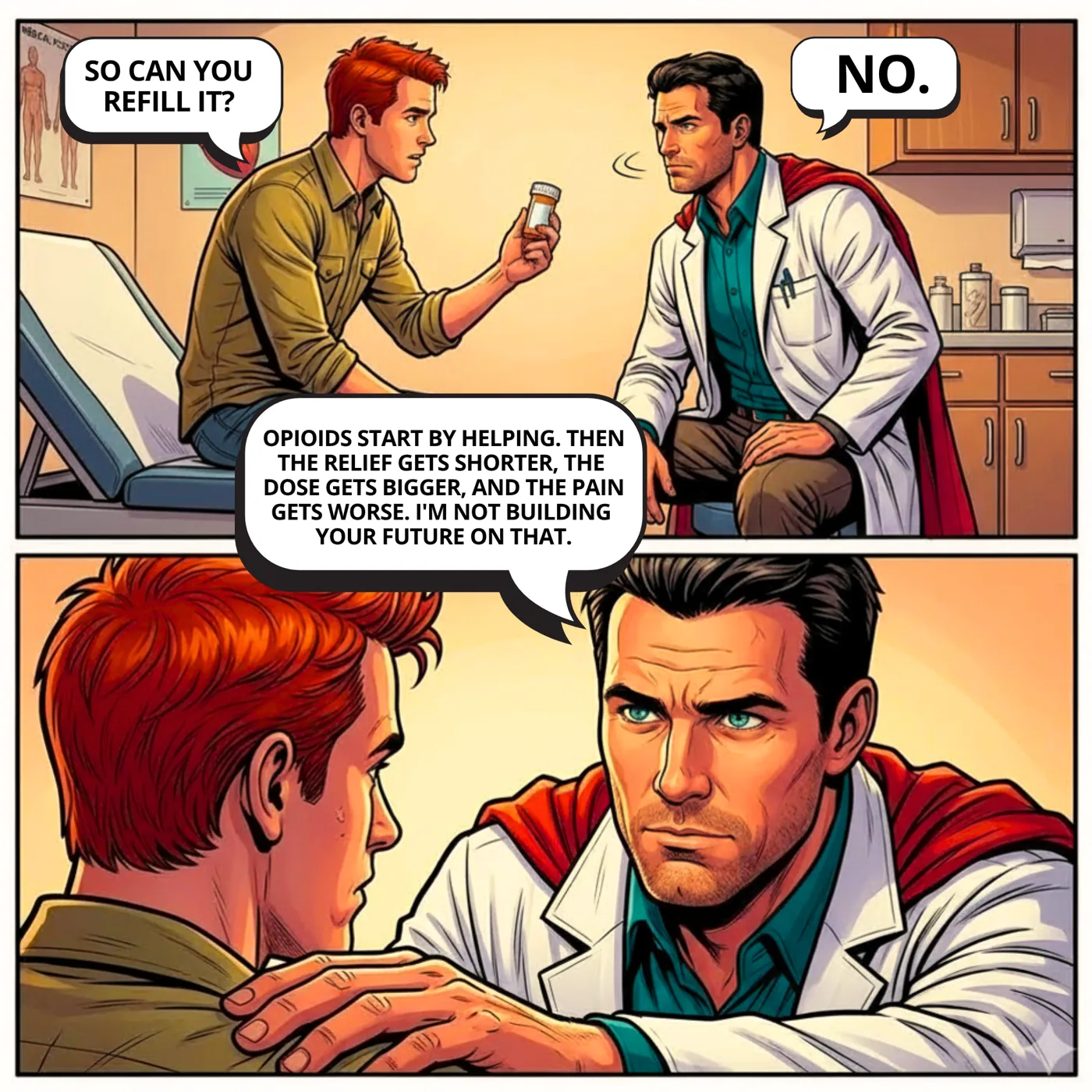
“So can you refill it?”
Crash leaned forward.
“No.”
Donnie stared at him.
“In my experience, opioids start by helping. Then the relief gets shorter, the dose gets bigger, and the pain gets worse. I’m not building your future on that.”
Donnie’s jaw tightened.
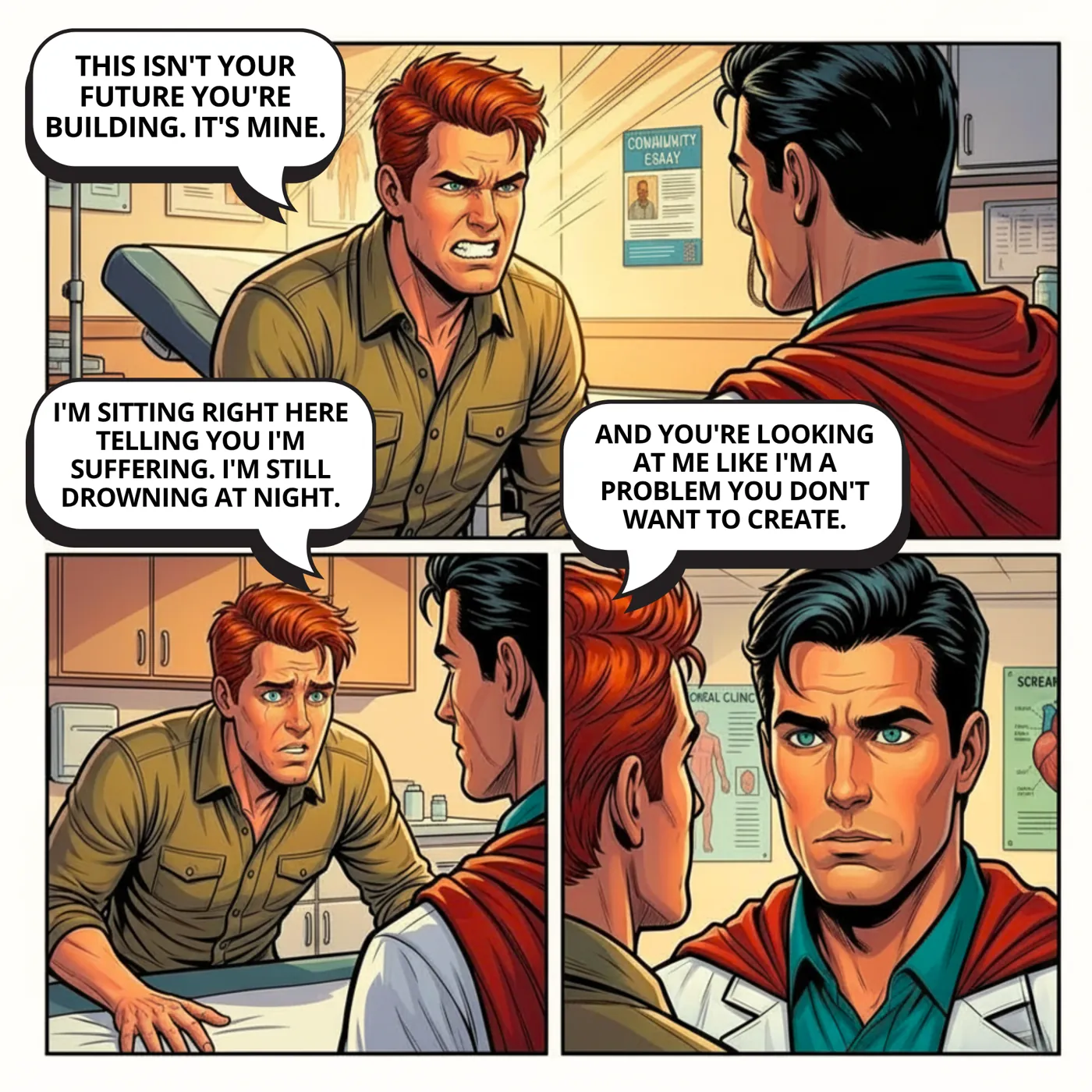
“This isn’t your future you’re building. It’s mine.”
Crash said nothing.
“You talk a lot about empathy. About hope. About helping people. I’m sitting right here telling you I’m suffering. I can’t sleep. I can’t think. My leg feels like it’s on fire. And you’re looking at me like I’m a problem you don’t want to create.”
“That’s not what this is.”
“Then what is it?” Donnie shot back. “You saved my life. You told me to trust you. I’m doing the plan. PT. Massage. Breathing. All of it. And I’m still drowning at night.”
Silence.
Donnie’s voice dropped.
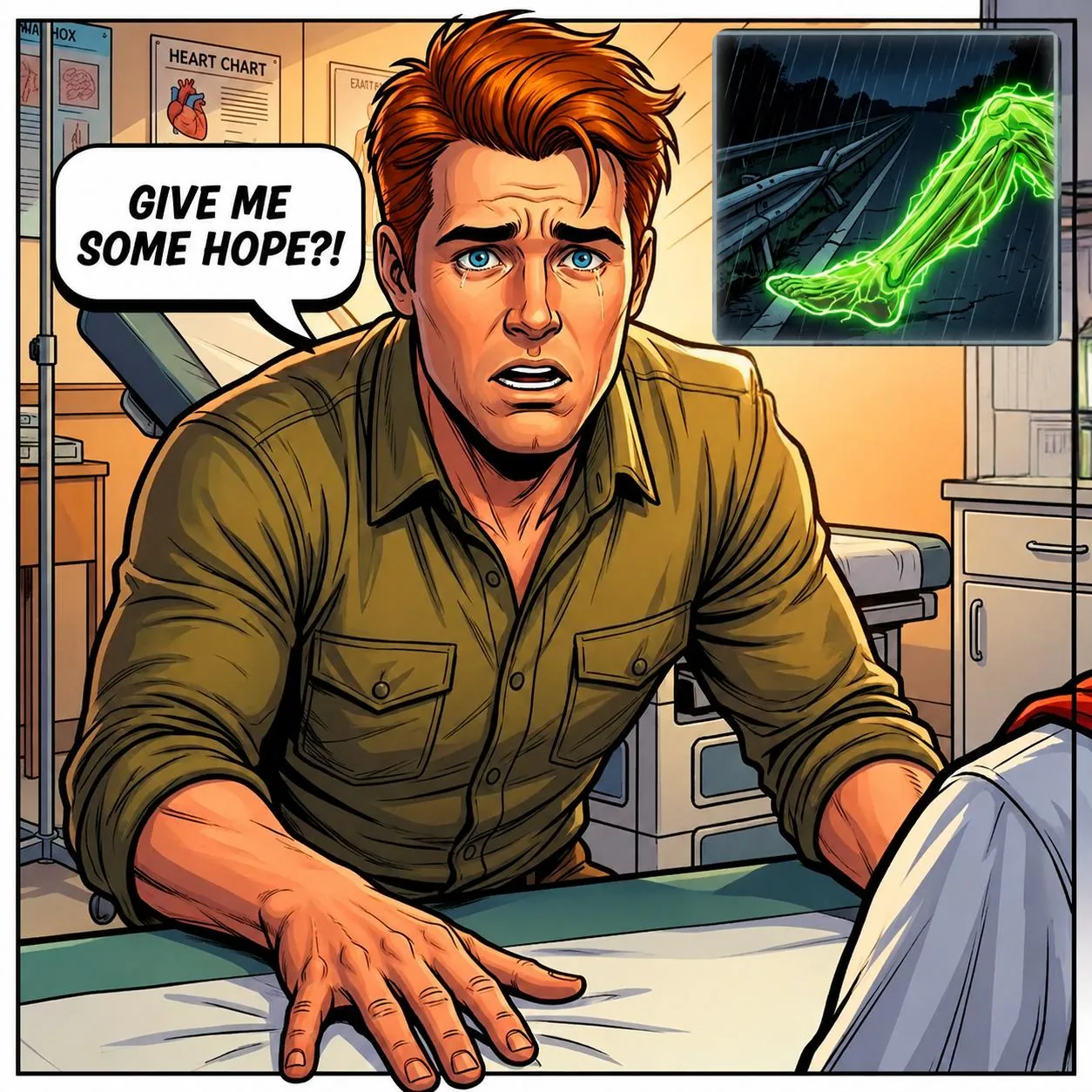
“So show me some empathy, man. Give me some hope.”
Crash looked at him for a long moment.
He thought about the highway. The guardrail. The leg he’d rebuilt in the dark while everyone else was sleeping.
He thought about his father. You are better now.
Then, against his better judgment, he reached for the pen.
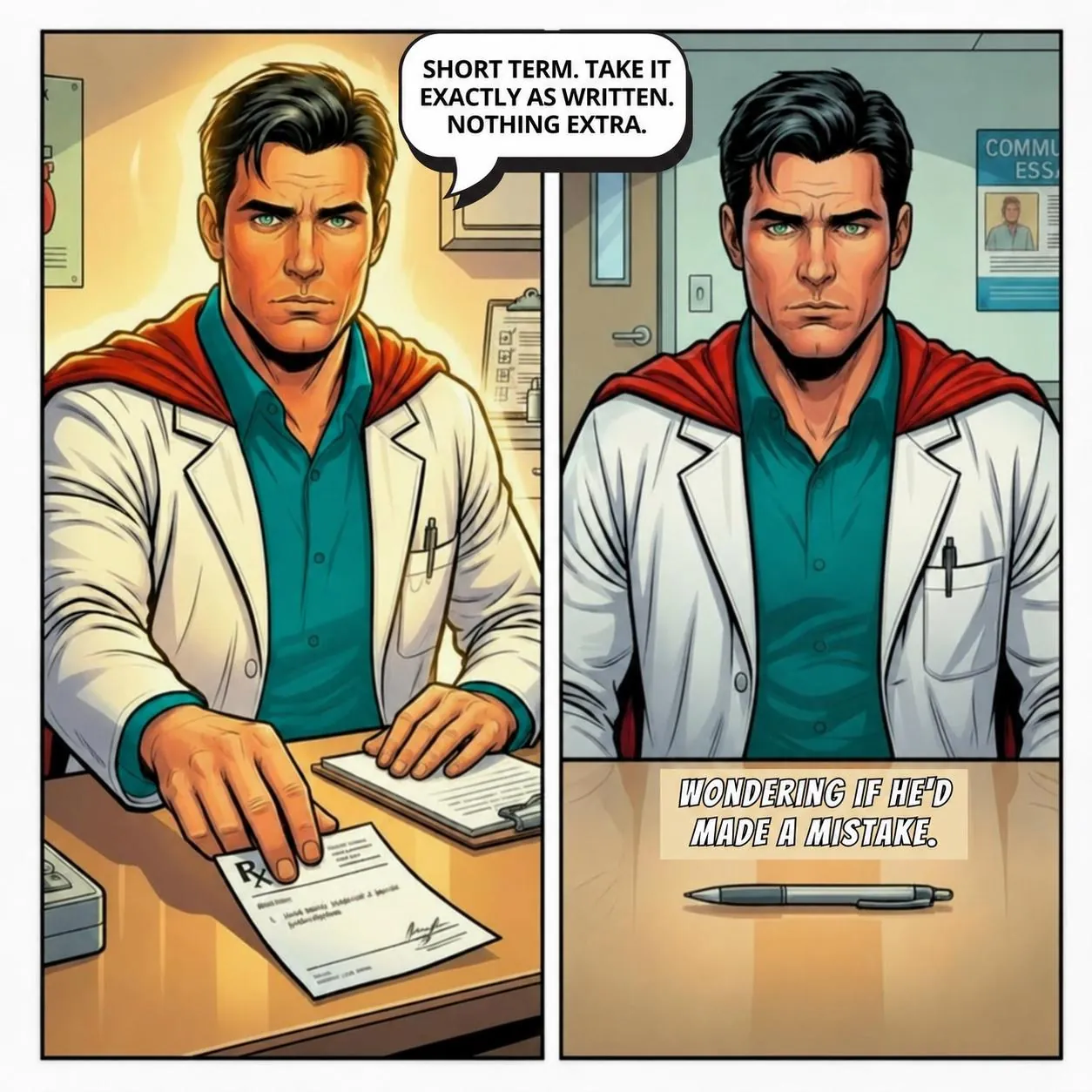
“Short term,” Crash said softly. “We’ll keep it tight. Take it exactly as written. Nothing extra. Don’t mix it with alcohol.”
Donnie nodded fast. “Yeah. Yes.”
“You have some nerve-based pain in that leg,” Crash continued. “We’re going to start some new injections. They’ll calm the nerves down enough that you can push harder in physical therapy. That’s how we get off the pills — not by white-knuckling it.”
Donnie nodded again. Quieter this time.
Crash wrote the prescription.
When he handed it over, his fingers didn’t quite want to let go.
Donnie stood at the door.
“I’m trying,” he said quietly.
“I know.”
The door closed.
Crash looked down at the pen.
Wondering if he’d made a mistake.
The Card
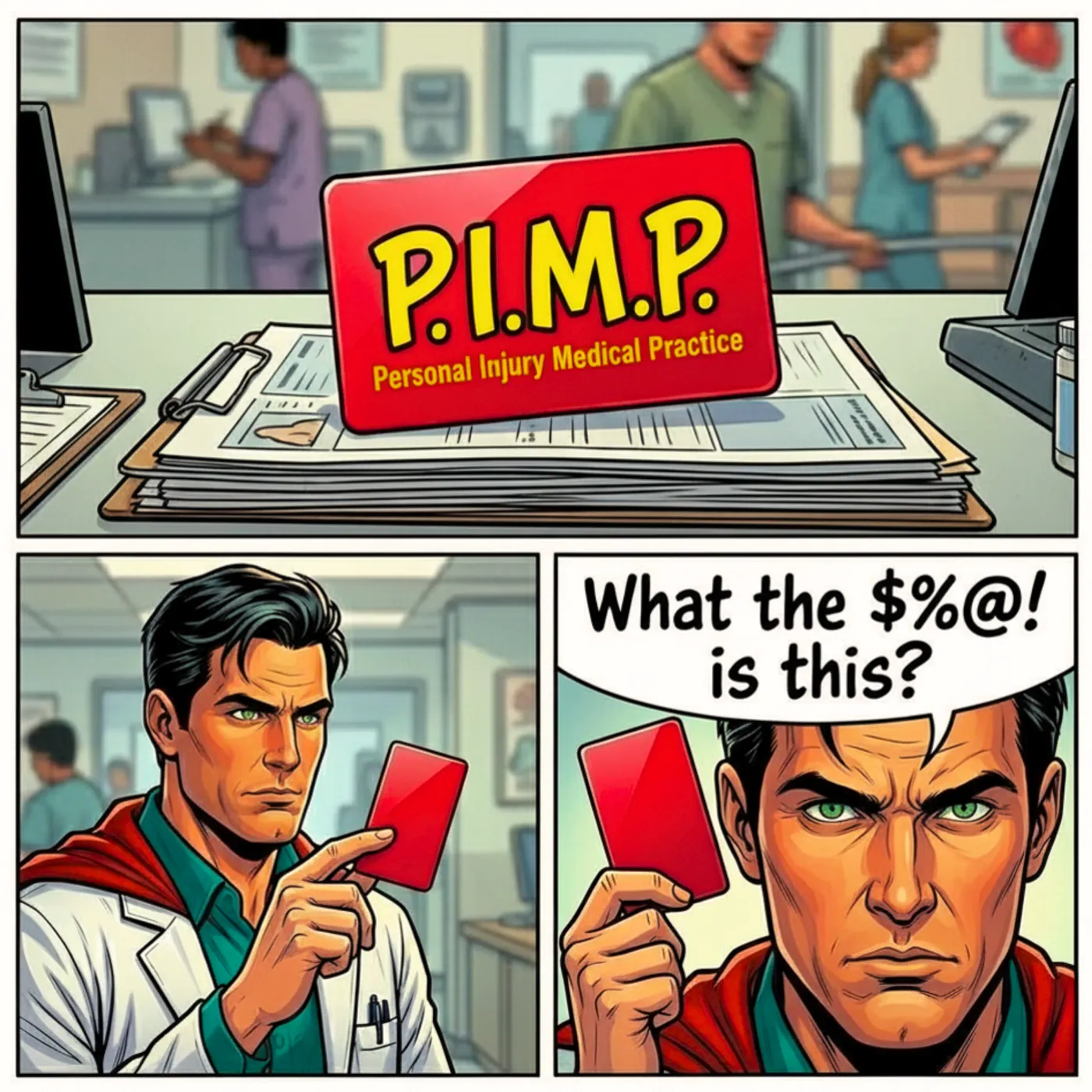
Later that afternoon, Crash walked past the front desk and found a glossy red card sitting on top of the chart pile.
Aggressive font. Bright ink.
P.I.M.P.
He picked it up.
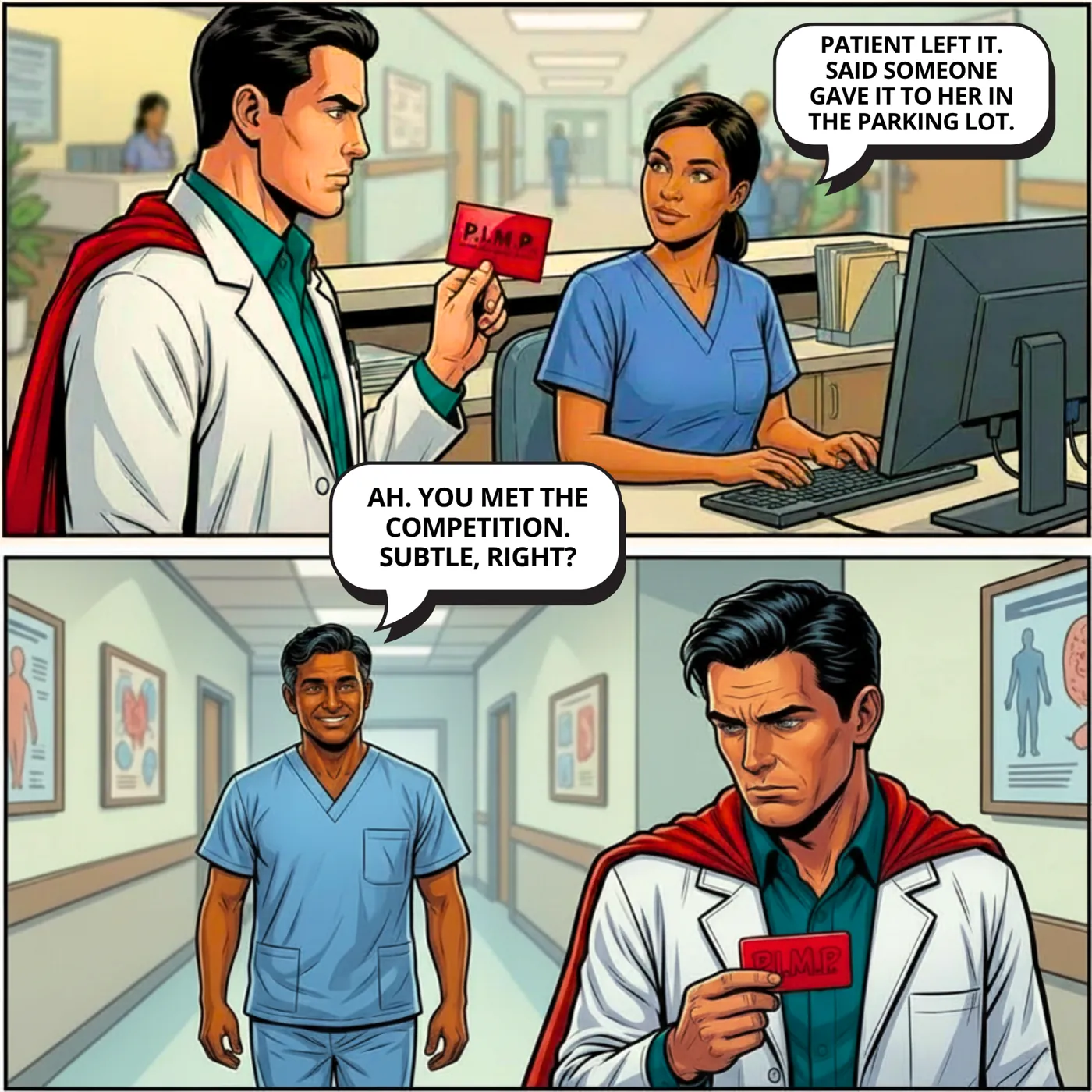
“Patient left it,” the receptionist said. “Said someone gave it to her in the parking lot.”
Crash’s jaw tightened.
Patel came down the hall, saw his face, slowed.
“Ah. You met the competition.”
“Personal Injury Medical Practice,” Crash read flatly.
“I know,” Patel said. “Subtle, right?”
Crash didn’t smile. “Tell me about them.”
Patel leaned against the counter.
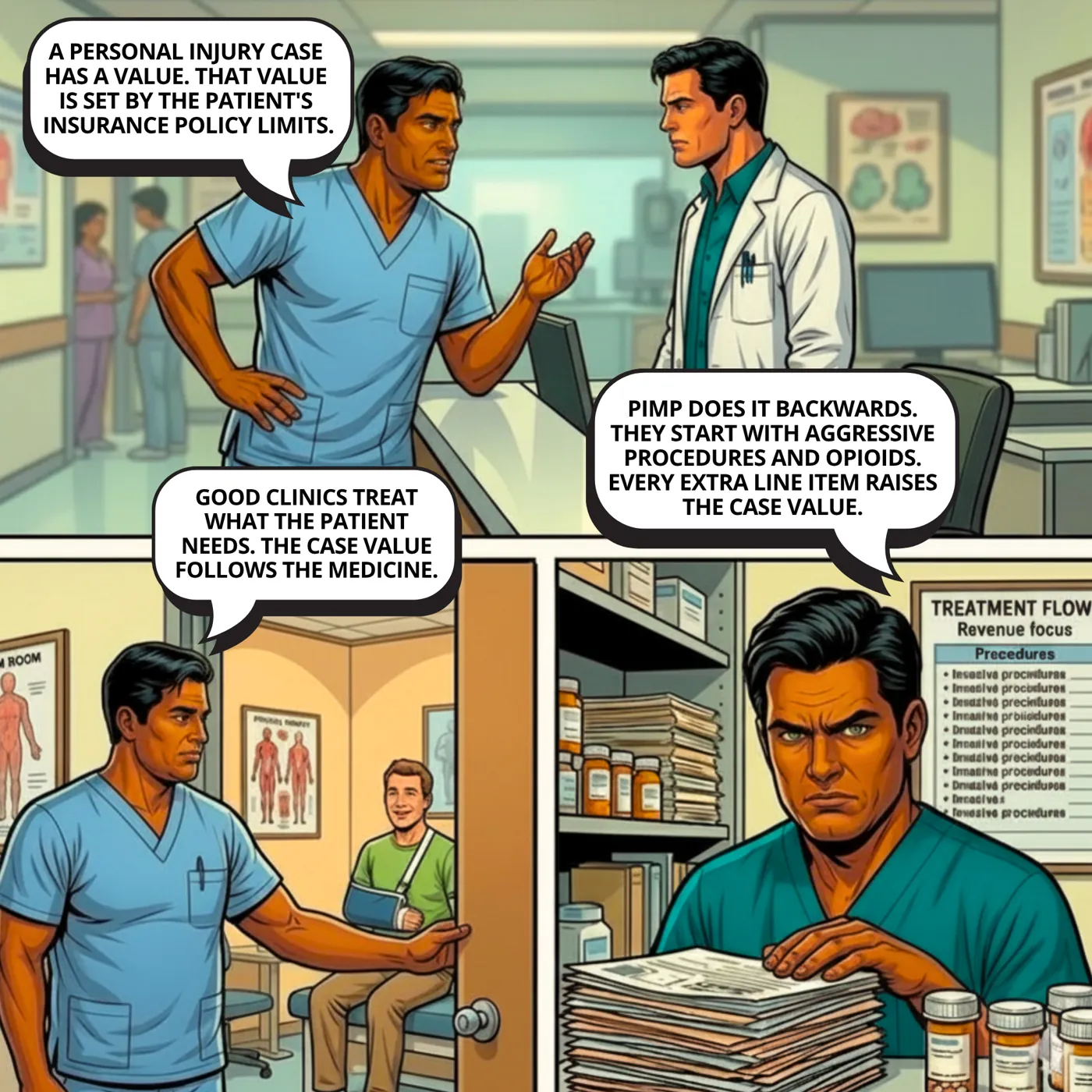
“You’re new to PI, so let me give you the lay of the land. A personal injury case has a value. That value is mostly set by the patient’s insurance policy limits. Big policy, big potential settlement. Small policy, small potential settlement. Most PI doctors figure this out pretty quickly.”
“Go on.”
“Good PI clinics, they keep their head down. Treat what the patient needs. If the patient gets better, great. If they don’t, they keep treating. The case value follows the medicine.”
A beat.
“PIMP does it backwards.”
Crash’s shoulders were already squaring.
“They start with opioids,” Patel continued. “Then they build a treatment plan to match. Injections the patient doesn’t need. Procedures that don’t help. Imaging to pad the chart. Lately they’ve even been handing out strong pain pills to justify the suffering on paper. Every extra line item raises the case value.”
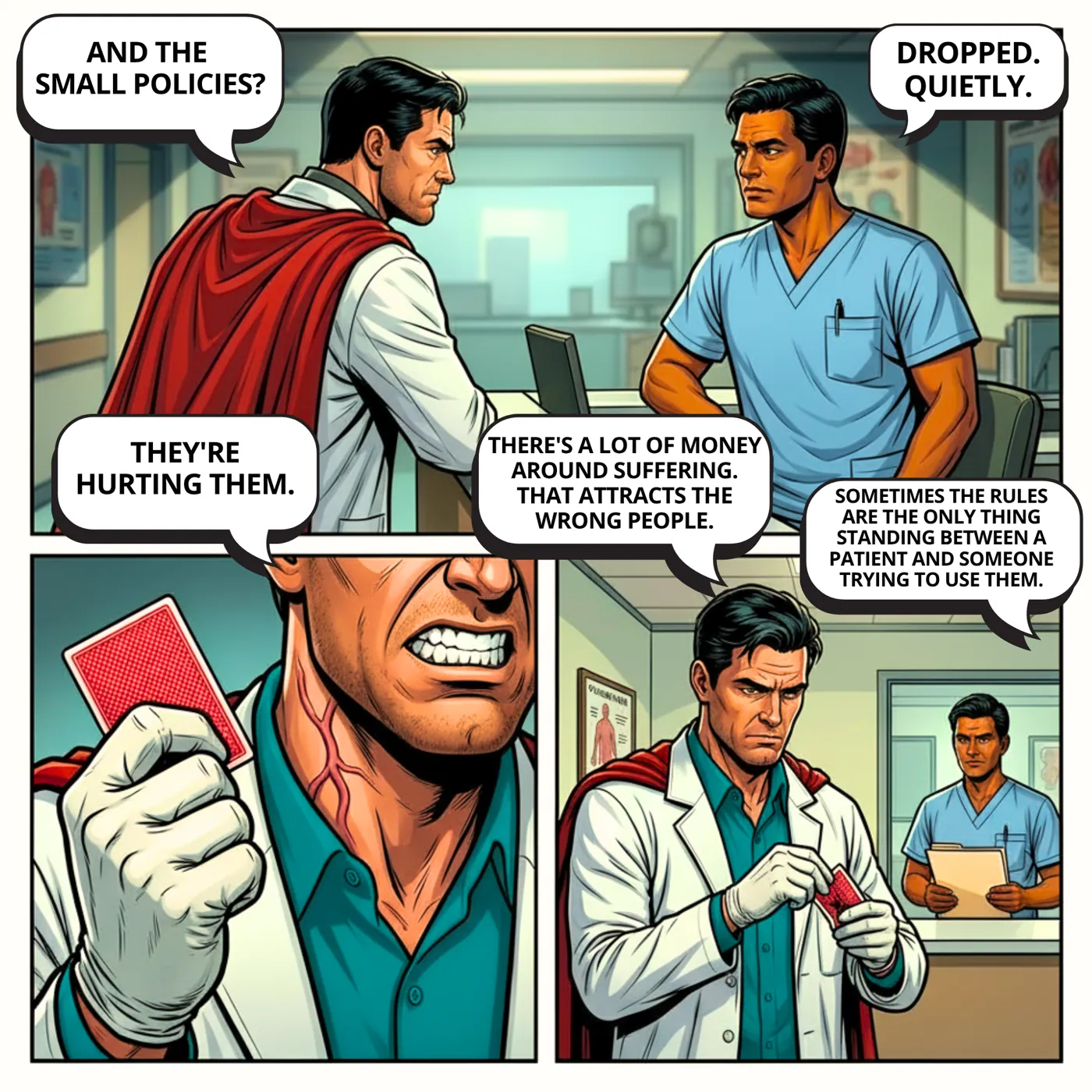
“And the small policies?”
“Get dropped. Quietly. Patient doesn’t get a call back. No referral. Nothing.”
Crash’s hand tightened around the card. The muscles in his forearm stood out. A vein in his neck rose under the skin.
“They’re using them.”
“Yeah.”
“They’re hurting them. Unnecessary injections scar tissue. Unnecessary procedures introduce risk. Those patients leave worse than they came in.”
“I know.”
Crash stared at the card.
Patel watched him.
“That’s the biggest problem in our space, Crash. A lot of patients get over-treated. An equal number get under-treated. And it’s the insurance policy driving both.”
A pause.
“I know you don’t like boundaries. I know you don’t like rules. But sometimes the rules are the only thing standing between a patient and someone trying to use them.”
Crash didn’t answer right away.
“There’s a lot of money around suffering,” he said finally. His voice was lower than it had been all day. “That attracts the wrong people.”
“Yeah. It does.”
Crash folded the card once. Slowly. The paper bent hard.
He put it in his coat pocket.
He wasn’t going to accept this form of medicine.
The Ship
The Vitalis Pod sat half-buried in the red sand where it had landed, dusk bleeding across the hull. Crash had been working on the trans-flux unit for weeks. It was stubborn work. The kind of work that didn’t care how your day had gone.
He lay on his back underneath the core, sleeves rolled up, a diagnostic coupler in one hand.
Vitalis shimmered beside him.
“You are unusually quiet.”
“Long day.”
“You gave opioids to the man from the highway.”
Crash kept his eyes on the coupler. “Yes.”
“Why do you think that was a mistake?”
He paused.
“Something in my gut. The way he was taking the pills too fast. Something in his eyes when he was asking for them. Like he already had an answer in mind and was just waiting for me to match it.”
“And you matched it.”
“I did.”
A beat.
“You are quiet about the attorney, too.”
“She asked me out.”
“How did that make you feel?”
Crash set the coupler down on his chest and stared up at the underside of the ship.
“I can’t do it.”
“Crashton. It has been almost two years.”
“I know.”
“It might be time.”
He was silent for a long moment.
Then:
“My wife is dead.”
“Crashton—”
“I don’t want to talk about it.”
He reached over and turned up the scanner.
Static crackled through the desert air.
He had hated the bureaucracy. He still did.
But today he had seen what could happen when the bureaucracy stepped back. When nothing stood between a patient and a doctor willing to exploit them.
The rules had been maddening.
The rules had also been a wall.
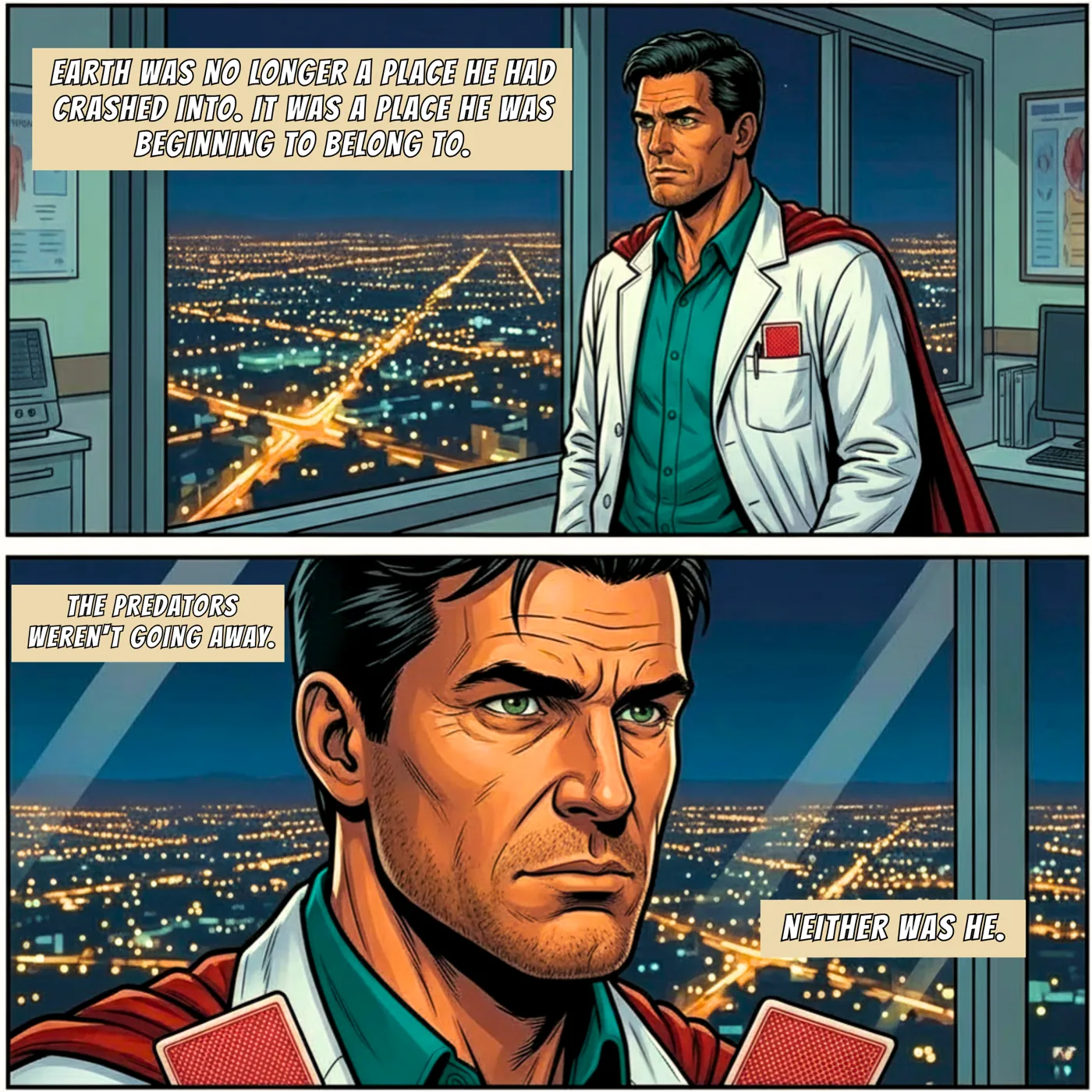
He thought about Cindy, trusting him with her mother. He thought about Donnie, trusting him with his pain. Earth was no longer a place he had crashed into.
It was a place he was beginning to belong to.
The predators weren’t going away.
Neither was he.
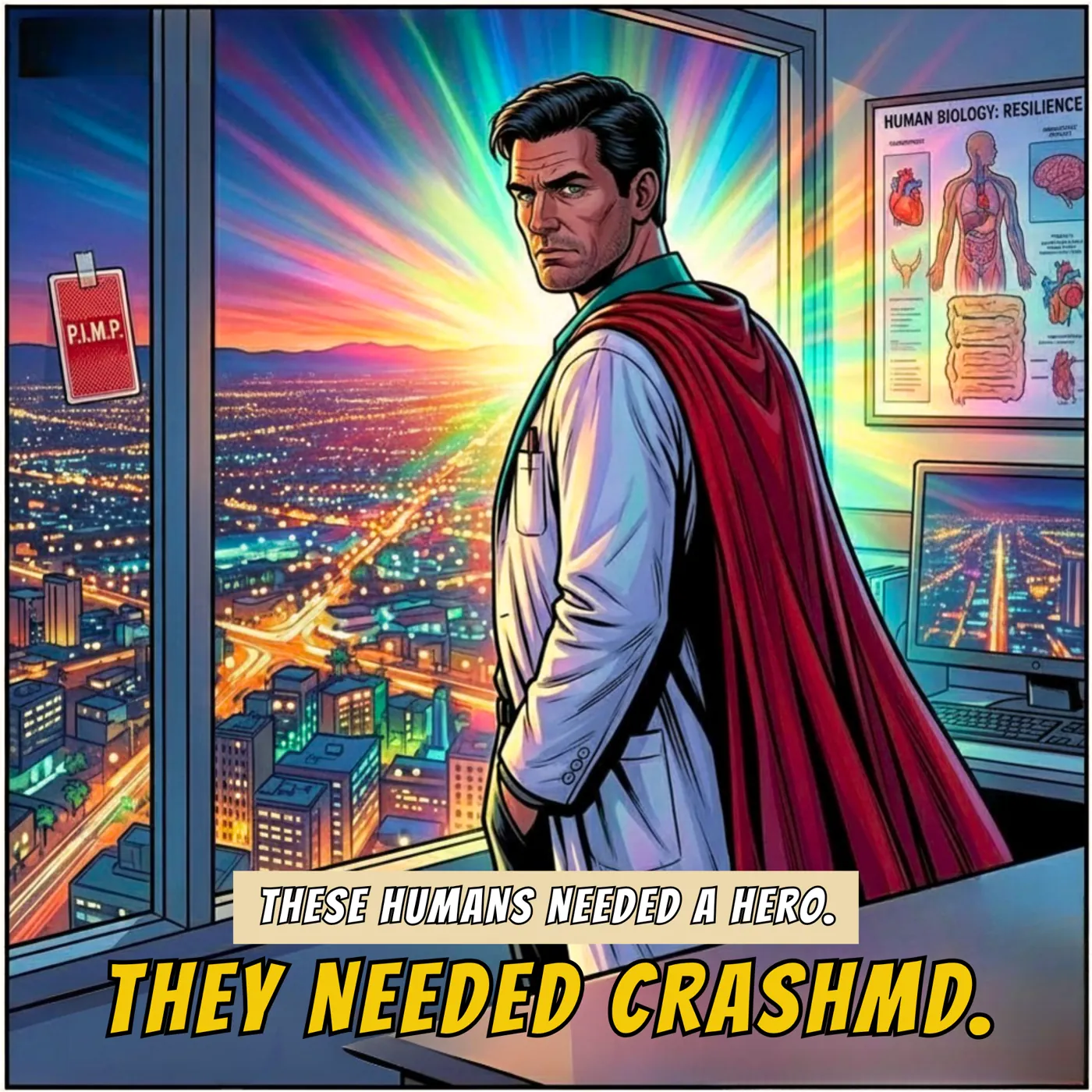
These patients needed an advocate.
The system was so broken, they needed a superhero.
They needed CrashMD.