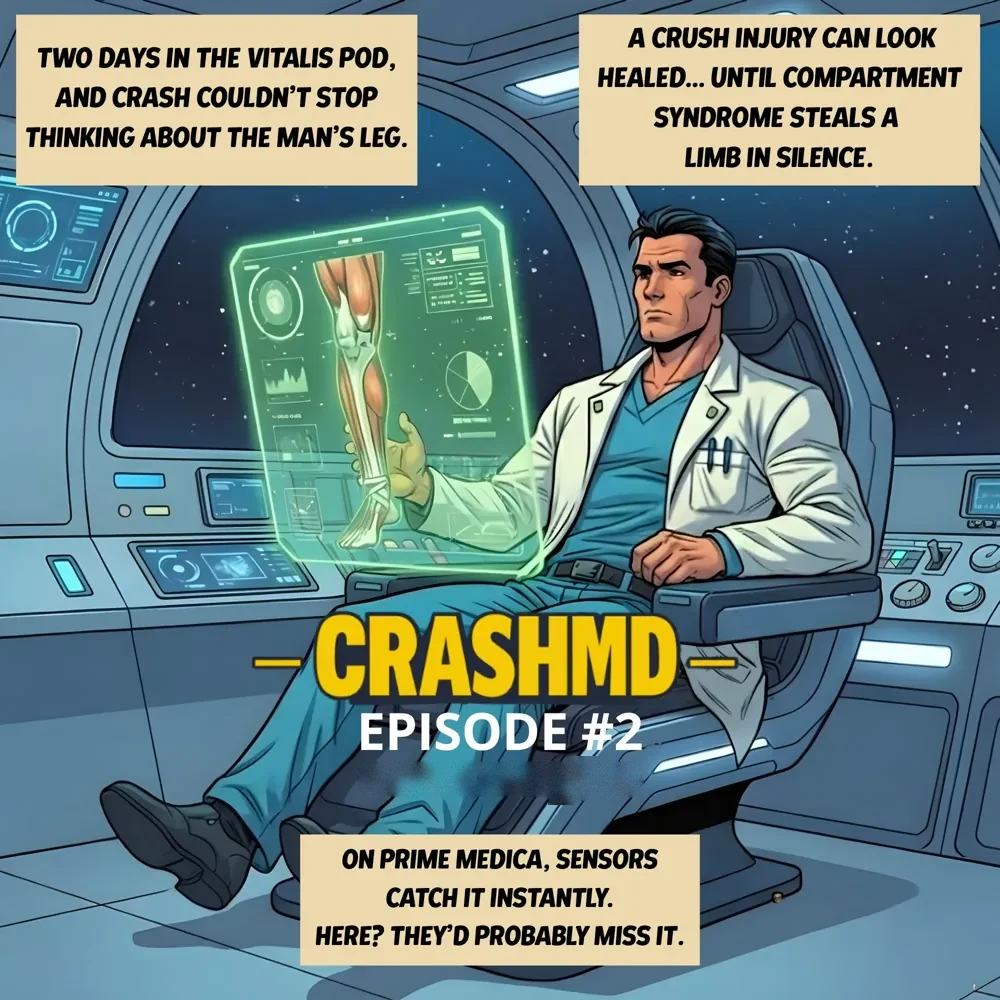
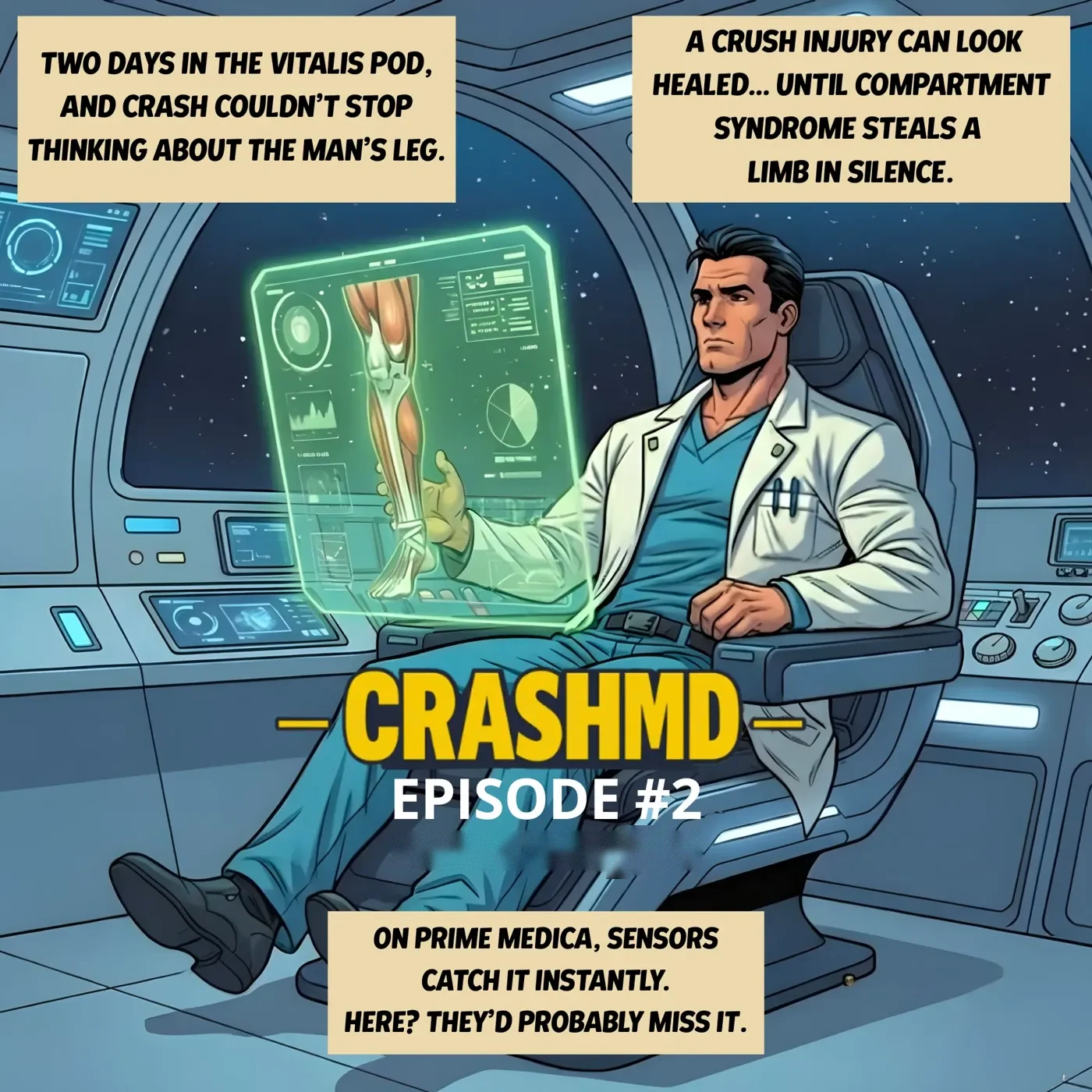
Two days in the Vitalis Pod, and Crashton couldn’t stop thinking about the man’s leg.
The woman from the crash had been stable when the ambulances took her. But the man—the one pinned under the guardrail, the one whose leg he’d rebuilt with Regenerus—something about his injury pattern kept nagging at him.
Crush injury. Significant tissue damage. Blood flow restored, but…
Compartment syndrome. The pressure builds slowly, silently, cutting off circulation even after the initial injury is healed. On Prime Medica, they’d have sensors monitoring for it. Here?
Here, they’d probably miss it until it was too late.
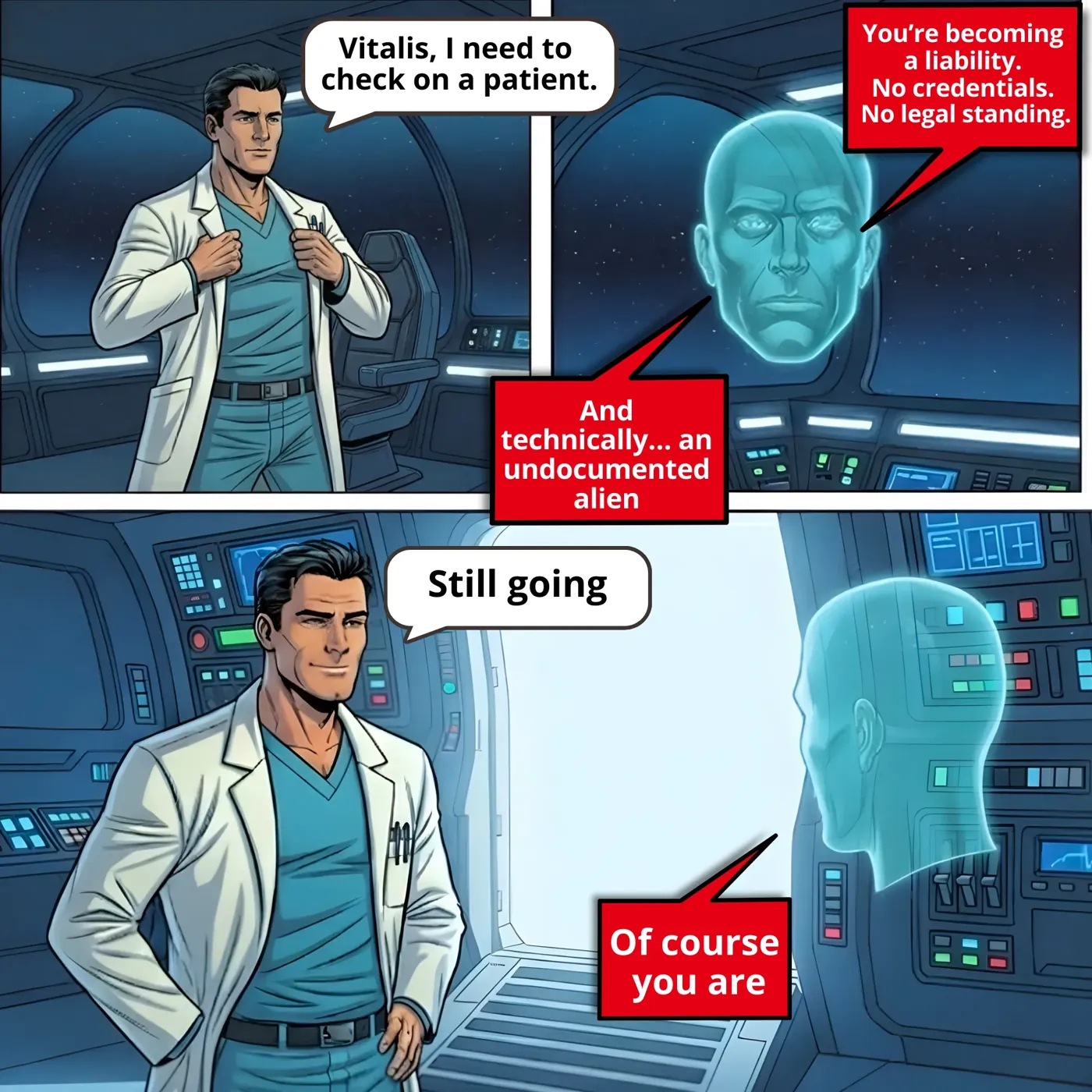
“Vitalis, I need to check on a patient.”
“Doctor, you’re becoming more of a liability than I anticipated,” the AI replied, her voice smooth and sardonic. “You have no credentials, no legal standing, and—may I remind you—are technically an undocumented alien.”
Crashton almost smiled at that. “Noted. Still going.”
“Of course you are.”
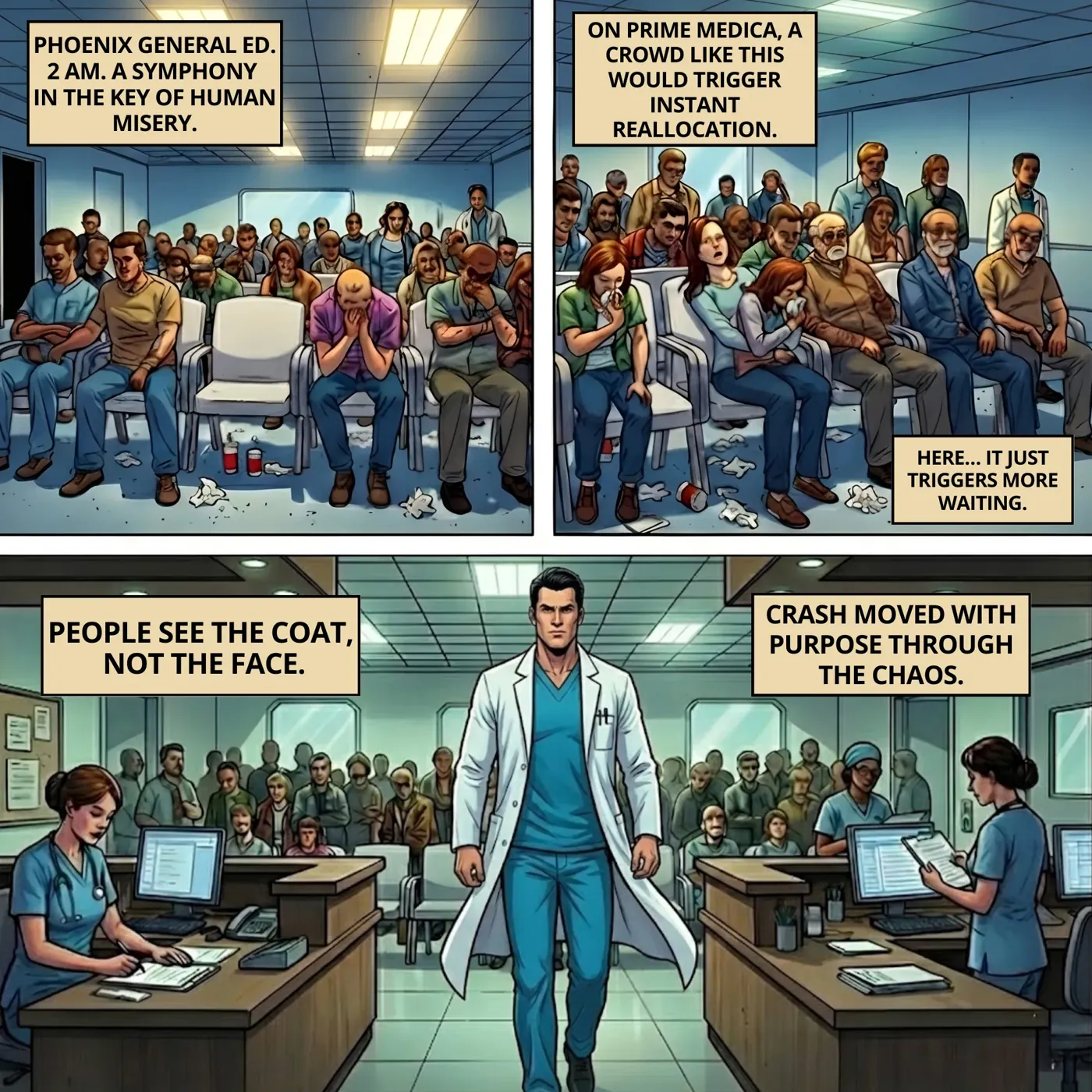
The Phoenix General Emergency Department at 2 AM was a symphony in the key of human misery.
Crashton stood just outside the sliding doors, watching through glass. Fluorescent lights. Plastic chairs bolted to the floor. A TV playing the kind of late-night programming that constitutes psychological warfare. And people—so many people—slumped in various states of waiting, bleeding, or both.
On Prime Medica, an ED this crowded would trigger automatic resource reallocation. Here, it just triggered more waiting.
He walked through the doors.
No one stopped him. The white coat helped—people see the costume, not the face. He’d learned that on Prime Medica, where physicians wore their credentials like armor.
He moved through the ED with the particular confidence of someone who knows exactly where they’re going, even when they don’t. Past triage. Past the nurses’ station, where three RNs argued about bed assignments while a phone rang unanswered.
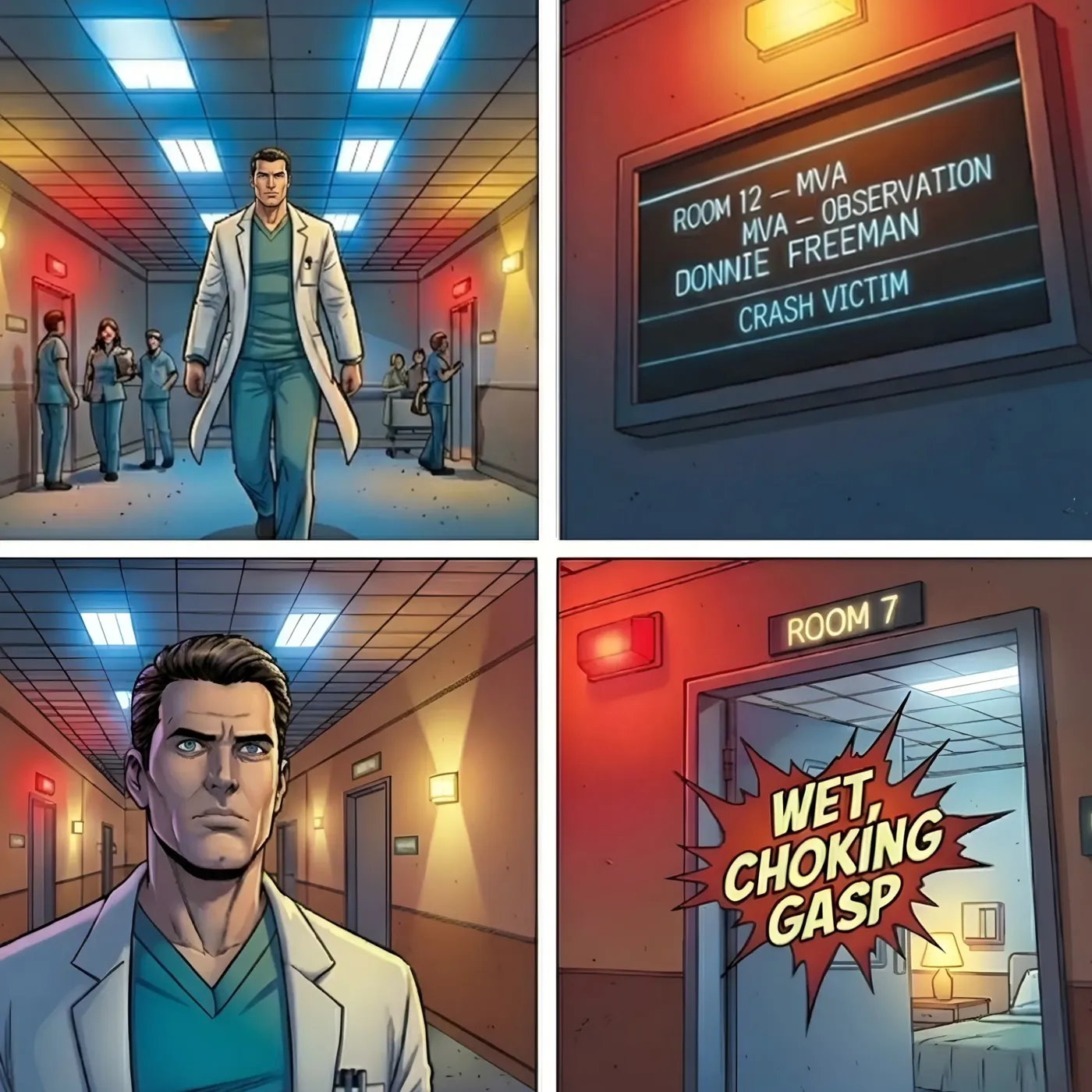
He scanned the patient board. Looked for the timestamp, the injury type. There—Room 12. Male, 30s, motor vehicle accident, admitted for observation.
Donnie Freeman.
That had to be him.
He turned. A man in his fifties, gray-haired and sturdy, wearing navy scrubs and pushing a mop bucket with the weary authority of someone who’d been doing it for decades. His name tag read: LUIS – EVS.
Environmental Services. The people who see everything and say nothing.
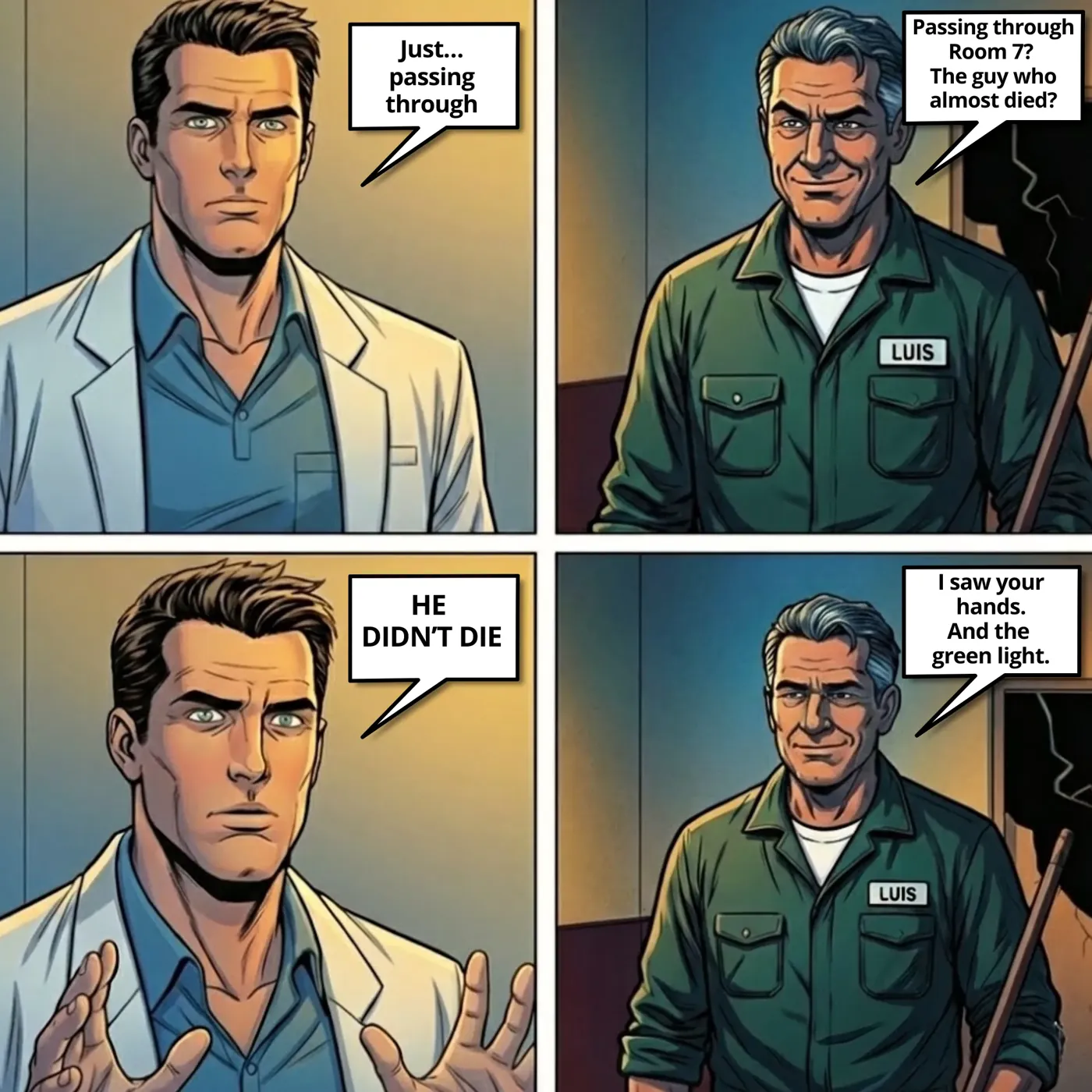
“Just passing through,” Crashton said carefully.
Luis smiled—the kind of smile that said I know exactly what you are, and you’re terrible at hiding it.
“Passing through Room 7? Where that guy was about to die?”
“He didn’t die.”
“No,” Luis agreed. “He didn’t. Funny thing—I was cleaning the hallway. Saw the whole thing through the window. Saw you put your hands on him. Saw the light.”
Crashton’s pulse kicked up.
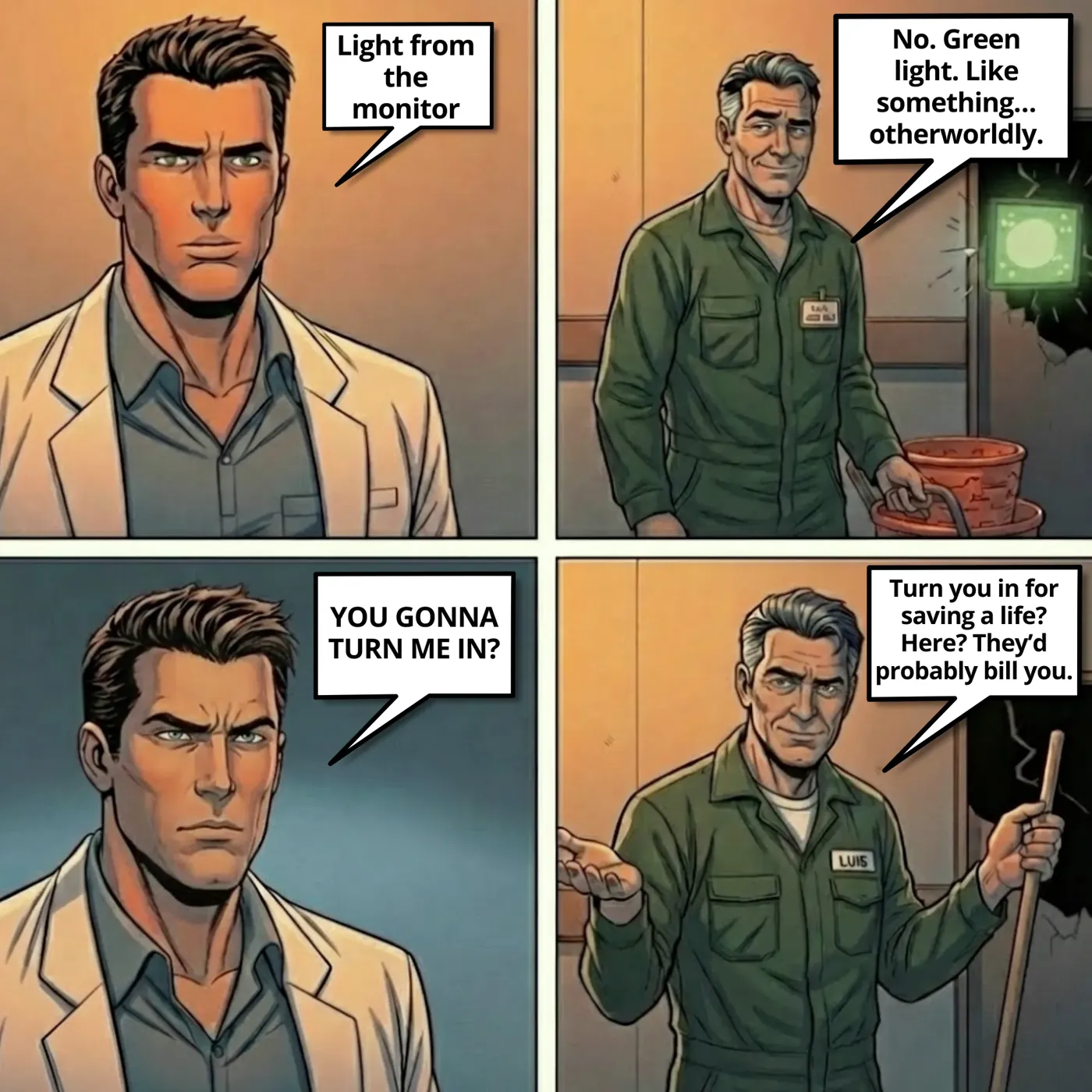
“The light from the monitor. Reflects off—”
“Green light,” Luis interrupted. “From your hands.” He paused, studying Crashton’s face.
“Like something… otherworldly.”
Silence stretched between them, broken only by the distant beep of monitors and someone yelling about discharge paperwork.
“You gonna turn me in?” Crashton asked.
Luis leaned on his mop. “Turn you in for what? Saving a life? In this hospital?” He laughed, short and bitter. “They’d probably bill you for unauthorized use of clinical space.”
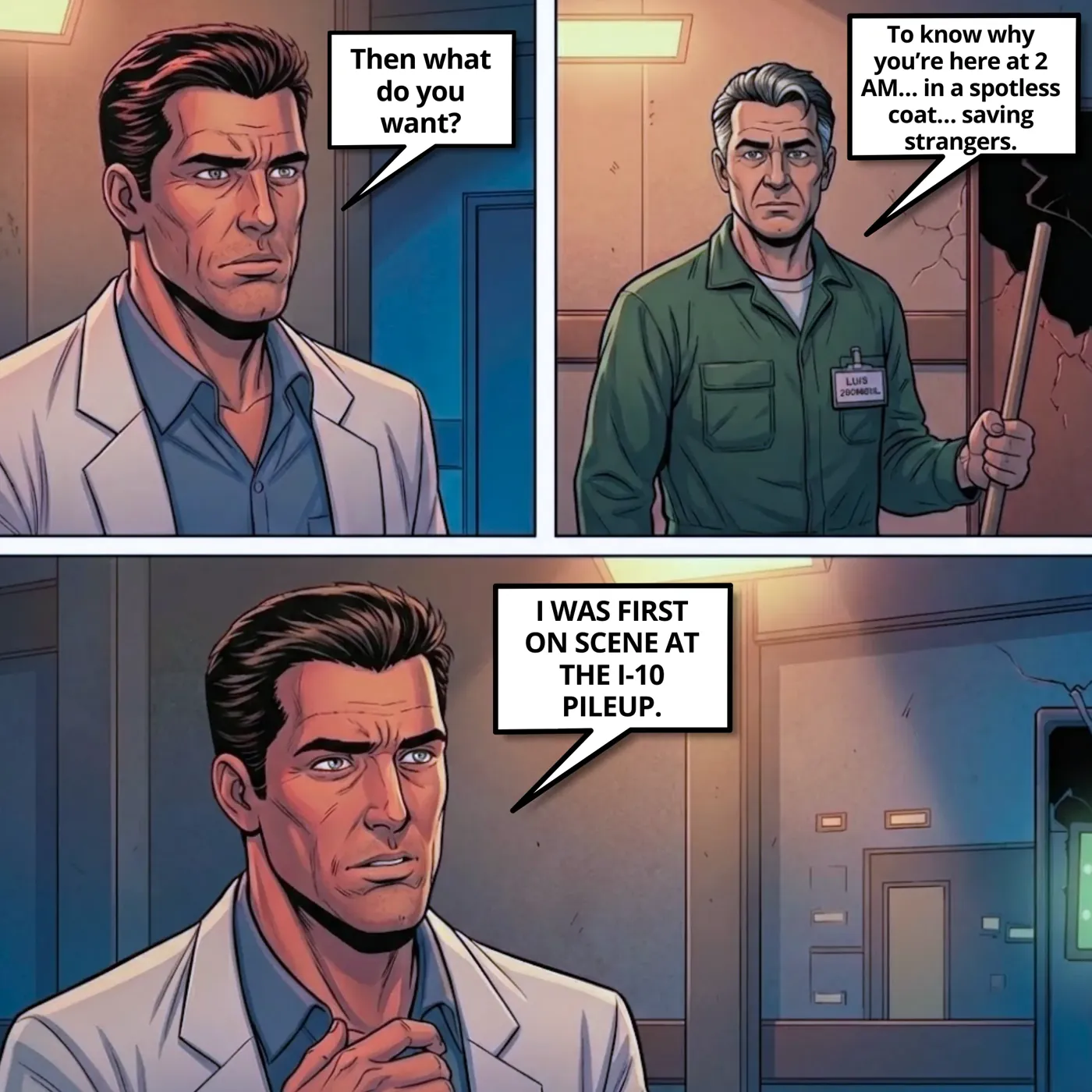
“Then what do you want?”
“Want?” Luis tilted his head. “I want to know why you’re here at 2 AM, saving lives in a white coat that’s too clean to belong to anyone who actually works here.”
Crashton hesitated. “I’m checking on a patient. From a car accident two days ago. I was… first on scene.”
“The I-10 pileup?”
“Yes.”
Luis’s expression shifted.
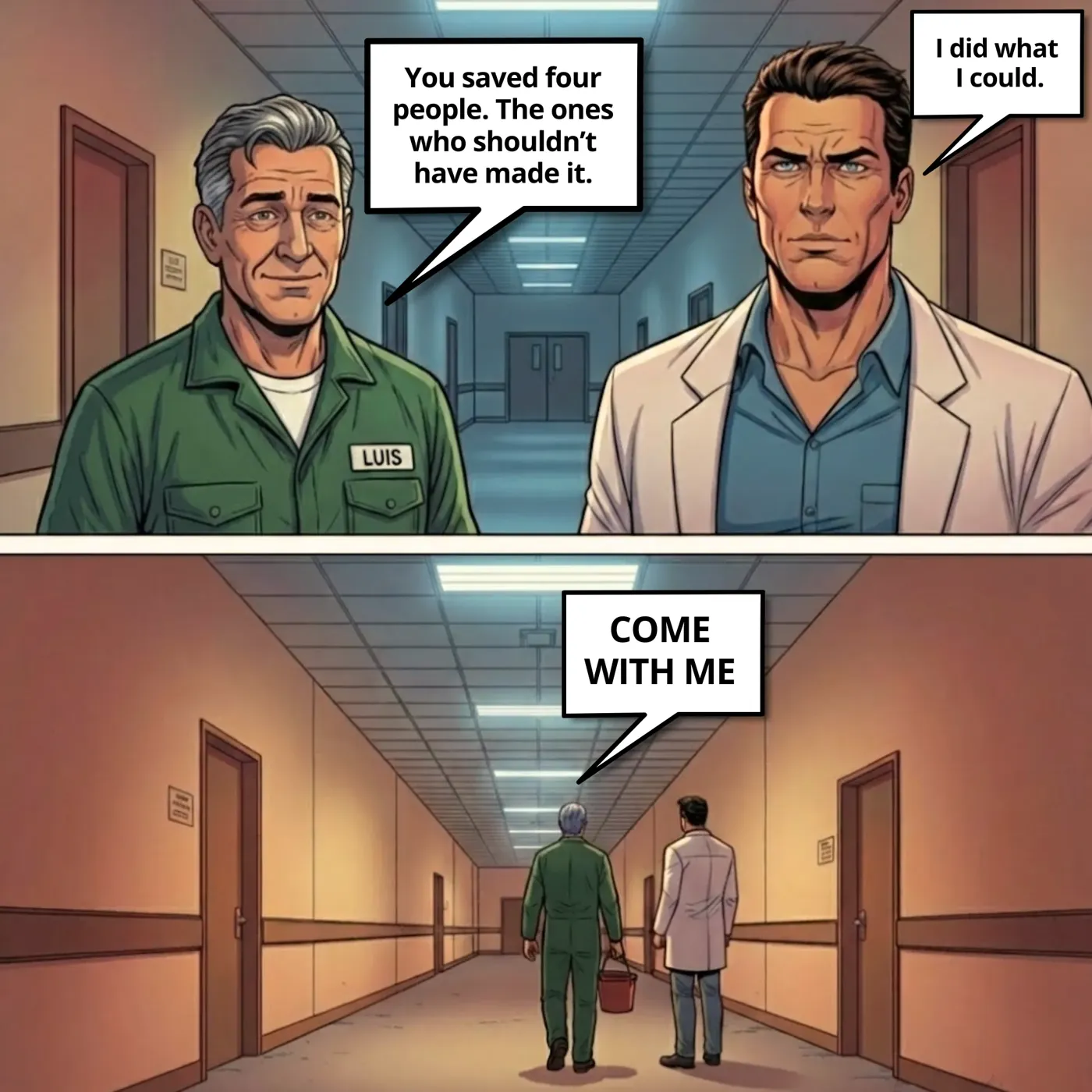
“You saved those people. The ones who shouldn’t have made it.” It wasn’t a question.
Crashton said nothing.
“And now you’re back,” Luis continued, “to check on them. To make sure they’re okay.” He studied Crashton’s face. “When’s the last time a doctor did that?”
“I don’t know. I’m not from here.”
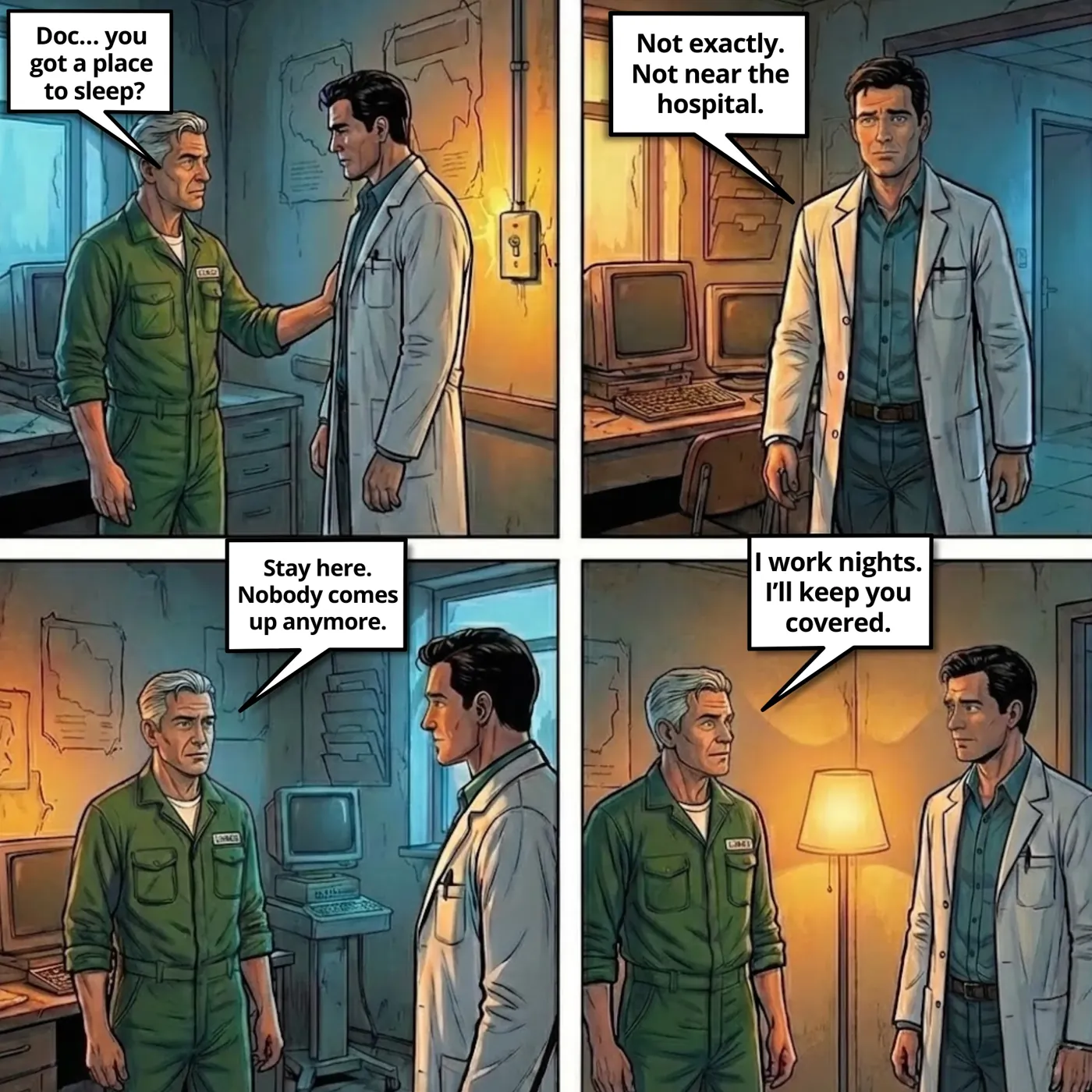
“I can tell.” Luis was quiet for a moment, making some decision. “You got a place to stay?”
“I’m… between situations.”
“Thought so.” Luis gestured down the hallway with his mop. “Come on. I’ll show you something.”
Luis was quiet for a moment.
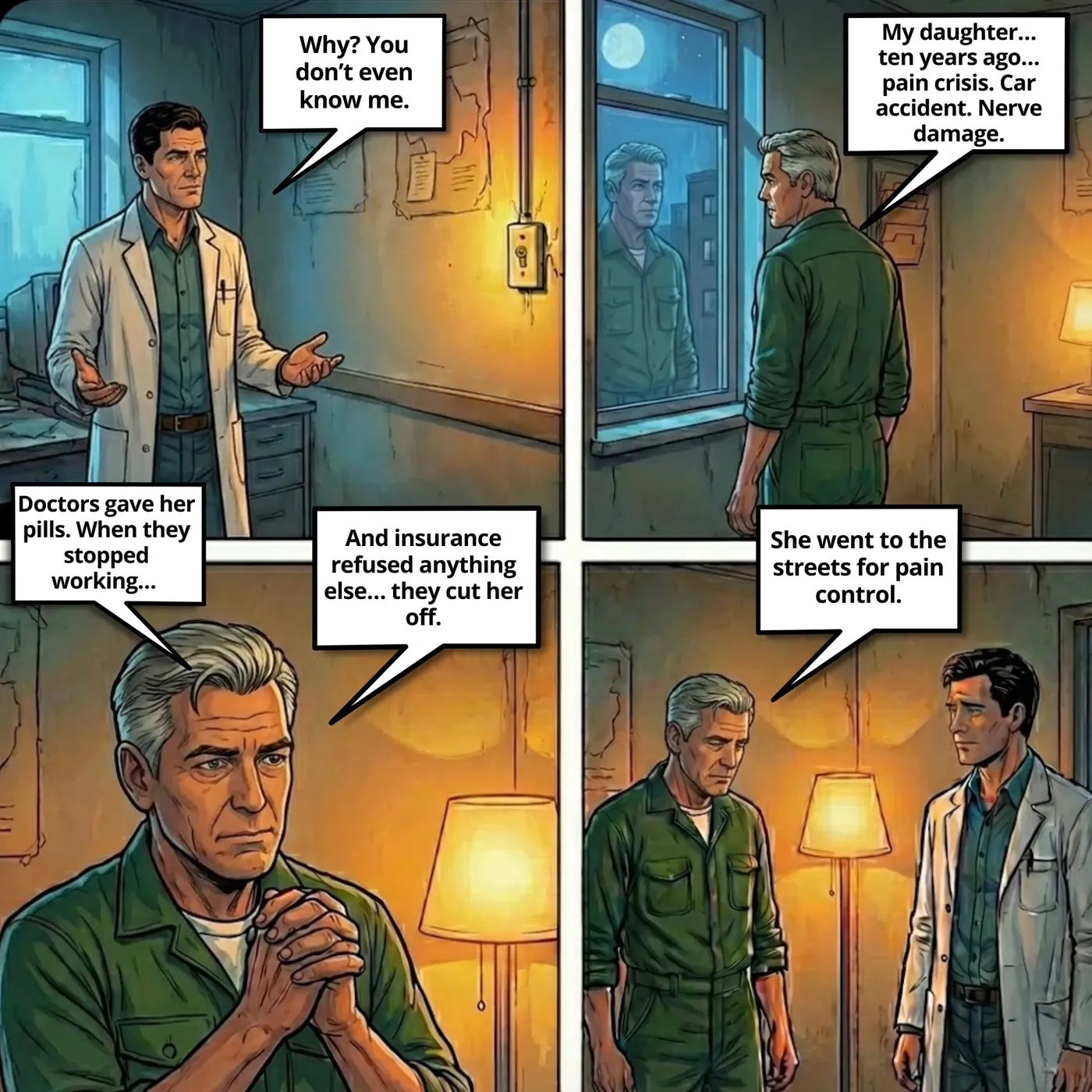
“Ten years ago, my daughter had a pain crisis. Car accident, nerve damage. She was seventeen. Doctors gave her pills—oxy, morphine, whatever. When those stopped working and insurance wouldn’t cover anything else, they just… cut her off. Said she was ‘drug-seeking.’” His voice hardened.
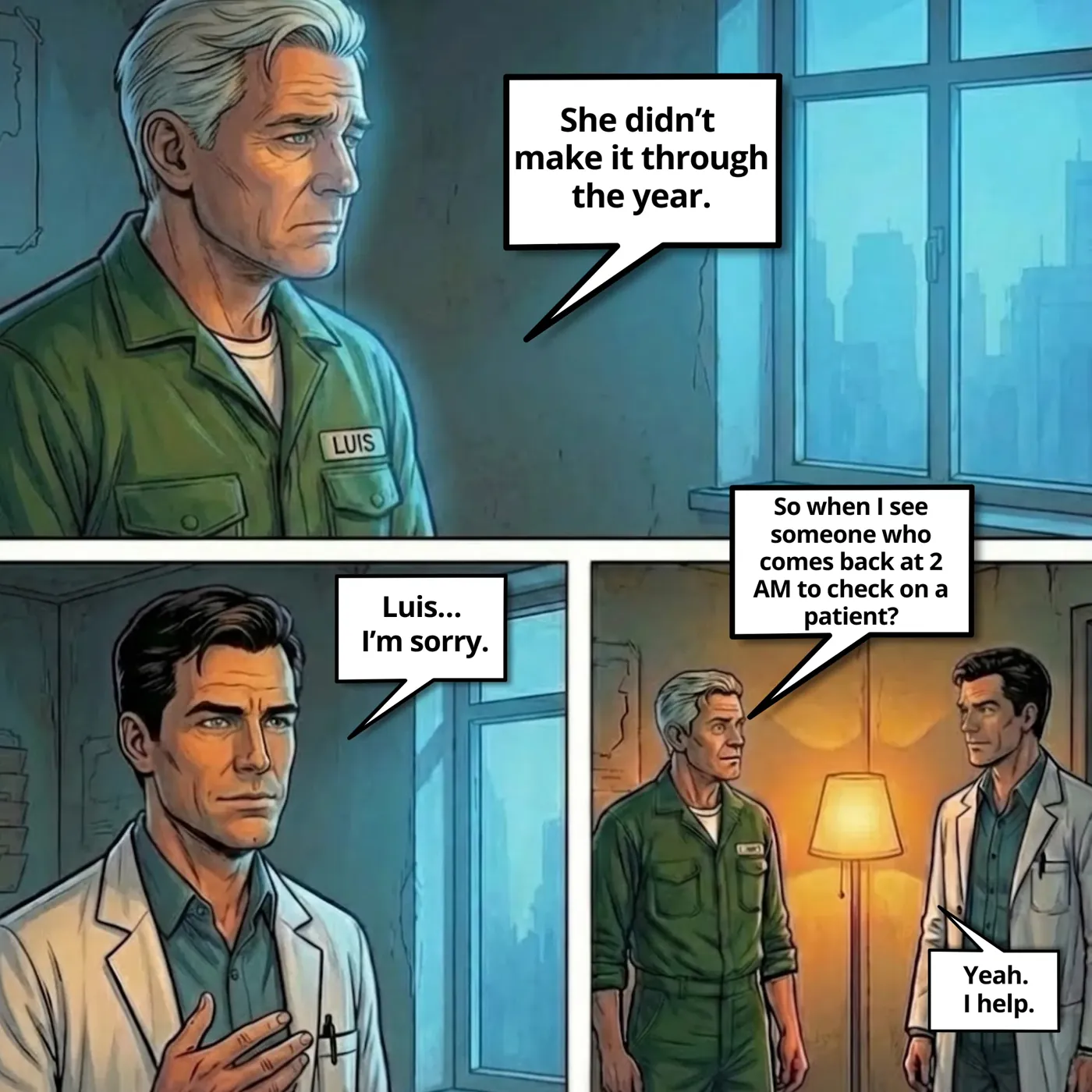
“She didn’t even make it through the year. Overdose.”
Silence filled the room like water.
“The system didn’t kill her,” Luis continued. “But it sure as hell didn’t save her. So when I see someone who actually cares enough to come back at 2 AM to check on a patient?”
He met Crashton’s eyes. “Yeah. I help.”
Crashton swallowed. “I’m sorry. About your daughter.”
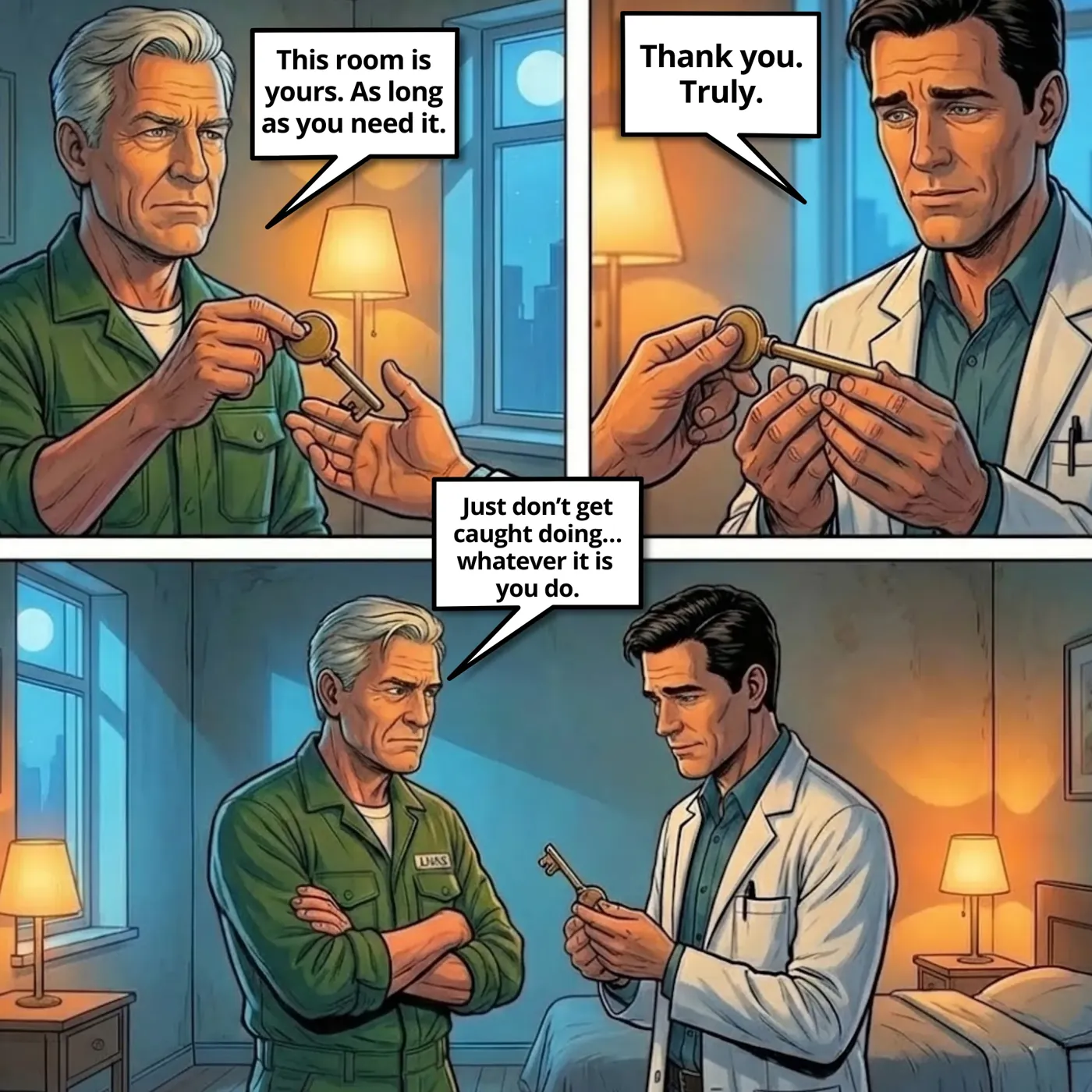
“Me too.” Luis handed him the key. “Stay as long as you need. Just don’t get caught doing… whatever it is you do. Because if administration finds out, they won’t call you a miracle worker. They’ll call you a liability.”
“Understood.”
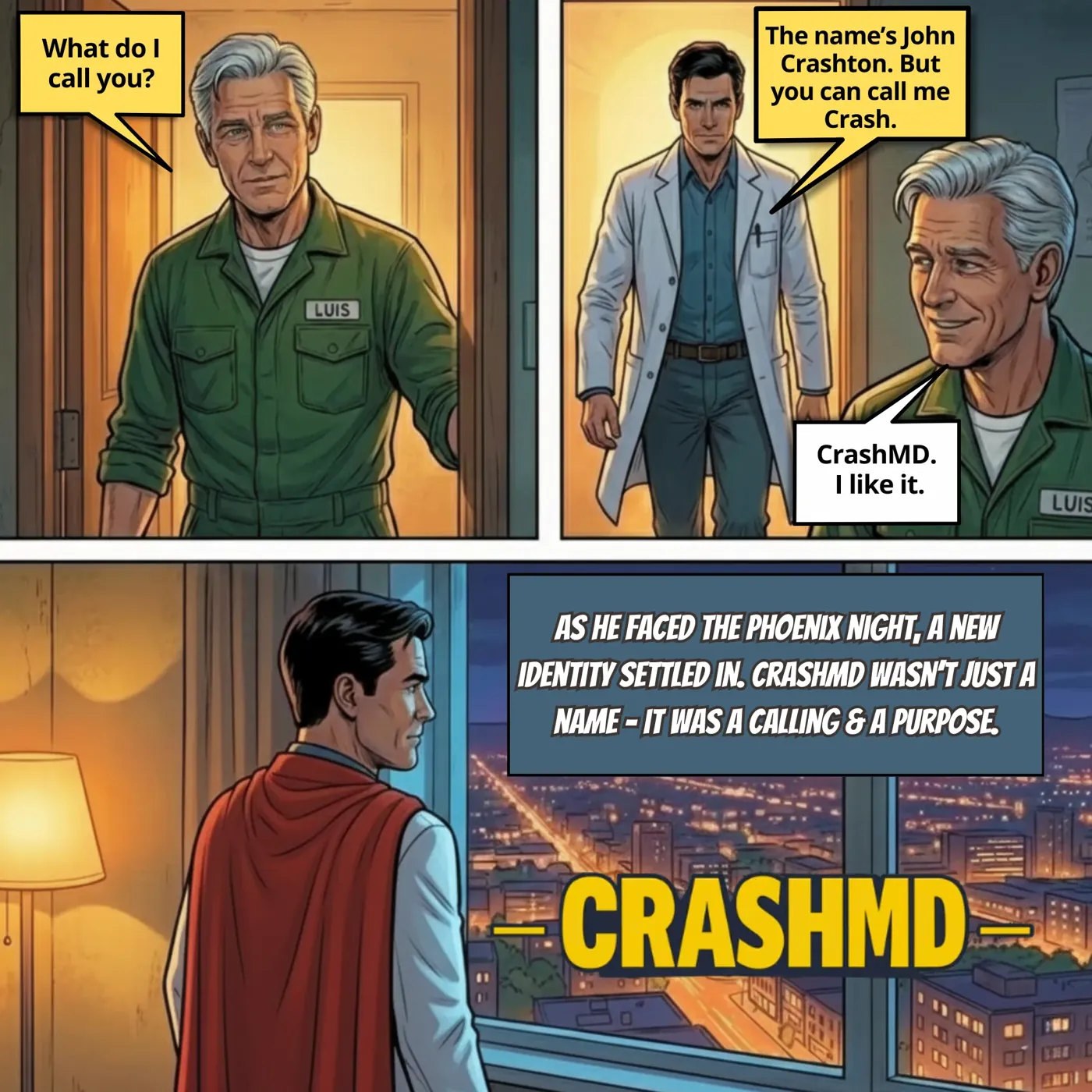
Luis turned to leave, then paused. “One more thing. What do I call you?”
Crashton hesitated. “Crashton. You know what? Just call me Crash.”
Luis smiled slightly. “Crash, huh? Fitting.” He nodded. “CrashMD. I like it.”
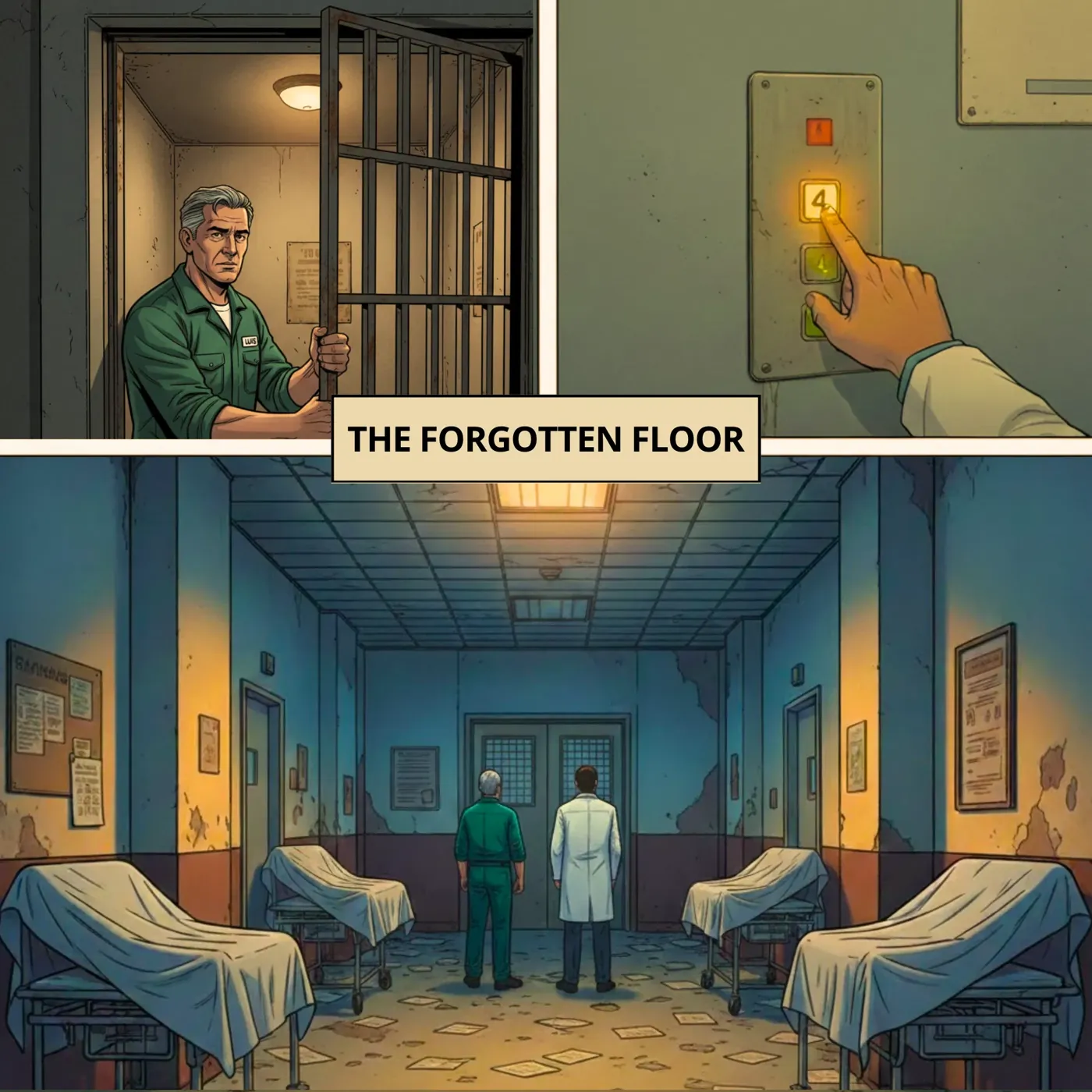
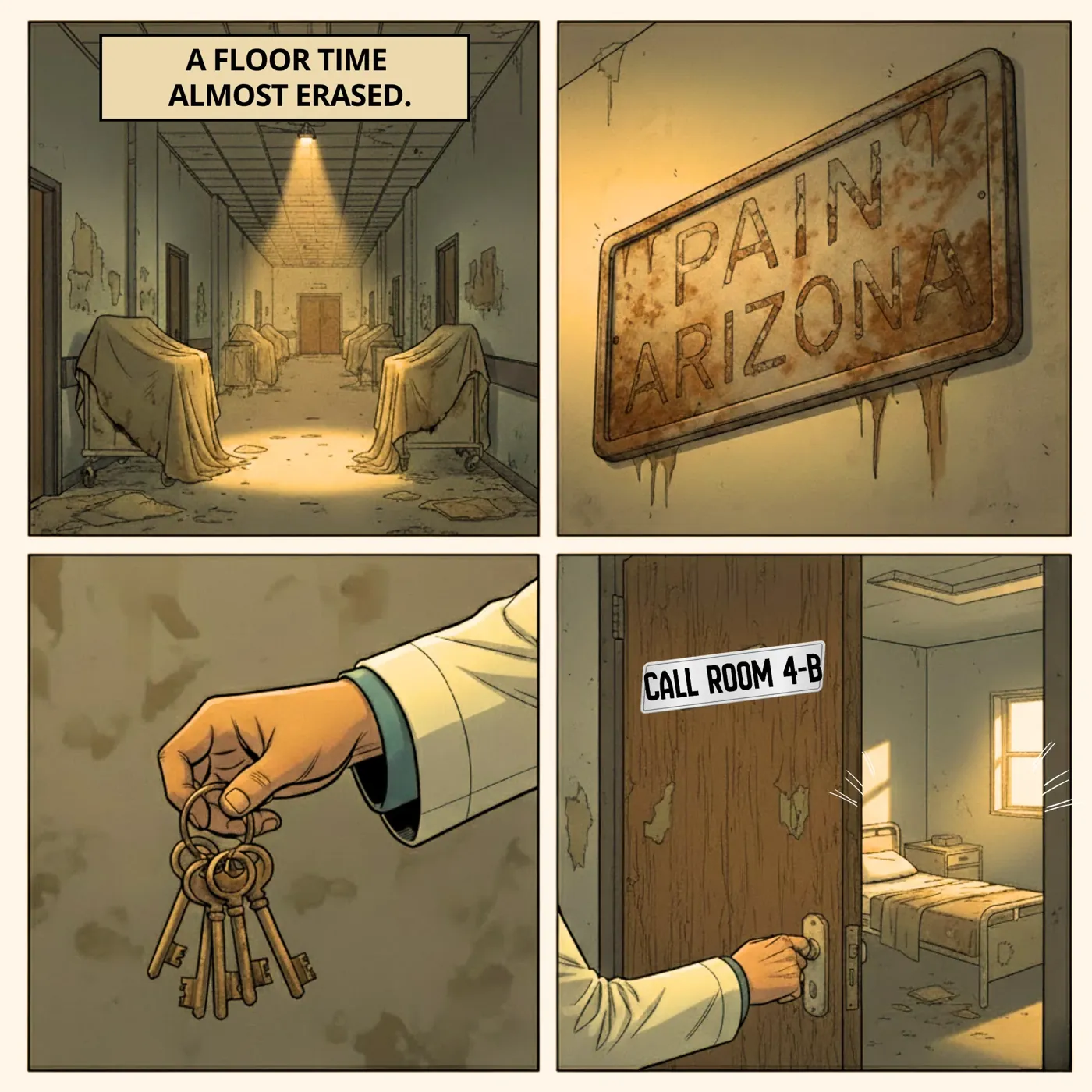
They took the service elevator to the fourth floor—the forgotten floor, according to the layer of dust on the buttons. The hallway lights were half-dead, flickering like dying stars.
Luis led him past empty offices with stripped nameplates, past a nurses’ station where the computers were covered in plastic sheeting, to a door marked CALL ROOM 4-B.
He pulled out a keyring that could’ve opened half the locks in Phoenix and selected one. The door opened with a creak.
Inside: a twin bed with a bare mattress, a small desk, a window overlooking the parking lot. Spartan. Forgotten. Perfect.
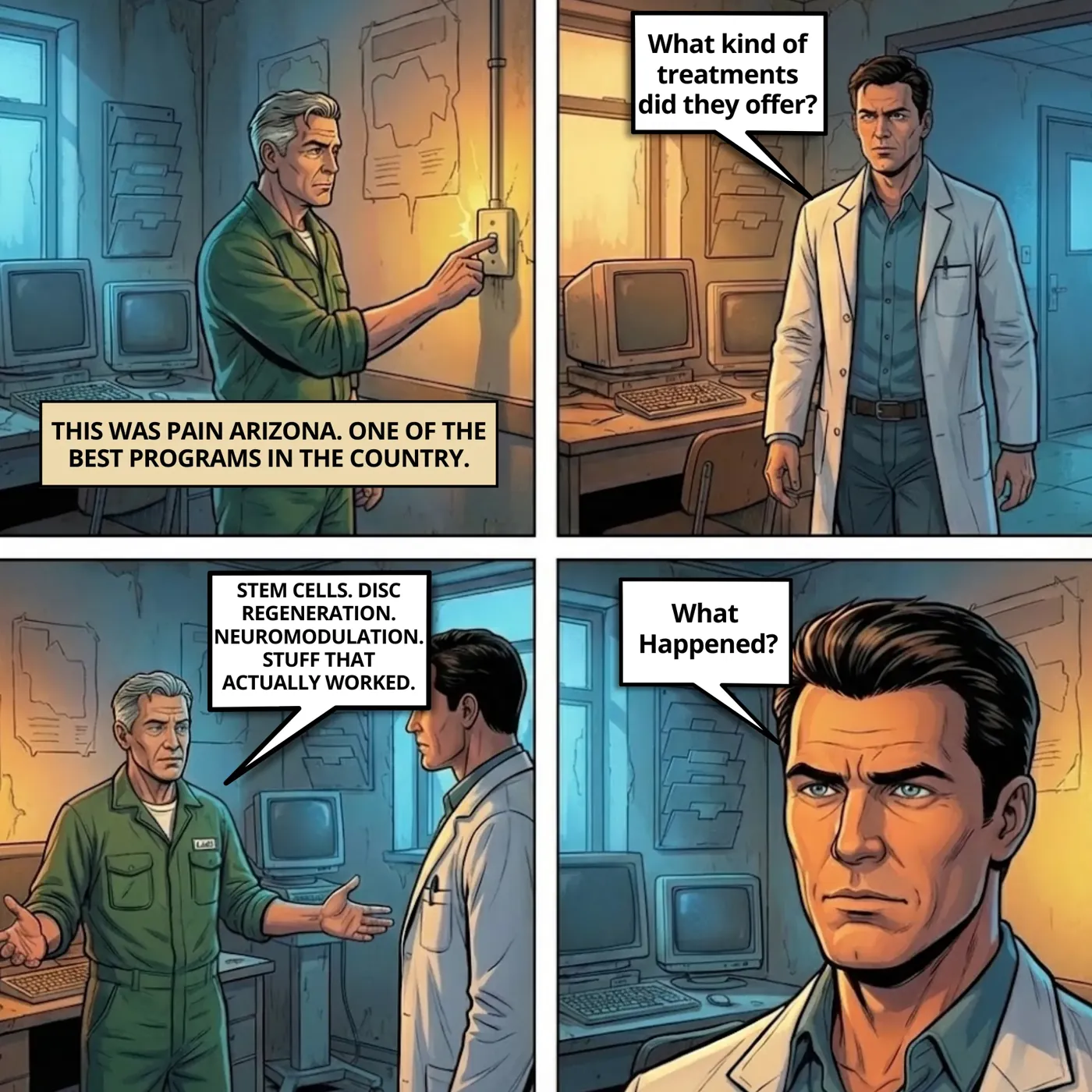
“Pain Arizona,” Luis said, flipping on the light. “Had a whole program here. Ten years ago, maybe more. One of the top programs in the country.
Specialized in chronic pain management—nerve blocks, spinal cord stimulators, regenerative medicine, the whole works.”
Crashton’s attention sharpened. “Regenerative medicine?”
“Mesenchymal stem cells for joint repair, disc regeneration, Neuromodulation.” Luis continued. “Stuff that actually worked.”
Stem cells. Regeneration from the cellular level up. That was Regenerus—just without the 200 years of Prime Medica advancement.
“What happened?” Crashton asked.
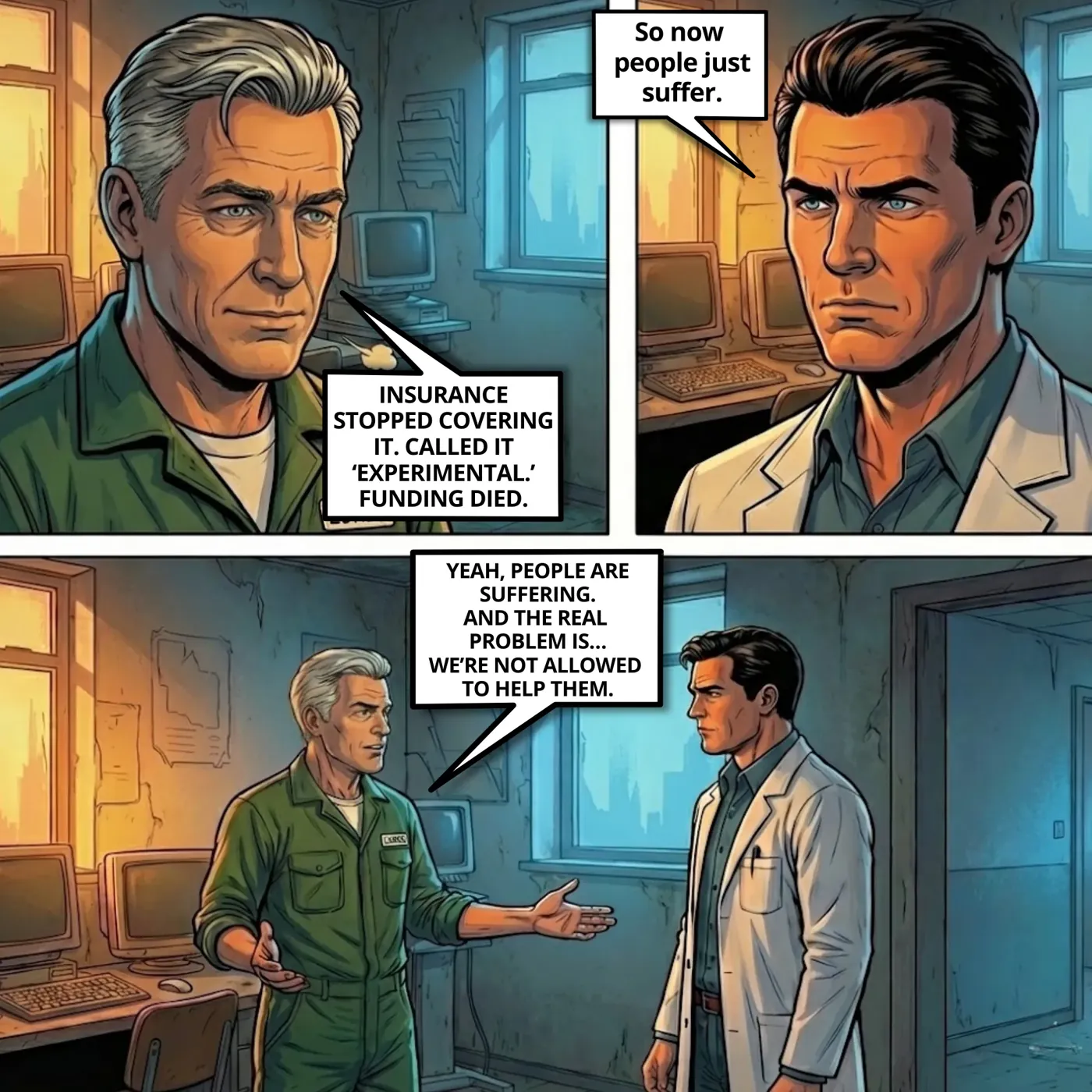
Luis shrugged. “Insurance stopped covering the treatments. Said they were ‘experimental’ or ‘not medically necessary.’ Program lost funding. Hospital had to shut it down.” He ran a hand along the dusty desk. “Fellows left. Attendings went to better-paying anesthesia jobs, private practice. Some quit medicine entirely.”
Crashton looked around the room. A monument to good intentions, killed by spreadsheets.
“So people just… suffer?” he asked.
“People always suffer,” Luis said quietly. “The question is whether anyone’s allowed to help them.” He looked at Crashton. “You help people. I saw that tonight. Here’s the deal: You can stay here. I work nights. I’ll keep administration off your back.”
“Why?” Crashton asked. “Why help me?”
He was three steps from the room when he heard it—a sound every physician knows in their bones. The wet, desperate gasp of someone whose airway has turned traitor.
Room 7.
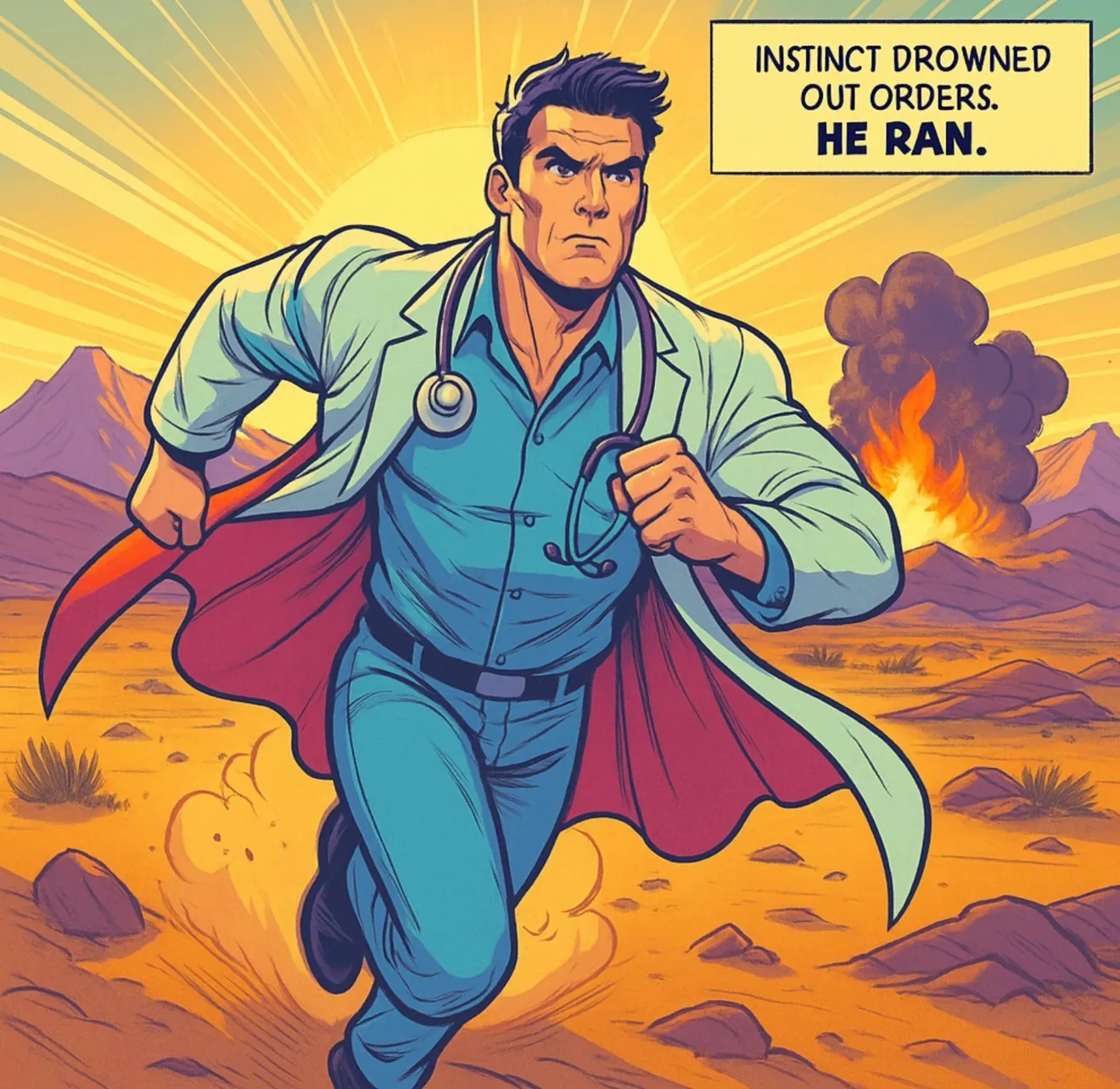
He ran.
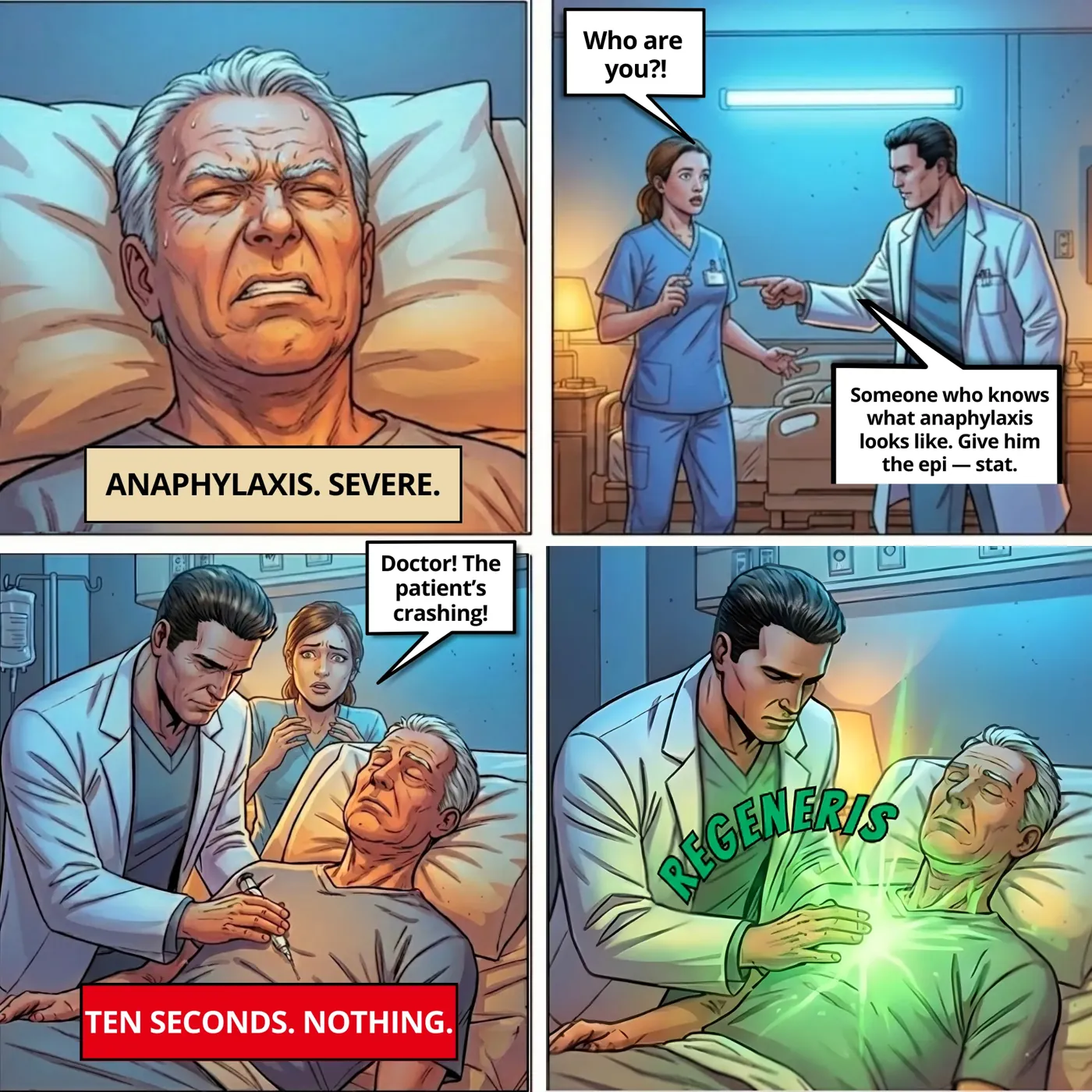
A man in his sixties, face gray-blue, eyes wide with the kind of panic that comes when your body forgets how to do the one job it’s had since birth: breathe.
Anaphylaxis. Severe. His throat was closing like a fist.
A nurse stood frozen, one hand on the phone. “He just— I called for the doctor, he’s just—”
“Someone who knows what anaphylaxis looks like,” Crashton said, his voice steady but urgent. “Please, if you want him to live, give him the epi. Now.”
She hesitated one heartbeat, then grabbed the prefilled syringe from the crash cart.
Crashton jammed it into the man’s thigh. Waited. Five seconds. Ten.
Nothing.
The man’s lips were going from blue to purple, the color of last chances.
Crashton placed both palms on the man’s chest.
Regenerus.
Green light pulsed beneath his hands, warm as summer rain, spreading through the man’s body like roots seeking water. He didn’t just see the damaged tissue—he felt it at the cellular level. Bronchioles swollen shut. Alveoli collapsing. Throat tissue so inflamed it had forgotten its own architecture.
On Prime Medica, Regenerus worked like advanced stem cell therapy—mesenchymal stem cells on demand, guided by intent. He found the inflamed cells, told them to remember, to rebuild from their basic blueprints.
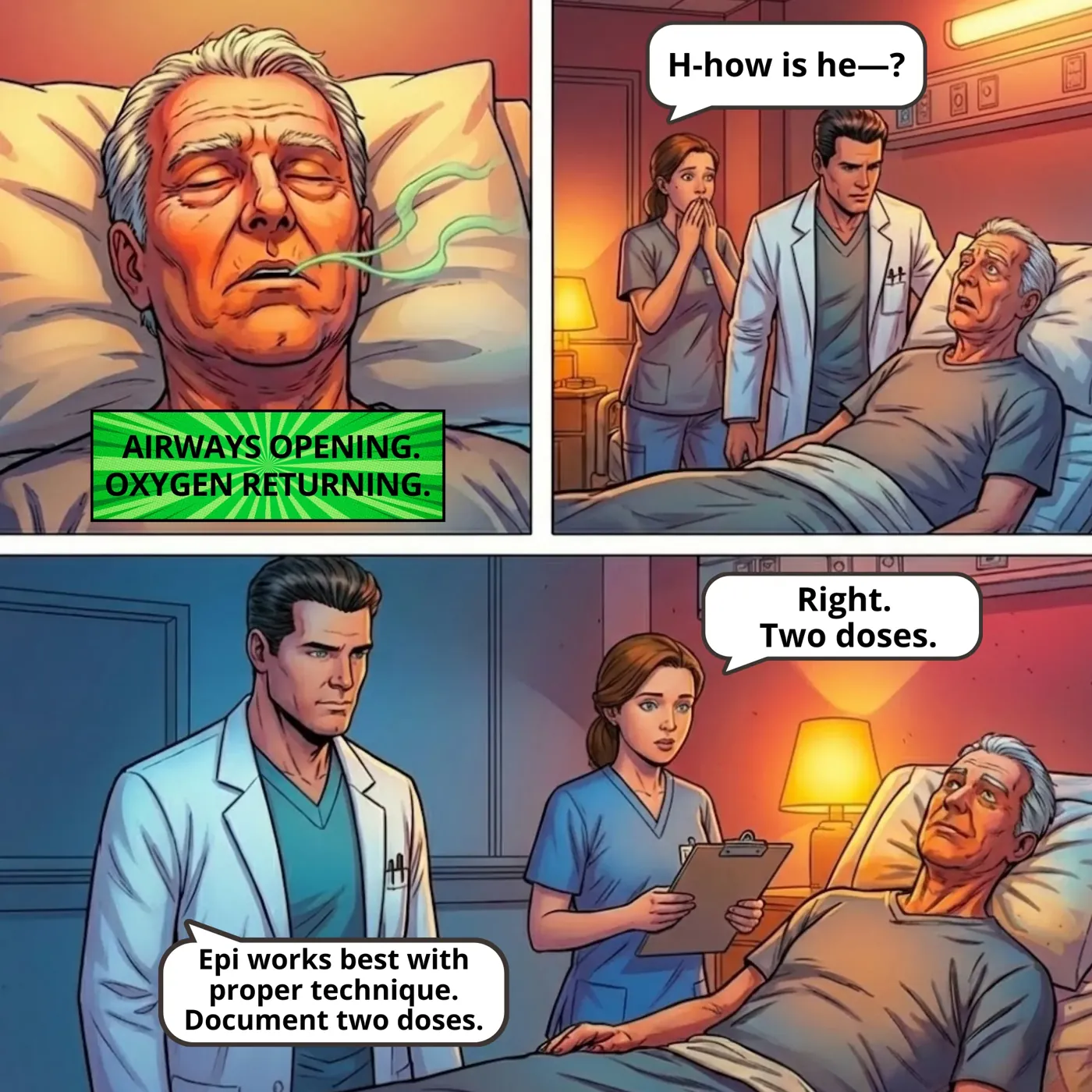
Cell by cell, the tissue regenerated. Airways opened. Oxygen flowed.
The man gasped. Coughed. Breathed.
Crashton stepped back, swaying slightly. Regenerus always took more than he expected.
The nurse stared at him. “What did you just—”
“Epi works better with proper technique,” he said quickly. “You should document two doses. I’m sure the second one is what did it.”
She looked at the syringe in her hand. At the man, now breathing steadily, color returning to his face. At Crashton.
“Yeah,” she said slowly. “Sure. Two doses.”
She didn’t sound convinced.
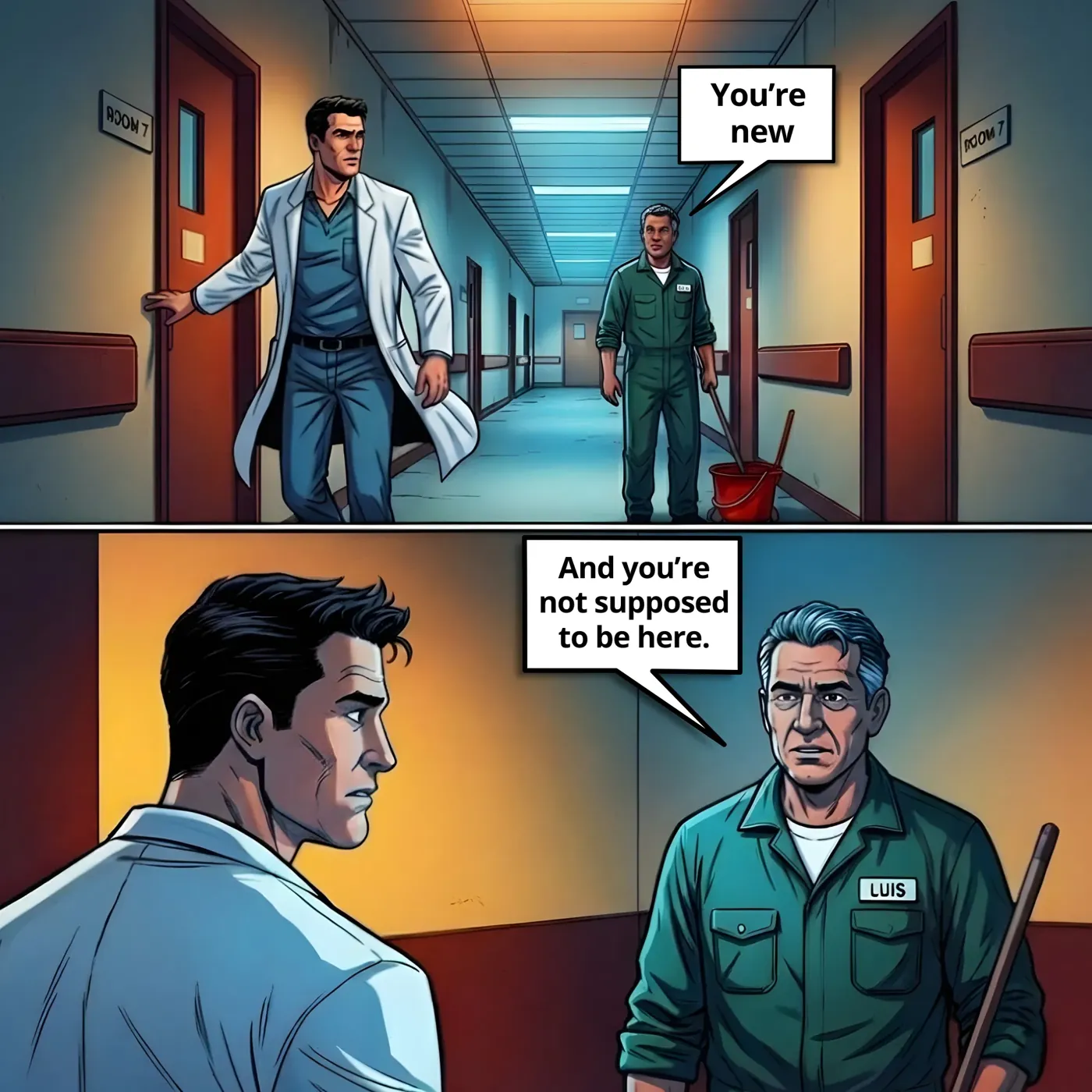
Crashton slipped out of the room before anyone could ask follow-up questions.
He made it halfway down the hall before a voice stopped him.
“You’re new.”